



What Is Yama in Buddhism? The Judge of the Dead Explained for Beginners
Quick Summary
- In Yama Buddhism discussions, “Yama” points to a vivid image of moral accountability after death: a judge who “reviews” one’s life.
- For beginners, it helps to treat Yama as a teaching device: a mirror for cause-and-effect (karma), not a cosmic courtroom you must fear.
- The “judgment” theme emphasizes that actions, habits, and intentions leave traces that shape experience—now and later.
- Yama imagery often functions like a conscience made visible: it makes ethical choices feel immediate and personal.
- You don’t need to settle metaphysical questions to learn from Yama; the practical point is responsibility and repair.
- Common confusion comes from reading Yama as a creator-god or eternal punisher, which doesn’t match the basic Buddhist lens.
- A useful takeaway: live as if your own mind will “testify” clearly—because it already does, moment by moment.
Introduction: Why Yama Confuses So Many Beginners
You keep seeing “Yama” described as the judge of the dead, and it can sound like Buddhism secretly runs on fear, punishment, and a divine courtroom—especially if you’re coming from a background where judgment after death is a central idea. The problem is that Yama Buddhism language is often symbolic and psychological at the same time, so if you read it too literally you miss the point, and if you dismiss it as “just myth” you also miss the point. At Gassho, we focus on clear, beginner-friendly explanations grounded in Buddhist practice and everyday experience.
A Clear Lens: What Yama Represents in Buddhist Thought
In the simplest terms, Yama is a figure associated with death, judgment, and the consequences of one’s actions. But the most helpful way to understand Yama Buddhism is as a lens for seeing moral cause-and-effect more clearly, not as a demand to adopt a particular supernatural belief.
The “judge” image points to something many people already sense: life has a kind of accounting. Not because someone is out to punish you, but because actions shape character, relationships, and the mind’s patterns. When you lie, you don’t only risk getting caught—you also train the mind to split, hide, and justify. When you act with care, you don’t only help others—you also train steadiness and self-respect.
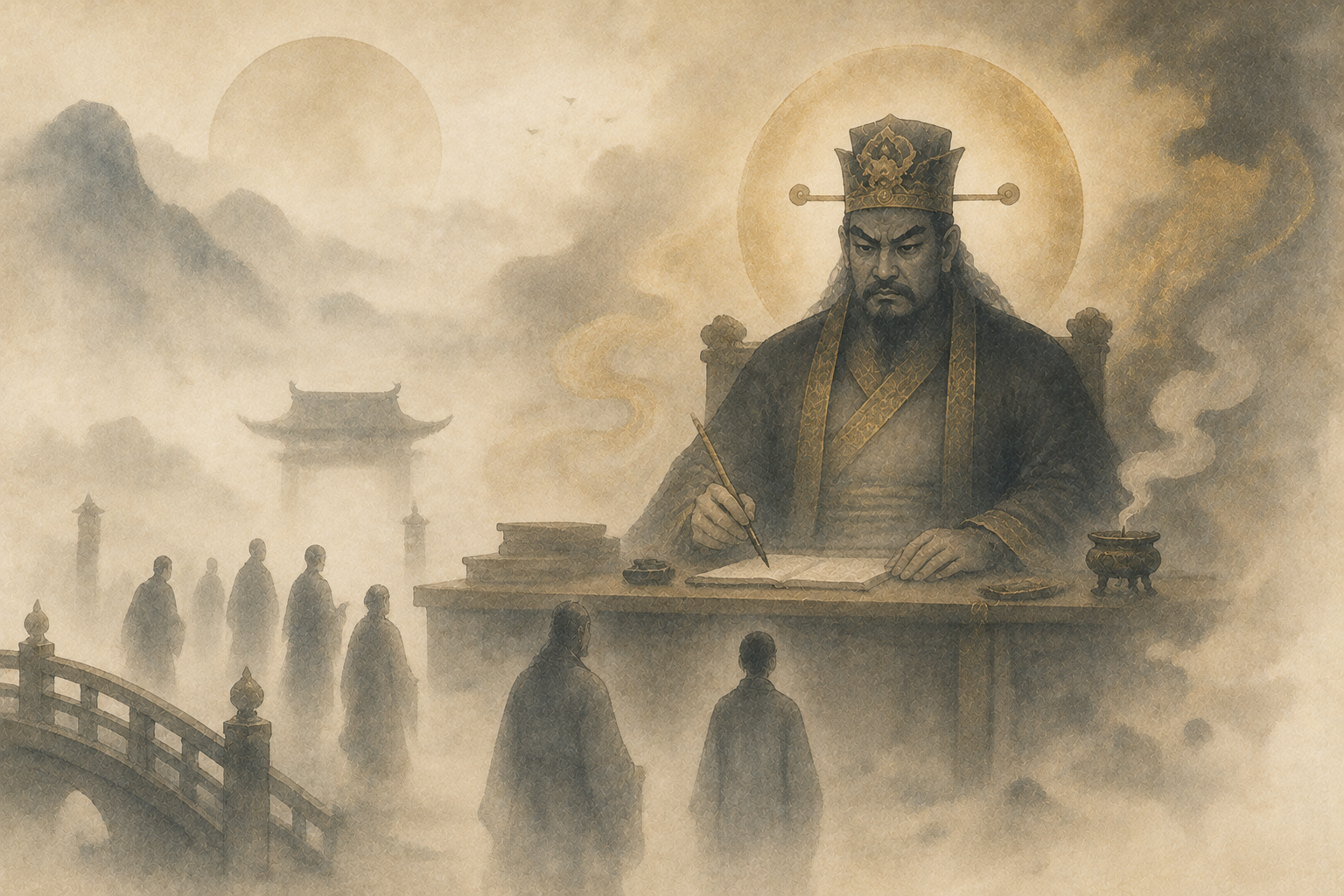
Yama’s courtroom is often described as a review of deeds. Read as a teaching image, that “review” is what happens when denial drops and you see your life plainly. In that sense, Yama is less like an external tyrant and more like an uncompromising mirror: what you did matters, and you can’t bargain your way out of your own patterns.
This is why Yama Buddhism stories can feel intense: they compress a long, subtle process—habit becoming destiny—into a single scene you can remember. The point isn’t to panic; it’s to wake up to responsibility while you still have choices.
GASSHO
Ask and learn about Buddhism in daily life.
GASSHO is a Buddhist community app where you can learn Buddhist teachings and ask questions to the head priest of Kongosanmaiin Temple on Mount Koya.
How the “Judge of the Dead” Shows Up in Ordinary Life
You don’t need to think about the afterlife to notice the “Yama effect” in daily experience. It shows up whenever you pause and feel the weight of what you just did—before you explain it away.
For example, you snap at someone you care about. A few minutes later, the mind starts building a case: “They deserved it,” “I was stressed,” “It wasn’t that bad.” Then, in a quieter moment, another kind of knowing appears: you recognize the tone, the harm, the unnecessary edge. That second moment is like the inner courtroom—less dramatic, more honest.
Or consider a small act of integrity no one sees: returning extra change, admitting a mistake at work, not joining in gossip. There may be no reward, but there is a subtle settling in the body and attention. You feel less divided. If Yama is a mirror, these moments are when the mirror feels clean.
Yama Buddhism also maps onto how memory works. When you repeatedly cross your own values, the mind often compensates with numbness or distraction. When you repeatedly align with your values, the mind tends to become simpler—fewer mental loopholes, fewer stories required to feel okay.
In relationships, the “judgment” theme appears as trust. Trust is not mystical; it’s the natural consequence of patterns. If you consistently show up, people relax around you. If you consistently manipulate, people tense up—even if they can’t explain why. That’s karma in a very ordinary sense: actions create predictable echoes.
Even your attention can feel judged. When you try to focus and notice how quickly the mind reaches for distraction, it can feel like being “caught.” But what’s catching you is simply clarity. The moment you see the impulse, you have a choice: follow it, or let it pass.
Seen this way, Yama is not mainly about fear after death. It’s about the fact that your life is already being recorded—by your habits, your nervous system, your relationships, and your own capacity to look honestly. The “judge” is the moment you stop negotiating with yourself.
Common Misunderstandings About Yama Buddhism
Misunderstanding 1: Yama is a creator-god who decides your fate. In Buddhist framing, the emphasis is on cause-and-effect: what you do conditions what you experience. Yama imagery highlights accountability; it doesn’t replace karma with a divine decree.
Misunderstanding 2: Yama is “Buddhist Satan.” That comparison can be tempting, but it usually imports a different religious structure. Yama functions more like a moral examiner or ruler of a realm associated with death, not an ultimate evil opposing goodness.
Misunderstanding 3: The stories are only superstition, so they have no value. Even if you read Yama symbolically, the stories can still train attention toward consequences, remorse, repair, and restraint—very practical skills for reducing harm.
Misunderstanding 4: The point is to feel guilty. Guilt often spirals into self-absorption. The more useful emphasis is responsibility: see clearly, make amends where possible, and change the pattern.
Misunderstanding 5: Yama means you should obsess about death. The healthier reading is the opposite: remembering death can sharpen priorities, so you waste less time on excuses and more time on what you actually respect.
Why This Teaching Matters When You’re Still Alive
Yama Buddhism matters because it makes ethics feel immediate. Many people treat morality as a social performance—good when watched, flexible when not. Yama imagery pushes against that by asking a simple question: if everything were seen clearly, what would your actions look like?
It also supports a grounded kind of courage. When you accept that actions have consequences, you stop relying on last-minute fixes: apologies without change, promises without follow-through, spiritual ideas without behavior. You begin to prefer small, consistent honesty over dramatic self-improvement plans.
Another benefit is emotional cleanliness. When you act against your values, the mind often becomes noisy—defensive thoughts, comparisons, rationalizations. When you act in line with your values, the mind tends to be quieter. Not perfect, not blissful—just less tangled.
Finally, Yama is a reminder that “later” is not guaranteed. That doesn’t mean panic. It means you can choose a life that you won’t need to edit in your own memory. If there is a judge, it’s the clarity you meet when you can no longer distract yourself.
Conclusion: Meeting Yama as a Mirror, Not a Threat
For beginners, the most useful approach to Yama Buddhism is to treat Yama as a mirror for accountability. Whether you take the stories literally, symbolically, or somewhere in between, the practical message stays steady: actions shape the mind, and the mind eventually reveals what it has been trained to do.
If the image of a “judge of the dead” makes you tense, try translating it into a daily question: what am I training in myself right now? That question is gentle, direct, and hard to fake—and it’s exactly why the Yama image has lasted.
Ask a Buddhist priest
Have a question about Buddhism?
In the GASSHO app, you can ask questions about Buddhist teachings, daily concerns, and how to understand Buddhism in everyday life.
Frequently Asked Questions
- FAQ 1: What does “Yama” mean in Yama Buddhism?
- FAQ 2: Is Yama a god in Buddhism?
- FAQ 3: Why is Yama called the “judge of the dead” in Yama Buddhism?
- FAQ 4: Does Yama decide where you go after death in Buddhism?
- FAQ 5: Is Yama the same as Mara in Buddhism?
- FAQ 6: Is Yama “Buddhist Satan”?
- FAQ 7: Do Buddhists worship Yama?
- FAQ 8: Is Yama Buddhism meant to scare people into being good?
- FAQ 9: How should beginners interpret Yama stories—literally or symbolically?
- FAQ 10: What is the connection between Yama and karma in Yama Buddhism?
- FAQ 11: Does Yama punish people forever?
- FAQ 12: What does “judgment” mean in Yama Buddhism if there is no permanent soul?
- FAQ 13: Is Yama found in all forms of Buddhism?
- FAQ 14: How can Yama Buddhism help with guilt and regret?
- FAQ 15: What is a practical way to apply Yama Buddhism in daily life?
FAQ 1: What does “Yama” mean in Yama Buddhism?
Answer: In Buddhist contexts, Yama is a figure associated with death and judgment, often portrayed as reviewing a person’s actions and their consequences. In Yama Buddhism discussions, the term usually points to this “judge of the dead” imagery used to highlight moral accountability.
Takeaway: Yama is best understood as a symbol of accountability and consequences.
FAQ 2: Is Yama a god in Buddhism?
Answer: Yama is sometimes described with god-like authority in stories, but the key Buddhist emphasis remains cause-and-effect (karma) rather than a creator deity who decides fate by personal preference. Yama functions more like an emblem of moral reckoning than an all-powerful god.
Takeaway: Yama is not a creator-god; the focus stays on karma and responsibility.
FAQ 3: Why is Yama called the “judge of the dead” in Yama Buddhism?
Answer: The “judge” title comes from narratives where Yama examines deeds and assigns outcomes that match those deeds. The image makes the idea of consequences vivid and memorable, especially for beginners who need a concrete picture of ethical cause-and-effect.
Takeaway: “Judge of the dead” is a teaching image for moral cause-and-effect.
FAQ 4: Does Yama decide where you go after death in Buddhism?
Answer: In story form, Yama appears to “assign” outcomes, but the underlying message is that actions and intentions condition results. Many readers treat Yama as a narrative way of expressing karma rather than a literal judge overriding it.
Takeaway: The deeper point is karma shaping outcomes, not arbitrary sentencing.
FAQ 5: Is Yama the same as Mara in Buddhism?
Answer: No. Yama is linked with death and judgment imagery, while Mara is typically associated with temptation, distraction, and obstacles to clarity. In Yama Buddhism discussions, mixing them up can blur two different teaching symbols.
Takeaway: Yama and Mara play different roles and shouldn’t be conflated.
FAQ 6: Is Yama “Buddhist Satan”?
Answer: That comparison is usually misleading. Yama is not primarily an embodiment of evil opposing goodness; Yama is more like a figure representing reckoning and consequences. The emotional tone can be scary, but the function is ethical clarity.
Takeaway: Yama is about accountability, not an ultimate evil force.
FAQ 7: Do Buddhists worship Yama?
Answer: In general, Buddhism emphasizes refuge in awakening, teaching, and community rather than worship of a judge figure. In cultures where Yama appears in devotional life, the intent is often respect, protection, or moral reminder—not treating Yama as the highest object of faith.
Takeaway: Yama is typically respected as a moral symbol, not worshiped as supreme.
FAQ 8: Is Yama Buddhism meant to scare people into being good?
Answer: The imagery can be frightening, but its more skillful use is to make consequences feel real and immediate. Ideally, it supports conscience, restraint, and repair rather than panic or shame.
Takeaway: The aim is ethical clarity, not fear-based control.
FAQ 9: How should beginners interpret Yama stories—literally or symbolically?
Answer: Many beginners do best by holding the stories lightly: take the ethical message seriously while staying open about metaphysical details. Whether literal or symbolic, the practical lesson is the same—actions shape outcomes and the mind remembers.
Takeaway: Hold the imagery lightly, and take the ethical message seriously.
FAQ 10: What is the connection between Yama and karma in Yama Buddhism?
Answer: Yama imagery dramatizes karma by portraying a “review” of deeds and their results. It’s a narrative shortcut that helps people feel the weight of cause-and-effect without needing abstract philosophy.
Takeaway: Yama is a storytelling form of karma’s accountability.
FAQ 11: Does Yama punish people forever?
Answer: Buddhist frameworks generally treat painful results as conditioned and impermanent rather than eternal punishment. Yama’s role in stories is to reflect consequences, not to impose never-ending torment as a final verdict.
Takeaway: The emphasis is on conditioned consequences, not eternal punishment.
FAQ 12: What does “judgment” mean in Yama Buddhism if there is no permanent soul?
Answer: “Judgment” can be understood as the unfolding of cause-and-effect across a stream of experience rather than a soul being sentenced. The image points to continuity of responsibility—your patterns don’t vanish just because you prefer they would.
Takeaway: Judgment imagery can coexist with non-self as a lesson in continuity of consequences.
FAQ 13: Is Yama found in all forms of Buddhism?
Answer: Yama appears widely in Buddhist storytelling and art across regions, but emphasis varies. Some communities highlight Yama strongly in moral teaching, while others focus on different images to convey the same core point: actions have consequences.
Takeaway: Yama is common, but not equally emphasized everywhere.
FAQ 14: How can Yama Buddhism help with guilt and regret?
Answer: At its best, Yama imagery shifts you from vague guilt to specific responsibility: name the harm, feel appropriate remorse, and choose repair and restraint. The “judge” is clarity—seeing what happened without excuses and without self-hatred.
Takeaway: Use Yama as a prompt for honest repair, not self-punishment.
FAQ 15: What is a practical way to apply Yama Buddhism in daily life?
Answer: A simple practice is to do a brief daily review: recall one action that increased harm and one that reduced harm, then decide one concrete adjustment for tomorrow. This mirrors the “life review” theme associated with Yama, but keeps it grounded and workable.
Takeaway: A small daily review turns Yama’s message into practical accountability.