



Why So Many Japanese Customs Feel Buddhist Without Looking Religious
Quick Summary
- Many Japanese customs feel “Buddhist” because they train attention, restraint, and care without requiring belief.
- In Japan, religion often functions as practice and etiquette, not as a declared identity.
- Everyday gestures—bowing, quiet voices, removing shoes—can mirror Buddhist values like humility and non-harming.
- Rituals around food, seasons, and ancestors carry Buddhist influence while staying socially “normal.”
- Temples, funerals, and memorial days shaped public habits even for people who don’t call themselves religious.
- What looks like spirituality is often a shared cultural language for respect, impermanence, and gratitude.
- Understanding this helps you read Japanese culture more accurately and participate more comfortably.
Introduction
You notice it in small moments: the careful way people offer and receive items, the quiet pauses before eating, the soft respect around death and remembrance—yet nobody is “preaching,” and many people will tell you they aren’t religious. That mismatch is the real confusion behind why so many Japanese customs feel Buddhist without looking religious, and it’s not your imagination—it’s how practice can hide in plain sight. At Gassho, we focus on Buddhism as lived culture and everyday training rather than as a label.
Part of the answer is historical: Buddhism has been woven into Japanese community life for centuries through temples, funerals, memorial services, calendars, and arts. But the more useful answer is practical: many customs are designed to shape behavior—how you enter a space, how you handle emotion, how you acknowledge others—without requiring you to sign onto a creed.
So when a custom “feels Buddhist,” it’s often because it nudges the same human muscles that Buddhist practice trains: attention, humility, gratitude, and a steady relationship with change. The outer form may look like etiquette, but the inner effect can be quietly contemplative.
A Lens That Explains the “Buddhist Feel” Without the Religious Look
A helpful lens is to separate belief from training. In many places, “religion” is assumed to mean stated beliefs, membership, and public identity. In Japan, many Buddhist-influenced behaviors survive as training embedded in social life: you learn them because they make relationships smoother, spaces calmer, and transitions more dignified.
This is why the customs can feel Buddhist even when no one names Buddhism. The point is often not to declare what you believe, but to enact what you value—respect, restraint, gratitude, and awareness of others. When a culture repeats these gestures across generations, they become “just how you do things,” even if their roots include Buddhist temples and teachings.
Another part of the lens is that Japanese customs often emphasize form as a container for mind. A bow, a pause, a careful way of speaking, a tidy threshold—these are not merely aesthetic. They are behavioral cues that reduce ego-display, soften conflict, and invite presence. You don’t have to call it spiritual for it to work on you.
Finally, many customs carry a quiet intimacy with impermanence: seasons change, things age, people die, and gratitude matters because nothing is guaranteed. That sensitivity can feel distinctly Buddhist, yet it can be expressed through food, festivals, household habits, and manners rather than through overt religious language.
GASSHO
Ask and learn about Buddhism in daily life.
GASSHO is a Buddhist community app where you can learn Buddhist teachings and ask questions to the head priest of Kongosanmaiin Temple on Mount Koya.
How It Shows Up in Ordinary Moments
Consider the simple act of removing shoes at the entrance. On the surface it’s cleanliness. Internally, it’s also a small reset: you slow down, you notice where you are, and you accept that different spaces ask for different behavior. That tiny pause is a kind of attention training, and it can feel “Buddhist” because it interrupts autopilot.
Bowing works similarly. It can be social etiquette, but it also reduces the urge to dominate a moment. When you bow, you briefly place the relationship ahead of your self-presentation. Even if you don’t think about it, the body learns a pattern of humility and mutual recognition.
Then there’s the careful way items are handed over—often with two hands, often with a slight pause. This can look formal to outsiders, but internally it encourages you to treat the exchange as real contact rather than a transaction. Attention moves from “my task” to “our moment,” which naturally softens impatience.
Food customs can carry the same effect. A brief phrase of gratitude before eating, a sense of not wasting, and an appreciation for seasonal ingredients all steer the mind toward interdependence: many conditions had to come together for this meal to exist. You don’t need religious belief to feel the quiet shift from entitlement to appreciation.
Silence is another everyday example. In many Japanese settings, silence isn’t automatically awkward; it can be a respectful space where you don’t rush to fill the air with self. Internally, that trains tolerance for uncertainty and reduces the reflex to control a conversation.
Even cleanliness and tidying can take on a contemplative tone. When a space is cared for, the mind often becomes less scattered. The action is ordinary—sweeping, arranging, putting things back—but the inner experience can be a gentle settling, like the environment is teaching you how to be.
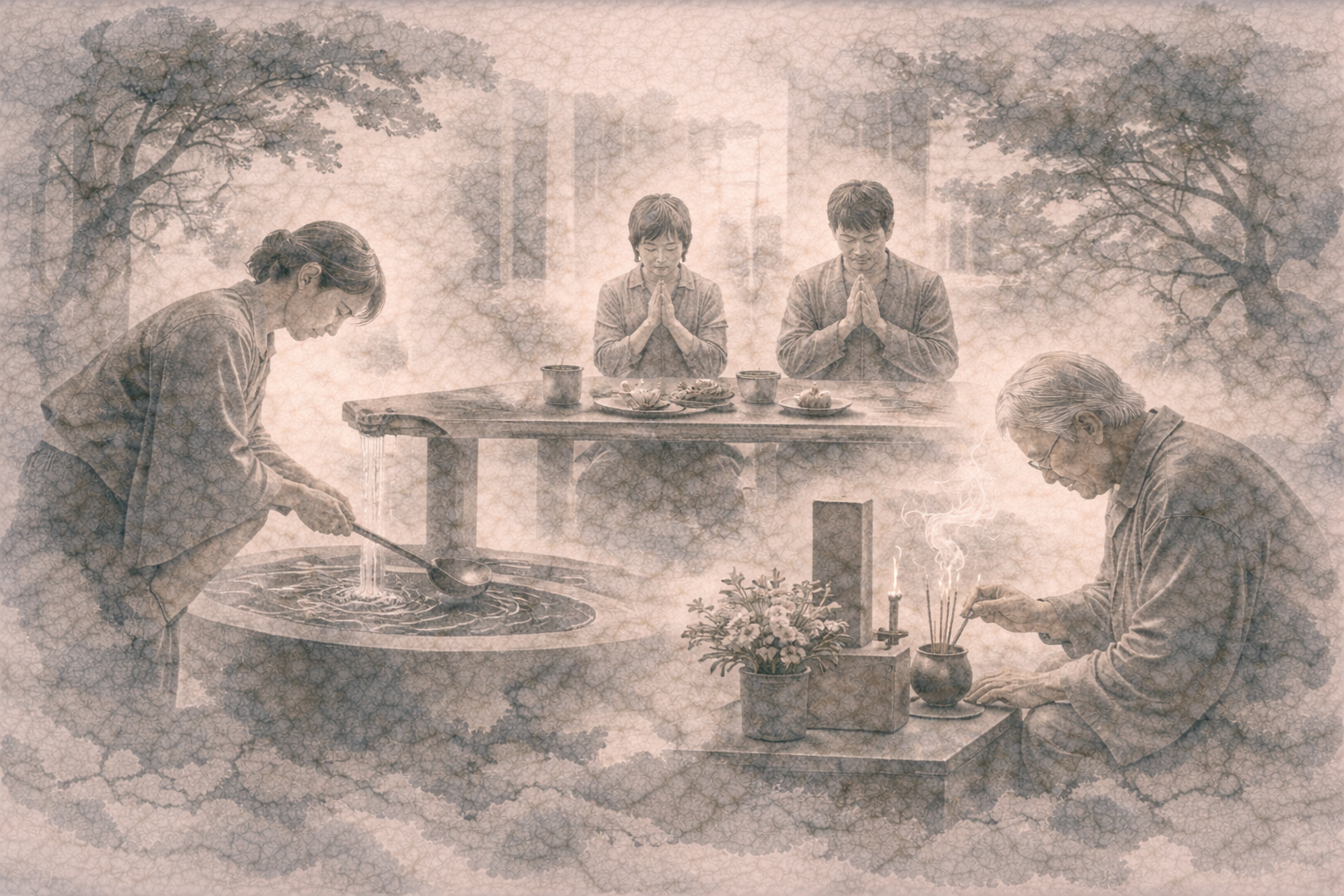
Finally, customs around remembrance—visiting family graves, keeping memorial dates, offering a moment of respect—normalize a relationship with death that is neither sensational nor avoided. That steadiness can feel Buddhist because it makes impermanence part of life’s rhythm, not a topic reserved for emergencies.
Common Misreadings That Create Confusion
One misunderstanding is assuming that if something feels Buddhist, it must be a hidden religious requirement. Often it’s simply shared etiquette shaped by history. People may participate because it’s considerate, not because they are making a doctrinal statement.
Another misreading is to treat Japanese culture as uniformly Buddhist. In reality, customs are layered: local traditions, family habits, community expectations, and multiple religious influences can overlap. What you’re sensing as “Buddhist” may be a blend that has become culturally natural.
A third confusion is thinking that “not religious” means “not influenced by religion.” Many societies carry religious influence in language, holidays, and moral instincts long after people stop identifying strongly with a tradition. Japan is a clear example of how influence can remain even when identity is quiet.
It’s also easy to mistake calm formality for emotional distance. Some customs prioritize not burdening others with your inner weather. That can look restrained, but it can also be a kind of compassion: you regulate yourself so the shared space stays workable for everyone.
Finally, outsiders sometimes romanticize these customs as “mystical.” The reality is more grounded: they are practical social technologies. They reduce friction, create predictability, and offer small moments of mindfulness without requiring anyone to talk about mindfulness.
Why This Matters for Daily Life and Cultural Understanding
If you’re visiting Japan, living there, or simply trying to understand Japanese media and relationships, this lens prevents awkward assumptions. You can participate in customs respectfully without feeling like you’re accidentally converting or performing beliefs you don’t hold.
It also changes how you interpret “religion” in Japan. Instead of looking for declarations, you start noticing patterns: how people enter spaces, how they handle conflict, how they mark transitions, how they honor the dead. The “Buddhist feel” is often the feel of practiced restraint and practiced gratitude.
On a personal level, these customs offer a gentle lesson: you don’t need dramatic spiritual experiences to live with more awareness. A small pause, a careful gesture, a moment of thanks—these are tiny trainings that shape the nervous system over time.
And if you come from a culture where religion is mostly about belief statements, Japan can broaden your definition. It shows how a tradition can influence a society through aesthetics, manners, and life-cycle rituals—quietly, persistently, and often beautifully.
Conclusion
Why so many Japanese customs feel Buddhist without looking religious comes down to this: the influence is often behavioral rather than declarative. The customs work as everyday training in attention, humility, gratitude, and acceptance of change—so they can feel spiritually textured even when nobody frames them as religion.
When you stop searching for explicit belief and start watching how form shapes mind, the puzzle resolves. What looks like “just etiquette” can still carry the quiet imprint of Buddhist ways of relating to self, others, and impermanence.
Ask a Buddhist priest
Have a question about Buddhism?
In the GASSHO app, you can ask questions about Buddhist teachings, daily concerns, and how to understand Buddhism in everyday life.
Frequently Asked Questions
- FAQ 1: Why do Japanese customs feel Buddhist even when people say they aren’t religious?
- FAQ 2: What makes a custom “feel Buddhist” if it doesn’t mention Buddhism?
- FAQ 3: Are bowing and polite speech actually Buddhist practices in disguise?
- FAQ 4: Why do Japanese rituals around death and remembrance feel Buddhist even for non-religious families?
- FAQ 5: Is the Japanese focus on cleanliness and tidying connected to Buddhism?
- FAQ 6: Why do Japanese food customs sometimes feel spiritual without being religious?
- FAQ 7: Why does Japanese silence in conversation feel “Zen” to outsiders?
- FAQ 8: Are Japanese seasonal traditions Buddhist, or just cultural?
- FAQ 9: Why do Japanese manners emphasize not inconveniencing others, and is that Buddhist?
- FAQ 10: Why do Japanese homes and neighborhoods sometimes include Buddhist elements without calling them “religious”?
- FAQ 11: Is it accurate to say Japanese culture is basically Buddhist?
- FAQ 12: Why do Japanese customs often prioritize form and procedure, and how does that relate to Buddhism?
- FAQ 13: Why do Japanese memorial days and visits to graves feel Buddhist even for people who don’t attend temples regularly?
- FAQ 14: Why do Japanese customs around giving and receiving feel so mindful?
- FAQ 15: How can I participate in Japanese customs that feel Buddhist without feeling like I’m adopting a religion?
FAQ 1: Why do Japanese customs feel Buddhist even when people say they aren’t religious?
Answer: Because many Buddhist-influenced behaviors became social norms over centuries—especially through community life, funerals, memorials, and temple-centered calendars—so people practice the “shape” of the values (respect, restraint, gratitude) without framing it as belief.
Takeaway: In Japan, Buddhist influence often shows up as culture and etiquette rather than declared identity.
FAQ 2: What makes a custom “feel Buddhist” if it doesn’t mention Buddhism?
Answer: It often trains the same inner habits associated with Buddhist practice: pausing before acting, reducing self-centered display, noticing others, and accepting change. The custom can be secular in appearance while still shaping attention and behavior.
Takeaway: The “Buddhist feel” is frequently an effect on the mind, not a religious message.
FAQ 3: Are bowing and polite speech actually Buddhist practices in disguise?
Answer: Not necessarily “in disguise,” but they can echo Buddhist values like humility and non-harming. In daily life they function mainly as social tools—ways to reduce friction and show respect—while still carrying historical and cultural Buddhist influence.
Takeaway: Many gestures are primarily etiquette, yet they can still reflect Buddhist-shaped values.
FAQ 4: Why do Japanese rituals around death and remembrance feel Buddhist even for non-religious families?
Answer: Because Buddhist temples historically handled funerals and memorial services, and those rhythms entered family life as standard ways to grieve, remember, and mark time. Participation can be cultural and relational rather than doctrinal.
Takeaway: Life-cycle customs can remain Buddhist-influenced even when belief is not emphasized.
FAQ 5: Is the Japanese focus on cleanliness and tidying connected to Buddhism?
Answer: It can be connected indirectly: caring for spaces supports calm, reduces distraction, and expresses respect for shared environments—qualities that align with Buddhist-influenced discipline. But it’s also shaped by broader cultural and practical factors, not Buddhism alone.
Takeaway: Cleanliness may feel Buddhist because it supports attention and respect, even when it’s simply “normal.”
FAQ 6: Why do Japanese food customs sometimes feel spiritual without being religious?
Answer: Small habits like pausing before eating, valuing seasonal ingredients, and avoiding waste can shift the mind toward gratitude and interdependence. That inner shift resembles Buddhist sensibilities, even when the practice is just good manners.
Takeaway: Everyday gratitude around food can carry a Buddhist tone without religious framing.
FAQ 7: Why does Japanese silence in conversation feel “Zen” to outsiders?
Answer: Because silence can signal presence, restraint, and respect rather than awkwardness. Those qualities resemble Buddhist-influenced composure, but in many Japanese contexts silence is simply a socially accepted way to avoid forcing emotion or ego into the space.
Takeaway: Silence can feel Buddhist because it reduces self-display and supports calm attention.
FAQ 8: Are Japanese seasonal traditions Buddhist, or just cultural?
Answer: Often both. Seasonal awareness is cultural, but Buddhism reinforced sensitivity to impermanence and change, which can deepen how seasons are felt and expressed through festivals, foods, and aesthetics.
Takeaway: Seasonal customs can be culturally mainstream while still resonating with Buddhist views of change.
FAQ 9: Why do Japanese manners emphasize not inconveniencing others, and is that Buddhist?
Answer: The emphasis on not burdening others can align with Buddhist ethics of non-harming and consideration, but it’s also a social strategy for harmony in dense communities. It feels Buddhist when it functions as self-regulation and compassion in action.
Takeaway: Consideration for others can be both practical etiquette and Buddhist-adjacent compassion.
FAQ 10: Why do Japanese homes and neighborhoods sometimes include Buddhist elements without calling them “religious”?
Answer: Because household and community practices around remembrance and respect can be treated as family tradition rather than religious affiliation. Objects and routines may be maintained for continuity, gratitude, and honoring ancestors, not as public declarations of faith.
Takeaway: In Japan, Buddhist-influenced home practices can be “just what we do” rather than “what we believe.”
FAQ 11: Is it accurate to say Japanese culture is basically Buddhist?
Answer: It’s an oversimplification. Buddhism has deeply influenced Japanese customs, arts, and life-cycle rituals, but Japanese culture is layered and includes multiple influences and local traditions. The “Buddhist feel” is real, but it isn’t the whole story.
Takeaway: Buddhism is a major influence, not a single explanation for all Japanese customs.
FAQ 12: Why do Japanese customs often prioritize form and procedure, and how does that relate to Buddhism?
Answer: Form can act as a container for mind: it slows you down, clarifies roles, and reduces impulsive behavior. That matches a Buddhist-flavored idea that how you do something shapes how you experience it, even if the custom is taught as simple etiquette.
Takeaway: Formality can feel Buddhist because it trains attention and restraint through repeated actions.
FAQ 13: Why do Japanese memorial days and visits to graves feel Buddhist even for people who don’t attend temples regularly?
Answer: Because remembrance practices can be relational rather than institutional: they’re about family continuity, gratitude, and acknowledging impermanence. Buddhist temples historically provided the structure, but the emotional function remains meaningful beyond formal religiosity.
Takeaway: Remembrance can carry Buddhist influence as a cultural rhythm, not a weekly religious commitment.
FAQ 14: Why do Japanese customs around giving and receiving feel so mindful?
Answer: Many exchanges include pauses, careful handling, and respectful language, which naturally brings attention into the moment and reduces self-centered rushing. That mindful quality can resemble Buddhist practice even when it’s simply considered good manners.
Takeaway: Mindfulness can be built into etiquette, making ordinary exchanges feel quietly Buddhist.
FAQ 15: How can I participate in Japanese customs that feel Buddhist without feeling like I’m adopting a religion?
Answer: Treat them as respect-based cultural practices: follow the local form, keep your intention simple (consideration, gratitude, quiet attention), and avoid making big claims about what it “means.” In most situations, participation is about harmony and care, not belief.
Takeaway: You can join respectfully by focusing on intention and etiquette rather than religious identity.