



Why Buddhist Teachings Took Different Forms in Different Countries
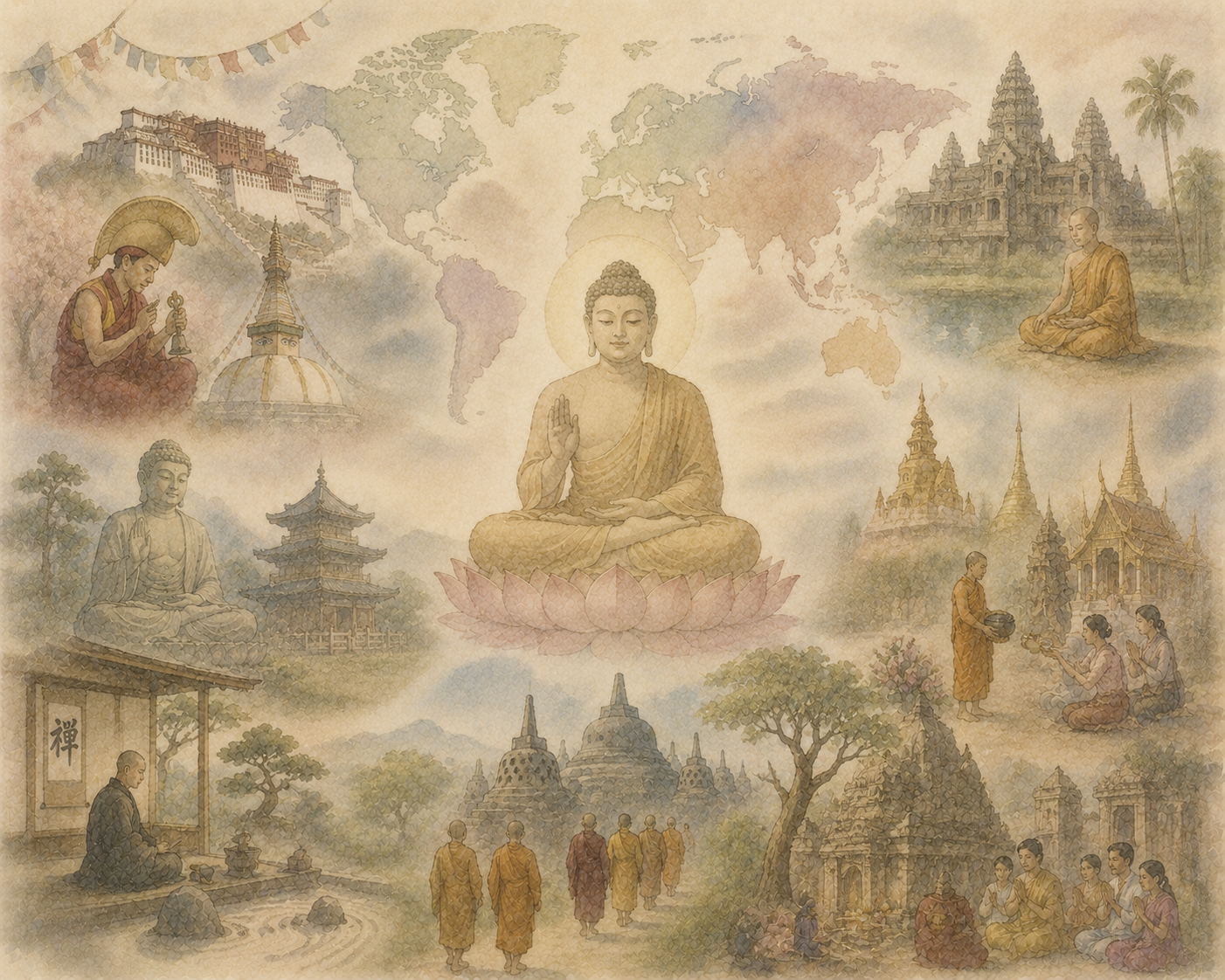
Quick Summary
- Buddhist teachings changed form across countries because people, languages, and social needs changed.
- Core aims stayed recognizable, while methods, symbols, and emphasis adapted to local life.
- Translation choices shaped what sounded “central,” “devotional,” or “philosophical” in each place.
- Politics, patronage, and institutions influenced which practices were supported and preserved.
- Local religions and customs blended with Buddhist expression without necessarily changing the underlying intent.
- Different climates of daily life (monastic vs. household, rural vs. urban) encouraged different practice styles.
- Seeing “different forms” as skillful adaptation reduces confusion and sectarian thinking.
Introduction
If you’ve compared Buddhism across countries, the differences can feel so big that it’s tempting to assume someone “changed the original” or that one place kept the “real” version while others drifted. That assumption is understandable—and usually misleading—because teachings don’t travel like sealed packages; they travel through human lives, with all the friction of language, culture, and practical needs. At Gassho, we focus on how Buddhist ideas function in lived experience rather than treating them as museum artifacts.
The more useful question isn’t “Which country got it right?” but “What happens to a teaching when it has to be understood, remembered, practiced, and supported by ordinary people in a new environment?” When you look through that lens, the variety starts to make sense: different forms often reflect different entry points into the same human problems—stress, grasping, fear, and the wish to live with clarity.
This topic matters because confusion about “different Buddhisms” can quietly block practice: you may hesitate, overthink, or feel you need to pick a side before you can begin. Understanding why forms diverged helps you relate to teachings more directly, without getting trapped in debates that don’t reduce suffering.
A Practical Lens for Understanding Different Buddhist Forms
A helpful way to understand why Buddhist teachings took different forms in different countries is to treat “Buddhism” less like a single fixed object and more like a set of tools aimed at a consistent human challenge: the mind’s tendency to cling, resist, and narrate experience in ways that create distress. Tools are chosen and shaped by context. A hammer looks different depending on what you’re building, what materials you have, and what your hands are used to holding.
When teachings move across borders, they must become speakable in a new language and livable in a new society. That means metaphors change, key terms get mapped onto local concepts, and practices are emphasized differently depending on what people can realistically do. A community of full-time renunciants will naturally highlight different supports than a community of householders working long days.
It also helps to separate “aim” from “expression.” The aim points to a shift in how experience is met—less compulsion, more clarity, more compassion. Expression includes rituals, art, chanting styles, ethical codes in daily life, and the way teachings are organized. Expression is where local culture shows up most strongly, and that’s often what people notice first.
From this perspective, diversity isn’t automatically a sign of corruption or contradiction. It can be a sign that people kept trying to make the teachings workable—memorable, teachable, and supportive—under different conditions. The question becomes: does a given form help people notice suffering clearly and respond with less reactivity?
GASSHO
Ask and learn about Buddhism in daily life.
GASSHO is a Buddhist community app where you can learn Buddhist teachings and ask questions to the head priest of Kongosanmaiin Temple on Mount Koya.
How Cultural Adaptation Shows Up in Ordinary Life
Think about what happens when you try to explain a subtle inner experience—like anxiety loosening its grip—to a friend from a different background. You automatically adjust your words. You choose examples they’ll recognize. You might even change the order of your explanation: first a story, then a principle; or first a principle, then a story. Nothing “mystical” is required to see how teachings change shape.
Now scale that up to a whole community. People need phrases that stick in memory, practices that fit their schedules, and ceremonies that mark births, deaths, and seasons. When a teaching meets those needs, it becomes part of daily life rather than an imported idea. The form that survives is often the form that people can actually repeat, share, and rely on when life gets hard.
Language is a major driver. When a key term is translated, it can lean toward “mind,” “heart,” “awareness,” “wisdom,” or “understanding,” depending on what the receiving language makes easiest to hear. That small tilt changes what people pay attention to internally. Over time, attention shapes practice: what you notice, what you name, and what you train.
Social structure matters too. In some places, religious life is supported by stable institutions; in others, it’s carried by families, small communities, or traveling teachers. That affects how teachings are packaged: long commentaries versus short recitations, formal study versus simple daily observances, private reflection versus communal ritual. None of these automatically indicates “deeper” or “shallower”—they indicate different constraints.
Local values also shape emphasis. A culture that prizes scholarly learning may highlight analysis and debate. A culture that prizes communal harmony may highlight ethical conduct and relational sensitivity. A culture shaped by hardship may gravitate toward practices that offer immediate steadiness and hope. These are not just “cultural decorations”; they influence what people practice when they’re tired, grieving, or angry.
Even aesthetics play a role in attention. Visual art, architecture, music, and storytelling styles guide the mind toward certain moods—reverence, simplicity, intimacy, awe. Mood affects receptivity. If a form helps people soften defensiveness and become more honest with themselves, it becomes a functional doorway into the teachings.
When you notice these forces in your own life—how you adapt your words to your workplace, your family, your friends—you can see why Buddhism diversified without needing to assume anyone was being careless. It’s the same human process: translating meaning into a form that can be carried.
Common Misunderstandings About “Different Buddhisms”
Misunderstanding 1: Different forms mean the teachings contradict each other. Often, what differs is the entry point: one culture may start with ethics, another with contemplation, another with devotion. These can be different ways of training the same capacities—attention, restraint, kindness, and insight—depending on what people find accessible.
Misunderstanding 2: One country preserved the “pure original,” and others diluted it. In real human history, preservation always involves selection: what gets copied, taught, funded, and remembered. “Original” is rarely a single stable package. It’s more accurate to say that communities preserved what they could sustain, and that sustainability shaped form.
Misunderstanding 3: Ritual and symbolism are “extra,” while philosophy is “real.” For many people, ritual is a technology of attention: it organizes the body, speech, and mind toward a chosen orientation. In another setting, analysis might do that job. Different cultures lean on different technologies to steady the mind.
Misunderstanding 4: Cultural blending proves the teachings were compromised. Blending can be superficial (names, festivals, imagery) while the practical intent remains intact: reducing harmful reactivity and cultivating wise response. The more relevant question is whether a form supports clarity and compassion in daily conduct.
Misunderstanding 5: If forms differ, you must pick the “right” one before practicing. This can become a sophisticated form of procrastination. You can start by observing your own mind—how grasping feels, how release feels—and then evaluate which forms help you do that more honestly and consistently.
Why This Diversity Still Matters Today
Understanding why Buddhist teachings took different forms in different countries helps you read differences with less suspicion and more precision. Instead of reacting to unfamiliar language or ceremony, you can ask: “What human problem is this addressing?” That question keeps the focus on function rather than branding.
It also makes you a better learner. When you encounter a teaching that feels foreign, you can treat it as a translation problem: maybe the metaphor doesn’t land in your culture, or maybe you’re hearing it through assumptions you didn’t know you had. Curiosity becomes part of practice—an antidote to quick judgment.
On a community level, this understanding reduces needless conflict. People often argue about forms because forms are visible. But the inner work—less reactivity, more honesty, more care—is harder to measure, so it gets overlooked. Remembering that forms evolved to meet conditions can soften the urge to rank traditions like competing products.
Finally, it gives you permission to be practical. If a certain presentation helps you become less compulsive and more kind, you don’t need to feel guilty that it looks different from another country’s presentation. The point is not to imitate a foreign culture perfectly; the point is to meet your life with wisdom.
Conclusion
Buddhist teachings took different forms in different countries for the same reason any living tradition changes when it travels: people had to understand it, speak it, remember it, fund it, and practice it under local conditions. Language, institutions, politics, aesthetics, and everyday needs all shaped what became prominent.
If you hold the diversity as adaptation rather than corruption, the landscape becomes less confusing. You can look past surface differences and ask what each form is trying to train in the human mind and heart. That shift—from comparison to function—makes the teachings usable again.
Ask a Buddhist priest
Have a question about Buddhism?
In the GASSHO app, you can ask questions about Buddhist teachings, daily concerns, and how to understand Buddhism in everyday life.
Frequently Asked Questions
- FAQ 1: Why did Buddhist teachings take different forms in different countries if the core message was the same?
- FAQ 2: Did translation differences cause major shifts in how Buddhism was understood across countries?
- FAQ 3: How did local cultures influence the forms Buddhist teachings took in different countries?
- FAQ 4: Why do some countries emphasize ritual while others emphasize study or contemplation?
- FAQ 5: Did politics and patronage affect why Buddhist teachings took different forms in different countries?
- FAQ 6: Why did Buddhist ethics and community rules differ from country to country?
- FAQ 7: Is the diversity of Buddhist forms across countries a sign that Buddhism fragmented?
- FAQ 8: Why do Buddhist stories, imagery, and sacred figures vary so much between countries?
- FAQ 9: Did geography and trade routes influence why Buddhist teachings took different forms in different countries?
- FAQ 10: Why do some countries present Buddhism as more devotional while others present it as more philosophical?
- FAQ 11: Did Buddhism absorb elements of local religions, and is that why forms differ by country?
- FAQ 12: Why do Buddhist teachings sound more “religious” in some countries and more “secular” in others?
- FAQ 13: If Buddhist teachings took different forms in different countries, how can a beginner choose where to start?
- FAQ 14: Are the differences between countries mostly about practice, or mostly about doctrine?
- FAQ 15: Does the fact that Buddhist teachings took different forms in different countries mean there is no authentic Buddhism?
FAQ 1: Why did Buddhist teachings take different forms in different countries if the core message was the same?
Answer: Because the teachings had to be translated into new languages and made workable within different social realities, so the outward expression changed while the practical aim could remain recognizable.
Takeaway: Different forms often reflect adaptation to local conditions, not a different human problem.
FAQ 2: Did translation differences cause major shifts in how Buddhism was understood across countries?
Answer: Yes. When key terms are rendered into a new language, they pick up local connotations, which can shift emphasis—what sounds like “mind,” “heart,” “wisdom,” or “discipline” depends on the receiving culture’s vocabulary.
Takeaway: Translation isn’t neutral; it shapes what people notice and practice.
FAQ 3: How did local cultures influence the forms Buddhist teachings took in different countries?
Answer: Local storytelling styles, symbols, festivals, and social values influenced how teachings were taught and remembered, often changing the “packaging” so it felt natural and meaningful to local communities.
Takeaway: Cultural familiarity helped teachings become livable rather than foreign.
FAQ 4: Why do some countries emphasize ritual while others emphasize study or contemplation?
Answer: Different societies developed different “attention supports.” Ritual can stabilize intention through repetition and community; study can stabilize understanding through clarity and debate; contemplation can stabilize awareness through direct observation. Context often determines which support is most accessible.
Takeaway: Emphasis varies because communities rely on different practical methods to train the mind.
FAQ 5: Did politics and patronage affect why Buddhist teachings took different forms in different countries?
Answer: Yes. When rulers, donors, or institutions supported certain communities, texts, or practices, those forms were more likely to be preserved, copied, and taught widely, shaping what became dominant in that region.
Takeaway: What survives historically is often what is socially supported.
FAQ 6: Why did Buddhist ethics and community rules differ from country to country?
Answer: Ethical guidance had to interface with local laws, family structures, and economic life, so communities often clarified or emphasized different aspects to address the most common real-world pressures people faced.
Takeaway: Ethical expression often responds to local daily-life challenges.
FAQ 7: Is the diversity of Buddhist forms across countries a sign that Buddhism fragmented?
Answer: Diversity can look like fragmentation from the outside, but it can also be understood as multiple solutions to the same practical task: helping people reduce harmful reactivity and cultivate wiser responses under different conditions.
Takeaway: Variety can be functional rather than divisive.
FAQ 8: Why do Buddhist stories, imagery, and sacred figures vary so much between countries?
Answer: Stories and imagery are teaching tools. As Buddhism entered new cultures, it adopted local artistic languages and narrative styles so teachings could be remembered and emotionally understood by ordinary people.
Takeaway: Imagery often changes to communicate effectively, not to change the goal.
FAQ 9: Did geography and trade routes influence why Buddhist teachings took different forms in different countries?
Answer: Yes. Teachings moved along trade routes and through border regions where multiple languages and customs met, so what arrived in a given place was often already shaped by earlier translations and local adaptations.
Takeaway: Transmission history affects the form a country receives and develops.
FAQ 10: Why do some countries present Buddhism as more devotional while others present it as more philosophical?
Answer: Presentation often reflects what a culture trusts as a path to transformation: heartfelt devotion, rigorous reasoning, communal practice, or personal introspection. These are different doorways that can lead to similar inner shifts.
Takeaway: “Devotional” vs. “philosophical” is often a difference in entry point and tone.
FAQ 11: Did Buddhism absorb elements of local religions, and is that why forms differ by country?
Answer: In many places, Buddhism interacted with existing customs and beliefs, and some elements blended at the level of festivals, symbols, and community roles. This blending often helped Buddhism integrate socially, even when core practices remained focused on training attention and conduct.
Takeaway: Blending can be social and symbolic without erasing practical intent.
FAQ 12: Why do Buddhist teachings sound more “religious” in some countries and more “secular” in others?
Answer: The surrounding culture’s relationship to religion shapes how Buddhism is framed. In some contexts, religious language is normal and supportive; in others, people prefer psychological or ethical language, so the same practices are described differently.
Takeaway: Framing changes with cultural comfort, even when practices overlap.
FAQ 13: If Buddhist teachings took different forms in different countries, how can a beginner choose where to start?
Answer: Start with what helps you observe your own reactivity and respond more skillfully in daily life. Then evaluate forms by their effects: do they support clarity, steadiness, and compassion rather than confusion and comparison?
Takeaway: Choose a starting point by practical usefulness, not by anxiety about “the one true form.”
FAQ 14: Are the differences between countries mostly about practice, or mostly about doctrine?
Answer: Often the most visible differences are in practice style, ritual life, and teaching language, while many underlying concerns remain similar: how to work with craving, aversion, confusion, and ethical action in ordinary life.
Takeaway: What looks like doctrinal distance is frequently a difference in emphasis and expression.
FAQ 15: Does the fact that Buddhist teachings took different forms in different countries mean there is no authentic Buddhism?
Answer: Authenticity can be understood less as a single historical “shape” and more as fidelity to purpose: reducing suffering through training attention, understanding, and compassionate conduct. Forms can vary while still serving that purpose.
Takeaway: Authenticity is often better measured by function in life than by uniform appearance.