



Why Buddhist Practice Looks Different Across Countries
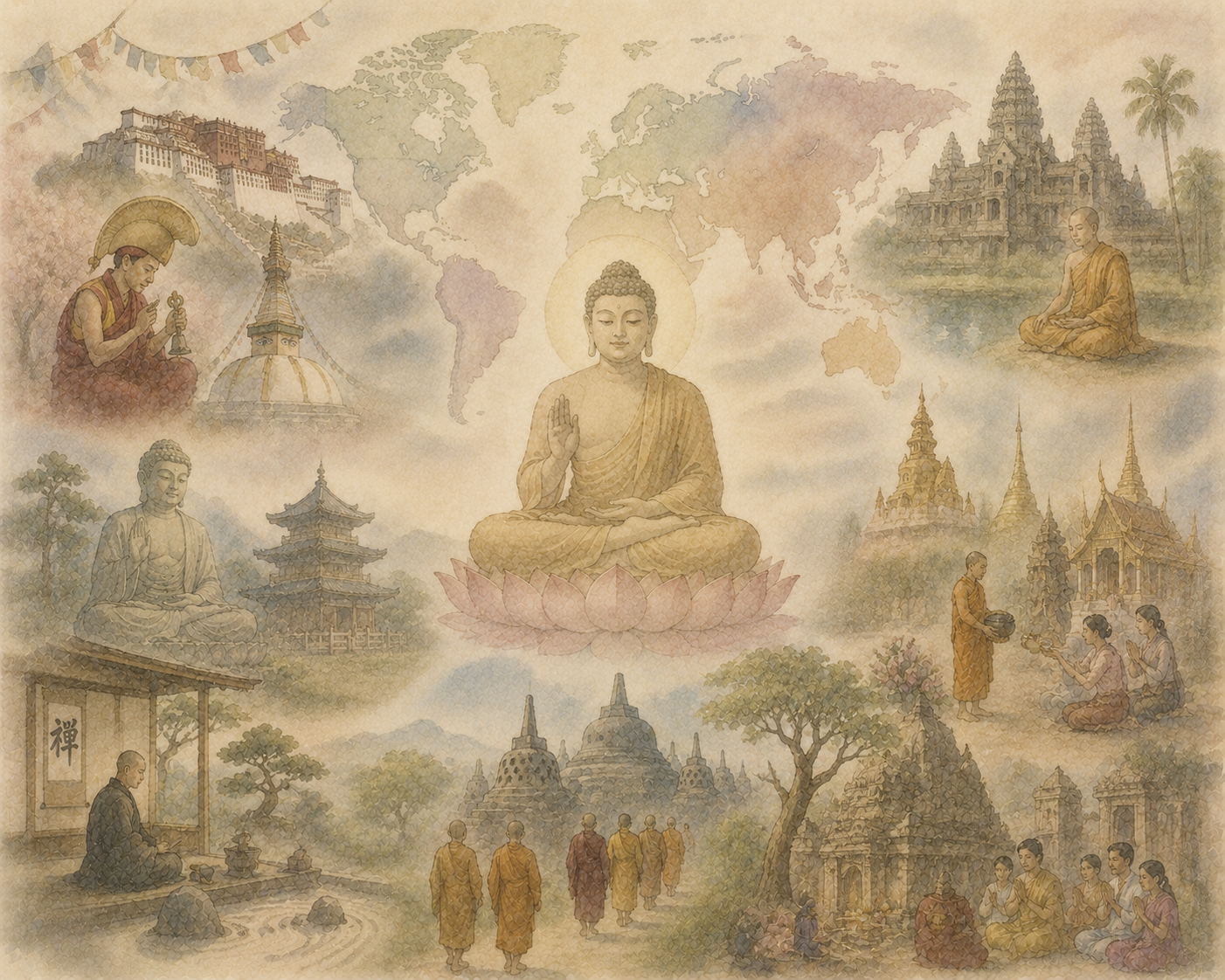
Why Buddhist Practice Looks Different Across Countries
Quick Summary
- Buddhist practice changes across countries because it adapts to local culture, language, and daily life.
- The core aim is often similar, but the “outer form” (rituals, schedules, community roles) can look very different.
- Different climates, work patterns, and family structures shape how people actually practice.
- History matters: migration, politics, and education systems influence what becomes “normal” practice in a place.
- Some countries emphasize temple life and ceremonies; others emphasize home practice and lay communities.
- It’s possible to respect local expressions without treating any one country’s style as the “real” version.
- A helpful approach is to look for function: what a practice is doing in people’s minds and relationships.
Introduction
If you’ve seen Buddhist practice in more than one country, the differences can feel confusing: one place looks quiet and minimal, another looks devotional and ceremonial, and another feels like a community service network with chanting on the side. It’s easy to wonder whether you’re seeing “real Buddhism” or just local customs wearing Buddhist clothing. At Gassho, we focus on practical clarity—how practice works in real human lives, not just how it looks on the surface.
When people say “Buddhist practice different countries,” they’re often pointing to visible contrasts: how temples are used, how often people chant, whether meditation is central, how teachers are addressed, and what counts as a “good practitioner.” Those contrasts are real—but they don’t automatically mean the underlying intention is different.
A more useful question than “Which country has the correct version?” is “What is this practice doing for people here?” That shift—from judging forms to understanding function—makes the global variety of Buddhism feel less like a contradiction and more like a living tradition meeting real conditions.
GASSHO
Ask and learn about Buddhism in daily life.
GASSHO is a Buddhist community app where you can learn Buddhist teachings and ask questions to the head priest of Kongosanmaiin Temple on Mount Koya.
A Simple Lens: Same Human Mind, Different Local Conditions
One grounded way to understand why Buddhist practice looks different across countries is to separate the inner work from the outer container. The inner work is about how attention behaves, how reactivity forms, how craving and aversion steer choices, and how kindness and clarity can be strengthened. The outer container is the set of habits that carry that work: language, symbols, schedules, etiquette, and community structures.
Countries differ most dramatically in the container because containers are built from local materials. A practice has to fit the day-to-day reality of people’s lives: how much time they have, what their homes are like, whether they live near temples, how families are structured, and what kinds of public gatherings feel normal or safe. When those conditions change, the same intention can be expressed through different routines.
This lens doesn’t require you to adopt a belief about which form is superior. It simply treats practice as something humans do with their minds and relationships, and it treats culture as the environment that shapes how that doing becomes visible. When you look this way, “different countries” stops being a problem to solve and becomes information about how people make practice workable.
It also helps explain why two communities can use very different methods—more silence here, more chanting there—yet still be aiming at similar qualities: steadier attention, less compulsive reaction, more ethical sensitivity, and a more realistic relationship with change.
How the Differences Show Up in Everyday Practice
Imagine walking into a Buddhist space in one country where the atmosphere is quiet, with long periods of sitting and minimal instruction. Your attention is pulled inward quickly. You notice restlessness, planning, and self-criticism because there’s less external structure to lean on. The practice “looks” simple, but internally it can feel intense because your mind has fewer distractions.
Now imagine a place where practice is woven into communal rhythm: bowing, chanting, offering, and responding together. Your attention is guided by sound, movement, and timing. Instead of wrestling with “What should I do right now?” you’re invited to synchronize with others. Internally, you may notice a different set of reactions: self-consciousness, resistance to formality, or relief at being carried by a shared container.
In another country, practice may happen mostly at home because temples are far away or because people’s work schedules are demanding. The internal experience shifts again: you’re responsible for starting, continuing, and ending practice without social reinforcement. You notice how quickly the mind negotiates—“I’ll do it later,” “I’m too tired,” “I’ll do a shorter version.” The practice becomes a close study of intention and follow-through.
Even the role of teachers can feel different across countries. In some places, the teacher is a formal figure you meet in structured settings; in others, guidance is more conversational and peer-supported. Internally, this changes what you notice: dependence, doubt, the urge to perform, or the urge to avoid accountability. Different social norms bring different mental habits to the surface.
Language also shapes experience. If practice is done in a classical or foreign liturgical language, you may relate to it as sound and rhythm rather than as literal meaning. That can quiet the analytical mind and highlight feeling-tone, resonance, and devotion. If practice is done in everyday language, it may sharpen conceptual clarity and make ethical reflection more explicit. Neither is automatically “deeper”; they train different aspects of attention.
Public holidays, funerals, and life-cycle rituals vary widely by country, and that changes what “being Buddhist” feels like. In some places, you mostly encounter Buddhism at major family events, which makes practice feel tied to gratitude, grief, and continuity. In other places, you encounter it as a weekly discipline, which makes practice feel tied to routine, self-observation, and community support.
What’s easy to miss is that these outer differences often reveal the same inner pattern: the mind clings, resists, compares, and seeks certainty. Whether you’re sitting in silence, chanting with others, or practicing alone at home, you’re meeting the same basic movements—just triggered by different environments.
Common Misunderstandings When Comparing Countries
Mistake 1: Assuming the most familiar style is the “original.” What feels normal to you can easily masquerade as what’s essential. But familiarity is often just exposure. A practice can be authentic and effective while still looking unfamiliar.
Mistake 2: Treating ritual as “not real practice.” In many countries, ritual is a training in attention, humility, gratitude, and community coordination. If you only evaluate it through personal preference—“I like it” or “I don’t”—you may miss what it’s designed to cultivate.
Mistake 3: Treating meditation as the only serious method. Some cultures emphasize ethical conduct, generosity, chanting, study, or service as the main entry points. That doesn’t mean inner transformation is absent; it may be approached through different daily behaviors that steadily reshape the mind.
Mistake 4: Confusing cultural etiquette with spiritual hierarchy. Forms of respect—how people bow, speak, dress, or sit—can be cultural norms rather than claims about someone’s worth. When you travel or join an international community, it helps to ask what a gesture means locally before interpreting it personally.
Mistake 5: Expecting one country’s Buddhism to represent all Buddhists. “Buddhist practice different countries” is not a minor detail; it’s the default reality of a global tradition. If you want a fair comparison, compare functions (what it trains) rather than aesthetics (what it looks like).
Why These Differences Matter for Your Own Path
Understanding why Buddhist practice looks different across countries protects you from a common trap: spending years chasing the “right” external form while ignoring what actually changes the mind. When you recognize that forms are shaped by conditions, you can choose practices that fit your life without feeling like you’re doing a second-rate version.
It also makes you more skillful in multicultural spaces. If you join a community with a different style, you can participate without constant internal commentary. Instead of “This is weird,” the question becomes “What quality is this training right now—patience, attention, humility, steadiness?” That shift alone can turn discomfort into practice.
On a practical level, it helps you build a stable routine. You can borrow what works from different countries—structure from one place, simplicity from another, community support from another—without turning your practice into a patchwork of trends. The guiding principle is coherence: fewer methods, practiced consistently, with clear intention.
Finally, it supports respect. When you see that people are practicing within real constraints—work, family, language, history—you’re less likely to judge. And when judgment softens, curiosity becomes possible, which is often the beginning of genuine learning.
Conclusion
Buddhist practice looks different across countries because human beings live differently across countries. The mind’s patterns may be familiar everywhere—grasping, resisting, comparing—but the containers that hold practice are built from local culture, history, and daily needs. If you focus on function over appearance, the variety becomes less confusing: different forms, similar human work.
If you’re navigating international styles of Buddhism, aim for two things at once: respect for local expression and honesty about what actually supports your attention, ethics, and steadiness. That balance is often where practice becomes both grounded and flexible.
Ask a Buddhist priest
Have a question about Buddhism?
In the GASSHO app, you can ask questions about Buddhist teachings, daily concerns, and how to understand Buddhism in everyday life.
Frequently Asked Questions
- FAQ 1: Why does Buddhist practice look so different in different countries?
- FAQ 2: Is Buddhist practice in one country more “authentic” than in another?
- FAQ 3: Why do some countries emphasize chanting while others emphasize meditation?
- FAQ 4: Why are Buddhist temples used differently from country to country?
- FAQ 5: Why do Buddhist ceremonies feel very formal in some countries and informal in others?
- FAQ 6: How does language affect Buddhist practice in different countries?
- FAQ 7: Why do some countries focus more on lay practice while others focus more on monastic life?
- FAQ 8: Does Buddhist practice change when it moves to a new country through immigration?
- FAQ 9: Why do offerings and devotional practices vary so much between countries?
- FAQ 10: Are ethical guidelines practiced differently across countries?
- FAQ 11: Why do Buddhist festivals and holidays differ between countries?
- FAQ 12: How can I respectfully join Buddhist practice in a country that does it differently than I’m used to?
- FAQ 13: What stays consistent when Buddhist practice differs across countries?
- FAQ 14: Why do some countries present Buddhism as a philosophy while others present it as a religion?
- FAQ 15: How should I compare Buddhist practice in different countries without oversimplifying?
FAQ 1: Why does Buddhist practice look so different in different countries?
Answer: Because Buddhism adapts to local language, culture, history, and daily life. The underlying aims may be similar, but the outward forms—rituals, community roles, and schedules—change to fit what is workable and meaningful in each place.
Takeaway: Different outer forms often reflect different local conditions, not different “levels” of Buddhism.
FAQ 2: Is Buddhist practice in one country more “authentic” than in another?
Answer: “Authentic” is hard to measure by appearance alone. A better test is whether a practice supports ethical living, steadier attention, and reduced reactivity in the people doing it—within their cultural context.
Takeaway: Compare function and results in daily life, not just aesthetics.
FAQ 3: Why do some countries emphasize chanting while others emphasize meditation?
Answer: Different countries inherit different community habits and educational styles. Chanting can train attention, memory, emotion regulation, and group cohesion; meditation can train sustained observation and clarity. Cultures often lean toward the methods that fit their social rhythm and institutions.
Takeaway: Chanting and meditation can serve overlapping purposes, expressed differently across countries.
FAQ 4: Why are Buddhist temples used differently from country to country?
Answer: In some countries temples function as community centers for ceremonies and family events; in others they function more like practice halls with regular training schedules. Geography, urban density, and social expectations shape what a temple becomes locally.
Takeaway: Temple “purpose” is often a cultural and practical adaptation.
FAQ 5: Why do Buddhist ceremonies feel very formal in some countries and informal in others?
Answer: Formality is strongly shaped by national etiquette and religious culture. Where public ritual is a normal part of life, Buddhist ceremonies may be highly structured; where informality is valued, ceremonies may be simplified to reduce barriers for newcomers.
Takeaway: Formality often reflects local social norms more than spiritual “strictness.”
FAQ 6: How does language affect Buddhist practice in different countries?
Answer: Language influences how teachings are understood and felt. Practice in a classical or liturgical language may emphasize rhythm and devotion; practice in everyday language may emphasize conceptual clarity and direct instruction. Translation choices also shape what people think Buddhism is “about.”
Takeaway: Language changes the experience of practice, even when intentions are similar.
FAQ 7: Why do some countries focus more on lay practice while others focus more on monastic life?
Answer: Social structure and history play a big role: education systems, economic support for religious institutions, and cultural expectations about clergy all influence whether practice centers on monasteries, households, or mixed communities.
Takeaway: Lay-versus-monastic emphasis often reflects how a society supports religious life.
FAQ 8: Does Buddhist practice change when it moves to a new country through immigration?
Answer: Yes. Communities often preserve familiar rituals for continuity while also adapting to new work schedules, languages, and the needs of younger generations. Over time, practice may become bilingual, more lay-led, or reorganized around weekends and public holidays.
Takeaway: Migration usually creates a blend of preservation and adaptation.
FAQ 9: Why do offerings and devotional practices vary so much between countries?
Answer: Local customs around gratitude, hospitality, and religious giving shape devotional expression. What counts as a respectful offering—food, flowers, incense, donations, service—often mirrors broader cultural habits of generosity and ceremony.
Takeaway: Devotion often takes the shape of a culture’s everyday ways of showing respect.
FAQ 10: Are ethical guidelines practiced differently across countries?
Answer: The basic ethical intentions may be similar, but emphasis can differ depending on social issues, laws, and community expectations. Some places stress community harmony and speech; others stress personal conduct and lifestyle choices, reflecting local pressures and norms.
Takeaway: Ethics can be consistent in aim while differing in emphasis by country.
FAQ 11: Why do Buddhist festivals and holidays differ between countries?
Answer: Countries adopt different calendars, local historical commemorations, and seasonal celebrations. Even when a festival has a shared theme, the date, rituals, and public visibility can vary based on national traditions and climate.
Takeaway: Shared meanings can appear through different local festival forms.
FAQ 12: How can I respectfully join Buddhist practice in a country that does it differently than I’m used to?
Answer: Start by observing, asking simple questions about etiquette, and participating gently without trying to “correct” the form. Focus on the intention you can bring—attention, humility, kindness—while learning what gestures mean in that local setting.
Takeaway: Respect grows when you learn local meaning before judging local form.
FAQ 13: What stays consistent when Buddhist practice differs across countries?
Answer: Even with different outward styles, many communities aim to reduce harmful reactivity, strengthen compassion, and cultivate clearer awareness in daily life. The methods and symbols vary, but the human problems being worked with are widely recognizable.
Takeaway: Look for consistent aims beneath changing cultural containers.
FAQ 14: Why do some countries present Buddhism as a philosophy while others present it as a religion?
Answer: National history, education, and the relationship between religion and public life shape how Buddhism is framed. In some places, religious identity is central and communal; in others, people prefer a secular or psychological framing, especially in public institutions.
Takeaway: “Philosophy vs. religion” is often a cultural framing difference, not a complete change of practice.
FAQ 15: How should I compare Buddhist practice in different countries without oversimplifying?
Answer: Compare specific elements (daily routines, community roles, rituals, study habits) and ask what each element is for in that setting. Avoid ranking countries; instead, notice how practice is shaped by work patterns, family life, language, and history.
Takeaway: Careful comparison focuses on context and function, not stereotypes.