



Why Is Benzaiten Worshipped in Japan? Meaning, Blessings, and Origins
Quick Summary
- Benzaiten is worshipped in Japan because she connects everyday needs (skill, money, relationships) with a deeper sense of harmony and flow.
- Her roots trace back to the Indian river goddess Saraswati, then moved through Buddhist transmission into Japan.
- In Japan she became closely linked with water, music, eloquence, learning, and later wealth and good fortune.
- People often visit Benzaiten shrines for “practical blessings” that still feel spiritually meaningful.
- Her popularity grew through blending with local sacred sites—especially islands, springs, caves, and coastal places.
- She is also known as one of the Seven Lucky Gods, which broadened her appeal beyond strictly religious boundaries.
- Understanding Benzaiten in Japan is less about “believing in a deity” and more about how symbols shape attention, intention, and conduct.
Introduction: Why Benzaiten Feels So “Japanese” Yet Comes From Elsewhere
If you’re confused about why Benzaiten is worshipped in Japan—especially when you hear she began as Saraswati in India—you’re noticing the exact point: Benzaiten is a living example of how Japan absorbs a symbol, reshapes it around local places and needs, and keeps it practical rather than purely doctrinal. At Gassho, we focus on how Buddhist and Japanese religious culture shows up in real life, not just in textbook definitions.
Benzaiten (also written Benten) is widely loved because she sits at the intersection of beauty and benefit: music and speech, learning and creativity, water and protection, and—very famously—wealth and good fortune. That mix makes her easy to approach for people who don’t want a complicated theology but still want a meaningful way to orient their hopes and actions.
In other words, Benzaiten worship in Japan isn’t only “religion” in the narrow sense. It’s also a cultural habit of visiting powerful places, making a vow, and returning to daily life with a clearer intention—often around work, art, study, business, or relationships.
The Core Lens: Benzaiten as a Symbol of Flow, Skill, and Support
A helpful way to understand why Benzaiten is worshipped in Japan is to treat her less as a distant supernatural figure and more as a “lens” that brings certain human concerns into focus: the wish to speak well, to learn, to create, to be protected, and to have enough resources to live. When a culture keeps returning to the same figure for centuries, it’s usually because that figure keeps matching real needs.
Benzaiten’s symbolism is unusually coherent: water flows, sound flows, words flow, money flows, and relationships flow. When people pray to Benzaiten, they are often naming a desire for smoother movement through life—fewer blockages, fewer self-sabotaging impulses, fewer avoidable conflicts, and more skillful expression.
Japan also tends to honor sacred presence through place: springs, islands, caves, and shorelines. Benzaiten’s strong association with water makes her easy to “locate” in the landscape. A shrine near water doesn’t just represent Benzaiten; it feels like Benzaiten, because the environment already carries the qualities she stands for.
Finally, Benzaiten worship persists because it doesn’t demand an all-or-nothing identity. People can respect her as a Buddhist deity, a lucky god, a guardian of arts, or simply as a traditional source of encouragement. That flexibility is not a weakness—it’s part of why she remains relevant.
GASSHO
Ask and learn about Buddhism in daily life.
GASSHO is a Buddhist community app where you can learn Buddhist teachings and ask questions to the head priest of Kongosanmaiin Temple on Mount Koya.
How Benzaiten Worship Shows Up in Ordinary Life
In everyday experience, Benzaiten worship often begins with a very normal feeling: “Something in my life isn’t moving.” A project stalls, a conversation goes badly, money feels tight, inspiration dries up, or confidence collapses right when you need it. People look for a way to reset their inner posture without pretending they can control everything.
Visiting a Benzaiten shrine creates a pause. You walk differently, speak less, notice more. Even before any prayer, attention becomes cleaner: the mind stops multitasking and starts naming what it actually wants. That alone can feel like a small return of power.
When someone makes an offering and states a wish, the wish becomes specific. “Help me succeed” turns into “Help me practice consistently,” “Help me speak honestly,” or “Help me stop wasting what I earn.” The act of addressing Benzaiten can quietly reorganize priorities, because it forces a person to hear their own intention out loud.
Many people also experience a shift from grasping to craft. Instead of obsessing over outcomes, they focus on skill: learning, rehearsing, refining, and showing up. Benzaiten’s link with music, eloquence, and learning makes her a natural companion for this mindset—less “give me luck,” more “help me do this well.”
There’s also a social dimension that’s easy to miss. Benzaiten is a shared reference point: students, artists, shop owners, and families can all visit the same shrine for different reasons. That shared practice reduces isolation. You’re reminded that wanting stability, creativity, and enough money is not shameful—it’s human.
Over time, the shrine visit becomes a kind of internal checkpoint. You notice whether you’re speaking carelessly, spending impulsively, neglecting practice, or chasing attention. Benzaiten worship, at its best, works like a mirror: not moralistic, just clarifying.
And because Benzaiten is often enshrined near water, the setting itself reinforces the lesson. Water doesn’t argue; it moves. People leave with a simple, embodied reminder: return to what flows—breath, practice, honest speech, steady effort.
Common Misunderstandings About Benzaiten in Japan
One common misunderstanding is that Benzaiten is “only” a money goddess. It’s true that many people seek her help for prosperity, business success, and good fortune, especially through her role among the Seven Lucky Gods. But historically her identity is broader: arts, learning, speech, and water-based protection are central themes, not side notes.
Another confusion is thinking her worship must be either purely Buddhist or purely Shinto. In Japan, religious life often blends without requiring a single label. Benzaiten can be honored in Buddhist temples and also in shrine contexts, and many visitors don’t feel a need to “solve” the category before they pray.
People also assume that because Benzaiten came from Saraswati, the Japanese form is a simple copy. In reality, transmission changes symbols. Japan emphasized Benzaiten’s connection to specific landscapes (especially islands and water) and expanded her popular role as a bringer of fortune. The origin matters, but so does the local life of the figure.
Finally, some dismiss Benzaiten worship as superstition. That misses how devotional acts can function psychologically and socially: they focus attention, strengthen resolve, and connect a person to a community and a place. Even if someone holds the practice lightly, it can still be effective as a way of aligning intention with action.
Why Benzaiten Still Matters Today
Benzaiten remains compelling in modern Japan because she addresses pressures that haven’t gone away: the need to communicate well, to learn quickly, to stay creative, and to remain financially stable. Her worship offers a culturally familiar way to admit those needs without turning them into private anxiety.
She also represents a balanced ideal: beauty with discipline, fortune with responsibility, expression with restraint. When people pray for success at a Benzaiten shrine, the subtext is often, “Let my efforts land well, and let me not lose myself in the process.”
And because Benzaiten is tied to water and to well-known pilgrimage-style sites, her worship naturally includes stepping out of routine. That small act—leaving the usual environment, bowing, offering, returning—can be enough to interrupt unhelpful habits and restart a more grounded rhythm.
Conclusion: Why Benzaiten Is Worshipped in Japan in One Sentence
Benzaiten is worshipped in Japan because she became a trusted symbol—rooted in older traditions yet shaped by Japanese places and daily concerns—for the kind of “good flow” people want in life: clear speech, creative skill, protection, and the stability that comes from both fortune and effort.
If you approach Benzaiten as a way to clarify intention and support consistent practice—rather than as a test of belief—her popularity in Japan starts to make simple sense.
Ask a Buddhist priest
Have a question about Buddhism?
In the GASSHO app, you can ask questions about Buddhist teachings, daily concerns, and how to understand Buddhism in everyday life.
Frequently Asked Questions
- FAQ 1: Why is Benzaiten worshipped in Japan if she originated as Saraswati in India?
- FAQ 2: What does Benzaiten mean in Japan, in simple terms?
- FAQ 3: Why is Benzaiten associated with water in Japan?
- FAQ 4: Why do people pray to Benzaiten for money and business success in Japan?
- FAQ 5: Why is Benzaiten worshipped by artists, musicians, and students in Japan?
- FAQ 6: Why is Benzaiten sometimes called Benten in Japan?
- FAQ 7: Why is Benzaiten worshipped at both temples and shrines in Japan?
- FAQ 8: Why is Benzaiten considered one of the Seven Lucky Gods in Japan?
- FAQ 9: Why is Benzaiten sometimes depicted with a biwa (lute) in Japan?
- FAQ 10: Why do some Benzaiten sites in Japan feel especially powerful or “different”?
- FAQ 11: Why is Benzaiten worshipped for relationships and social harmony in Japan?
- FAQ 12: Why is Benzaiten worshipped in Japan without requiring strict belief?
- FAQ 13: Why did Benzaiten’s blessings expand from learning to wealth in Japan?
- FAQ 14: Why is Benzaiten worshipped in Japan specifically at island shrines?
- FAQ 15: Why is Benzaiten worshipped in Japan today, even in a modern lifestyle?
FAQ 1: Why is Benzaiten worshipped in Japan if she originated as Saraswati in India?
Answer: Benzaiten is worshipped in Japan because the figure traveled through Buddhist transmission and was then reinterpreted through Japanese culture, sacred geography, and everyday needs. Over time, the Japanese Benzaiten kept the themes of learning and eloquence while gaining strong ties to water sites and popular blessings like prosperity.
Takeaway: Benzaiten’s Japanese worship reflects adaptation, not contradiction.
FAQ 2: What does Benzaiten mean in Japan, in simple terms?
Answer: In Japan, Benzaiten commonly means a sacred presence connected to “flow” in life—especially the flow of words (eloquence), sound (music), learning (knowledge), and resources (good fortune). People relate to her as someone who supports skillful expression and practical well-being.
Takeaway: Benzaiten is a symbol of skill, expression, and supportive fortune.
FAQ 3: Why is Benzaiten associated with water in Japan?
Answer: Benzaiten is associated with water because her older roots connect to a river goddess, and in Japan her worship became strongly anchored to springs, islands, caves, and shorelines. Water also matches her symbolism: movement, sound, purification, and the sense of life being sustained by something continuously flowing.
Takeaway: Water sites make Benzaiten’s qualities feel tangible and local.
FAQ 4: Why do people pray to Benzaiten for money and business success in Japan?
Answer: People pray to Benzaiten for money and business success because her blessings expanded in popular religion to include prosperity and good fortune, especially through her role among the Seven Lucky Gods. She is also linked to talents—speech, persuasion, artistry, learning—that directly affect work and income.
Takeaway: Prosperity prayers fit Benzaiten’s wider theme of skill and favorable conditions.
FAQ 5: Why is Benzaiten worshipped by artists, musicians, and students in Japan?
Answer: Benzaiten is worshipped by artists, musicians, and students because she is traditionally connected with music, eloquence, and learning—areas where practice and inspiration both matter. Visiting her shrines is a way to dedicate effort, ask for steadiness, and reaffirm commitment to craft.
Takeaway: Benzaiten is sought for creativity, study, and the discipline behind them.
FAQ 6: Why is Benzaiten sometimes called Benten in Japan?
Answer: “Benten” is a common shortened reading of Benzaiten used in everyday Japanese speech and in place names. It’s not a different deity; it’s a familiar way people refer to the same figure, especially in local shrine culture.
Takeaway: Benten is a widely used nickname for Benzaiten in Japan.
FAQ 7: Why is Benzaiten worshipped at both temples and shrines in Japan?
Answer: Benzaiten is worshipped at both because Japanese religious life often blends Buddhist and local shrine practices, especially around popular deities and sacred sites. Benzaiten entered Japan through Buddhism, but her worship also fits shrine-style devotion tied to place, water, and community festivals.
Takeaway: Benzaiten crosses temple and shrine boundaries in a typically Japanese way.
FAQ 8: Why is Benzaiten considered one of the Seven Lucky Gods in Japan?
Answer: Benzaiten is included among the Seven Lucky Gods because she came to represent accessible, this-worldly benefits—fortune, talent, and protection—that ordinary people could pray for. Her popularity in that group helped spread her worship through seasonal visits, pilgrimages, and local traditions.
Takeaway: The Seven Lucky Gods tradition made Benzaiten worship more widespread and practical.
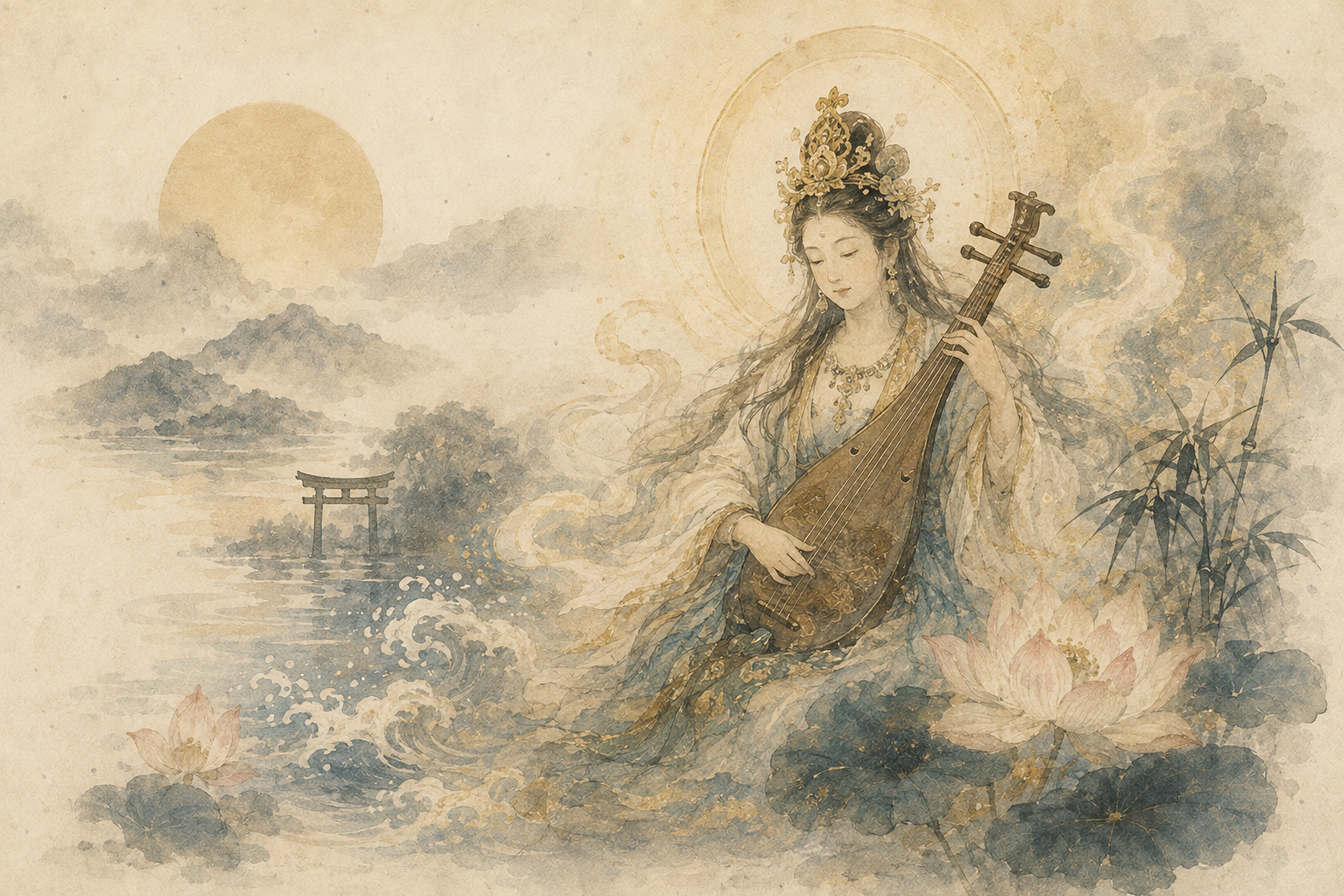
FAQ 9: Why is Benzaiten sometimes depicted with a biwa (lute) in Japan?
Answer: Benzaiten is depicted with a biwa because her identity includes music, sound, and refined expression. The instrument visually communicates her blessing of the arts and the idea that harmony—like music—comes from attention, timing, and practice.
Takeaway: The biwa highlights Benzaiten’s connection to music and cultivated skill.
FAQ 10: Why do some Benzaiten sites in Japan feel especially powerful or “different”?
Answer: Many Benzaiten sites are located in striking natural settings—near water, on islands, or by caves and springs—so the environment itself shapes the experience. The combination of landscape, ritual behavior, and shared cultural expectation can make the visit feel unusually focused and memorable.
Takeaway: Place, water, and ritual together amplify Benzaiten’s presence in Japan.
FAQ 11: Why is Benzaiten worshipped for relationships and social harmony in Japan?
Answer: Benzaiten is worshipped for relationships because she is linked to speech, charm, and the ability to communicate skillfully—qualities that affect love, friendship, and workplace dynamics. People often seek help not only for “romance,” but for smoother interaction and fewer conflicts caused by careless words.
Takeaway: Benzaiten’s relationship blessings often center on communication and harmony.
FAQ 12: Why is Benzaiten worshipped in Japan without requiring strict belief?
Answer: Benzaiten worship often functions as a practice rather than a creed: you visit, make an offering, state a wish, and return to life with renewed intention. In Japan, many people participate in such devotion as a respectful cultural and spiritual habit, even if they describe their belief in flexible terms.
Takeaway: Benzaiten worship can be meaningful as an intentional act, not a doctrinal statement.
FAQ 13: Why did Benzaiten’s blessings expand from learning to wealth in Japan?
Answer: Her blessings expanded because symbols evolve with social life: as commerce, urban culture, and popular pilgrimage grew, people naturally sought divine support for prosperity as well as for arts and education. Benzaiten’s themes—skill, attraction, and “flow”—made that expansion feel consistent rather than random.
Takeaway: Benzaiten’s prosperity role grew alongside Japan’s everyday economic concerns.
FAQ 14: Why is Benzaiten worshipped in Japan specifically at island shrines?
Answer: Island shrines fit Benzaiten because islands naturally emphasize boundaries, water, and a sense of entering a distinct sacred space. Many famous Benzaiten sites developed where the geography already suggested protection, purification, and concentrated presence—qualities strongly associated with her in Japan.
Takeaway: Islands intensify Benzaiten’s water symbolism and the feeling of sacred separation.
FAQ 15: Why is Benzaiten worshipped in Japan today, even in a modern lifestyle?
Answer: Benzaiten is worshipped today because modern life still depends on what she represents: communication, learning, creativity, and financial stability. Her shrines offer a simple, culturally familiar way to pause, clarify priorities, and ask for support—without needing to withdraw from ordinary responsibilities.
Takeaway: Benzaiten remains relevant because her blessings match modern pressures and goals.