



Who Was Kukai? The Monk Who Established Shingon Buddhism in Japan
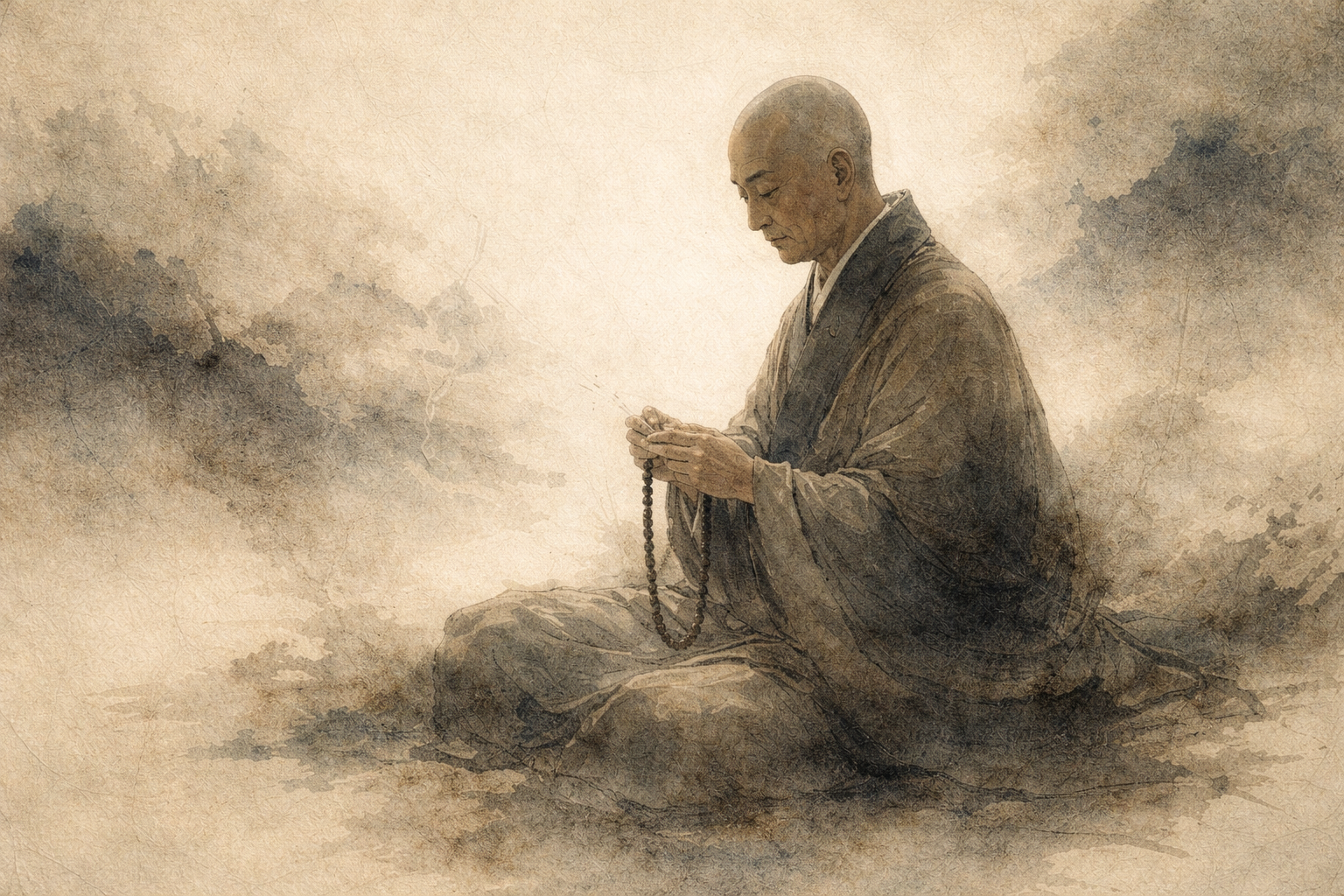
Quick Summary
- Kukai (774–835), also known as Kobo Daishi, was a Japanese monk, scholar, and cultural figure of the early Heian period.
- He traveled to Tang China, trained in esoteric Buddhist methods, and returned with a clear, practice-centered system.
- He established Shingon Buddhism in Japan and helped shape how ritual, art, language, and ethics could work together.
- His approach emphasized embodied practice: voice, gesture, and focused attention as tools for transformation.
- He founded the monastic center at Mount Koya (Koyasan), which became a major spiritual and cultural hub.
- He was also a public intellectual: writing, teaching, advising, and contributing to education and infrastructure.
- Understanding who Kukai was helps clarify why Shingon feels “practical” and aesthetic rather than purely theoretical.
Introduction: Why People Get Stuck on “Who Was Kukai?”
If you search “who was Kukai,” you usually hit two unsatisfying extremes: a saintly legend with miracles on one side, and a dry timeline of dates and temple names on the other. The useful middle is simpler: Kukai was a person who treated spiritual practice as something you do with your whole life—speech, attention, relationships, and craft—not just something you believe. I’m writing from the perspective of Gassho, a Zen/Buddhism site focused on clear practice and careful history.
Kukai lived in Japan’s early Heian period, a time when the court, monasteries, and new cultural currents were all competing to define what “real learning” and “real practice” meant.
He began as a bright student headed toward a conventional career, then turned sharply toward religious life, choosing training and discipline over status.
What made him stand out wasn’t only devotion—it was his ability to organize a complete path: a coherent set of practices, a philosophy that supported them, and institutions that could preserve them.
That combination is why he’s remembered not just as a monk, but as a founder, teacher, writer, and cultural architect whose influence still shapes Japanese Buddhism.
A Clear Lens for Understanding Kukai’s Role
A grounded way to understand Kukai is to see him as someone who insisted that insight is not merely an idea you hold in your head; it is something you train into your body and behavior. When people ask “who was Kukai,” they often want a label—saint, magician, philosopher, founder. A better lens is function: he built a method for aligning attention, speech, and action so practice becomes concrete.
From that perspective, ritual is not “extra.” It’s a structured way to work with the mind. Repetition, sound, and precise movement can stabilize attention, interrupt habitual reactions, and make values feel real rather than abstract. You don’t have to accept supernatural claims to see the practical logic: the mind is shaped by what it repeatedly does.
He also treated symbols, images, and language as training tools. Instead of arguing endlessly about concepts, you use forms that guide perception and emotion. The point is not to collect exotic knowledge; it’s to become less scattered, less reactive, and more capable of acting with clarity.
Finally, Kukai’s legacy makes more sense when you view it as a complete ecosystem: disciplined practice, careful teaching, and a community structure that can carry it forward. That’s why his impact lasted—he didn’t only inspire; he implemented.
GASSHO
Ask and learn about Buddhism in daily life.
GASSHO is a Buddhist community app where you can learn Buddhist teachings and ask questions to the head priest of Kongosanmaiin Temple on Mount Koya.
How Kukai’s Approach Shows Up in Ordinary Life
Think about how your day actually unfolds: you wake up, your mind starts narrating, and before you know it you’re living inside commentary—plans, worries, judgments. Kukai’s style of practice, at its most human level, is a way of stepping out of that fog by giving attention something skillful to do.
When attention is untrained, it gets pulled by whatever is loudest: a notification, a craving, a fear, a memory. A structured practice interrupts that pattern. You return to a chosen form—sound, breath, posture, a short recitation—and the return itself becomes the training.
Speech is another everyday battleground. Most regret comes from words said too quickly: defensiveness, sarcasm, exaggeration, the need to win. Kukai’s emphasis on voice and formulaic phrases can be read as a discipline of speech—learning to speak with intention rather than impulse.
Then there’s the body. Stress doesn’t only live in thoughts; it lives in shoulders, jaw, stomach, and pacing. Practices that coordinate body and attention can reveal how often we brace against life. Noticing that bracing is already a shift: you see the reaction instead of being it.
In relationships, the same principle applies. You can watch the moment you turn someone into a role—enemy, judge, audience, obstacle. A practice-oriented lens makes that moment visible. You may still feel irritation or fear, but you’re less compelled to act it out immediately.
Even work becomes a field of practice. When tasks feel meaningless, the mind looks for escape. When tasks feel threatening, the mind looks for control. A disciplined method doesn’t magically remove those feelings; it gives you a way to meet them without collapsing into them.
Seen this way, “who was Kukai” is not only a historical question. It’s also a question about what kind of training actually changes a life: not grand experiences, but repeated, embodied returns to what you intend to cultivate.
Common Misunderstandings About Kukai
Misunderstanding 1: Kukai was mainly a miracle worker. Stories about extraordinary feats grew around him, especially after his death. Those legends matter culturally, but they can hide the more useful point: he was a disciplined organizer of practice, education, and institutions.
Misunderstanding 2: His teachings are “too esoteric” to be meaningful. The outer forms can look unfamiliar, but the inner logic is straightforward: train attention, refine speech, and embody values through repeated, intentional action.
Misunderstanding 3: Kukai was only a religious figure, not a cultural one. He was also a writer and thinker who influenced art, calligraphy, learning, and the broader intellectual life of his time. Reducing him to “just a monk” misses why he mattered to society.
Misunderstanding 4: Knowing the dates is the same as knowing the person. A timeline helps, but it doesn’t explain why his work endured. His significance comes from how he connected training methods to lived life and built places where those methods could be transmitted.
Why Kukai Still Matters Today
Kukai matters because he represents a practical answer to a modern problem: we are overloaded with information but undertrained in attention. His legacy points to a simple truth—what you repeatedly do with body, speech, and mind becomes your character.
He also matters because he shows how spirituality and culture can support each other. Beauty, form, and discipline aren’t distractions from practice; they can be containers that make practice sustainable.
And he matters because he built communities. Many people today try to practice alone, guided by fragments. Kukai’s example highlights the value of coherent training, responsible teaching, and institutions that preserve depth over time.
If “who was Kukai” is your question, the most honest answer is: he was someone who made practice workable—repeatable, teachable, and integrated into real life.
Conclusion: A Founder, a Builder, and a Practitioner
Kukai was a Japanese monk of the early Heian period who traveled, trained, returned, and then did the hard work of building something that could last. He is remembered as Kobo Daishi because people felt his presence as compassionate and effective, but his enduring influence comes from more ordinary strengths: clarity, discipline, and an ability to translate deep practice into forms people could actually do.
When you ask “who was Kukai,” you’re not only asking for a biography. You’re asking why a single person’s approach could shape centuries of practice. The answer is that he didn’t just teach ideas—he established a living method.
Ask a Buddhist priest
Have a question about Buddhism?
In the GASSHO app, you can ask questions about Buddhist teachings, daily concerns, and how to understand Buddhism in everyday life.
Frequently Asked Questions
- FAQ 1: Who was Kukai in Japanese Buddhist history?
- FAQ 2: What is Kukai most famous for?
- FAQ 3: When did Kukai live?
- FAQ 4: Where was Kukai born?
- FAQ 5: Why is Kukai also called Kobo Daishi?
- FAQ 6: Did Kukai really travel to China, and why?
- FAQ 7: What did Kukai bring back from Tang China?
- FAQ 8: What did Kukai teach that was distinctive?
- FAQ 9: What is Kukai’s connection to Mount Koya (Koyasan)?
- FAQ 10: Was Kukai only a monk, or also a scholar?
- FAQ 11: What writings is Kukai known for?
- FAQ 12: Did Kukai have a role in Japanese art and calligraphy?
- FAQ 13: Are the miracle stories about Kukai historically reliable?
- FAQ 14: How did Kukai die, and what is the “eternal meditation” belief?
- FAQ 15: Why is Kukai still important for people asking “who was Kukai” today?
FAQ 1: Who was Kukai in Japanese Buddhist history?
Answer: Kukai (774–835) was a Japanese monk, scholar, and religious founder best known for establishing Shingon Buddhism in Japan after training in Tang China and creating institutions to transmit that practice.
Takeaway: Kukai is remembered as both a practitioner and a builder of a lasting tradition.
FAQ 2: What is Kukai most famous for?
Answer: He is most famous for bringing a complete esoteric Buddhist system from China to Japan, founding a major monastic center at Mount Koya, and shaping Japanese religious culture through teaching and writing.
Takeaway: His fame comes from transmission, institution-building, and cultural influence.
FAQ 3: When did Kukai live?
Answer: Kukai lived from 774 to 835, during Japan’s early Heian period, when the imperial court and Buddhist institutions were rapidly developing.
Takeaway: His life sits at a formative moment for Japanese religion and culture.
FAQ 4: Where was Kukai born?
Answer: He was born on Shikoku (traditionally in Sanuki Province, present-day Kagawa Prefecture), a region later closely associated with pilgrimage traditions connected to him.
Takeaway: Kukai’s origins are tied to Shikoku, a key place in his later legacy.
FAQ 5: Why is Kukai also called Kobo Daishi?
Answer: “Kobo Daishi” is a posthumous honorific title meaning something like “Great Teacher who Spread the Dharma,” reflecting the respect later generations had for Kukai’s teaching and public contributions.
Takeaway: Kobo Daishi is an honorific name that points to his long-term impact.
FAQ 6: Did Kukai really travel to China, and why?
Answer: Yes. Kukai traveled to Tang China as part of an official mission and sought advanced training; he returned with texts, ritual knowledge, and a structured approach he could teach in Japan.
Takeaway: His China journey was pivotal because it shaped what he later established in Japan.
FAQ 7: What did Kukai bring back from Tang China?
Answer: He brought back scriptures, commentaries, ritual manuals, and a coherent training system centered on embodied practice (including recitation and symbolic forms), along with authority to transmit it.
Takeaway: Kukai returned with both materials and a teachable method.
FAQ 8: What did Kukai teach that was distinctive?
Answer: He emphasized a practice path that integrates body, speech, and mind through structured forms, aiming to make transformation practical and repeatable rather than purely conceptual.
Takeaway: His distinctiveness lies in integrated, embodied training.
FAQ 9: What is Kukai’s connection to Mount Koya (Koyasan)?
Answer: Kukai founded the monastic complex at Mount Koya as a dedicated training center, which became one of Japan’s most important Buddhist sites and a focal point of devotion to him.
Takeaway: Koyasan is central to Kukai’s institutional and spiritual legacy.
FAQ 10: Was Kukai only a monk, or also a scholar?
Answer: He was both. Kukai wrote extensively, engaged in intellectual debates of his time, and contributed to education and the arts, including calligraphy and literary culture.
Takeaway: Kukai’s influence extends beyond temples into scholarship and culture.
FAQ 11: What writings is Kukai known for?
Answer: He is known for works that explain doctrine, practice, and the role of language and symbolism in training; many are studied for both religious and literary value (often in classical Chinese used in Japan at the time).
Takeaway: Kukai’s writings helped systematize and communicate his approach.
FAQ 12: Did Kukai have a role in Japanese art and calligraphy?
Answer: Yes. He is traditionally celebrated as a master calligrapher and as someone who helped shape the aesthetic and symbolic dimensions of Japanese Buddhist culture.
Takeaway: Kukai’s legacy includes the arts, not only religious practice.
FAQ 13: Are the miracle stories about Kukai historically reliable?
Answer: Many miracle stories are part of later devotional tradition rather than verifiable biography; they reflect how communities experienced Kukai’s compassion and authority over time, not necessarily literal events.
Takeaway: Legends can be meaningful without being straightforward historical records.
FAQ 14: How did Kukai die, and what is the “eternal meditation” belief?
Answer: Historically, Kukai died in 835, but a strong tradition holds that he remains in a profound meditative state at Koyasan; this belief expresses ongoing devotion and a sense of his continuing presence.
Takeaway: His death is historical, while “eternal meditation” is a devotional interpretation.
FAQ 15: Why is Kukai still important for people asking “who was Kukai” today?
Answer: Kukai remains important because he shows how a spiritual path can be made concrete—through disciplined methods, careful teaching, and communities that preserve practice—rather than remaining only an inspiring idea.
Takeaway: Kukai matters today as an example of practice made workable and enduring.