



Who Is Benzaiten? The Buddhist Goddess of Wisdom, Music, and Fortune
Quick Summary
- Benzaiten is a widely loved Buddhist goddess in Japan associated with wisdom, music, eloquence, and good fortune.
- She is closely connected to water imagery (springs, rivers, islands) and to the flow of speech, art, and learning.
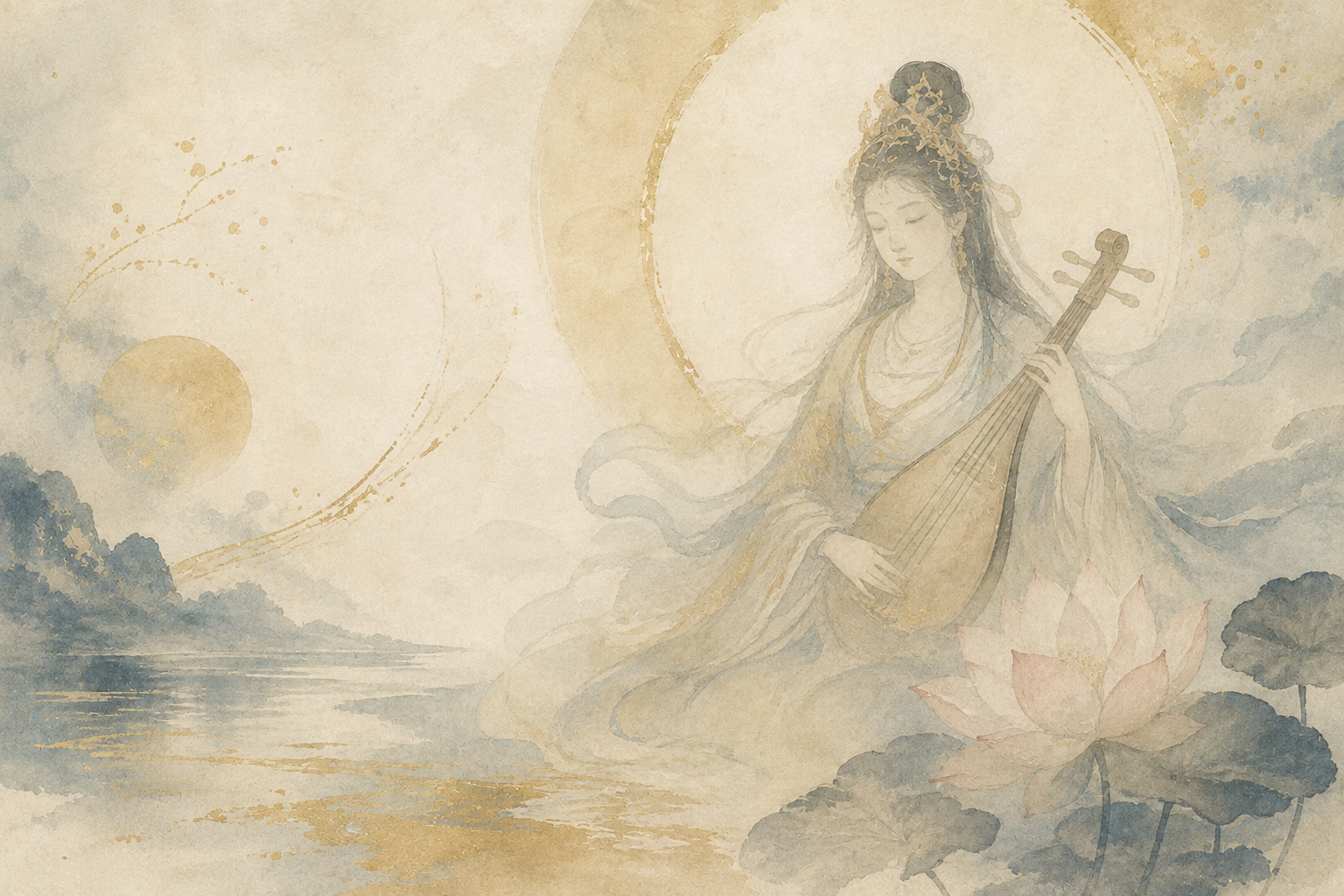
- Many depictions show her holding a biwa (lute), highlighting her link to music and refined expression.
- Her roots trace back to the Indian river goddess Saraswati, later adapted into Buddhist and Japanese religious life.
- Benzaiten is often honored for practical concerns: creativity, study, communication, protection, and prosperity.
- She appears both as a gentle musician and, in some forms, as a powerful protector with multiple arms.
- Approaching Benzaiten can be understood as training attention toward clarity, harmony, and responsible use of talent.
Introduction
If “Benzaiten” keeps showing up in temple photos, travel guides, or lucky charm shops, the confusion is understandable: is she a Buddhist deity, a Shinto kami, a symbol of money, or a patron of music—and how can one figure hold all of that without it turning into superstition? At Gassho, we focus on clear, grounded explanations of Buddhist culture and practice without the hype.
Benzaiten (also written Benzai-ten) is best known in Japan as a goddess of wisdom, music, eloquence, and fortune. She is also counted among the Seven Lucky Gods (Shichifukujin), which is why her image appears in New Year traditions and popular “good luck” contexts. Yet her story is deeper than a prosperity mascot: her symbolism points to how skill, speech, and creativity can either liberate the mind or entangle it.
When people pray to Benzaiten, they often ask for success in study, artistic ability, better communication, or financial stability. Those wishes can be read in a simple way: we want our lives to flow. Benzaiten’s water imagery—springs, rivers, islands—mirrors that desire for movement without blockage, expression without harm, and abundance without grasping.
Benzaiten as a Lens for Wisdom, Art, and Fortune
A helpful way to understand Benzaiten is to treat her less as a distant “mythic being” and more as a lens for seeing how wisdom moves through ordinary life. Wisdom here doesn’t mean having the right opinions; it means noticing what leads to clarity and what leads to confusion—especially in the areas Benzaiten represents: speech, learning, creativity, and desire for success.
Music and eloquence are not random attributes. Sound is immediate: it arises, vibrates through the body, and disappears. Speech is similar—once words leave the mouth, they can’t be retrieved. Benzaiten’s association with music and language points to a practical question: can we use expression to reduce suffering, or do we use it to inflate ourselves, manipulate others, or chase approval?
Fortune, in this lens, is not only “getting things.” It’s the felt sense that life is workable: resources are sufficient, relationships are stable, and the mind is not constantly at war with itself. Benzaiten’s popularity around prosperity can be read as a cultural way of naming conditions that support practice and well-being—while still reminding us that clinging to outcomes creates its own kind of poverty.
Finally, Benzaiten’s water symbolism ties the whole picture together. Water adapts to its container, finds pathways, and wears down obstacles over time. As a lens, Benzaiten invites a softer kind of strength: steady learning, consistent practice, and the humility to keep refining how we speak and act.
GASSHO
Ask and learn about Buddhism in daily life.
GASSHO is a Buddhist community app where you can learn Buddhist teachings and ask questions to the head priest of Kongosanmaiin Temple on Mount Koya.
How Benzaiten Shows Up in Everyday Experience
You can see Benzaiten’s themes the moment you try to speak clearly under pressure. A meeting starts, your mind races, and your words come out tangled. In that moment, “eloquence” isn’t about sounding impressive—it’s about settling enough to say what is true, necessary, and kind.
Or consider learning. You sit down to study, practice an instrument, or write something meaningful. At first there’s energy, then distraction, then self-judgment. Benzaiten’s symbolism points to what actually helps: returning to the next small step, again and again, without turning the process into a referendum on your worth.
Creativity often arrives with a strange mix of joy and fear. You might feel a genuine impulse to make something, followed immediately by the urge to compare yourself to others. The “goddess of music” aspect can be read as permission to listen more closely—less to the inner critic, more to the simple rhythm of doing the work.
Water imagery becomes relevant when emotions surge. A harsh email lands, a family member says something cutting, or a plan falls apart. The mind wants to harden. But if you notice the reaction early—tight chest, clenched jaw, rehearsed arguments—you can choose a different response: pause, breathe, and let the first wave pass before you speak.
Fortune shows up in subtler ways than winning. It appears when you stop sabotaging yourself with impulsive spending, when you ask for help before a problem becomes a crisis, or when you keep a promise to yourself. These are not glamorous moments, but they build the kind of stability people often mean when they say they want “good luck.”
Even the biwa in Benzaiten’s hands can be read experientially. Music requires listening, timing, and restraint. In daily life, that translates into not filling every silence, not forcing every outcome, and not treating conversation as a competition. You begin to notice that harmony is something you participate in, not something you demand.
When people visit a Benzaiten shrine or temple, the most practical effect is often a shift in attention. You slow down, you remember what you care about, and you make a quiet commitment—study with sincerity, speak with care, create with patience. That shift is small, but it’s real.
Origins and Symbols: From Saraswati to Benzaiten
Benzaiten’s story begins far from Japan. Her roots are commonly traced to Saraswati, an Indian goddess associated with rivers, learning, speech, and the arts. As Buddhism traveled across Asia, many figures and symbols were translated into new cultures, taking on local forms while keeping recognizable themes.
In Japan, Benzaiten became especially associated with water sites—springs, caves, lakes, and islands. This is why you’ll often find Benzaiten shrines near water or in places where water is central to the landscape. The symbolism is intuitive: water nourishes life, carries sound, and represents continuous movement.
Her most familiar icon is Benzaiten holding a biwa, a traditional lute. This image emphasizes refined expression: music, poetry, and the kind of communication that brings people together rather than tearing them apart. In other depictions, Benzaiten may appear with multiple arms, holding different objects—suggesting a broader protective and beneficent role.
You may also see Benzaiten connected with serpents or dragons in some local traditions. Rather than taking this as a literal claim, it can be understood as symbolic language for powerful natural forces—water, weather, fertility, and the unpredictable conditions that shape human life.
Common Misunderstandings About Benzaiten
One common misunderstanding is that Benzaiten is “only” a money goddess. While she is associated with prosperity, her older and deeper themes are wisdom, learning, speech, and the arts. Wealth is just one expression of “supportive conditions,” and it can easily become harmful if it feeds greed or carelessness.
Another misunderstanding is that Benzaiten must be either Buddhist or Shinto, as if religious life in Japan fits into neat boxes. In practice, Benzaiten has been honored in ways that blend temple and shrine culture. For a modern reader, it can be more useful to focus on what her symbolism is pointing to rather than trying to force a single label.
Some people assume that devotion to Benzaiten requires believing in miracles. But many visitors approach Benzaiten in a simpler way: as a moment to clarify intention, to remember the value of disciplined practice, and to ask for support in using one’s abilities responsibly. Even without supernatural assumptions, the act of pausing and recommitting can change behavior.
Finally, Benzaiten is sometimes reduced to aesthetics—beautiful statues, elegant music imagery, “cool” mythology. The risk is missing the ethical edge of her symbolism: speech can heal or harm; talent can serve others or serve ego; fortune can be shared or hoarded. Benzaiten’s popularity makes more sense when you keep those tensions in view.
Why Benzaiten Still Matters in Modern Life
Benzaiten matters because the problems she points to are not ancient—they’re daily. We live in a world of constant messaging, performative speech, and attention economies that reward outrage and self-promotion. Benzaiten’s association with eloquence and music can be read as a quiet counterweight: communicate with care, listen for harmony, and don’t confuse volume with truth.
She also matters for anyone trying to learn a skill. Whether it’s studying, writing, coding, parenting, or practicing an instrument, the real obstacle is often not intelligence but discouragement. Benzaiten symbolizes steady cultivation: returning to the basics, respecting the process, and letting improvement be gradual.
Her link to fortune is relevant in a time when many people feel financially and emotionally precarious. Benzaiten doesn’t have to mean “get rich.” She can mean: build supportive conditions, reduce self-inflicted chaos, and treat resources—time, money, energy, relationships—as something to steward rather than something to squeeze.
And for artists and creatives, Benzaiten offers a grounded reminder that inspiration is not only a mood. It’s also practice, listening, and humility. When you approach creativity as service—making something that brings clarity, beauty, or relief—you naturally step away from the exhausting need to be impressive.
Conclusion
Benzaiten is often introduced as the Buddhist goddess of wisdom, music, and fortune, but her real value is how she gathers these themes into one practical mirror. She points to the flow of life: how we speak, how we learn, how we create, and how we relate to success.
If you keep Benzaiten as a lens rather than a test of belief, her symbolism becomes immediately usable. Wisdom looks like noticing what you’re doing with your attention. Music looks like listening and restraint. Fortune looks like conditions that support a stable, ethical, workable life.
Ask a Buddhist priest
Have a question about Buddhism?
In the GASSHO app, you can ask questions about Buddhist teachings, daily concerns, and how to understand Buddhism in everyday life.
Frequently Asked Questions
- FAQ 1: Who is Benzaiten in Buddhism?
- FAQ 2: Is Benzaiten the same as Saraswati?
- FAQ 3: What does Benzaiten symbolize?
- FAQ 4: Why is Benzaiten associated with music and the biwa?
- FAQ 5: Is Benzaiten one of the Seven Lucky Gods?
- FAQ 6: What is Benzaiten the goddess of?
- FAQ 7: Why is Benzaiten linked to water and islands?
- FAQ 8: Are Benzaiten shrines Buddhist or Shinto?
- FAQ 9: What offerings are commonly made to Benzaiten?
- FAQ 10: What is the difference between Benzaiten and Kannon?
- FAQ 11: Why is Benzaiten sometimes shown with multiple arms?
- FAQ 12: Is Benzaiten connected to wealth and business success?
- FAQ 13: What is the meaning of the name “Benzaiten”?
- FAQ 14: How do people pray to Benzaiten respectfully?
- FAQ 15: What are famous places to worship Benzaiten in Japan?
FAQ 1: Who is Benzaiten in Buddhism?
Answer: Benzaiten is a revered goddess figure in Japanese Buddhism associated with wisdom, eloquence, music, and beneficial fortune. She is often approached as a protector of learning and the arts, and as a symbol of supportive conditions for a stable life.
Takeaway: Benzaiten represents clear speech, cultivated skill, and the kind of “good fortune” that supports wise living.
FAQ 2: Is Benzaiten the same as Saraswati?
Answer: Benzaiten is widely understood as the Japanese form that developed from Saraswati, an Indian goddess linked to rivers, learning, and the arts. Over time, the figure was adapted into Buddhist and Japanese religious culture, gaining local symbols such as the biwa.
Takeaway: Benzaiten and Saraswati are closely connected, with Benzaiten reflecting a Japanese Buddhist cultural expression of older themes.
FAQ 3: What does Benzaiten symbolize?
Answer: Benzaiten commonly symbolizes wisdom in action: skillful speech, learning, artistic expression, and the harmonious “flow” of life. Her water associations also suggest adaptability and steady nourishment rather than force.
Takeaway: Benzaiten’s symbols point to clarity, creativity, and responsible use of talent.
FAQ 4: Why is Benzaiten associated with music and the biwa?
Answer: Benzaiten is often depicted holding a biwa (lute) to emphasize her connection to music, refined arts, and eloquent expression. The biwa also highlights listening, timing, and restraint—qualities that translate into careful speech and mindful communication.
Takeaway: The biwa is a visual reminder that expression can be cultivated and used skillfully.
FAQ 5: Is Benzaiten one of the Seven Lucky Gods?
Answer: Yes. Benzaiten is commonly included among the Seven Lucky Gods (Shichifukujin) in Japan, which is why she appears in popular good-luck imagery, especially around the New Year.
Takeaway: Benzaiten’s “luck” role is part of a broader cultural tradition, not only a narrow prosperity symbol.
FAQ 6: What is Benzaiten the goddess of?
Answer: Benzaiten is most often described as the goddess of wisdom, music, eloquence, learning, and fortune. In many local traditions she is also seen as a protective presence connected with water and the well-being of a community.
Takeaway: Benzaiten’s domains cluster around skill, communication, and supportive conditions for life.
FAQ 7: Why is Benzaiten linked to water and islands?
Answer: Benzaiten’s origins connect her to river symbolism, and in Japan she is frequently enshrined near springs, lakes, caves, and islands. Water represents flow, nourishment, and the way conditions change—an intuitive match for her associations with speech, music, and fortune.
Takeaway: Water imagery helps explain Benzaiten as a symbol of flow, adaptability, and support.
FAQ 8: Are Benzaiten shrines Buddhist or Shinto?
Answer: Benzaiten is honored in both temple and shrine contexts in Japan, and the boundaries can be historically blended depending on the site. Rather than a single category, Benzaiten devotion often reflects Japanese religious culture where practices and symbols overlap.
Takeaway: Benzaiten can appear in both Buddhist and Shinto settings, shaped by local history.
FAQ 9: What offerings are commonly made to Benzaiten?
Answer: Offerings vary by location, but common ones include coins, incense, candles, flowers, and simple food offerings. The spirit of offering is usually gratitude and sincerity rather than “payment” for a result.
Takeaway: Offerings to Benzaiten are best understood as respectful gestures that clarify intention.
FAQ 10: What is the difference between Benzaiten and Kannon?
Answer: Benzaiten is primarily associated with wisdom, eloquence, music, and fortune, while Kannon is most strongly associated with compassion and responding to suffering. Both are beloved figures, but their symbolism emphasizes different aspects of human life and practice.
Takeaway: Benzaiten highlights skill and expression; Kannon highlights compassion and relief of suffering.
FAQ 11: Why is Benzaiten sometimes shown with multiple arms?
Answer: Multi-armed forms of Benzaiten appear in some traditions to express expanded capacity—holding different symbolic items and offering protection in multiple ways. It’s a visual language for “many functions,” not necessarily a literal claim about anatomy.
Takeaway: Multiple arms symbolize broad activity and protection rather than something to interpret narrowly.
FAQ 12: Is Benzaiten connected to wealth and business success?
Answer: Yes, Benzaiten is often prayed to for prosperity, financial stability, and success—especially because of her role among the Seven Lucky Gods. Many people also connect her “fortune” aspect with the practical benefits of skill, good communication, and steady learning.
Takeaway: Benzaiten’s prosperity symbolism is often tied to cultivating abilities and supportive conditions.
FAQ 13: What is the meaning of the name “Benzaiten”?
Answer: The name “Benzaiten” is commonly explained in relation to ideas of eloquence and talent, and it is historically linked to the Japanese rendering of Saraswati’s name and attributes. Usage and nuance can vary by period and tradition, but the core association with speech and artistry is consistent.
Takeaway: Benzaiten’s name is closely tied to eloquence, talent, and the cultural transmission of Saraswati’s imagery.
FAQ 14: How do people pray to Benzaiten respectfully?
Answer: A respectful approach is simple: pause, bow if appropriate at the site, offer a brief sincere wish or gratitude, and avoid treating prayer as a demand. Many people focus on intentions aligned with Benzaiten’s themes—learning, ethical speech, creative discipline, and wise stewardship of resources.
Takeaway: Keep Benzaiten prayer sincere, modest, and aligned with wisdom and skillful expression.
FAQ 15: What are famous places to worship Benzaiten in Japan?
Answer: Benzaiten is enshrined across Japan, often at water-linked sites. Well-known examples include Enoshima (Kanagawa) and Chikubushima (Shiga), among many regional Benzaiten shrines and temple halls dedicated to her.
Takeaway: Benzaiten worship is widespread, and many prominent sites emphasize her connection to water and good fortune.