



When and How Did Buddhism Arrive in Japan?
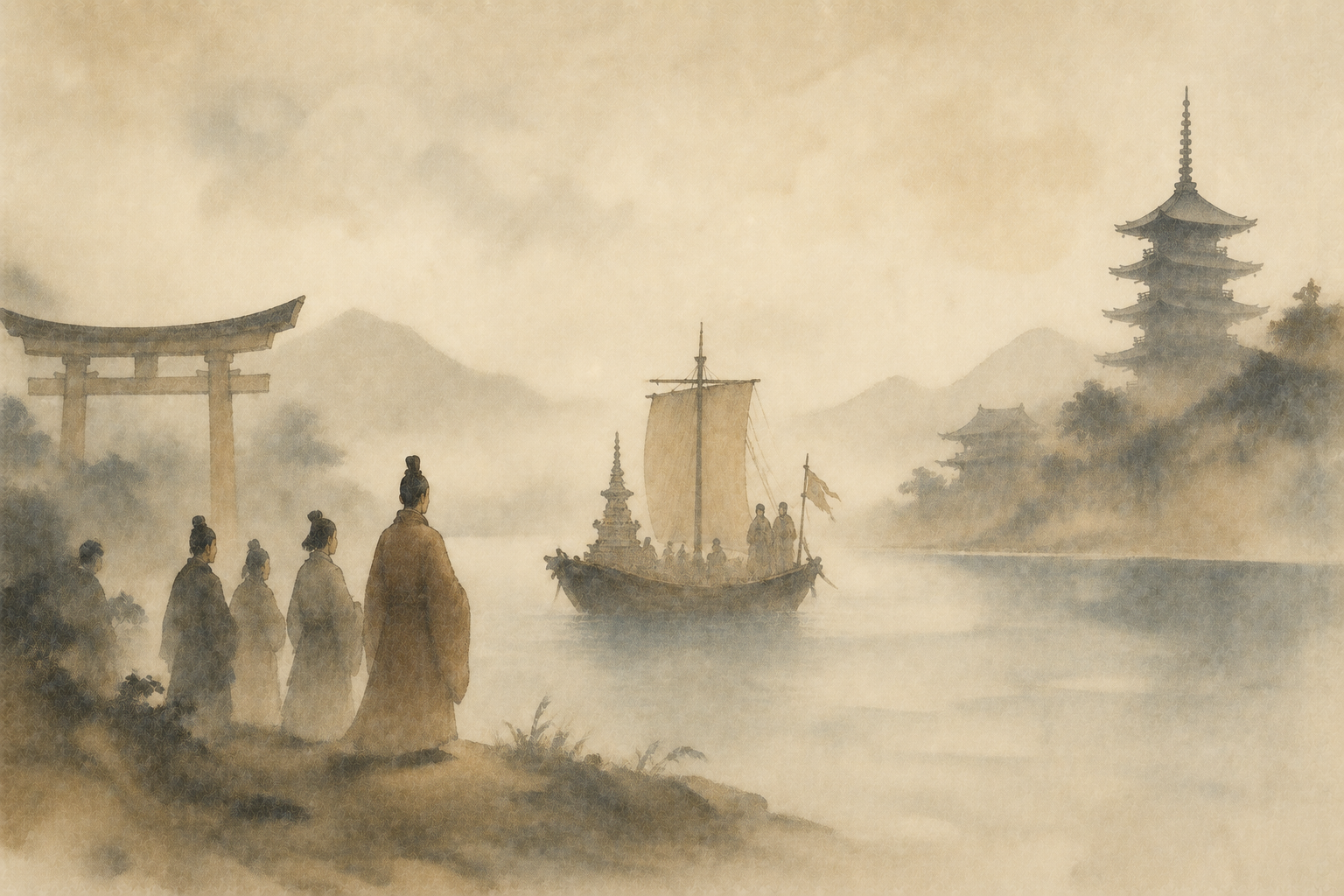
Quick Summary
- Buddhism reached Japan in the mid-6th century, most famously via the Korean kingdom of Baekje.
- It arrived as more than “religion”: it came with books, images, ritual know-how, and diplomatic prestige.
- Early adoption was political and practical, tied to state-building, literacy, and international standing.
- Acceptance was contested; some elites supported it while others resisted it as foreign and disruptive.
- Over time, Buddhism blended with local practices rather than simply replacing them.
- Japan’s first centuries of Buddhism were shaped by court sponsorship, temple networks, and imported specialists.
- The “when” has a standard textbook date, but the “how” is best understood as a gradual, multi-channel process.
Introduction
You keep seeing a neat date for when Buddhism “arrived” in Japan, but the story never feels that neat: different sources give different years, and “arrival” can mean a gift at court, a monk landing at a port, or ordinary people beginning to practice. The cleanest answer is mid-6th century, yet the more honest answer is that Buddhism entered Japan through diplomacy and migration and then took root through institutions, politics, and daily life. At Gassho, we focus on clear historical framing without turning it into a mythic origin story.
So the question “when and how did Buddhism arrive in Japan” is really two questions: when did Japanese elites first encounter it in a documented way, and how did it become something practiced, funded, argued over, and eventually woven into the culture.
A Clear Lens for “Arrival”: Contact, Adoption, and Rooting
It helps to treat “arrival” as a process with three layers: contact (first introductions), adoption (people with power choosing to support it), and rooting (institutions and habits forming over time). This lens keeps you from getting trapped in a single date as if a ship docked and a whole country instantly changed.
Contact is about pathways. In Japan’s case, Buddhism came through East Asian networks that already linked the Korean peninsula, China, and the Japanese archipelago. That means the “how” includes envoys, interpreters, artisans, monks, texts, and images moving along established diplomatic and trade routes.
Adoption is about incentives. Early Japanese rulers and aristocrats were building a more centralized state and looking outward to the continent’s advanced systems of writing, law, and court culture. Buddhism arrived bundled with literacy, ritual technologies, and a sense of international legitimacy—useful tools for a court trying to consolidate authority.
Rooting is about repetition. Temples need land, labor, and ongoing patronage; rituals need trained specialists; teachings need copying and teaching. Once those supports exist, Buddhism stops being a foreign import and becomes part of the country’s lived religious landscape—often alongside older local practices rather than in simple competition with them.
GASSHO
Ask and learn about Buddhism in daily life.
GASSHO is a Buddhist community app where you can learn Buddhist teachings and ask questions to the head priest of Kongosanmaiin Temple on Mount Koya.
How the Story Shows Up in Real Life: Why Dates Feel Confusing
When people ask “when did Buddhism arrive,” they often want a single moment they can picture. But everyday understanding doesn’t work that way: we notice a thing only after it’s already been circulating, and we call it “new” long after it has quietly become familiar.
Think about how ideas spread now. You might first hear a term from a friend, then see it in the news, then notice it in your workplace, and only later feel it has “arrived” in your life. Each step is real, but none of them is the whole story.
Historical records amplify this effect. A court chronicle might record a diplomatic gift because it mattered to politics, while leaving out years of smaller, less “official” contact. So the first written mention can feel like the first appearance, even if it’s more like the first time someone bothered to write it down.
Even the word “Buddhism” can mislead. What arrived was not an abstract philosophy; it was a package of practices: images for worship, rituals for protection and legitimacy, specialists who knew how to perform them, and texts that required literacy and copying. People can adopt parts of a package at different speeds.
Then there’s the human side: reaction. Some people respond to a new influence with curiosity, others with suspicion, and many with a pragmatic “does this help us?” Early Japan shows all three responses, which means “arrival” includes debate, rivalry, and negotiation—not just acceptance.
Finally, blending happens quietly. Once a practice becomes familiar, people stop labeling it as foreign and start treating it as simply part of the landscape. That shift—when something stops feeling imported—is often what we mean emotionally by “arrival,” even if it happens generations after the first contact.
Common Misunderstandings About Buddhism’s Entry into Japan
Misunderstanding 1: “There’s one exact year and everyone agrees.” Many introductions use 552 CE, while some sources point to 538 CE. The disagreement doesn’t mean the story is unknowable; it means “first official introduction” is being dated from different records and interpretations.
Misunderstanding 2: “It arrived directly from India.” Buddhism originated in India, but Japan encountered it through East Asian transmission—especially via the Korean peninsula and through broader continental networks connected to China.
Misunderstanding 3: “It replaced local religion.” Early Japan already had local rites and shrine-centered practices. Buddhism’s spread involved coexistence, adaptation, and mutual influence rather than a clean swap.
Misunderstanding 4: “It was purely spiritual from day one.” Spiritual motives mattered, but early support was also political and institutional. Temples, rituals, and texts were tied to governance, diplomacy, and the prestige of continental civilization.
Misunderstanding 5: “Ordinary people adopted it immediately.” Early Buddhism in Japan was heavily court-centered. Wider diffusion took time, infrastructure, and local relationships—often unfolding over centuries.
Why This History Still Matters Today
Understanding when and how Buddhism arrived in Japan keeps you from treating Japanese Buddhism as a timeless monolith. It highlights that religious life is shaped by travel, translation, and the needs of real communities.
It also clarifies why Japanese Buddhist culture can feel both deeply “Japanese” and unmistakably connected to wider Asia. The tradition grew through exchange: people carried texts, skills, and art across borders, and Japan developed its own expressions through that contact.
On a personal level, this history is a reminder that practice is often transmitted through ordinary channels—friendship, institutions, language, and daily routines. Big changes rarely arrive as a single dramatic moment; they settle in through repeated attention and shared support.
Conclusion
Buddhism arrived in Japan in the mid-6th century, most famously through an official introduction connected to the Korean kingdom of Baekje, but it didn’t “arrive” all at once. It entered through diplomacy and migration, was adopted through court sponsorship and institutional building, and then rooted itself through temples, texts, and lived practice over time. If you remember one thing, let it be this: the date is useful, but the process is the real answer.
Ask a Buddhist priest
Have a question about Buddhism?
In the GASSHO app, you can ask questions about Buddhist teachings, daily concerns, and how to understand Buddhism in everyday life.
Frequently Asked Questions
- FAQ 1: When did Buddhism arrive in Japan?
- FAQ 2: How did Buddhism arrive in Japan in the first place?
- FAQ 3: Which country introduced Buddhism to Japan?
- FAQ 4: Why do some sources say 538 and others say 552?
- FAQ 5: Did Buddhism arrive in Japan directly from India?
- FAQ 6: What exactly was brought to Japan when Buddhism first arrived?
- FAQ 7: Who first supported Buddhism in Japan?
- FAQ 8: Was Buddhism immediately accepted after it arrived in Japan?
- FAQ 9: Where in Japan did Buddhism first take root?
- FAQ 10: How did Buddhism spread beyond the court after arriving in Japan?
- FAQ 11: Did Buddhism’s arrival change Japanese government or society?
- FAQ 12: How did Buddhism interact with existing Japanese beliefs when it arrived?
- FAQ 13: What role did diplomacy play in Buddhism arriving in Japan?
- FAQ 14: Is there archaeological evidence for early Buddhism in Japan?
- FAQ 15: What is the simplest accurate way to answer “when and how did Buddhism arrive in Japan”?
FAQ 1: When did Buddhism arrive in Japan?
Answer: Buddhism is generally said to have arrived in Japan in the mid-6th century, with many textbooks citing 552 CE as the date of an official introduction, while some traditions and scholarship also use 538 CE.
Takeaway: The “when” is mid-6th century, with 552 and 538 as the two most cited dates.
FAQ 2: How did Buddhism arrive in Japan in the first place?
Answer: It arrived through diplomatic and cultural exchange, especially via the Korean peninsula, with envoys bringing Buddhist images, texts, and knowledge of rituals to the Japanese court.
Takeaway: Buddhism entered Japan through international networks, not as an isolated event.
FAQ 3: Which country introduced Buddhism to Japan?
Answer: The most famous account links the introduction to Baekje (a Korean kingdom), which sent gifts and an envoy to the Yamato court; broader transmission also involved connections to China through the peninsula.
Takeaway: Korea—especially Baekje—played a central role in the initial introduction.
FAQ 4: Why do some sources say 538 and others say 552?
Answer: Different historical chronicles and later interpretations record the court-level introduction differently, so the “official arrival” date depends on which record and dating system a source prioritizes.
Takeaway: The date difference reflects record-keeping and interpretation, not a totally different story.
FAQ 5: Did Buddhism arrive in Japan directly from India?
Answer: No. While Buddhism originated in India, Japan encountered it through East Asian transmission routes, especially via Korea and the broader cultural sphere connected to China.
Takeaway: Japan received Buddhism through regional networks, not a direct India-to-Japan jump.
FAQ 6: What exactly was brought to Japan when Buddhism first arrived?
Answer: Early introductions typically included Buddhist images (icons), scriptures or written materials, and specialists or instructions for rituals—practical components that made worship and court ceremonies possible.
Takeaway: Buddhism arrived as a full cultural package: objects, texts, and know-how.
FAQ 7: Who first supported Buddhism in Japan?
Answer: Early support came from segments of the Yamato court and powerful clans who saw value in continental learning and ritual power, while other elites opposed it as an unsettling foreign influence.
Takeaway: From the start, Buddhism’s adoption was tied to elite politics and competing interests.
FAQ 8: Was Buddhism immediately accepted after it arrived in Japan?
Answer: No. The early period included resistance and conflict among factions at court, and broader acceptance took time as temples, patronage, and trained practitioners became established.
Takeaway: “Arrival” did not equal instant acceptance; it unfolded through debate and institution-building.
FAQ 9: Where in Japan did Buddhism first take root?
Answer: It first took root around the political center of the Yamato court (in the Kinai region), where court sponsorship could fund temples and support specialists connected to continental diplomacy.
Takeaway: Early Japanese Buddhism was centered near the court before spreading more widely.
FAQ 10: How did Buddhism spread beyond the court after arriving in Japan?
Answer: It spread through temple networks, patronage by regional elites, the training of clergy, copying of texts, and the gradual integration of Buddhist rituals into community and state life.
Takeaway: Expansion depended on institutions and local support, not just ideas.
FAQ 11: Did Buddhism’s arrival change Japanese government or society?
Answer: Over time, yes. Buddhism contributed to new forms of state ritual, literacy and record culture, temple-based economic power, and international alignment with continental models of governance and prestige.
Takeaway: Buddhism’s influence was social and political as well as religious.
FAQ 12: How did Buddhism interact with existing Japanese beliefs when it arrived?
Answer: Rather than simply replacing local rites, Buddhism often coexisted and blended with them, with people adopting Buddhist rituals and symbols while continuing shrine-centered practices in various forms.
Takeaway: The “how” includes adaptation and blending, not a clean takeover.
FAQ 13: What role did diplomacy play in Buddhism arriving in Japan?
Answer: Diplomacy was central: presenting Buddhist gifts and knowledge strengthened alliances, signaled cultural sophistication, and created channels for ongoing exchange of specialists, texts, and technologies.
Takeaway: Buddhism’s entry was tightly linked to international relations.
FAQ 14: Is there archaeological evidence for early Buddhism in Japan?
Answer: Yes. Early temple sites, Buddhist images, and related artifacts help confirm that Buddhism was being materially supported and practiced, complementing what written chronicles report about its introduction.
Takeaway: Material remains support the picture of a gradual, institution-based arrival.
FAQ 15: What is the simplest accurate way to answer “when and how did Buddhism arrive in Japan”?
Answer: Buddhism arrived in Japan in the mid-6th century, introduced through diplomatic contact—especially via Korea—bringing images, texts, and ritual expertise to the court, and then spreading over time through patronage, temples, and local adoption.
Takeaway: Mid-6th century via Korea and court diplomacy, followed by gradual spread through institutions.