



Wheel of Life in Buddhism: What It Really Explains
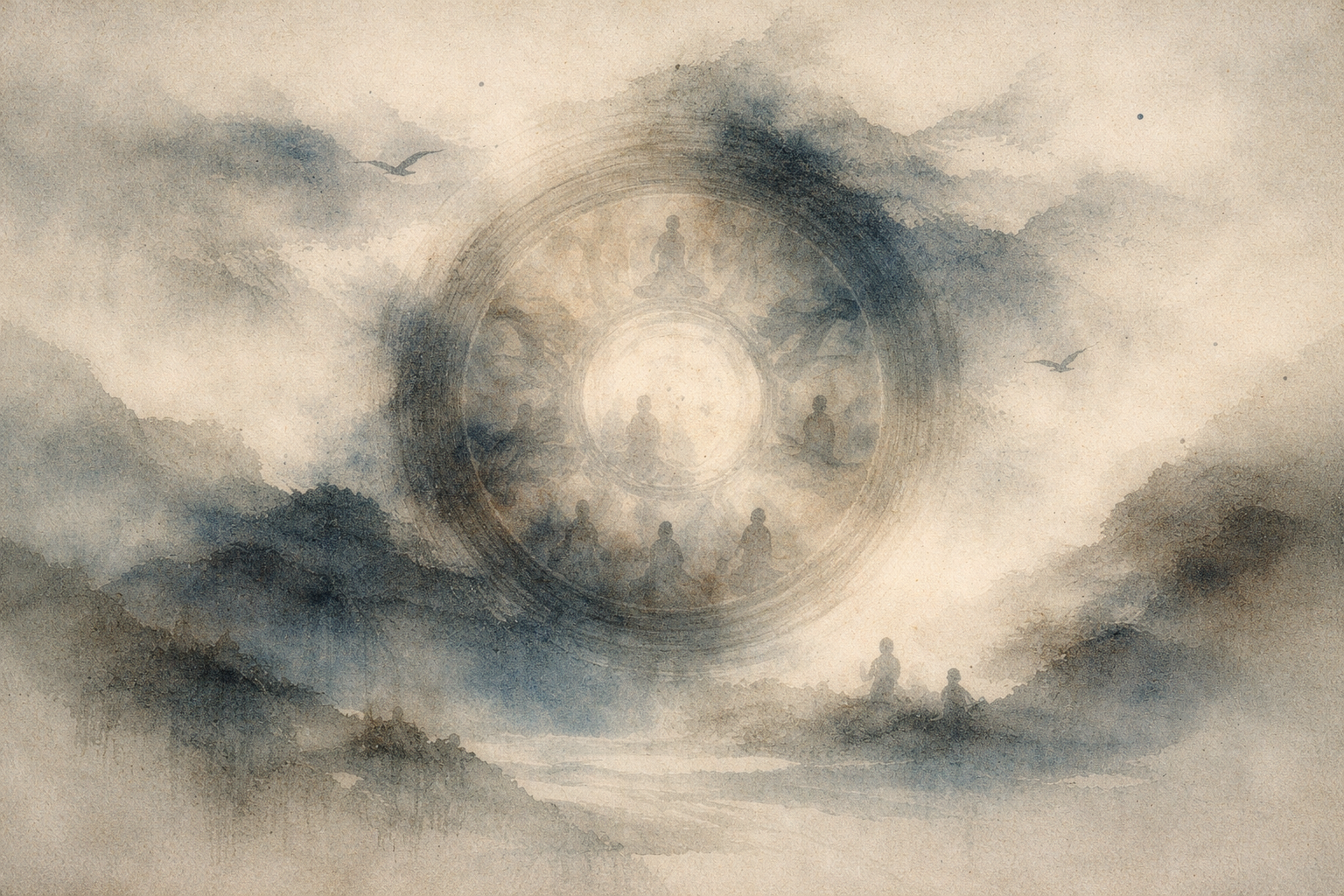
Quick Summary
- The Wheel of Life in Buddhism explains how everyday reactions keep repeating, not a map of “somewhere else.”
- It points to a cycle: wanting, resisting, and drifting into habits that feel automatic.
- The “wheel” is less about punishment and more about momentum—how one moment conditions the next.
- Its imagery is meant to be recognized in ordinary life: work stress, relationship friction, fatigue, and distraction.
- Misreadings often come from treating it as literal cosmology or a moral scoreboard.
- What it really explains is how suffering is manufactured in real time through clinging and aversion.
- It becomes relevant whenever attention returns to what is happening right now, before the next reaction lands.
Introduction
If you’ve searched “wheel of life buddhism explained,” you’re probably stuck between two unsatisfying options: a mystical poster full of monsters and realms, or a dry diagram that doesn’t connect to your actual life. The Wheel of Life is often presented like a belief you’re supposed to accept, when it’s closer to a mirror you’re supposed to recognize—especially in the most ordinary, repetitive parts of your day. This explanation is written in plain language for readers who want clarity without hype or dogma.
The traditional image can look intimidating: a wheel held by a fierce figure, rings of scenes, and many symbolic details. But the emotional point is simple. Life can feel like it keeps “spinning” because the mind keeps reaching for what it wants, pushing away what it dislikes, and falling asleep inside routines that repeat themselves.
When people ask what the Wheel of Life in Buddhism really explains, they’re usually asking something more personal: why the same arguments happen again, why the same anxieties return, why satisfaction fades so quickly, and why the mind can’t just rest. The wheel is a way of seeing those patterns without needing to blame yourself or romanticize them.
The Wheel as a Lens for Repeating Patterns
The Wheel of Life is best understood as a picture of how experience loops when it’s driven by habit. Not “habit” as a moral flaw, but habit as the mind’s default way of managing discomfort: chasing what seems to promise relief, resisting what feels unpleasant, and zoning out when things are unclear. The wheel shows how that momentum can keep turning even when you sincerely want something different.
Seen this way, the wheel isn’t asking you to adopt a new worldview. It’s offering a practical lens: notice how quickly a moment becomes a story, how quickly a story becomes a stance, and how quickly a stance becomes a reaction. At work, this can look like reading one message and immediately tightening—before you even know what you’re defending. In relationships, it can look like hearing a familiar tone and already preparing your counterargument.
The “life” in Wheel of Life doesn’t have to mean a grand, distant timeline. It can mean the life of this afternoon. A small irritation appears, the mind labels it, the body braces, and then the day is quietly organized around that bracing. The wheel is pointing to that ordinary sequence: contact, reaction, repetition.
Even fatigue fits the picture. When you’re tired, the mind tends to simplify: like/dislike, yes/no, mine/theirs. The wheel helps explain why tiredness can make the same old loops feel inevitable. It’s not that you “became a worse person.” It’s that the conditions for repeating patterns got stronger, and the mind followed the familiar track.
How the Wheel Shows Up in Everyday Experience
In daily life, the Wheel of Life can feel like the sense that you’re always arriving a moment too late. You notice you’re stressed only after you’ve already sent the sharp email. You notice you’re defensive only after the conversation has turned cold. The wheel is that “already”—the way reaction often happens before clear seeing catches up.
Consider a normal morning: you check your phone, see something you don’t like, and your attention narrows. The body subtly contracts. The mind starts arranging the day around a problem that may not even be real yet. Nothing dramatic occurred, but the inner weather changed, and the rest of the morning now has a flavor. The wheel is the repeating of that flavor, day after day, through tiny triggers.
At work, it can show up as a constant scanning for approval or threat. A compliment lifts the mood; a neutral comment drops it. The mind tries to stabilize itself by collecting reassurance and avoiding discomfort, but the stability never lasts. The wheel explains why: when attention is organized around grasping and resisting, it keeps needing new fuel.
In relationships, the wheel often looks like predictability. The same topic appears, the same tone appears, the same inner script starts running. You can almost feel the track: the moment where you stop listening and start preparing. Even if you say different words this time, the inner movement can be identical—tightening, blaming, justifying, withdrawing. The wheel is not the argument itself; it’s the inner mechanics that make the argument feel pre-written.
In quieter moments, the wheel can be more subtle. You sit down in silence and immediately reach for stimulation: a thought, a plan, a memory, a snack, another tab. The mind doesn’t necessarily do this because silence is “bad,” but because openness can feel unstructured, and the habitual mind prefers something it can hold. The wheel explains that reflex to fill space, even when nothing is wrong.
Even pleasure can reveal the wheel. Something enjoyable happens—good food, a warm conversation, a small win—and almost instantly the mind leans forward: “How do I keep this?” The leaning is gentle, sometimes invisible, but it changes the experience. Enjoyment becomes management. The wheel points to that shift, where a simple moment becomes a project.
And when things don’t go your way, the wheel can feel like a quick hardening into identity: “This always happens to me,” “I’m the kind of person who…,” “They never…” The mind tries to make the discomfort coherent by turning it into a fixed story. The story can feel protective, but it also keeps the same emotional world returning, because the next moment is interpreted through the same frame.
Misreadings That Keep the Image Distant
A common misunderstanding is treating the Wheel of Life as mainly a chart of literal places you might go after death. That reading can make the whole image feel remote, like it belongs to another culture or another era. Even if someone holds that view, the wheel still functions as a description of how the mind creates “worlds” right now—hellish moods, hungry moods, numb moods—through ordinary reactions.
Another misunderstanding is using the wheel as a moral scoreboard: good people rise, bad people fall. That framing is tempting because it feels clean and controllable, especially when life feels messy. But the wheel is more intimate than that. It’s showing how certain inner movements naturally lead to agitation and repetition, while other moments naturally feel more open and less compelled.
Some people also assume the wheel is pessimistic, as if Buddhism is saying life is nothing but suffering. In experience, it’s more nuanced. The wheel is pointing to how suffering is added—how a neutral moment becomes a problem, how a pleasant moment becomes anxiety about losing it, how a difficult moment becomes a fixed identity. The tone is observational, like noticing how a knot forms in a rope.
Finally, it’s easy to treat the Wheel of Life as a one-time lesson: you “get it,” and then you move on. But the patterns it describes are not rare. They show up when you’re rushed, when you’re tired, when you’re trying to be liked, when you’re trying to be right, when you’re trying to escape a feeling. The wheel stays relevant because the conditions that spin it are ordinary.
Where This Understanding Touches Daily Life
When the Wheel of Life is understood as a description of repeating reactions, it stops being an exotic symbol and starts sounding like your Tuesday. The commute, the inbox, the small disappointments, the small cravings, the background tension in the shoulders—these are the places where the “wheel” is easiest to recognize.
It can also soften how personal everything feels. A sharp mood doesn’t have to mean you’re broken; it can simply mean a familiar loop is running. A conflict doesn’t have to mean the relationship is doomed; it can mean both people are caught in momentum. This doesn’t excuse harm or erase responsibility, but it changes the emotional temperature around what’s happening.
In quieter moments, the wheel can be noticed as the urge to edit experience: to make it more impressive, more secure, more certain. Even small pauses—waiting for water to boil, standing in line, sitting in a parked car—can reveal how quickly the mind tries to leave the moment it’s in. The image becomes less about “Buddhism” and more about attention.
Over time, the wheel’s value is not in memorizing its parts, but in recognizing the feel of repetition as it forms. Noticing that feel is already part of what the image is for, because it brings the focus back to what is actually happening, rather than what the mind insists should be happening.
Conclusion
The Wheel of Life is not far away. It turns wherever grasping and resistance quietly organize the next moment. In the middle of an ordinary day, the wheel can be seen in the instant a reaction appears and the instant it is known. The rest is left to be verified in the texture of your own attention.
Related Pages
- Samsara Meaning: A Practical Explanation
- Karma Explained Without Superstition
- Mindfulness in Daily Life: Seeing the Moment You’re In
- The Four Noble Truths in Simple Language
Frequently Asked Questions
- FAQ 1: What does the Wheel of Life in Buddhism represent?
- FAQ 2: Is the Wheel of Life the same as samsara?
- FAQ 3: Why is the wheel often shown being held by a frightening figure?
- FAQ 4: Do the “realms” on the Wheel of Life have to be taken literally?
- FAQ 5: What is the main lesson of the Wheel of Life for everyday life?
- FAQ 6: How is the Wheel of Life different from a Buddhist “belief”?
- FAQ 7: What do the outer rings of the Wheel of Life generally point to?
- FAQ 8: Is the Wheel of Life meant to make people feel guilty or afraid?
- FAQ 9: Why does the Wheel of Life feel so relevant during stress?
- FAQ 10: Does the Wheel of Life say life is only suffering?
- FAQ 11: How does the Wheel of Life relate to relationships and conflict?
- FAQ 12: Is the Wheel of Life a meditation diagram?
- FAQ 13: What is a simple way to “read” the Wheel of Life image?
- FAQ 14: Why do different versions of the Wheel of Life look different?
- FAQ 15: What does it mean to “step off the wheel” in a non-mystical sense?
FAQ 1: What does the Wheel of Life in Buddhism represent?
Answer: The Wheel of Life represents the repeating momentum of human experience when it is driven by habit—wanting what feels pleasant, resisting what feels unpleasant, and drifting into automatic patterns. It’s less a statement about what you must believe and more a way of noticing how one reaction conditions the next moment.
Takeaway: The wheel points to repetition in the mind, not just a religious picture.
FAQ 2: Is the Wheel of Life the same as samsara?
Answer: They’re closely related. “Samsara” refers to the ongoing cycle of dissatisfaction and repetition, and the Wheel of Life is a visual way of showing how that cycle operates. Many people find the image helpful because it makes an abstract idea feel recognizable in daily reactions.
Takeaway: Samsara is the cycle; the wheel is a picture of how it keeps turning.
FAQ 3: Why is the wheel often shown being held by a frightening figure?
Answer: The frightening figure is commonly used to convey that conditioned life can feel overpowering and hard to control once momentum builds. Psychologically, it can be read as a reminder that habits can “hold” attention tightly, especially under stress, fatigue, or fear.
Takeaway: The image emphasizes the force of habit, not a threat aimed at the viewer.
FAQ 4: Do the “realms” on the Wheel of Life have to be taken literally?
Answer: Not necessarily. Many readers understand the realms as descriptions of lived states of mind—moments of anger, craving, numbness, or ease—rather than distant places. Either way, the practical value is in recognizing how quickly the mind can shift into a “world” that colors everything.
Takeaway: The realms can be read as inner climates you already know.
FAQ 5: What is the main lesson of the Wheel of Life for everyday life?
Answer: The main lesson is that suffering often comes from repeatable inner movements: clinging to what you want, pushing away what you don’t want, and running on autopilot. The wheel highlights how these movements create the sense of being “stuck” in the same emotional loops at work, at home, and even in quiet moments.
Takeaway: It explains why the same patterns return, even when you want them to stop.
FAQ 6: How is the Wheel of Life different from a Buddhist “belief”?
Answer: A belief is something you hold as an idea. The Wheel of Life is more like a lens you test against experience: does grasping tighten the body, does resistance harden the mind, does distraction multiply restlessness? Its usefulness depends on recognition, not agreement.
Takeaway: It’s meant to be noticed, not merely accepted.
FAQ 7: What do the outer rings of the Wheel of Life generally point to?
Answer: In many depictions, the outer rings illustrate sequences of cause-and-effect in experience—how contact leads to reaction, and how reaction leads to further conditions. Even without memorizing details, the overall message is that patterns are built moment by moment through ordinary responses.
Takeaway: The rings emphasize momentum: one moment shaping the next.
FAQ 8: Is the Wheel of Life meant to make people feel guilty or afraid?
Answer: It doesn’t have to function that way. Fear and guilt can arise when the image is treated like a judgment. But it can also be read as compassionate realism: habits repeat because conditions repeat, and seeing that clearly can soften self-blame.
Takeaway: The wheel can be a mirror, not a verdict.
FAQ 9: Why does the Wheel of Life feel so relevant during stress?
Answer: Stress narrows attention and makes the mind rely on familiar strategies—control, avoidance, reassurance-seeking, or distraction. Those strategies can temporarily relieve discomfort while also reinforcing the same loops. The wheel describes that self-reinforcing quality of stressed attention.
Takeaway: Stress strengthens the grooves that keep experience repeating.
FAQ 10: Does the Wheel of Life say life is only suffering?
Answer: No. It points to how suffering is added through clinging and resistance, even in otherwise ordinary or pleasant situations. The image includes pleasure and pain, but it emphasizes how quickly the mind turns both into instability by trying to secure or avoid them.
Takeaway: It’s not denying joy; it’s showing how joy can become grasping.
FAQ 11: How does the Wheel of Life relate to relationships and conflict?
Answer: In relationships, the wheel can be seen in how quickly a familiar trigger produces a familiar script: defensiveness, blame, withdrawal, or the need to be right. The conflict may look new on the surface, but the inner mechanics can be repetitive and predictable.
Takeaway: The wheel shows the pattern underneath the argument.
FAQ 12: Is the Wheel of Life a meditation diagram?
Answer: It can support reflection, but it’s not a technical meditation chart in the way a posture guide might be. Its main function is to help you recognize cycles of reaction and habit in real time—during sitting, during conversation, and during routine tasks.
Takeaway: It’s a recognition tool more than a technique manual.
FAQ 13: What is a simple way to “read” the Wheel of Life image?
Answer: A simple reading is: notice the wheel as “repetition,” notice the scenes as “different moods and situations,” and notice the overall message as “habit has momentum.” You don’t need to decode every symbol for the image to point back to your own cycles of wanting, resisting, and drifting.
Takeaway: Read it as a map of repeating reactions, not a puzzle to solve.
FAQ 14: Why do different versions of the Wheel of Life look different?
Answer: Different artists and communities emphasize different details, so the number of scenes, the style of the realms, and the arrangement can vary. The core intent remains similar: to depict how conditioned patterns keep cycling and how easily attention gets pulled into them.
Takeaway: The artwork varies, but the theme of repetition stays consistent.
FAQ 15: What does it mean to “step off the wheel” in a non-mystical sense?
Answer: In a non-mystical sense, it can mean a moment when the usual compulsion to grasp or resist is not followed—when a reaction is seen without immediately becoming a story and a stance. Even brief pauses in the loop can reveal that the “wheel” is not an external fate, but an internal momentum.
Takeaway: “Off the wheel” can describe a simple moment of not being carried by habit.