



What Was the First Buddhist Council? Why It Still Matters
Quick Summary
- The First Buddhist Council is traditionally described as a gathering held soon after the Buddha’s death to preserve his teachings.
- It is commonly placed at Rājagaha (Rajgir) and associated with senior disciples reciting teachings from memory.
- The council’s core aim was consistency: agreeing on what was taught and how it should be remembered and practiced.
- Accounts emphasize two streams of preservation: discourses (Dhamma) and monastic discipline (Vinaya).
- Modern historians debate the exact details, but the story reflects real early concerns about accuracy and unity.
- Its lasting relevance is less about “minutes from a meeting” and more about how communities safeguard meaning over time.
Introduction
If you’re trying to figure out what the First Buddhist Council actually was, the confusing part is that you’ll find two things at once: a clear traditional story and a lot of modern caution about what can be proven. Both matter, and treating either one as the whole truth usually leads to a shallow understanding. I write for Gassho, a Zen/Buddhism site focused on clear, practice-grounded explanations of Buddhist history and ideas.
The simplest way to hold the question “what was the first buddhist council” is to see it as an early community’s response to a practical problem: when a teacher is gone, how do you keep the teaching from drifting, fragmenting, or being reshaped by strong personalities? The First Council story is a snapshot of that pressure—human, organizational, and deeply relevant.
A grounded way to understand the First Council
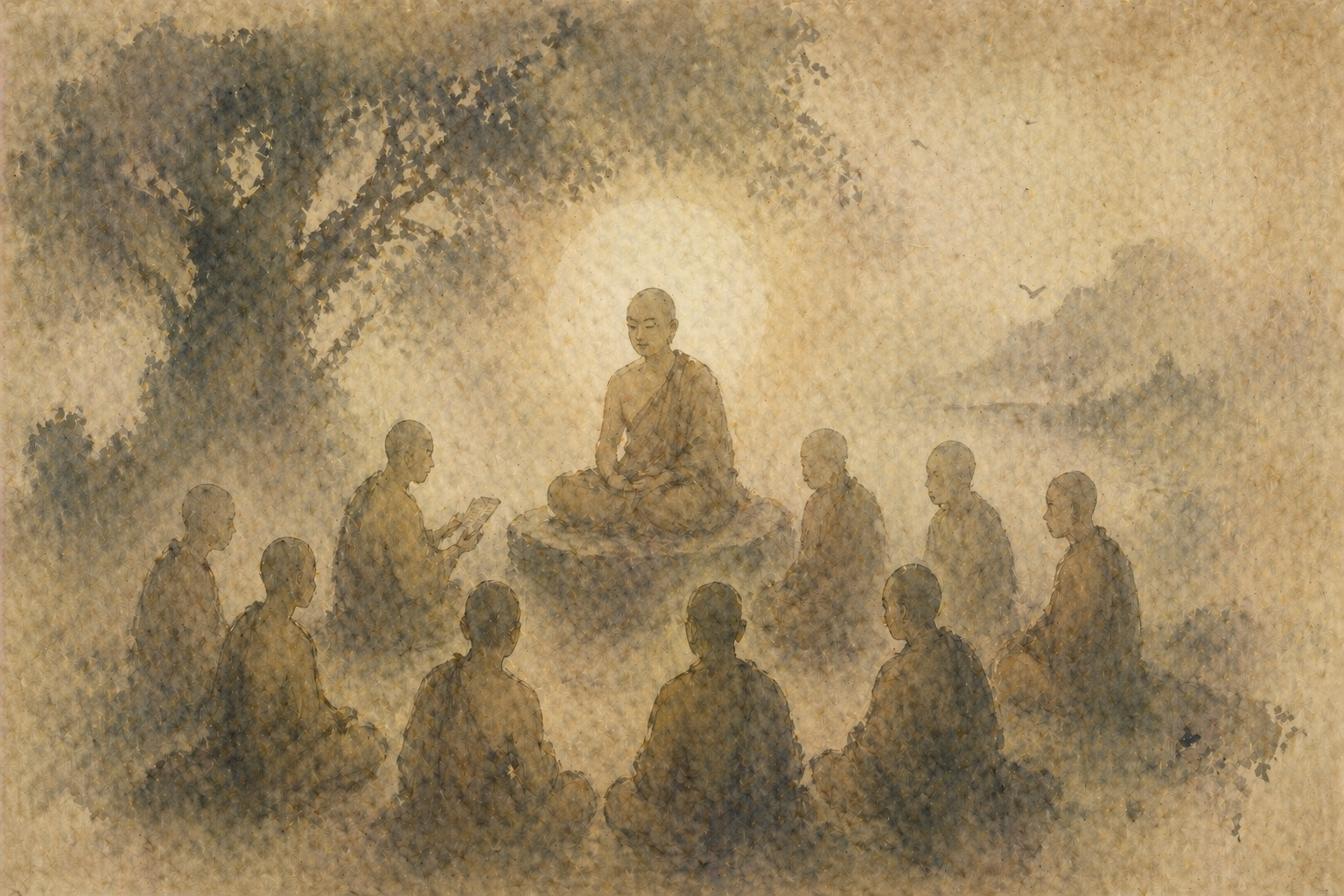
At its heart, the First Buddhist Council is best understood as an act of collective remembering. The tradition describes senior monastics gathering soon after the Buddha’s passing to recite what they had heard and learned, so the community could share a stable reference point rather than relying on scattered, private recollections.
This isn’t just “history trivia.” It’s a lens for how teachings survive: not as abstract ideas floating in space, but as words, practices, and guidelines carried by people with imperfect memory, different temperaments, and different local pressures. A council—formal or informal—functions like a calibration. It asks, “Are we still pointing to the same thing?”
Traditional accounts highlight two main areas that needed careful preservation: the discourses (teachings given in talks and dialogues) and the discipline (the practical rules and procedures that shape monastic life). In other words, the council story is about both meaning and container: what is taught, and how a community lives so that the teaching remains workable.
Even if you set aside questions of exact dates and exact participants, the central perspective remains useful: the First Council represents the moment a living teaching begins to face time. It’s where “I heard the Buddha say…” starts turning into “This is what we, together, agree was taught.”
GASSHO
Ask and learn about Buddhism in daily life.
GASSHO is a Buddhist community app where you can learn Buddhist teachings and ask questions to the head priest of Kongosanmaiin Temple on Mount Koya.
How the First Council shows up in ordinary life
You can see the same dynamic in everyday situations: you hear something important, then later you try to repeat it accurately—and notice how quickly it shifts. A phrase gets simplified. A detail gets dropped. A point you didn’t like gets quietly edited out. That’s not moral failure; it’s how minds work under time and emotion.
When people care about something, they naturally start comparing notes. “Is that what you heard too?” “Are we remembering the same point?” This is the basic human version of a council: not a grand event, but a shared attempt to keep the signal clear.
There’s also the pressure of authority. In groups, confident voices can dominate, and quieter voices can disappear. The First Council story—whatever its historical precision—points to a counterbalance: the idea that teachings should be checked against a shared standard, not just asserted by the most persuasive person in the room.
Another everyday parallel is how rules function. Without agreed guidelines, even well-meaning communities drift into inconsistency: one person says something is fine, another says it isn’t, and soon the group is spending more energy on friction than on purpose. The emphasis on discipline in First Council accounts reflects a simple insight: clarity about conduct reduces confusion and frees attention for practice.
You can also notice how memory and meaning interact. Sometimes you remember the words but miss the intent; other times you remember the intent but paraphrase the words. A community trying to preserve a teaching has to work with both: keeping language stable enough to transmit, while keeping the point alive enough to apply.
Finally, the First Council theme shows up when you ask yourself, quietly, “Am I still practicing what I think I’m practicing?” Over time, we all drift toward convenience. We keep the label and lose the substance. The council story is a reminder to return to sources—teachings, ethical commitments, and honest reflection—before drift becomes identity.
Common misunderstandings that blur the picture
Mistaking the First Council for a modern academic conference. Traditional descriptions involve recitation and communal agreement, not paper presentations and published proceedings. Thinking in modern terms can make the event seem either more bureaucratic or more “official” than it likely was.
Assuming the story is either perfectly factual or completely invented. Early Buddhist history often sits between these extremes. The First Council narrative can preserve a real memory of early standardization efforts while also reflecting later community needs and ideals.
Reducing it to “they wrote down the scriptures.” The earliest layers of Buddhist transmission were primarily oral for a long time. The First Council is usually described as organizing and reciting teachings, not producing a written canon on the spot.
Thinking it was only about doctrine. The Vinaya (discipline) is central in the traditional account. That emphasis suggests the community cared as much about how people lived together as about how they explained ideas.
Believing it settled every disagreement forever. Even within traditional histories, later councils and later debates appear. The First Council is better seen as an early attempt at coherence, not a final lock on interpretation.
Why the First Buddhist Council still matters today
The First Buddhist Council matters because it highlights a tension that never goes away: teachings need continuity, but life keeps changing. Without continuity, a tradition dissolves into personal preference. Without adaptability, it becomes brittle and performative. The council story is an early example of trying to protect continuity without freezing the living point of practice.
It also matters because it models a communal approach to truth. Instead of “my experience is the whole teaching,” the council theme leans toward “let’s check together.” That doesn’t guarantee perfection, but it reduces the risk of private distortion becoming public norm.
For modern readers, the First Council is a reminder to be careful with certainty. When you read a Buddhist text or hear a teaching, you’re receiving something that passed through many minds and many generations. Respecting that transmission doesn’t require blind belief; it invites careful listening, comparison, and humility.
Finally, it matters because it points to the practical side of Dharma: the teaching is not only what is said, but what is lived. The First Council’s focus on discipline is a quiet message that community health, ethical clarity, and day-to-day conduct are not “extras”—they are part of how wisdom is preserved.
Conclusion
So, what was the first buddhist council? In traditional terms, it was a gathering soon after the Buddha’s death—often located at Rājagaha—where senior disciples recited and agreed upon the teachings and monastic discipline to preserve them for the future. In practical terms, it represents the moment a community realizes that memory drifts and that care is required to keep a teaching intact.
If you hold the First Council as a living question rather than a museum fact, it becomes immediately relevant: What are you relying on as your reference point? How do you verify what you think you know? And what supports—ethical, communal, and reflective—help keep your understanding from quietly sliding off course?
Ask a Buddhist priest
Have a question about Buddhism?
In the GASSHO app, you can ask questions about Buddhist teachings, daily concerns, and how to understand Buddhism in everyday life.
Frequently Asked Questions
- FAQ 1: What was the First Buddhist Council?
- FAQ 2: When did the First Buddhist Council take place?
- FAQ 3: Where was the First Buddhist Council held?
- FAQ 4: Who organized the First Buddhist Council?
- FAQ 5: Who recited the teachings at the First Buddhist Council?
- FAQ 6: What was decided at the First Buddhist Council?
- FAQ 7: Did the First Buddhist Council create the Buddhist canon?
- FAQ 8: Was the First Buddhist Council written down at the time?
- FAQ 9: Why was the First Buddhist Council needed?
- FAQ 10: How many monks attended the First Buddhist Council?
- FAQ 11: Is the First Buddhist Council considered historically certain?
- FAQ 12: What texts are associated with the First Buddhist Council?
- FAQ 13: Did the First Buddhist Council settle disagreements in Buddhism?
- FAQ 14: What is the main takeaway of the First Buddhist Council for modern readers?
- FAQ 15: How is the First Buddhist Council different from later Buddhist councils?
FAQ 1: What was the First Buddhist Council?
Answer: The First Buddhist Council is traditionally described as a meeting of senior monastics held soon after the Buddha’s death to preserve his teachings by reciting and agreeing on the discourses (Dhamma) and the monastic discipline (Vinaya).
Takeaway: It’s remembered as an early effort to keep the Buddha’s teaching consistent after his passing.
FAQ 2: When did the First Buddhist Council take place?
Answer: Traditional sources place it shortly after the Buddha’s parinirvana (death), often described as within the first year, though modern historical dating is uncertain.
Takeaway: Tradition says “soon after,” while exact chronology is debated.
FAQ 3: Where was the First Buddhist Council held?
Answer: The traditional location is Rājagaha (often identified with modern Rajgir in India), associated with a cave or meeting place used for recitation and communal agreement.
Takeaway: The First Council is most commonly linked with Rājagaha/Rajgir.
FAQ 4: Who organized the First Buddhist Council?
Answer: Traditional accounts credit Mahākassapa (Mahā Kassapa), a senior disciple, with convening or leading the gathering to ensure the teachings were preserved accurately.
Takeaway: The council is commonly associated with leadership by a respected elder.
FAQ 5: Who recited the teachings at the First Buddhist Council?
Answer: In traditional narratives, Ānanda is associated with reciting the discourses (because he was known for hearing many talks), and Upāli is associated with reciting the Vinaya (discipline).
Takeaway: The story emphasizes specialized reciters for discourses and discipline.
FAQ 6: What was decided at the First Buddhist Council?
Answer: The council is said to have established an agreed recitation of the Buddha’s teachings and the monastic rules, creating a shared reference for the community’s memory and practice.
Takeaway: Its “decision” was a communal standard for what would be preserved and repeated.
FAQ 7: Did the First Buddhist Council create the Buddhist canon?
Answer: It is traditionally linked to the early formation of what later became canonical collections, but it was primarily an oral recitation and agreement process rather than the production of a finalized written canon.
Takeaway: Think “oral standardization,” not “instant printed scripture.”
FAQ 8: Was the First Buddhist Council written down at the time?
Answer: Traditional accounts emphasize oral transmission; widespread writing of Buddhist texts is generally understood to have occurred later, so the First Council is not usually portrayed as a writing project.
Takeaway: The First Council is mainly about recitation and memorization.
FAQ 9: Why was the First Buddhist Council needed?
Answer: The story presents a practical need: after the Buddha’s death, the community feared confusion, drift, or conflicting versions of teachings, so elders gathered to preserve a consistent body of instruction and discipline.
Takeaway: It addresses the problem of preserving accuracy when a founder is gone.
FAQ 10: How many monks attended the First Buddhist Council?
Answer: Traditional sources often mention 500 arahants (fully realized monks) as participants, though this number is generally treated as part of the traditional narrative rather than a verifiable headcount.
Takeaway: “500” is a famous traditional figure, not a confirmed statistic.
FAQ 11: Is the First Buddhist Council considered historically certain?
Answer: Many historians treat the detailed traditional account with caution because early records were transmitted orally and written down later; however, the narrative likely reflects real early efforts to organize and preserve teachings.
Takeaway: The event’s exact details are debated, but the preservation impulse is historically plausible.
FAQ 12: What texts are associated with the First Buddhist Council?
Answer: Tradition associates it with the recitation of the Vinaya (monastic discipline) and the Sutta/Sūtra teachings (discourses), forming a foundation for later collections in multiple Buddhist traditions.
Takeaway: The council is linked to organizing discipline and discourses as core categories.
FAQ 13: Did the First Buddhist Council settle disagreements in Buddhism?
Answer: The traditional story emphasizes unity and preservation, but later Buddhist history includes further councils and debates, suggesting that the First Council did not permanently eliminate differences of interpretation or practice.
Takeaway: It aimed for coherence, not a once-and-for-all end to disagreement.
FAQ 14: What is the main takeaway of the First Buddhist Council for modern readers?
Answer: Its main lesson is that preserving a teaching requires communal care: checking accuracy, maintaining ethical and practical guidelines, and resisting the tendency for memory and preference to reshape what was received.
Takeaway: The First Council highlights how communities protect meaning over time.
FAQ 15: How is the First Buddhist Council different from later Buddhist councils?
Answer: The First Council is traditionally framed as an immediate post-Buddha preservation effort focused on recitation and agreement, while later councils are often described as responding to emerging disputes, regional developments, or questions of discipline and doctrine over time.
Takeaway: The First Council is remembered as the initial “preserve and standardize” gathering, with later councils addressing later complexities.