



What Questions Did the Buddha Refuse to Answer?
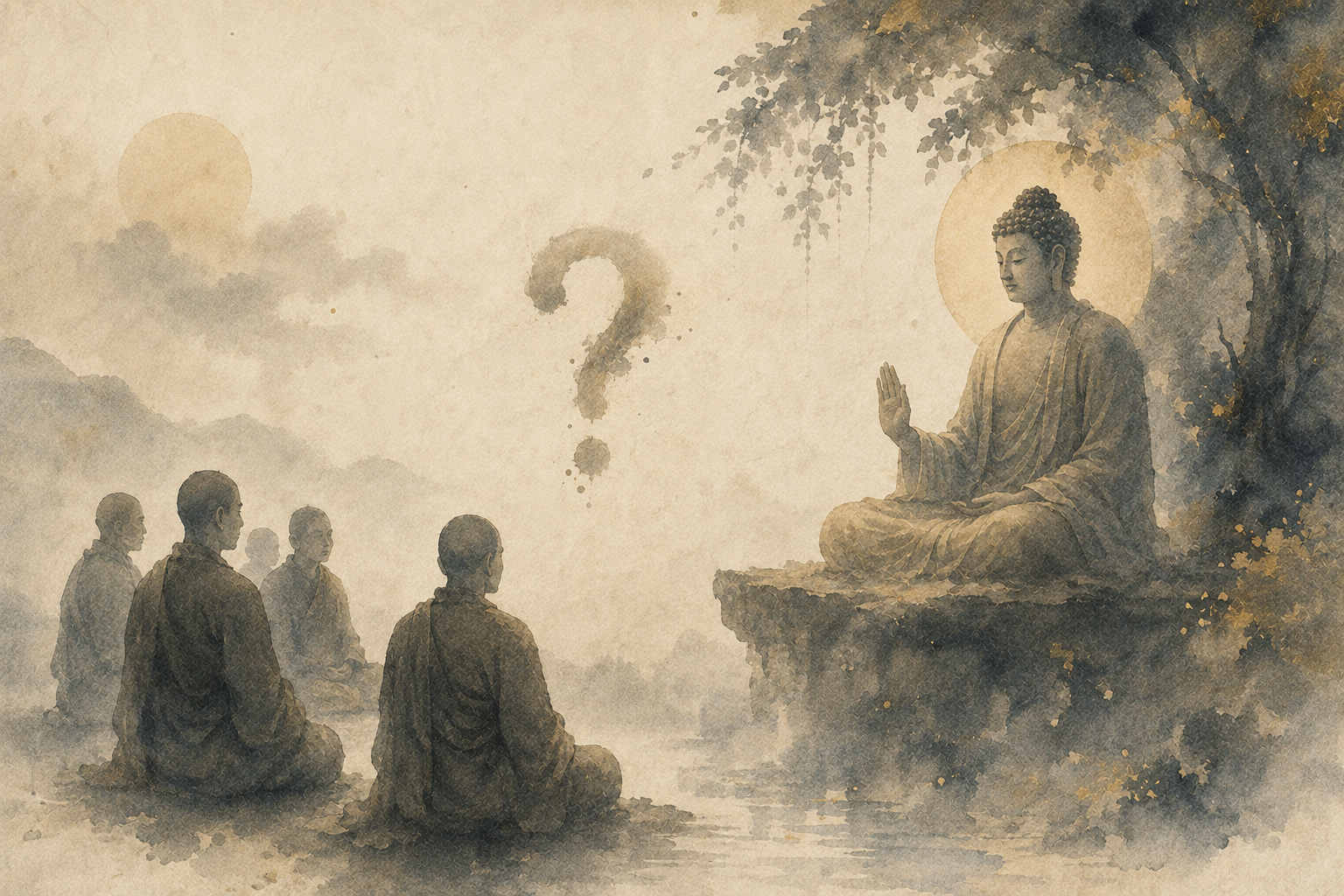
Quick Summary
- The Buddha refused to answer certain speculative questions because they didn’t reduce suffering in lived experience.
- These “unanswered questions” often revolve around the cosmos, the soul/self, and what happens after death.
- Silence wasn’t evasion; it was a practical teaching strategy aimed at clarity and freedom.
- Fixating on unanswerables can intensify anxiety, identity-clinging, and argument rather than insight.
- The alternative offered is direct investigation: stress, its causes, its ending, and the path of practice.
- You can use the Buddha’s refusal as a filter: “Does this question help me relate more wisely to experience?”
- The point is not to ban big questions, but to notice when they become a detour from what’s workable now.
Introduction
You’re trying to understand why a teacher known for insight would sometimes refuse to answer questions—especially the ones that feel most important, like what the universe is, what “you” really are, and what happens after death. The uncomfortable truth is that some questions can be intellectually thrilling while quietly reinforcing the very confusion and tension you’re trying to resolve, and the Buddha treated that as a practical problem, not a philosophical game. At Gassho, we focus on early Buddhist themes with a down-to-earth, practice-oriented lens.
When people ask, “What Questions Did the Buddha Refuse to Answer?” they’re often looking for a list. A list exists, but the deeper value is learning the pattern: what kinds of questions tend to trap the mind in speculation, and what kinds of questions open the mind into direct seeing.
This matters because many modern seekers repeat the same loop: they read a little, form a metaphysical theory, defend it, doubt it, and then feel stuck. The Buddha’s refusals point to a different way of relating to uncertainty—one that doesn’t require shutting down curiosity, but does require prioritizing what actually changes how you suffer.
A Practical Lens for the Buddha’s Silence
The core perspective is simple: the Buddha measured questions by their effect on suffering. If a question led to more grasping, more agitation, or more entanglement in views, it wasn’t treated as “deep”—it was treated as unhelpful in the moment. This is less about having the “right” metaphysical map and more about learning to see how the mind creates pressure through the way it frames reality.
Many of the refused questions share a feature: they demand a final, fixed answer about things that are experienced as changing, conditioned, and interpreted through concepts. When the mind insists on certainty in areas where experience doesn’t provide it, it tends to manufacture positions—then defend them as identity. The Buddha’s silence interrupts that reflex.
Another part of the lens is timing. Some questions are not “wrong” in an absolute sense; they’re unskillful because they pull attention away from what can be known directly right now. The Buddha repeatedly redirected attention toward what is immediate and testable: stress, craving, clinging, and the possibility of release.
So the refusal is not anti-intellectual. It’s a kind of compassionate discipline: don’t feed the mind’s habit of turning uncertainty into a battleground. Instead, use questions that illuminate experience and soften the grip of reactivity.
GASSHO
Ask and learn about Buddhism in daily life.
GASSHO is a Buddhist community app where you can learn Buddhist teachings and ask questions to the head priest of Kongosanmaiin Temple on Mount Koya.
How the Unanswered Questions Show Up in Everyday Mind
It often starts innocently: you notice fear, grief, or restlessness, and the mind tries to solve it by building a worldview. If you could just know what you “really are,” or what the universe “really is,” maybe the unease would stop. The question feels like a doorway, but it can become a treadmill.
Then attention narrows. Instead of feeling the body’s tension or noticing the story-like quality of thought, you chase an answer in the abstract. The mind rehearses arguments, imagines debates, or searches for the perfect explanation. For a moment it feels productive—until you notice you’re more keyed up than before.
In ordinary life, this can look like lying awake at night trying to decide whether the self is “real” or “not real,” or whether death is “the end” or “a transition.” The mind flips between options, each one briefly soothing, each one eventually unstable. The emotional charge doesn’t resolve because the question is being used to avoid directly meeting uncertainty.
Another common pattern is identity-building. You adopt a view—“I believe the cosmos is eternal,” or “I believe consciousness survives”—and it becomes part of who you are. When someone challenges it, you feel personally challenged. The original aim (peace) gets replaced by the need to be right.
Even without debate, the mind can harden around a position internally. You notice a subtle contraction: a sense of bracing, as if life must conform to your conclusion. When experience doesn’t match, frustration appears. The view demands maintenance.
The Buddha’s refusal points to a different move: return to what is actually happening. What does fear feel like in the body? What thought is being believed? What is being clung to as “me” or “mine” right now? These questions don’t promise a cosmic answer, but they often reduce the heat immediately.
Over time, you may notice something quietly liberating: not knowing can be workable. When the mind stops forcing a final theory, attention becomes available for a more intimate kind of understanding—how suffering is constructed moment by moment, and how it can loosen.
The Classic “Unanswered Questions” and What They Have in Common
When people refer to the Buddha’s refused questions, they often mean a set traditionally called the “unanswered” or “undeclared” points. Different texts present them with slightly different wording, but the themes are consistent. They tend to cluster around three areas: the nature of the world, the nature of the self, and the fate of a liberated person after death.
One well-known group is the “ten undeclared questions,” which include whether the world is eternal or not eternal, finite or infinite, whether the soul is the same as the body or different, and what happens to a realized person after death (exists, does not exist, both, neither). The Buddha does not endorse any of these options as the right metaphysical endpoint.
What do these have in common? They invite the mind to treat reality as a set of fixed propositions to affirm or deny. But the Buddha’s teaching emphasis is on conditionality: experiences arise due to causes and conditions, and clinging to views is itself a condition for distress. A final metaphysical answer can become another object of attachment.
Importantly, the refusal is paired with redirection. Instead of answering “Is the world eternal?” the teaching returns to what is directly relevant: how craving and clinging operate, how stress is felt, and how release is cultivated. The unanswered questions are not “forbidden”; they’re deprioritized in favor of what is immediately liberating.
Common Misreadings of the Buddha’s Refusal
One misunderstanding is that the Buddha refused because he didn’t know. In the traditional framing, the issue is not lack of knowledge but lack of usefulness: answering would not lead to dispassion, peace, or freedom from suffering. The refusal functions like a doctor declining to debate irrelevant theories while a patient needs treatment.
Another misunderstanding is that the Buddha was promoting blind faith or anti-reason. The pattern is the opposite: he emphasizes what can be tested in experience. The problem is not thinking; it’s thinking that inflames clinging and distracts from direct observation.
A third misunderstanding is that the unanswered questions don’t matter at all. They matter in the sense that people get stuck on them, and that stuckness has consequences—anxiety, rigidity, and endless argument. The Buddha’s approach is to notice the cost of certain questions and to choose questions that reduce that cost.
Finally, some people assume the refusal means “nothing exists” or “everything is meaningless.” That’s a leap. The refusal is not a hidden nihilism; it’s a refusal to turn ultimate claims into a substitute for the work of understanding suffering and its causes.
Why This Approach Helps in Daily Life
In daily life, the unanswered questions show up as mental spirals: replaying unresolvable problems, trying to secure certainty, and feeling threatened when certainty won’t come. The Buddha’s refusal offers a practical boundary: if a question repeatedly increases agitation, it may not be the right tool for the moment.
This doesn’t mean you stop caring about meaning. It means you shift from “What is the ultimate truth of the cosmos?” to “What is happening in me when I demand an ultimate answer?” That shift can transform a late-night existential panic into a workable moment of noticing, breathing, and softening.
It also improves relationships. When you’re less invested in defending a metaphysical position, you can listen more openly. Conversations become less about winning and more about understanding what someone is actually experiencing—fear, grief, hope, confusion.
And it supports ethical clarity. When attention is grounded in cause and effect—how actions shape the mind, how speech affects others—you’re more likely to choose what reduces harm. The Buddha’s redirection keeps the focus on what you can do, not what you can speculate.
Conclusion
So, what questions did the Buddha refuse to answer? The ones that invite the mind to cling to a final metaphysical position—especially about the cosmos, the self, and the post-death status of a liberated person—when that clinging doesn’t relieve suffering. The refusal is not a shutdown of inquiry; it’s a steering wheel.
If you’re caught in these questions, try treating them as signals rather than puzzles. Notice what the question is doing to your body and mind. Then experiment with a different line of inquiry: what is stressful right now, what is fueling it, and what happens when you stop feeding it for even a moment.
Ask a Buddhist priest
Have a question about Buddhism?
In the GASSHO app, you can ask questions about Buddhist teachings, daily concerns, and how to understand Buddhism in everyday life.
Frequently Asked Questions
- FAQ 1: What are the main questions the Buddha refused to answer?
- FAQ 2: Why did the Buddha refuse to answer certain questions?
- FAQ 3: Did the Buddha refuse to answer because he didn’t know?
- FAQ 4: What are the “ten undeclared questions” associated with the Buddha’s silence?
- FAQ 5: Did the Buddha refuse to answer questions about the afterlife?
- FAQ 6: Did the Buddha refuse to answer whether the universe is eternal or infinite?
- FAQ 7: Did the Buddha refuse to answer whether the self is the same as the body?
- FAQ 8: What does it mean when texts say the Buddha “remained silent”?
- FAQ 9: Are the Buddha’s refused questions considered “wrong questions”?
- FAQ 10: How did the Buddha redirect people when he refused to answer?
- FAQ 11: Does the Buddha’s refusal mean Buddhism avoids philosophy?
- FAQ 12: What is the “poisoned arrow” analogy and how does it relate to the refused questions?
- FAQ 13: Did the Buddha refuse to answer whether a liberated person exists after death?
- FAQ 14: How can I tell if I’m stuck in the kind of question the Buddha refused to answer?
- FAQ 15: If the Buddha refused to answer these questions, what should I focus on instead?
FAQ 1: What are the main questions the Buddha refused to answer?
Answer: They are commonly summarized as speculative questions about whether the world is eternal or not, finite or infinite, whether the self/soul is the same as the body or different, and what happens to a liberated person after death (exists, doesn’t exist, both, or neither). He declined to declare any of these as final truths because they didn’t lead to the ending of suffering.
Takeaway: The refused questions cluster around cosmology, self-theory, and post-death speculation.
FAQ 2: Why did the Buddha refuse to answer certain questions?
Answer: Because he evaluated questions by whether they reduce suffering and confusion in direct experience. If answering would encourage clinging to views, endless debate, or distraction from practice, he chose silence or redirection instead.
Takeaway: The refusal is a practical teaching method, not a dodge.
FAQ 3: Did the Buddha refuse to answer because he didn’t know?
Answer: In the traditional presentation, no—the issue is not ignorance but usefulness. The Buddha’s point is that some answers don’t help with liberation and can even intensify attachment to opinions.
Takeaway: “Unanswered” often means “not conducive to freedom,” not “unknown.”
FAQ 4: What are the “ten undeclared questions” associated with the Buddha’s silence?
Answer: They are typically listed as: (1) the world is eternal, (2) not eternal, (3) finite, (4) infinite, (5) the soul/self is the same as the body, (6) different from the body, and after death a liberated person (7) exists, (8) does not exist, (9) both exists and does not exist, or (10) neither exists nor does not exist. The Buddha refused to endorse any of these positions as the final answer.
Takeaway: The classic list shows a pattern of forced either/or metaphysics.
FAQ 5: Did the Buddha refuse to answer questions about the afterlife?
Answer: He refused certain speculative framings about what happens after death—especially when posed as fixed propositions about existence or non-existence of a liberated person. The refusal targets the way the question is framed and clung to, not a blanket ban on discussing death.
Takeaway: It’s the clinging to a definitive metaphysical conclusion that’s being challenged.
FAQ 6: Did the Buddha refuse to answer whether the universe is eternal or infinite?
Answer: Yes, those are central examples. He declined to declare whether the world is eternal or not, and whether it is finite or infinite, because such conclusions were not presented as necessary for ending suffering.
Takeaway: Cosmological certainty is treated as optional—and often distracting.
FAQ 7: Did the Buddha refuse to answer whether the self is the same as the body?
Answer: Yes. He refused to settle the question “Is the self identical with the body or different from it?” because it tends to lock the mind into rigid self-theories rather than loosening identification and clinging.
Takeaway: The refusal protects practice from turning into an identity debate.
FAQ 8: What does it mean when texts say the Buddha “remained silent”?
Answer: It means he intentionally did not give a yes/no (or any) metaphysical verdict and often redirected attention to what is directly knowable: suffering, its causes, its cessation, and the path. Silence is part of the instruction.
Takeaway: Silence can be a teaching that points you back to experience.
FAQ 9: Are the Buddha’s refused questions considered “wrong questions”?
Answer: They’re “wrong” in the sense of being unhelpful for the stated aim: liberation from suffering. They can be fascinating intellectually, but the Buddha treated fascination that fuels clinging as a dead end.
Takeaway: A question can be interesting and still be unskillful.
FAQ 10: How did the Buddha redirect people when he refused to answer?
Answer: He typically redirected toward immediate, practical inquiry: noticing stress, seeing how craving and clinging arise, and cultivating the conditions for release. The emphasis is on what can be verified in lived experience rather than settled by speculation.
Takeaway: The alternative to speculation is direct investigation of suffering and its causes.
FAQ 11: Does the Buddha’s refusal mean Buddhism avoids philosophy?
Answer: Not necessarily. It means philosophical questions are evaluated by their impact on suffering and freedom. If a line of thought strengthens attachment to views, it’s set aside; if it clarifies experience and reduces clinging, it can be useful.
Takeaway: The standard is pragmatic: does it help liberation?
FAQ 12: What is the “poisoned arrow” analogy and how does it relate to the refused questions?
Answer: It’s a teaching story where a wounded person refuses treatment until they get answers to irrelevant details; the delay causes harm. Likewise, the Buddha suggests that insisting on speculative answers before practicing is like refusing medicine until the universe is explained.
Takeaway: Don’t postpone relief by demanding irrelevant certainty.
FAQ 13: Did the Buddha refuse to answer whether a liberated person exists after death?
Answer: Yes—he refused all four proposed options (exists, doesn’t exist, both, neither) because each option tends to force liberation into conceptual categories that invite grasping and confusion. The refusal prevents turning awakening into a metaphysical object.
Takeaway: The post-death status question is treated as a conceptual trap.
FAQ 14: How can I tell if I’m stuck in the kind of question the Buddha refused to answer?
Answer: A clue is repetition without resolution: the question loops, increases agitation, and turns into identity-defense or debate, while your relationship to stress doesn’t improve. Another clue is that the question demands a final verdict rather than inviting careful observation of present experience.
Takeaway: If a question reliably fuels clinging, it may be an “unanswerable” for you right now.
FAQ 15: If the Buddha refused to answer these questions, what should I focus on instead?
Answer: Focus on what is immediate and workable: how stress is felt, what triggers reactivity, how craving and clinging operate, and what happens when you release them even slightly. This keeps inquiry grounded in experience rather than in speculative conclusions.
Takeaway: Replace metaphysical certainty-seeking with direct, liberating investigation.