



What Is the Anguttara Nikaya? Numbered Teachings of the Buddha Explained
Quick Summary
- The Anguttara Nikaya is a major collection of early Buddhist discourses organized by numbers (ones, twos, threes, and so on).
- Its “numbered” structure is practical: it helps you remember teachings and apply them in daily situations.
- Many suttas are short, direct, and focused on habits of mind, ethics, and training attention.
- The numbers are not trivia; they point to complete sets (like “three kinds of…” or “five ways to…”).
- Reading it well means looking for the pattern: what is being trained, what is being abandoned, and what changes in experience.
- You don’t need to “believe” anything to benefit; you can treat each list as a testable lens on cause and effect in the mind.
- A good starting approach is to read one short sutta, pick one numbered set, and try it for a week.
Introduction: Why the Anguttara Nikaya Confuses Smart Readers
If you’ve opened the Anguttara Nikaya and felt oddly lost, you’re not alone: the teachings can look like a pile of lists, repetitions, and “three this, five that,” and it’s not obvious how any of it connects to your actual mind on an ordinary day. The trick is to stop reading it like a linear book and start reading it like a toolbox designed for memory, reflection, and practice, and that’s exactly how we approach it at Gassho.
The Anguttara Nikaya (often shortened to AN) is one of the main collections in the Pali Canon, preserving many early discourses attributed to the Buddha and his close disciples.
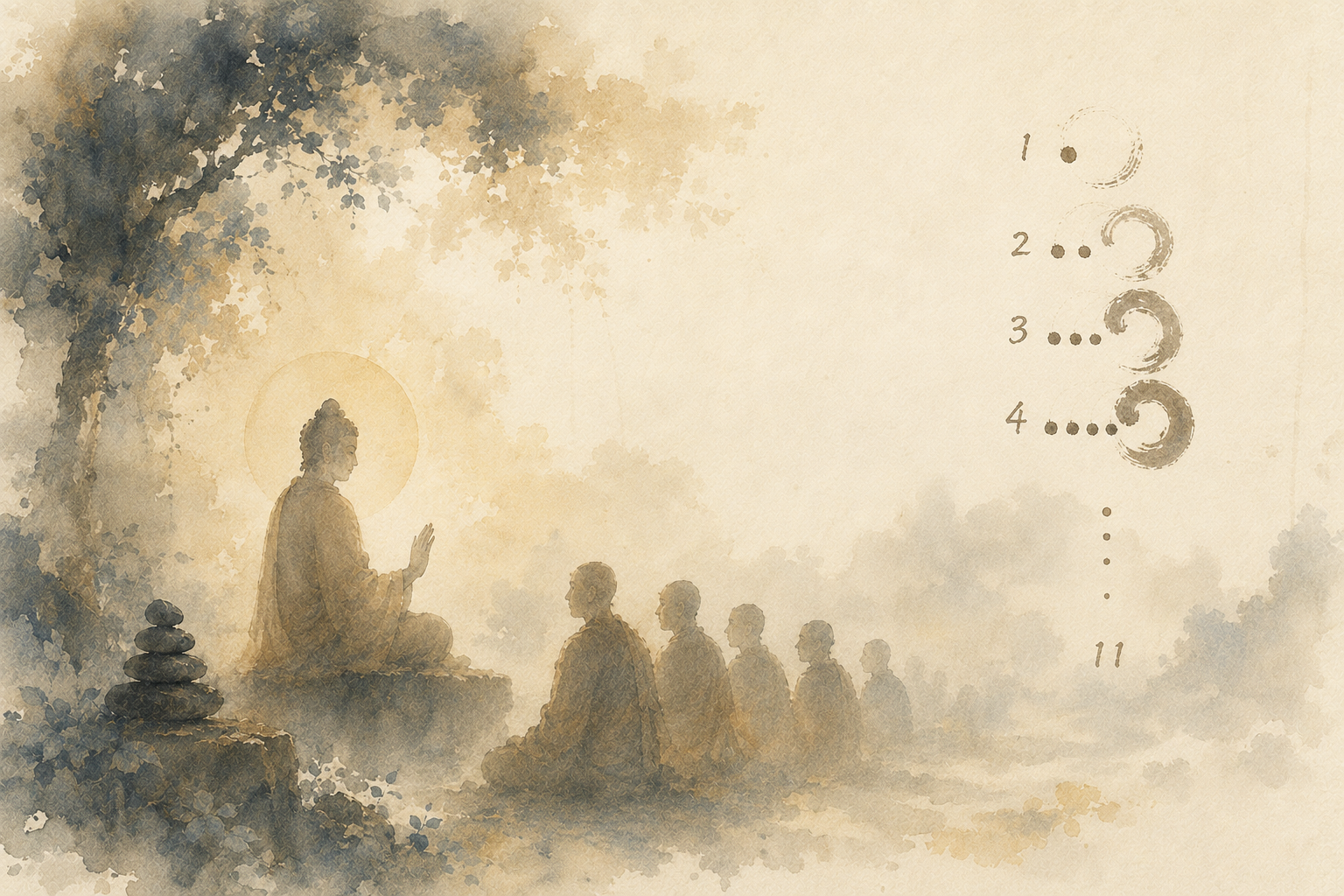
Its organizing principle is simple: teachings are grouped by the number of items they contain—ones, twos, threes, all the way up through elevens in the standard arrangement.
That structure can feel mechanical at first, but it’s also what makes the Anguttara Nikaya unusually usable: it turns big themes—ethics, attention, intention, speech, relationships—into compact sets you can actually remember when life gets messy.
The Core Lens: Numbered Teachings as a Map of Cause and Effect
The central perspective of the Anguttara Nikaya is that inner life is not random. Thoughts, moods, and actions arise from conditions, and those conditions can be recognized and shaped. The numbered format is not there to impress you with categorization; it’s there to make cause-and-effect visible in small, repeatable units.
When a sutta says “there are three kinds of…” or “these five things lead to…,” it’s offering a lens: if you can spot these factors in real time, you can predict what tends to happen next. In that sense, the Anguttara Nikaya reads less like philosophy and more like careful observation of how craving, irritation, clarity, generosity, and restraint actually function.
Another key lens is completeness. A numbered set often aims to be “enough” for a specific purpose: enough to diagnose a problem, enough to cultivate a skill, enough to avoid a common trap. The number is part of the instruction—like a checklist you can carry into a conversation, a workday, or a difficult decision.
Finally, the Anguttara Nikaya repeatedly points toward training rather than identity. It tends to describe qualities to develop and tendencies to abandon, without requiring you to adopt a label. You can treat the teachings as experiments: try the conditions, observe the results, adjust with honesty.
GASSHO
Ask and learn about Buddhism in daily life.
GASSHO is a Buddhist community app where you can learn Buddhist teachings and ask questions to the head priest of Kongosanmaiin Temple on Mount Koya.
How the Anguttara Nikaya Shows Up in Ordinary Moments
You’re in the middle of a normal day and a sharp comment lands badly. Before you even decide what to do, the mind starts assembling a story: what they meant, what you should have said, what this implies about you. The Anguttara Nikaya’s numbered teachings are useful here because they give you something small to notice—one or two key factors—before the story hardens.
For example, many AN lists quietly train discrimination between what is skillful and unskillful in the moment. Not as moral scoring, but as a practical question: does this thought pattern lead to tightening, agitation, and regret, or does it lead to steadiness and fewer problems? When you ask that question early, you often catch the reaction while it’s still forming.
In conversations, the Anguttara Nikaya’s sets about speech can become a quick internal pause. Instead of trying to “win,” you notice the urge to exaggerate, the urge to punish with words, or the urge to perform. The numbered framing helps because it’s easy to remember a small set of checks—simple enough to use while you’re still listening.
When motivation drops, AN-style lists can clarify what’s missing without drama. You might notice that effort collapses when the mind is scattered, when sleep is off, or when you’re feeding resentment. A short list can function like a mirror: not “what’s wrong with me,” but “which condition is present right now?”
In moments of temptation—scrolling, snacking, procrastinating—the Anguttara Nikaya often points to the immediate reward and the delayed cost. You can watch how the mind narrows around the reward, how it edits out consequences, and how quickly the urge changes when you simply name what’s happening. The teaching isn’t “never enjoy anything”; it’s “see the mechanism clearly.”
In relationships, the AN’s lists about friendship, generosity, gratitude, and patience can feel surprisingly concrete. You notice how small acts of appreciation change the tone of a day, or how a single moment of restraint prevents a week of tension. The numbered sets make these qualities feel doable because they break “being a good person” into specific behaviors.
Even when you’re alone, the Anguttara Nikaya’s approach can reshape self-talk. Instead of treating anxiety or irritation as a personal failure, you start noticing conditions: contact, feeling tone, habitual interpretation, and the push to act. That shift—from identity to conditions—often creates just enough space to choose a different response.
Common Misunderstandings That Make AN Harder Than It Is
Mistake 1: Treating the numbers as trivia. The “threes” and “fives” aren’t there to be memorized for their own sake. They’re memory aids for practice: a compact way to carry a teaching into real situations.
Mistake 2: Assuming repetition means low value. Many discourses repeat phrases because they were preserved in an oral culture. Repetition is part of how the teaching becomes familiar enough to recall under stress.
Mistake 3: Reading lists as rigid commandments. The Anguttara Nikaya often offers sets as training guidelines. If you treat them as inflexible rules, you miss their real function: helping you observe what leads to harm and what leads to ease.
Mistake 4: Expecting a single storyline. AN is not arranged like a narrative. It’s closer to a reference library: you dip in, find a relevant set, and work with it.
Mistake 5: Thinking it’s only for monastics or scholars. A large portion of the Anguttara Nikaya speaks directly to householders—work, family, money, friendship, conflict, and the inner habits that shape all of it.
Why the Numbered Discourses Matter for Daily Life
The Anguttara Nikaya matters because it respects your limited attention. When life is busy, you rarely have the bandwidth for long reflection. A short numbered set can be recalled quickly and used immediately, which is often the difference between reacting automatically and responding with care.
It also helps you become specific. Vague self-improvement goals tend to collapse under pressure, but “watch these three triggers” or “cultivate these four supports” gives the mind something workable. The AN’s lists turn “practice” into small, observable actions.
Just as importantly, the Anguttara Nikaya repeatedly points toward the relief that comes from abandoning unhelpful patterns rather than endlessly optimizing the self. Many teachings emphasize simplicity: fewer regrets, fewer conflicts, fewer compulsions, more steadiness.
Finally, AN is a strong antidote to spiritual vagueness. It keeps returning to what you can verify: what happens when you speak a certain way, hold a grudge, act on an impulse, or practice generosity. You don’t need a special mood; you need honest observation.
Conclusion: Reading AN as a Practical Companion
The Anguttara Nikaya becomes clear when you stop asking it to be a single continuous argument and let it be what it is: a collection of compact teachings designed to be remembered and used. The numbers are handles for the mind—small sets that help you notice conditions, interrupt unhelpful momentum, and cultivate steadier ways of living.
If you want a simple way to begin, pick one short sutta, write down the numbered set in your own words, and look for it in your day—especially in the moments you usually run on autopilot.
Ask a Buddhist priest
Have a question about Buddhism?
In the GASSHO app, you can ask questions about Buddhist teachings, daily concerns, and how to understand Buddhism in everyday life.
Frequently Asked Questions
- FAQ 1: What does “Anguttara Nikaya” mean?
- FAQ 2: How is the Anguttara Nikaya organized?
- FAQ 3: Is the Anguttara Nikaya part of the Pali Canon?
- FAQ 4: What kinds of teachings are most common in the Anguttara Nikaya?
- FAQ 5: Why are there so many lists in the Anguttara Nikaya?
- FAQ 6: Is the Anguttara Nikaya difficult for beginners?
- FAQ 7: What is the difference between the Anguttara Nikaya and the Digha Nikaya?
- FAQ 8: What is the difference between the Anguttara Nikaya and the Majjhima Nikaya?
- FAQ 9: Are the teachings in the Anguttara Nikaya meant to be memorized?
- FAQ 10: How do I cite a passage from the Anguttara Nikaya?
- FAQ 11: What is a “nipata” in the Anguttara Nikaya?
- FAQ 12: Does the Anguttara Nikaya include teachings for laypeople?
- FAQ 13: What is a good way to start reading the Anguttara Nikaya?
- FAQ 14: Is the Anguttara Nikaya the same as the “Ekottara Agama”?
- FAQ 15: What makes the Anguttara Nikaya especially useful for practice?
FAQ 1: What does “Anguttara Nikaya” mean?
Answer: “Anguttara Nikaya” is commonly understood as the “Numerical Discourses” or “Numbered Collection,” referring to how the suttas are arranged by the number of items in their teaching lists (ones, twos, threes, etc.).
Takeaway: The name points to the AN’s organizing method: teachings grouped by numbers.
FAQ 2: How is the Anguttara Nikaya organized?
Answer: The Anguttara Nikaya is organized into “books” (nipatas) based on numbers: the Book of Ones, Twos, Threes, and so on, typically up to Elevens. Within each book are short discourses built around that number.
Takeaway: If you know the number, you know where to look.
FAQ 3: Is the Anguttara Nikaya part of the Pali Canon?
Answer: Yes. The Anguttara Nikaya is one of the five nikayas (collections) in the Sutta Pitaka of the Pali Canon, a major body of early Buddhist texts preserved in Pali.
Takeaway: AN is a core early source, not a later add-on.
FAQ 4: What kinds of teachings are most common in the Anguttara Nikaya?
Answer: Many AN suttas focus on practical training: ethical conduct, qualities to cultivate, unskillful habits to abandon, factors that support clarity, and guidance for relationships and daily responsibilities.
Takeaway: AN is especially strong on practical, repeatable guidance.
FAQ 5: Why are there so many lists in the Anguttara Nikaya?
Answer: The lists serve as memory aids and practice checklists. In an oral tradition, numbered sets made teachings easier to remember, recite, and apply in real situations.
Takeaway: The lists are a feature for usability, not a flaw in writing.
FAQ 6: Is the Anguttara Nikaya difficult for beginners?
Answer: It can feel unfamiliar at first because it’s not a narrative and many suttas are compact. But beginners often do well with AN precisely because the teachings are short and organized into manageable sets.
Takeaway: Start small—one short sutta and one numbered set at a time.
FAQ 7: What is the difference between the Anguttara Nikaya and the Digha Nikaya?
Answer: The Anguttara Nikaya is organized by numbered lists and contains many short-to-medium discourses, while the Digha Nikaya is a collection of generally longer discourses arranged by length and theme rather than by numbers.
Takeaway: AN is “numbered and modular,” DN is “longer and more expansive.”
FAQ 8: What is the difference between the Anguttara Nikaya and the Majjhima Nikaya?
Answer: The Majjhima Nikaya is a collection of “middle-length” discourses often presented as fuller dialogues, while the Anguttara Nikaya emphasizes numbered sets and frequently shorter teachings designed for recall and application.
Takeaway: MN often develops a topic through dialogue; AN often delivers it as a memorable set.
FAQ 9: Are the teachings in the Anguttara Nikaya meant to be memorized?
Answer: Historically, memorization supported preservation and practice, but you don’t need to memorize large portions to benefit. Many readers find it helpful to remember just one small numbered set that matches a current life challenge.
Takeaway: Memorize selectively—use memory in service of practice.
FAQ 10: How do I cite a passage from the Anguttara Nikaya?
Answer: A common format is “AN” followed by the nipata (number book) and sutta number (for example, AN 3.65). Some editions also include additional numbering systems, so it helps to note the translation and edition you used.
Takeaway: Use AN + number book + discourse number for clear references.
FAQ 11: What is a “nipata” in the Anguttara Nikaya?
Answer: A nipata is a division or “book” within the Anguttara Nikaya based on a number. For example, the “Tika Nipata” is the Book of Threes, containing teachings structured around sets of three.
Takeaway: Nipata = the AN’s number-based book divisions.
FAQ 12: Does the Anguttara Nikaya include teachings for laypeople?
Answer: Yes. The Anguttara Nikaya contains many discourses addressed to householders, covering themes like generosity, ethical livelihood, friendship, family responsibilities, and mental qualities that support a stable life.
Takeaway: AN is highly relevant to everyday, non-monastic life.
FAQ 13: What is a good way to start reading the Anguttara Nikaya?
Answer: Choose a reliable translation, begin with the Book of Ones to Threes, and read slowly. After each short sutta, write the numbered set in your own words and look for it in your day (speech, reactions, intentions).
Takeaway: Treat AN as a practice manual: read a little, apply a lot.
FAQ 14: Is the Anguttara Nikaya the same as the “Ekottara Agama”?
Answer: They are related but not identical. The Anguttara Nikaya is the Pali “Numbered Collection,” while the Ekottara Agama is a parallel numbered collection preserved in other early Buddhist textual traditions. They overlap in theme and structure but differ in language, arrangement, and specific contents.
Takeaway: Think “close relatives,” not “the exact same book.”
FAQ 15: What makes the Anguttara Nikaya especially useful for practice?
Answer: Its short discourses and numbered sets make it easy to remember key points under pressure. Instead of requiring long study sessions, AN offers compact teachings you can carry into conversations, decisions, and moments of reactivity.
Takeaway: AN’s strength is portability: small teachings that fit real life.