



What Is an Offering in Buddhism? A Beginner-Friendly Introduction
Quick Summary
- An offering in Buddhism is a deliberate act of giving that trains the heart toward gratitude, humility, and non-clinging.
- Offerings can be material (food, flowers, incense) or non-material (time, attention, ethical conduct).
- The point is the intention and the shift in mind, not “paying” for blessings or earning spiritual points.
- Offerings often support communities and practice spaces, but they also work as personal training in generosity.
- You can make simple offerings at home with ordinary items and a clear, respectful attitude.
- A good offering feels clean: freely given, within your means, and without pressure or guilt.
- If you’re unsure what to offer, offer what reduces harm and increases care—starting with your actions.
Introduction
If “offering” in Buddhism sounds like a religious transaction—give something, get something—you’re not alone, and that misunderstanding can make the whole practice feel awkward or even manipulative. In a beginner-friendly view, an offering is simply a way to practice giving on purpose, so the mind learns to loosen its grip and relate to life with more respect and less entitlement. At Gassho, we focus on practical Buddhist basics you can apply without needing to adopt a new identity.
People also get stuck on the “what” of offerings: What items are correct? Is money required? Is it disrespectful to offer something small? Those questions matter, but they’re secondary. The heart of the practice is the inner movement from taking to giving—from “What do I get?” to “What can I contribute?”
Once you see offerings as training rather than superstition, the practice becomes surprisingly ordinary. It can look like placing a cup of water on a small altar, bringing fruit to a community gathering, or choosing to speak honestly when it would be easier to hide. The outer form varies; the inner direction is consistent.
A Clear Lens: What an Offering Means in Buddhism
In Buddhism, an offering is an intentional act of giving that expresses respect and cultivates generosity. It’s less about the object and more about the mind that gives: a mind practicing gratitude, humility, and care. You could offer something valuable, something simple, or even something symbolic—what matters is that it’s offered freely and sincerely.
This lens treats offerings as a way to work with attachment in real time. When you give, you can notice the subtle tightening that says, “I might need this later,” or “Will I be seen as generous?” The offering becomes a small, safe place to observe clinging and soften it—without needing dramatic life changes.
Offerings also function as a gesture of relationship. They acknowledge that you’ve received something—teachings, support, a place to practice, or simply the conditions that make your life possible. In that sense, offering is a way of saying, “I don’t stand alone,” and letting that recognition shape your behavior.
Importantly, this isn’t a belief that an external power needs your gifts. The practice is aimed inward: it trains the giver. If anything “returns,” it’s often the natural result of a mind that’s less grasping and more willing to act with care.
GASSHO
Ask and learn about Buddhism in daily life.
GASSHO is a Buddhist community app where you can learn Buddhist teachings and ask questions to the head priest of Kongosanmaiin Temple on Mount Koya.
How Offerings Show Up in Everyday Experience
You decide to make a small offering—maybe a piece of fruit, a candle, or a simple glass of water. Before you even place it down, you may notice a quick mental scan: “Is this enough?” “Is this the right thing?” “Will it look strange?” That moment is already the practice, because it reveals how much of our giving is tied to self-image.
As you offer, attention often becomes more precise. You handle the object more carefully, you slow down, and you become aware of the space around you. The offering is doing something subtle: it’s turning a routine moment into a deliberate one, where you can feel intention in your hands and posture.
Then the mind reacts. Sometimes it feels warm and open. Sometimes it feels resistant: “I don’t want to part with this,” or “This is pointless.” Rather than judging those reactions, you can simply notice them. An offering is a small mirror that shows you where you cling and where you relax.
Offerings also highlight expectation. You might catch yourself hoping for a reward—good luck, a sign, a better day. When that hope appears, the practice is to recognize it gently and return to the original intention: giving without bargaining. That shift can be quiet but meaningful.
In community settings, offerings can bring up comparison. You see what others give, and the mind starts ranking: more, less, better, worse. This is common. The practice is to come back to what is honest and sustainable for you, and to give within your means without performing generosity.
Over time, offerings can change how you relate to ordinary resources. Food becomes less automatic and more appreciated. Money becomes less purely “mine” and more something you steward. Even time can be seen as offerable—something you can share rather than hoard.
And sometimes, the most revealing offering is invisible: choosing patience in a tense conversation, choosing not to exaggerate, choosing to clean up a shared space without needing credit. These moments feel like giving because they are—giving up a small piece of ego for the sake of clarity and kindness.
Common Misunderstandings Beginners Run Into
Misunderstanding 1: “An offering is payment for blessings.” This turns practice into a transaction. A healthier view is that offerings train generosity and respect; any benefit is a natural byproduct of a less grasping mind, not a guaranteed payout.
Misunderstanding 2: “Only expensive offerings count.” Many traditional offerings are intentionally simple—water, flowers, light—because the point is sincerity, not display. A small offering given cleanly can be more aligned than a large offering given with pressure or pride.
Misunderstanding 3: “If I don’t offer, I’m a bad Buddhist.” Guilt-based giving isn’t the goal. Offerings are voluntary training. If you’re not in a place to give materially, you can offer time, helpfulness, or ethical restraint.
Misunderstanding 4: “Offerings are only for temples.” Community offerings are common, but the practice can be done at home in a quiet, simple way. The inner gesture—gratitude and letting go—doesn’t require a special location.
Misunderstanding 5: “There’s one correct ritual.” Forms vary widely. If you keep the basics—respect, clarity, non-harming, and sincerity—you can adapt the form to your life without turning it into a performance.
Why This Practice Matters Outside of Ritual
Offerings matter because they train a skill most of us don’t practice intentionally: giving without tightening. In daily life, we often give while keeping score—who owes whom, who appreciates us, who noticed. Offering practice gently interrupts that habit.
They also strengthen gratitude in a grounded way. Gratitude isn’t just a feeling; it’s a relationship to what supports you. When you offer, you’re acknowledging support—food, teachers, friends, the work of others—and that acknowledgment can reduce entitlement.
Offerings can make ethics feel less like self-denial and more like contribution. Choosing not to harm, choosing honesty, choosing restraint—these can be understood as offerings to the people around you and to your own peace of mind.
Finally, offerings support continuity. Communities, practice spaces, and shared learning often exist because people give. Even when you practice alone, the habit of offering can keep you connected to something larger than your immediate preferences.
Conclusion
So, what is an offering in Buddhism? It’s a deliberate act of giving that trains the mind toward gratitude, respect, and non-clinging. The object can be simple, the form can be modest, and the setting can be ordinary—what matters is the intention to give freely and to loosen the reflex to grasp.
If you want a beginner-friendly starting point, choose one small offering you can repeat—weekly or daily—and use it to notice your inner reactions: pride, doubt, expectation, reluctance, warmth. That honest noticing is part of the offering too.
Ask a Buddhist priest
Have a question about Buddhism?
In the GASSHO app, you can ask questions about Buddhist teachings, daily concerns, and how to understand Buddhism in everyday life.
Frequently Asked Questions
- FAQ 1: What is an offering in Buddhism in simple terms?
- FAQ 2: What is the purpose of making offerings in Buddhism?
- FAQ 3: Are offerings in Buddhism meant for the Buddha to receive?
- FAQ 4: What are common examples of offerings in Buddhism?
- FAQ 5: Do offerings in Buddhism have to be expensive?
- FAQ 6: Is money considered an offering in Buddhism?
- FAQ 7: Can time and service be an offering in Buddhism?
- FAQ 8: What makes an offering “good” or “proper” in Buddhism?
- FAQ 9: Are offerings in Buddhism a form of worship?
- FAQ 10: What is the difference between an offering and a donation in Buddhism?
- FAQ 11: Do Buddhists believe offerings create merit?
- FAQ 12: Can I make an offering at home, and how do I do it simply?
- FAQ 13: Is it disrespectful to offer something small in Buddhism?
- FAQ 14: What should I avoid when making an offering in Buddhism?
- FAQ 15: If I don’t make offerings, can I still practice Buddhism?
FAQ 1: What is an offering in Buddhism in simple terms?
Answer: An offering in Buddhism is an intentional act of giving—material or non-material—done to express respect and to cultivate generosity and non-clinging.
Takeaway: An offering is training the mind to give, not a spiritual purchase.
FAQ 2: What is the purpose of making offerings in Buddhism?
Answer: The purpose is to develop generosity, gratitude, and humility, and to reduce attachment and self-centeredness through a concrete act of giving.
Takeaway: The main “result” is inner cultivation, not external reward.
FAQ 3: Are offerings in Buddhism meant for the Buddha to receive?
Answer: Offerings are not based on the idea that the Buddha needs objects; they are gestures of respect and reminders for the practitioner to practice giving and gratitude.
Takeaway: The offering is primarily for shaping the giver’s mind.
FAQ 4: What are common examples of offerings in Buddhism?
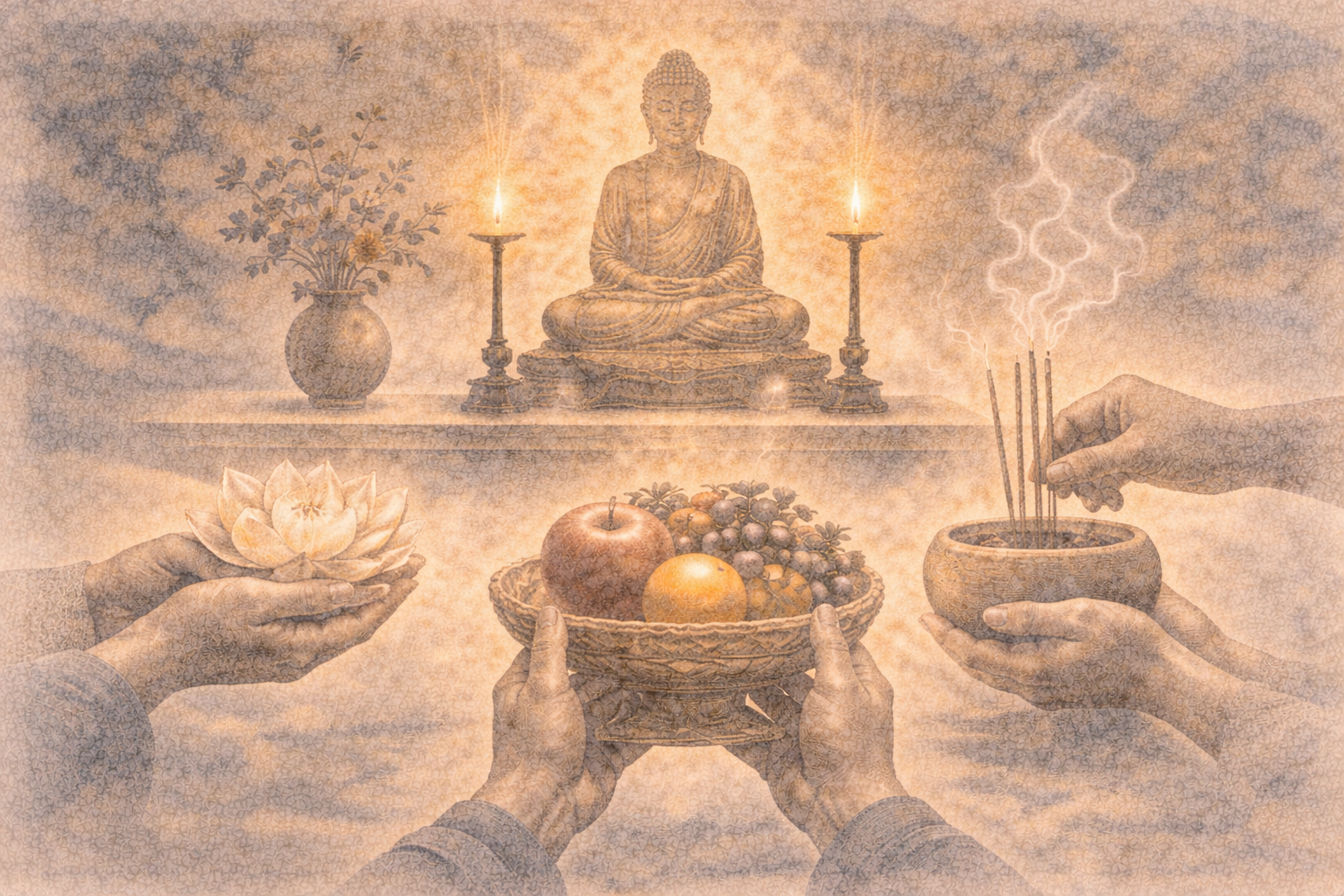
Answer: Common offerings include water, flowers, candles or lamps (light), incense, food, and donations that support a community or practice space.
Takeaway: Simple, everyday items are often considered perfectly appropriate.
FAQ 5: Do offerings in Buddhism have to be expensive?
Answer: No. A small offering given sincerely and within your means is generally more aligned with Buddhist practice than an expensive gift given for status or out of pressure.
Takeaway: Intention and freedom matter more than price.
FAQ 6: Is money considered an offering in Buddhism?
Answer: Yes, money can be an offering when it supports teachers, communities, or helpful activities, and when it’s given voluntarily without expectation of special treatment.
Takeaway: Financial offerings are valid when they’re ethical, willing, and transparent.
FAQ 7: Can time and service be an offering in Buddhism?
Answer: Yes. Volunteering, helping others, cleaning shared spaces, and offering attentive presence can all be offerings when done with a generous, respectful intention.
Takeaway: Offerings are not limited to objects—you can offer your actions.
FAQ 8: What makes an offering “good” or “proper” in Buddhism?
Answer: A “proper” offering is typically something obtained ethically, given freely, within your means, and offered with respect rather than guilt, fear, or a desire to impress.
Takeaway: A clean intention is the core of a good offering.
FAQ 9: Are offerings in Buddhism a form of worship?
Answer: They can look like worship externally, but many Buddhists understand offerings as a practice of respect and mind-training rather than devotion aimed at gaining favors.
Takeaway: Offerings can be reverent without being transactional.
FAQ 10: What is the difference between an offering and a donation in Buddhism?
Answer: A donation is usually practical support (often money or goods), while an offering emphasizes the inner intention of giving and respect; in practice, the same act can be both.
Takeaway: “Offering” highlights the mind of giving, not just the transfer of resources.
FAQ 11: Do Buddhists believe offerings create merit?
Answer: Many Buddhists connect offerings with wholesome results because generosity tends to shape the mind and behavior in beneficial ways; it’s best understood as cause-and-effect rather than a guaranteed cosmic reward.
Takeaway: Offerings support wholesome momentum, not a points system.
FAQ 12: Can I make an offering at home, and how do I do it simply?
Answer: Yes. Choose a clean, simple item (like water or fruit), place it respectfully in a dedicated spot, pause for a moment of gratitude, and offer it without asking for anything in return.
Takeaway: A home offering can be minimal—clarity and respect are enough.
FAQ 13: Is it disrespectful to offer something small in Buddhism?
Answer: Not necessarily. Small offerings are common and often encouraged; what matters is that the offering is sincere, clean, and given without contempt or carelessness.
Takeaway: “Small” is fine—careless or performative is the real issue.
FAQ 14: What should I avoid when making an offering in Buddhism?
Answer: Avoid giving what was obtained unethically, giving with strings attached, giving to manipulate outcomes, or giving beyond your means in a way that creates resentment or harm.
Takeaway: An offering should reduce grasping, not create new suffering.
FAQ 15: If I don’t make offerings, can I still practice Buddhism?
Answer: Yes. Offerings are a supportive practice, not a requirement; you can still practice through ethical living, mindfulness, and acts of kindness, and add offerings when it feels natural and sustainable.
Takeaway: Offerings help, but practice is broader than any single ritual.