



What Do People Put on a Buddhist Altar at Home?
Quick Summary
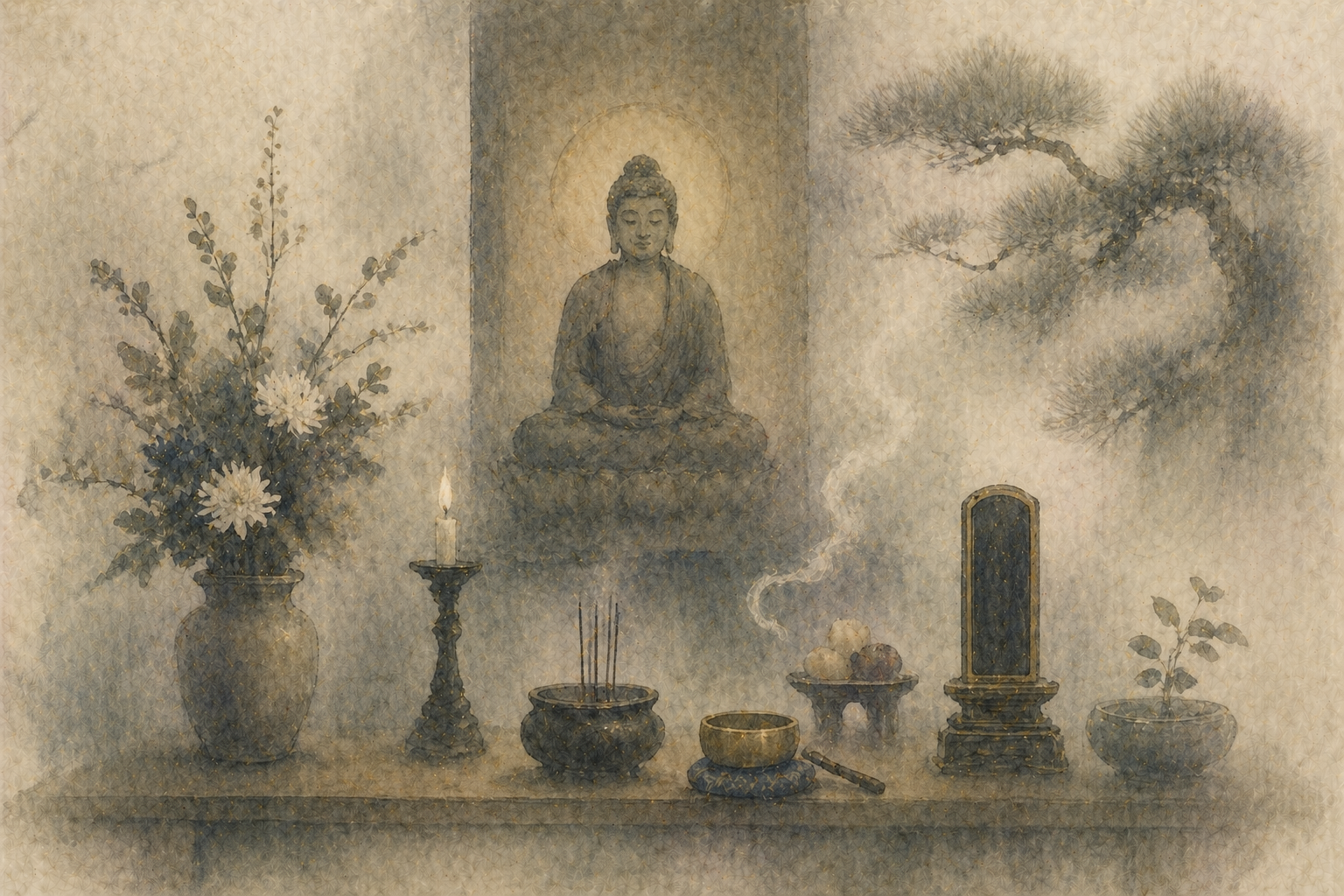
- Most home Buddhist altars include a central image (Buddha statue, figure, or scroll) plus simple offerings like water, light, and flowers.
- People often add incense, a small bowl for offerings, and a clean cloth to keep the space tidy and respectful.
- Offerings are symbolic: they train attention, gratitude, and restraint more than they “please” a deity.
- What matters most is consistency and sincerity, not expensive objects or perfect aesthetics.
- Many households include a short text (a sutra, verse, or printed teaching) to support daily reflection.
- It’s common to keep the altar simple, uncluttered, and placed a bit higher than everyday surfaces.
- If you’re unsure, start with one image, one candle (or LED light), and one cup of water—then adjust gently over time.
Introduction
You want to set up a Buddhist altar at home, but the internet makes it feel like you need the “right” statue, the “right” bowls, and the “right” arrangement—or you’ll do it wrong. The truth is simpler: people put a few meaningful, clean, intentional items on a home altar to support remembrance, steadiness, and everyday practice, not to pass a test of correctness. At Gassho, we focus on practical home practice and clear, tradition-respecting guidance without turning it into a shopping list.
A home altar is less about decoration and more about creating a reliable place where your attention can settle—briefly, daily, and without negotiation.
A Simple Lens for Understanding Home Altars
When people ask, “what do people put on a Buddhist altar at home,” it helps to see the altar as a training environment. The objects are not random; they’re cues that shape how you show up. You’re building a small corner of life that quietly says: pause, remember what matters, and act with care.
Most items on a Buddhist altar function as reminders rather than requirements. A central image points the mind toward awakening qualities like clarity and compassion. Offerings—water, light, incense, flowers—point the mind toward generosity, impermanence, and gratitude. Even the act of cleaning the altar is part of the practice: you’re rehearsing respect and attention in a concrete way.
This lens also keeps things grounded. Instead of asking, “Is this object officially correct?” you can ask, “Does this support steadiness, humility, and kind intention?” If it does, it likely belongs. If it distracts, clutters, or turns the altar into a display shelf, it may not be helping—even if it looks impressive.
Finally, a home altar is personal but not purely self-expressive. People often choose items that connect them to a wider stream of practice—simple, recognizable symbols—while keeping the space modest and functional for daily life.
GASSHO
Ask and learn about Buddhism in daily life.
GASSHO is a Buddhist community app where you can learn Buddhist teachings and ask questions to the head priest of Kongosanmaiin Temple on Mount Koya.
How a Home Altar Feels in Everyday Life
In ordinary mornings, the altar often becomes the first “clean” moment of the day. You walk past it with a busy mind, and the sight of a candle or a cup of water gently interrupts the rush. Nothing mystical needs to happen; the interruption itself is the point.
People notice how quickly the mind turns practice into performance: “Is my altar good enough?” That thought can soften when you keep the setup simple. A single image and a single offering can be enough to shift attention from self-judgment to sincerity.
Offerings also reveal your relationship with habit. Replacing water daily, refreshing flowers, or lighting incense asks for small consistency. You see the mind bargain—“I’ll do it later”—and you also see the relief that comes from doing one small thing fully.
When emotions run high, the altar can function like a stable reference point. People often stand there for a minute, breathe, and let the body settle. The objects don’t solve the problem; they help you stop feeding the problem with frantic reaction.
Over time, you may notice a shift from “What should I put on the altar?” to “What does this space invite out of me?” A cluttered altar can mirror a cluttered mind. A clean, minimal altar can make it easier to notice what you’re carrying.
Even the smallest gestures—straightening a cloth, wiping dust, setting a bowl down carefully—train a kind of nonverbal integrity. You’re practicing how to touch your life with care, not just how to think about care.
And on days when you do nothing else, people often still manage one glance, one bow, or one moment of quiet. That’s how a home altar earns its place: it makes returning easier.
Common Misunderstandings About What Belongs on the Altar
Misunderstanding 1: You need a lot of objects for it to “count.” Many home altars are intentionally spare. A central image and one offering can be complete. Adding more is optional, not a requirement.
Misunderstanding 2: Offerings are bribes or transactions. In a home setting, offerings are primarily for training the heart-mind: generosity, gratitude, and remembrance. The value is in the intention and the act, not in impressing anyone.
Misunderstanding 3: Only expensive or “authentic” items are appropriate. People use what they can maintain cleanly and respectfully. A printed image in a simple frame can be more supportive than a costly statue that makes you anxious to handle it.
Misunderstanding 4: The altar must look a certain way or follow one fixed layout. While there are common patterns (image centered, offerings in front), home altars adapt to real homes. The key is clarity: a focal point, a clean surface, and items that support practice rather than distraction.
Misunderstanding 5: Anything meaningful belongs there. Sentimental items can be fine, but many people find it helpful to keep the altar focused. If an object pulls you into nostalgia, status, or clutter, it may be better placed elsewhere.
Why These Items Matter More Than They Look
A home altar works because it makes values visible. In a normal room, your attention is constantly recruited by messages, chores, and entertainment. An altar is a small counterweight: it quietly prioritizes wakefulness, restraint, and kindness.
The specific objects people put on a Buddhist altar at home tend to support three practical functions: a focal point (image), a practice of giving (offerings), and a practice of care (cleanliness and order). These functions are simple, but they reach into the rest of the day—how you speak, how you pause, how you respond.
It also matters because it reduces friction. When the space is ready, you don’t have to “get ready” each time. You can step in for one minute and be done—yet that minute can change the tone of the next hour.
Finally, the altar can be a gentle boundary. It’s a place where you practice not turning everything into consumption. You don’t need to buy your way into sincerity; you need to show up.
Conclusion
So, what do people put on a Buddhist altar at home? Usually: a central image, a few simple offerings (often water, light, incense, flowers), and whatever supports daily remembrance without clutter. Start small, keep it clean, and choose items you can maintain with steady respect.
If you’re unsure, let function guide you: one clear focal point, one simple offering, and one small daily gesture. The altar is doing its job when it helps you return—quietly, repeatedly, and without drama.
Ask a Buddhist priest
Have a question about Buddhism?
In the GASSHO app, you can ask questions about Buddhist teachings, daily concerns, and how to understand Buddhism in everyday life.
Frequently Asked Questions
- FAQ 1: What do people put on a Buddhist altar at home as the main centerpiece?
- FAQ 2: What are the most common offerings people put on a Buddhist altar at home?
- FAQ 3: Do people put food on a Buddhist altar at home?
- FAQ 4: What kind of incense do people put on a Buddhist altar at home?
- FAQ 5: What type of light do people put on a Buddhist altar at home?
- FAQ 6: How many bowls of water do people put on a Buddhist altar at home?
- FAQ 7: Do people put flowers on a Buddhist altar at home, and do they have to be fresh?
- FAQ 8: What texts do people put on a Buddhist altar at home?
- FAQ 9: Do people put prayer beads on a Buddhist altar at home?
- FAQ 10: What do people put on a Buddhist altar at home for remembrance of loved ones?
- FAQ 11: Is it okay to put crystals or decorative objects on a Buddhist altar at home?
- FAQ 12: What do people put on a Buddhist altar at home if they have very little space?
- FAQ 13: What should people avoid putting on a Buddhist altar at home?
- FAQ 14: How often do people change or refresh what they put on a Buddhist altar at home?
- FAQ 15: What do people put on a Buddhist altar at home if they don’t want to use incense or candles?
FAQ 1: What do people put on a Buddhist altar at home as the main centerpiece?
Answer: Most people place a central image such as a Buddha statue, a framed picture, or a scroll that serves as the focal point for remembrance and reflection.
Takeaway: Start with one clear focal image you can treat with steady respect.
FAQ 2: What are the most common offerings people put on a Buddhist altar at home?
Answer: Common offerings include a cup of water, a candle or lamp (light), incense, and flowers—simple items that are easy to refresh and keep clean.
Takeaway: Choose offerings you can maintain regularly, not ones that create stress.
FAQ 3: Do people put food on a Buddhist altar at home?
Answer: Some people do, often fruit or small portions, but it depends on the household. If you offer food, keep it fresh, remove it before it spoils, and treat it as a mindful offering rather than a display.
Takeaway: Food offerings are optional—freshness and care matter most.
FAQ 4: What kind of incense do people put on a Buddhist altar at home?
Answer: Many people use simple stick incense or cone incense with a stable holder; the best choice is one that is not overpowering and can be used safely in your space.
Takeaway: Pick incense that supports calm attention and is safe for your home.
FAQ 5: What type of light do people put on a Buddhist altar at home?
Answer: People commonly use a candle, an oil lamp, or an electric/LED light if open flame isn’t practical. The point is the symbolism of clarity and wakefulness, not the fuel source.
Takeaway: A safe, steady light is better than a risky “traditional” setup.
FAQ 6: How many bowls of water do people put on a Buddhist altar at home?
Answer: Some households place one cup or bowl of water; others use multiple small bowls in a neat row. Either is fine—what matters is keeping the water clean and refreshed.
Takeaway: One clean water offering is enough if it’s done consistently.
FAQ 7: Do people put flowers on a Buddhist altar at home, and do they have to be fresh?
Answer: Flowers are common because they naturally express impermanence. Fresh flowers are ideal, but if that’s not realistic, a simple alternative is to offer something you can keep tidy and respectful without letting it decay unnoticed.
Takeaway: Use offerings you can care for; avoid anything that becomes neglected.
FAQ 8: What texts do people put on a Buddhist altar at home?
Answer: Many people place a short scripture, chant sheet, or a small book of teachings near the altar to support daily recitation or reflection, keeping it clean and elevated rather than tossed casually.
Takeaway: A simple text can anchor daily practice if you treat it carefully.
FAQ 9: Do people put prayer beads on a Buddhist altar at home?
Answer: Some people place prayer beads on the altar when not in use, especially if they’re used for chanting or recitation. If you do, keep them neatly arranged and not mixed with unrelated items.
Takeaway: It’s fine to place practice items there if it keeps the space orderly and focused.
FAQ 10: What do people put on a Buddhist altar at home for remembrance of loved ones?
Answer: Some households include a small photo or memorial tablet near (not replacing) the main focal image, keeping it simple and respectful so the altar remains a place of practice rather than only a memorial shelf.
Takeaway: Memorial items can fit, but keep the altar’s main focus clear.
FAQ 11: Is it okay to put crystals or decorative objects on a Buddhist altar at home?
Answer: People sometimes do, but many find it better to keep the altar focused on a central image and simple offerings. If an object turns the altar into decoration or distraction, it may not be serving the purpose.
Takeaway: Choose items for function—remembrance and practice—over decoration.
FAQ 12: What do people put on a Buddhist altar at home if they have very little space?
Answer: A small shelf or corner can hold a single image and one offering (like water or a small light). Many people keep it minimal so it stays clean and easy to maintain.
Takeaway: Small space is not a barrier—simplicity often works best.
FAQ 13: What should people avoid putting on a Buddhist altar at home?
Answer: People generally avoid clutter, spoiled offerings, unrelated everyday items (keys, mail), and anything that feels disrespectful or careless. The altar works best when it stays intentionally separate from daily mess.
Takeaway: If it creates clutter or neglect, it doesn’t belong on the altar.
FAQ 14: How often do people change or refresh what they put on a Buddhist altar at home?
Answer: Water is often refreshed daily, incense and light are used as needed, and flowers or food are replaced before they wilt or spoil. The schedule should match what you can do consistently.
Takeaway: Regular upkeep is more important than having many offerings.
FAQ 15: What do people put on a Buddhist altar at home if they don’t want to use incense or candles?
Answer: Many people use a cup of water, fresh flowers, and an LED light or simple lamp instead. The altar can remain fully meaningful without smoke or open flame.
Takeaway: Adapt offerings to your home while keeping the intention clear.