



What Digital Tools Can and Can’t Do for Buddhist Practice
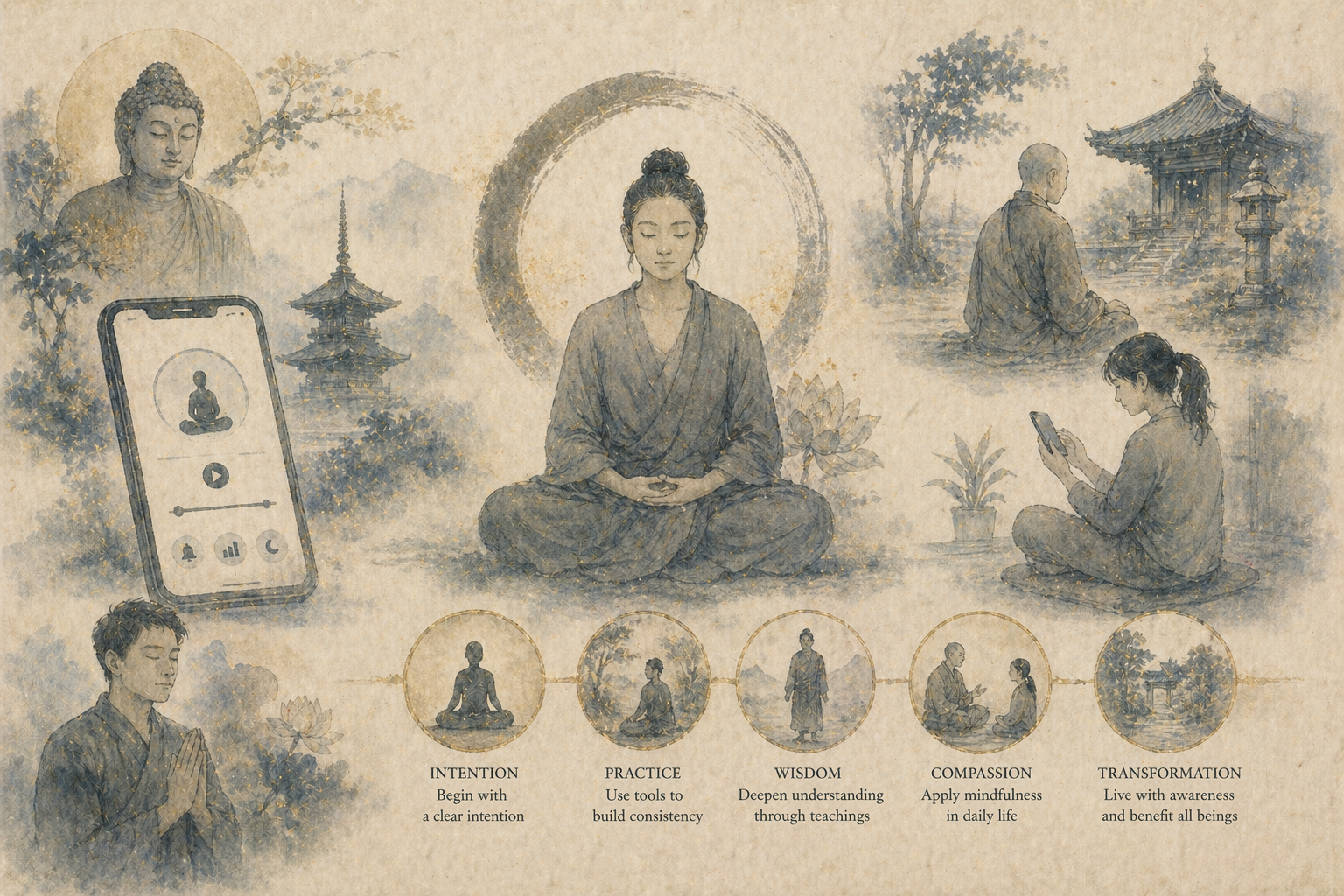
Quick Summary
- Digital tools can support Buddhist practice by reducing friction: reminders, timers, texts, and community access.
- They can’t do the actual work of practice: noticing, letting go, and meeting experience directly.
- The main risk is confusing “practice activity” (tracking, consuming content) with practice itself.
- Use tools to shape conditions, not to chase results or outsource attention.
- Choose fewer tools, set clear boundaries, and review whether they increase steadiness and kindness.
- Online community can be real support, but it can also amplify comparison and performative spirituality.
- A good rule: if a tool makes you more present off-screen, it’s helping; if it keeps you looping on-screen, it’s not.
Introduction
You want to practice sincerely, but the modern reality is that your phone is also where your timer lives, your teachings live, your community lives—and your distractions live. The confusion isn’t whether digital tools are “good” or “bad”; it’s whether they’re quietly training the opposite of what Buddhist practice is meant to cultivate: steadiness, clarity, and a less reactive mind. Gassho is a Zen/Buddhism site focused on practical, grounded guidance for everyday practice.
Digital tools can be helpful when they make practice simpler and more consistent, and harmful when they turn practice into another form of consumption, self-optimization, or identity-building. The goal is not purity or tech avoidance; it’s learning what supports direct experience and what pulls you away from it.
A Clear Lens for Digital Tools and Practice
A useful way to see this is: Buddhist practice is training in relationship—relationship to sensations, thoughts, emotions, and the world as it is. Digital tools are not that relationship; they are conditions around it. They can set the stage, but they can’t step onto it for you.
When a tool works well, it reduces unnecessary obstacles. A timer removes the need to check the clock. A short reminder helps you remember an intention you already chose. A text or audio teaching can clarify what to do when you sit down. In each case, the tool points back to your own attention and conduct.
When a tool works poorly, it subtly replaces practice with proxies: streaks, badges, analytics, endless playlists, constant “learning,” or public posting. These can feel like progress because they are measurable and socially reinforced, but they often keep attention outward—toward metrics, opinions, and novelty—rather than inward toward direct seeing and letting go.
So the central question becomes simple and practical: does this tool help you meet experience more directly, or does it keep you managing an image of practice? This isn’t a moral judgment. It’s a functional test you can apply again and again.
GASSHO
Ask and learn about Buddhism in daily life.
GASSHO is a Buddhist community app where you can learn Buddhist teachings and ask questions to the head priest of Kongosanmaiin Temple on Mount Koya.
How It Shows Up in Ordinary Moments
You open a meditation app to start a session. Before you even press “begin,” you notice the urge to check messages, skim headlines, or adjust settings. That urge is not a failure; it’s a clear display of the mind’s momentum. The tool has already become part of the field of practice: you can notice the pull, name it softly, and return to the simple intention to sit.
A guided audio begins, and the voice is calming. A few minutes later, irritation appears: the pacing feels wrong, the instructions feel repetitive, or the tone feels artificial. This is another ordinary moment. The practice is not to find the perfect guide; it’s to recognize irritation as irritation, feel it in the body, and see what happens when you don’t feed it with commentary.
You track your sessions and see a streak. A small lift of pride appears, followed by a subtle fear of breaking it. The mind turns practice into a performance for itself. If you notice that shift, you can gently reframe: the point is not continuity on a chart; it’s continuity of returning—again and again—when you’re lost in thought, when you’re busy, when you’re discouraged.
You join an online group and feel supported. Then comparison creeps in: other people seem more disciplined, more insightful, more “spiritual.” The mind starts building a self-image and measuring it. Here, the digital environment amplifies a very human habit. The practice is to recognize comparison as a mental event and to come back to what is actually asked of you today: one honest breath, one kind action, one moment of restraint.
You read a thread about Buddhist practice and feel a surge of certainty—then a surge of doubt. The mind swings between opinions. Digital spaces can make this faster and louder. In that moment, it can help to pause and feel your feet on the floor, relax the jaw, and remember that practice is not winning an argument; it’s reducing suffering in real time, starting with your own reactivity.
You set reminders for mindful pauses, and sometimes you ignore them. The reminder isn’t wasted. Each ignored ping can still be a tiny bell that reveals your current state: rushed, avoidant, scattered, or simply focused elsewhere. Over time, you learn what kinds of prompts actually help and what kinds become background noise.
You decide to practice without any device for a week and discover a different kind of restlessness: the mind wants stimulation even without the phone. That discovery is valuable. It shows that the deeper issue isn’t the tool itself; it’s the habit of seeking relief through distraction. Seeing that clearly is already part of the path.
Common Misunderstandings That Create Friction
Misunderstanding 1: “If it’s digital, it’s not real practice.” Practice is defined by what you’re training—attention, intention, and conduct—not by whether the bell sound comes from a wooden block or a phone speaker. A digital timer can support real practice if it leads you back to direct experience.
Misunderstanding 2: “More content equals deeper practice.” Teachings can be helpful, but constant input often becomes avoidance. If you’re always consuming, you may be postponing the simple work of sitting still, feeling what you feel, and responding wisely in daily life.
Misunderstanding 3: “Tracking keeps me honest.” Tracking can support consistency, but it can also train self-judgment and compulsive checking. Honesty in practice is quieter: noticing when you’re lost, returning without drama, and being willing to start again.
Misunderstanding 4: “Online community is either perfect support or pure distraction.” It’s usually both. Community can reduce isolation and provide accountability, while also increasing comparison, debate, and performative posting. The question is whether your participation makes you more grounded and kind offline.
Misunderstanding 5: “The right app will fix my mind.” Tools can structure time and provide prompts, but they can’t replace the moment-to-moment choice to notice, soften, and refrain. If you’re waiting for the perfect setup, you may be delaying the only place practice happens: right now.
Why This Matters in Daily Life
Most people don’t struggle because they lack information; they struggle because attention is constantly fragmented. Buddhist practice is, in part, learning to live without being yanked around by every impulse. Digital tools can either protect that training or undermine it, depending on how they’re used.
Used well, technology can help you practice in the life you actually have: a short timer before work, a reminder to pause before replying to a difficult message, a digital copy of a text you return to slowly, or a weekly online sit that keeps you connected. These are supports for steadiness and ethical responsiveness.
Used poorly, the same technology can turn practice into another arena for craving and aversion: craving for reassurance, novelty, and recognition; aversion to boredom, silence, and discomfort. That pattern doesn’t stay on the screen. It shows up in how you speak to family, how you handle stress, and how you treat your own mind.
A practical approach is to decide what you want your tools to do—and what you refuse to let them do. For example: “My phone can ring a bell and hold a text. It cannot decide whether I’m a good practitioner. It cannot be the place I go to escape every uncomfortable feeling.” This kind of boundary is itself a form of practice.
When you keep the purpose clear, digital tools become ordinary: useful, limited, and not worth fighting about. That simplicity frees energy for what matters most—meeting your life with more presence and less reactivity.
Conclusion
Digital tools can support Buddhist practice by making it easier to begin, remember, and stay connected. They can’t do the essential work: noticing what’s happening, letting go of what tightens the mind, and choosing kinder responses in real situations.
If you’re unsure whether a tool is helping, use a simple test for a week: does it reduce friction and bring you back to direct experience, or does it increase checking, comparing, and consuming? Keep what supports steadiness. Drop what trains distraction. Then return to the next breath, the next step, the next honest moment.
Ask a Buddhist priest
Have a question about Buddhism?
In the GASSHO app, you can ask questions about Buddhist teachings, daily concerns, and how to understand Buddhism in everyday life.
Frequently Asked Questions
- FAQ 1: What digital tools can and can’t do for Buddhist practice in one sentence?
- FAQ 2: Can a meditation app count as real Buddhist practice?
- FAQ 3: What can digital timers and reminders do well for Buddhist practice?
- FAQ 4: What can’t digital tools do when it comes to mindfulness and awareness?
- FAQ 5: Do streaks, badges, and analytics help or hurt Buddhist practice?
- FAQ 6: Can online teachings replace in-person guidance for Buddhist practice?
- FAQ 7: What role can digital community play in Buddhist practice?
- FAQ 8: Can AI tools help with Buddhist practice, and what can’t they do?
- FAQ 9: How do I know if a digital tool is becoming a distraction in my Buddhist practice?
- FAQ 10: What digital tools can’t do for ethical practice and compassion?
- FAQ 11: Are digital chanting or recitation recordings useful, and what are their limits?
- FAQ 12: Can digital journaling apps support Buddhist practice?
- FAQ 13: What’s a healthy way to set boundaries with digital tools for Buddhist practice?
- FAQ 14: Can digital tools help with consistency without turning practice into self-optimization?
- FAQ 15: If I want to simplify, which digital tools are most worth keeping for Buddhist practice?
FAQ 1: What digital tools can and can’t do for Buddhist practice in one sentence?
Answer: Digital tools can support the conditions for practice (reminders, access, structure), but they can’t replace the direct training of attention, ethics, and letting go in lived experience.
Takeaway: Use tools to set the stage, not to do the practice for you.
FAQ 2: Can a meditation app count as real Buddhist practice?
Answer: The app itself isn’t the practice; it can be a support for practice if it helps you sit, notice, and return. If it mainly keeps you consuming content or chasing metrics, it’s functioning more like entertainment than training.
Takeaway: The measure is what it does to your attention, not the label on the app.
FAQ 3: What can digital timers and reminders do well for Buddhist practice?
Answer: They reduce friction by removing clock-checking, prompting brief pauses, and supporting consistency. They work best when they are simple, predictable, and not tied to performance goals.
Takeaway: Simple prompts can protect practice time and reduce decision fatigue.
FAQ 4: What can’t digital tools do when it comes to mindfulness and awareness?
Answer: They can’t notice your breath for you, feel your emotions for you, or choose your response in a tense moment. Awareness is trained by repeatedly returning to experience, not by having more features or better tracking.
Takeaway: No tool can substitute for the moment you actually notice.
FAQ 5: Do streaks, badges, and analytics help or hurt Buddhist practice?
Answer: They can help some people build a habit, but they often increase craving (for numbers) and aversion (fear of breaking the streak). If metrics create pressure, self-judgment, or compulsive checking, they’re likely undermining practice.
Takeaway: If tracking makes you tighter, simplify or turn it off.
FAQ 6: Can online teachings replace in-person guidance for Buddhist practice?
Answer: Online teachings can offer clarity and accessibility, but they can’t fully replace the relational aspects of guidance: being seen over time, receiving context-specific feedback, and practicing with others in shared silence and conduct.
Takeaway: Online learning is valuable, but it has limits as a substitute for relationship.
FAQ 7: What role can digital community play in Buddhist practice?
Answer: It can reduce isolation, provide encouragement, and offer accountability. It can also amplify comparison, debate, and performative posting, which can pull attention outward and increase reactivity.
Takeaway: Join spaces that make you steadier offline, not louder online.
FAQ 8: Can AI tools help with Buddhist practice, and what can’t they do?
Answer: AI can summarize texts, suggest practice structures, and help you reflect with prompts. It can’t verify your inner experience, confer wisdom, or replace the ethical and attentional training that happens through your own choices.
Takeaway: Use AI for support and clarity, not for authority or validation.
FAQ 9: How do I know if a digital tool is becoming a distraction in my Buddhist practice?
Answer: Signs include frequent switching between apps, constant tweaking of settings, anxiety about metrics, and feeling less willing to sit without guidance. Another sign is needing the tool to feel “ready” before you can practice.
Takeaway: If the tool becomes the ritual, it may be replacing the practice.
FAQ 10: What digital tools can’t do for ethical practice and compassion?
Answer: They can’t make you speak truthfully, refrain from harm, or repair a relationship. They can remind you of intentions, but compassion is trained in real interactions—especially when you’re stressed, defensive, or tired.
Takeaway: Ethics isn’t an app feature; it’s a daily choice.
FAQ 11: Are digital chanting or recitation recordings useful, and what are their limits?
Answer: Recordings can help you learn rhythm and words and can support regularity. They can’t replace your own embodied participation, sincerity, and the way recitation trains attention and intention when you do it yourself.
Takeaway: Let recordings teach you, then practice with your own voice and presence.
FAQ 12: Can digital journaling apps support Buddhist practice?
Answer: Yes, if they help you notice patterns—reactivity, triggers, habits of speech—and clarify intentions. They can’t replace the actual moment of restraint or the willingness to feel discomfort without immediately narrating it.
Takeaway: Journal to see clearly, not to endlessly analyze.
FAQ 13: What’s a healthy way to set boundaries with digital tools for Buddhist practice?
Answer: Keep the toolset small (timer, one text source, one community space), disable nonessential notifications, and decide when you practice without a screen. Review monthly: is your mind calmer and more responsive, or more restless and comparative?
Takeaway: Boundaries are part of practice, not a separate self-help project.
FAQ 14: Can digital tools help with consistency without turning practice into self-optimization?
Answer: Yes—use tools that emphasize showing up over scoring: a simple calendar checkmark, a gentle reminder, or a fixed daily time. Avoid features that push competition, public performance, or constant “improvement” narratives.
Takeaway: Aim for steadiness and sincerity, not optimization.
FAQ 15: If I want to simplify, which digital tools are most worth keeping for Buddhist practice?
Answer: Keep the tools that reduce friction and point back to direct experience: a basic timer, a small set of trusted readings, and a limited community connection if it genuinely supports you. Let go of tools that increase checking, comparison, or endless consumption.
Takeaway: Keep what returns you to the present; drop what keeps you scrolling.