



What Are the Five Remembrances in Buddhism?
Quick Summary
- The Five Remembrances are five short reflections on aging, illness, death, separation, and the results of our actions.
- They are not meant to be gloomy; they are meant to make life feel more honest and workable.
- Each remembrance points to what we can’t control—and what we still can choose.
- Practiced gently, they reduce denial and sharpen priorities in daily life.
- They support compassion by reminding us that everyone shares the same vulnerabilities.
- You can use them as a daily recitation, journaling prompt, or moment-to-moment reset.
- The goal is steadiness and clarity, not fear or perfection.
Introduction
If the Five Remembrances sound like a list designed to make you anxious, you’re not alone—and that reaction is exactly why they’re useful: they cut through the quiet fantasy that life will stay stable if we worry hard enough or plan perfectly. At Gassho, we focus on practical Buddhist reflections that meet ordinary life without drama.
The Five Remembrances are traditionally phrased as simple statements you return to again and again. They point to five facts that are easy to intellectually accept and surprisingly hard to emotionally remember when you’re stressed, attached, or rushing.
When people first encounter them, they often ask two questions: “Is this supposed to be depressing?” and “How do I use this without spiraling?” The heart of the practice is learning to hold reality in view while staying kind, functional, and present.
A Clear Lens: What the Five Remembrances Point To
The Five Remembrances are a way of looking at life that emphasizes honesty over comfort. They don’t ask you to adopt a belief system; they ask you to notice what is already true, especially what the mind prefers to edit out. In that sense, they function like a lens: they bring certain features of experience into focus so your choices become less reactive.
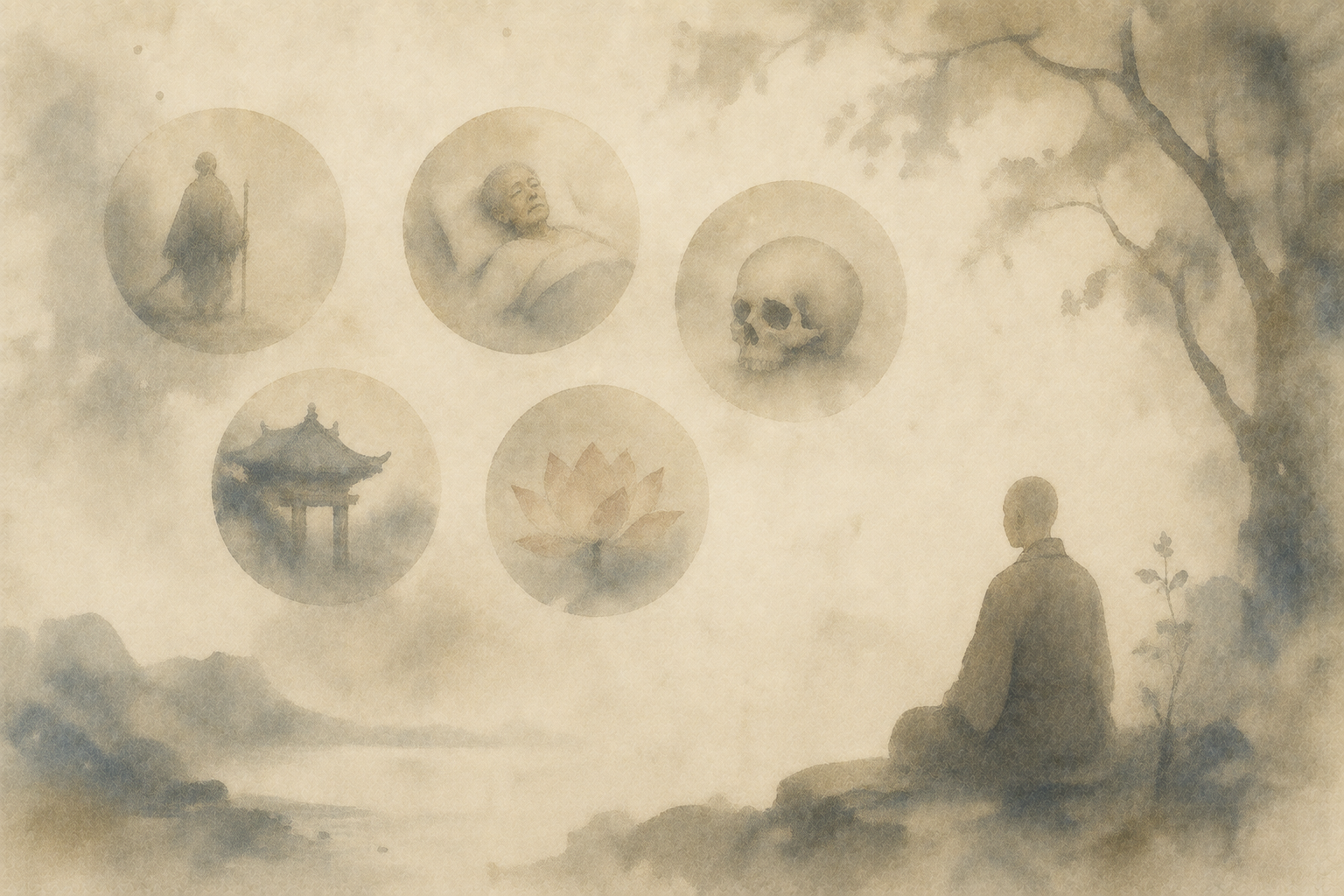
Although wording varies slightly across translations, the Five Remembrances are commonly expressed like this: (1) I am of the nature to grow old; I cannot avoid aging. (2) I am of the nature to have ill health; I cannot avoid illness. (3) I am of the nature to die; I cannot avoid death. (4) All that is dear to me and everyone I love are of the nature to change; I will be separated from them. (5) My actions are my only true belongings; I cannot escape the results of my actions.
Notice the structure: the first four remembrances describe forms of change and loss that are not personal failures. They are not punishments and not exceptions; they are built into being alive. The fifth remembrance shifts from what you can’t control to what you can: your intentions, your speech, your behavior, and the patterns you reinforce.
Seen this way, the Five Remembrances are not “negative thoughts.” They are reality checks that reduce the shock of reality. They help you stop bargaining with the inevitable and start investing in what actually helps—care, integrity, attention, and relationships that aren’t based on pretending things won’t change.
GASSHO
Ask and learn about Buddhism in daily life.
GASSHO is a Buddhist community app where you can learn Buddhist teachings and ask questions to the head priest of Kongosanmaiin Temple on Mount Koya.
How the Remembrances Show Up in Everyday Moments
You read “I cannot avoid aging,” and the mind may immediately jump to a future image: wrinkles, weakness, dependence. But in lived experience, aging is usually felt as small signals: needing more rest, recovering more slowly, noticing how quickly a year passes. The remembrance invites you to feel those signals without turning them into a personal insult.
Illness is similar. Most days it’s not a dramatic diagnosis; it’s a headache, a sore throat, a flare-up, a mental fog, a friend canceling plans because they’re unwell. The remembrance doesn’t ask you to like it. It asks you to stop acting surprised that bodies are vulnerable—and to soften the extra layer of resentment that says, “This shouldn’t be happening.”
Death can feel abstract until it suddenly isn’t. In ordinary life, the death remembrance often appears as a quiet urgency: the sense that time is real, that conversations matter, that postponing what’s meaningful has a cost. It can also show up as a subtle fear in the background. The practice is to notice that fear, name it, and let it inform your priorities rather than hijack your day.
Separation from what we love is not only about bereavement. It’s also the everyday separations: children growing up, friendships changing, coworkers moving on, a relationship shifting, a pet aging, a favorite place becoming unrecognizable. The remembrance helps you see attachment in real time—how the mind tries to freeze what is moving—and it gently encourages appreciation without clinging.
The fifth remembrance—about actions and their results—often shows up as a moment of choice. You feel the impulse to snap at someone, to exaggerate, to avoid a difficult conversation, to doomscroll, to numb out. Then you remember: whatever I do next becomes part of my mind’s training. This is not moral perfectionism; it’s cause and effect at the level of habit.
Over time, these reflections can change the texture of attention. You may notice less arguing with reality and more willingness to meet what’s here. You may also notice more tenderness: when you remember that everyone is aging, everyone gets sick, everyone loses what they love, it becomes harder to treat people as obstacles.
Most importantly, the Five Remembrances can be practiced in small doses. A single honest breath—“Yes, this changes”—can interrupt a spiral. The point is not to think about loss all day; it’s to stop building your life on the assumption that loss won’t happen.
Common Misreadings That Make the Practice Harder
One common misunderstanding is that the Five Remembrances are meant to make you pessimistic. If you use them to rehearse dread, they will feel heavy. But their function is closer to sobriety than sadness: they clear away denial so you can respond wisely to what’s actually happening.
Another misreading is to treat them as a punishment for enjoying life. The remembrances don’t say, “Don’t love anything.” They say, “Love with your eyes open.” Enjoyment becomes cleaner when it isn’t secretly demanding permanence.
People also sometimes interpret the fifth remembrance as fatalism: “Everything is karma, so whatever happens is my fault.” That’s not what the reflection is pointing to. It highlights responsibility in the present—what you choose now matters—without turning life into a courtroom.
Finally, some try to use the remembrances as a way to bypass grief: “Everything changes, so I shouldn’t feel sad.” In practice, remembering impermanence can make grief more honest, not less. The reflections support feeling what you feel without adding confusion, blame, or avoidance.
Why These Five Reflections Matter in Daily Life
The Five Remembrances matter because they reduce wasted energy. A lot of suffering comes from fighting what cannot be negotiated: time passing, bodies being fragile, relationships changing. When you stop arguing with those facts, you free up attention for what helps—care, repair, gratitude, and skillful action.
They also clarify priorities. When you remember that separation is inevitable, you may be more willing to say the kind thing now, to apologize sooner, to stop postponing the conversation that would bring relief. The reflections don’t demand urgency as panic; they encourage urgency as sincerity.
In relationships, the remembrances can soften blame. If someone is irritable because they’re unwell, or distant because they’re grieving, remembering vulnerability makes space for compassion without excusing harm. You can hold boundaries while still seeing the human condition clearly.
And the fifth remembrance is quietly empowering. Even when you can’t control outcomes, you can still choose the next right effort: a truthful sentence, a patient pause, a generous act, a refusal to feed a harmful habit. Over time, those choices become a steadier refuge than circumstances.
If you want a simple way to practice, try reciting the Five Remembrances once a day and then asking one question: “Given this, what matters today?” Keep the answer small and doable. The practice works best when it stays close to real life.
Conclusion
What are the Five Remembrances in Buddhism? They are five grounded reflections that keep you close to the truth of change: aging, illness, death, separation, and the inescapable impact of your actions. Practiced gently, they don’t darken life—they make it more direct, more compassionate, and less ruled by denial.
If you approach them as a daily reset rather than a philosophical statement, they become surprisingly practical: a way to stop postponing what matters, to meet fear without feeding it, and to live with a little more integrity and warmth.
Ask a Buddhist priest
Have a question about Buddhism?
In the GASSHO app, you can ask questions about Buddhist teachings, daily concerns, and how to understand Buddhism in everyday life.
Frequently Asked Questions
- FAQ 1: What are the Five Remembrances in Buddhism?
- FAQ 2: What is the purpose of the Five Remembrances?
- FAQ 3: Are the Five Remembrances meant to be depressing?
- FAQ 4: What are the exact words of the Five Remembrances?
- FAQ 5: Why do the Five Remembrances include aging, illness, and death?
- FAQ 6: What does the fourth remembrance mean about being separated from what we love?
- FAQ 7: What does the fifth remembrance mean by “my actions are my true belongings”?
- FAQ 8: How do you practice the Five Remembrances day to day?
- FAQ 9: How often should you reflect on the Five Remembrances?
- FAQ 10: Can the Five Remembrances help with anxiety about death?
- FAQ 11: Are the Five Remembrances the same as the Five Precepts?
- FAQ 12: Do the Five Remembrances require belief in karma or rebirth?
- FAQ 13: What is a good short version of the Five Remembrances to memorize?
- FAQ 14: How should the Five Remembrances be used when grieving?
- FAQ 15: What is the main lesson of the Five Remembrances in Buddhism?
FAQ 1: What are the Five Remembrances in Buddhism?
Answer: The Five Remembrances are five reflections: (1) I will grow old, (2) I will get sick, (3) I will die, (4) I will be separated from what I love, and (5) I am the owner of my actions and will experience their results.
Takeaway: They are a practical set of reminders about change and responsibility.
FAQ 2: What is the purpose of the Five Remembrances?
Answer: Their purpose is to reduce denial and reactivity by keeping unavoidable realities in view, so you can live with clearer priorities, more compassion, and more skillful choices.
Takeaway: They help you respond wisely instead of being shocked by change.
FAQ 3: Are the Five Remembrances meant to be depressing?
Answer: No. They can feel heavy at first, but they are intended to bring steadiness and honesty, not despair. The practice is to remember reality without spiraling into dread.
Takeaway: Used well, they support clarity and gratitude rather than gloom.
FAQ 4: What are the exact words of the Five Remembrances?
Answer: Translations vary, but a common version is: “I am of the nature to grow old; I cannot avoid aging. I am of the nature to have ill health; I cannot avoid illness. I am of the nature to die; I cannot avoid death. All that is dear to me and everyone I love are of the nature to change; I will be separated from them. My actions are my only true belongings; I cannot escape the results of my actions.”
Takeaway: The meaning matters more than one fixed phrasing.
FAQ 5: Why do the Five Remembrances include aging, illness, and death?
Answer: Because these are universal features of embodied life. Remembering them reduces the extra suffering that comes from acting as if we are exceptions or as if control can eliminate vulnerability.
Takeaway: They normalize what the mind often treats as “unfair surprises.”
FAQ 6: What does the fourth remembrance mean about being separated from what we love?
Answer: It means that change is built into relationships and possessions: people move, feelings shift, circumstances alter, and eventually separation happens in some form. The reflection encourages love without clinging.
Takeaway: Appreciate deeply, but don’t demand permanence.
FAQ 7: What does the fifth remembrance mean by “my actions are my true belongings”?
Answer: It points to the idea that what you do—your intentions, speech, and behavior—shapes your life and mind more reliably than anything you can own or control. Actions “follow” you as habits and consequences.
Takeaway: Your next choice is a more dependable refuge than circumstances.
FAQ 8: How do you practice the Five Remembrances day to day?
Answer: You can recite them each morning, reflect on one line during a stressful moment, or journal briefly on how one remembrance applies today—then choose one small, skillful action in response.
Takeaway: Keep the practice simple and tied to real situations.
FAQ 9: How often should you reflect on the Five Remembrances?
Answer: Many people use them daily or weekly. The best frequency is the one that increases clarity without triggering rumination—often a short daily recitation is enough.
Takeaway: Consistency matters more than intensity.
FAQ 10: Can the Five Remembrances help with anxiety about death?
Answer: They can help by replacing avoidance with gentle familiarity. Rather than forcing fear away, the reflections encourage acknowledging mortality and then returning to what you can do now: live honestly, care for others, and act in line with your values.
Takeaway: The practice aims for steadiness, not suppression.
FAQ 11: Are the Five Remembrances the same as the Five Precepts?
Answer: No. The Five Remembrances are reflections on reality and responsibility; the Five Precepts are ethical commitments about conduct. They can support each other, but they are different lists with different purposes.
Takeaway: Remembrances are contemplations; precepts are behavioral guidelines.
FAQ 12: Do the Five Remembrances require belief in karma or rebirth?
Answer: You can practice them without adopting metaphysical beliefs. The fifth remembrance can be understood in a straightforward way: actions have consequences in your relationships, your habits, and your mental patterns.
Takeaway: You can apply the practice as simple cause-and-effect in daily life.
FAQ 13: What is a good short version of the Five Remembrances to memorize?
Answer: A concise version is: “I will age. I will get sick. I will die. I will be separated from what I love. My actions shape my life.” This keeps the core meaning while being easy to recall.
Takeaway: Short phrasing makes it easier to remember in real moments.
FAQ 14: How should the Five Remembrances be used when grieving?
Answer: Use them to support honesty, not to shut feelings down. The fourth remembrance can validate loss as part of life, while the fifth can guide you toward caring actions—rest, reaching out, and speaking truthfully—without rushing your grief.
Takeaway: Let the reflections steady you, not silence you.
FAQ 15: What is the main lesson of the Five Remembrances in Buddhism?
Answer: The main lesson is that change is unavoidable, and your most reliable freedom lies in how you meet that change—through awareness, compassion, and responsible action.
Takeaway: Accept what you can’t control and commit to what you can choose.