



Five Precepts in Daily Life: Meaning and Everyday Practice
Quick Summary
- The Five Precepts in Buddhism are practical ethical trainings for everyday life, not commandments.
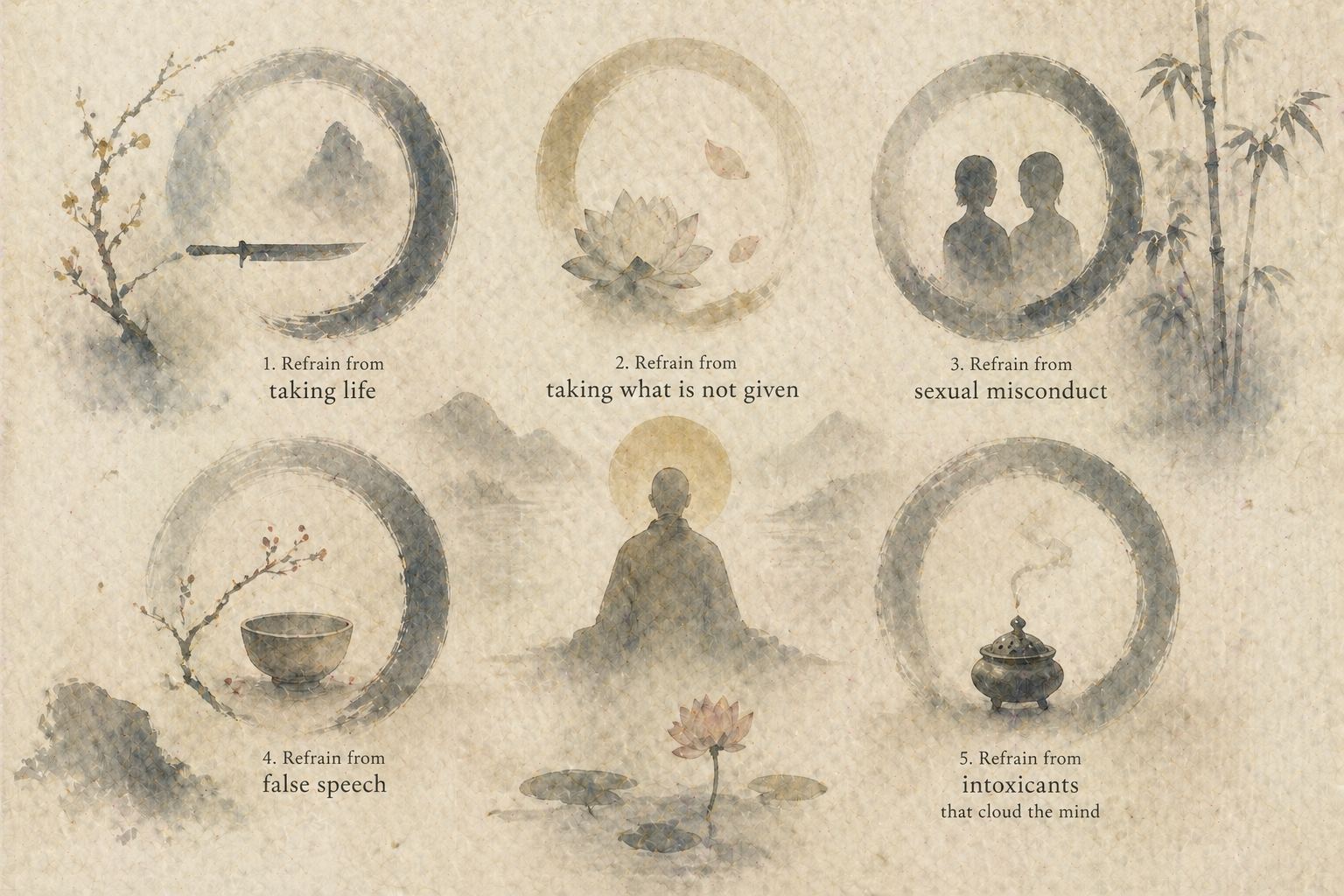
- They are: avoid killing, avoid stealing, avoid sexual misconduct, avoid false speech, and avoid intoxicants that cloud the mind.
- Each precept points to reducing harm and strengthening clarity, trust, and self-respect.
- You can practice them gradually; they’re meant to be lived, not “passed.”
- The precepts work best when you treat them as questions: “What action leads to less suffering here?”
- They apply to thoughts, words, online behavior, work, relationships, and consumption.
- Even partial practice tends to make meditation and daily life steadier and less conflicted.
Introduction
If you’re trying to figure out what the Five Precepts in Buddhism actually are, the confusing part is usually this: they sound like strict religious rules, yet people talk about them as “training” and “freedom” in the same breath. The simplest way to understand them is as five everyday guardrails that reduce harm and reduce inner friction—so your life becomes easier to live and your mind becomes easier to settle. At Gassho, we focus on clear, beginner-friendly Buddhist fundamentals without assuming prior background.
The keyword question—what are the five precepts in buddhism—has a straightforward answer, but the meaning is richer than a list. The precepts are often undertaken by lay practitioners (people living ordinary household lives), and they’re also foundational for deeper practice because they build trust: trust from others, and trust in yourself.
Here are the Five Precepts in their common, plain-English form:
- Refrain from killing (avoid intentionally taking life).
- Refrain from stealing (avoid taking what isn’t freely given).
- Refrain from sexual misconduct (avoid sexual behavior that causes harm, betrayal, or exploitation).
- Refrain from false speech (avoid lying and harmful misuse of speech).
- Refrain from intoxicants that cloud the mind (avoid substances and habits that strongly impair clarity and restraint).
Notice the tone: “refrain” points to intention and training, not perfection. The precepts are less about moral scoring and more about learning what happens in your mind and relationships when you choose non-harming.
A Clear Way to See the Five Precepts
A helpful lens is to see the Five Precepts as a set of experiments in cause and effect. When you act in ways that protect life, respect boundaries, and keep your mind clear, certain results tend to follow: fewer conflicts, fewer regrets, and more steadiness. When you act in ways that harm, take, manipulate, or numb out, different results tend to follow: anxiety, defensiveness, fractured trust, and a mind that’s harder to calm.
In this view, the precepts aren’t there to make you “good.” They’re there to make suffering easier to understand. Each precept highlights a common place where humans create pain—sometimes loudly, sometimes quietly—and invites you to notice the moment before the harm: the urge, the story, the justification, the pressure.
They also function like a mirror. If you break a precept (even in a small way), you can often feel the mind tighten: hiding, rationalizing, replaying. If you keep a precept under pressure, you can often feel the mind relax: nothing to conceal, nothing to defend. That inner “cleanliness” is not abstract; it’s a lived sense of being aligned.
Finally, the Five Precepts are relational. They protect other people from your worst impulses, and they protect you from the fallout of those impulses. Practiced gently and consistently, they become less like rules and more like a stable baseline for kindness and clarity.
GASSHO
Ask and learn about Buddhism in daily life.
GASSHO is a Buddhist community app where you can learn Buddhist teachings and ask questions to the head priest of Kongosanmaiin Temple on Mount Koya.
How the Precepts Show Up in Ordinary Moments
The precepts become real in small, unglamorous moments—when you’re tired, irritated, rushed, or trying to get your way. That’s usually when the mind looks for shortcuts: a sharp comment, a “harmless” lie, a little bending of boundaries. Practicing the precepts starts with noticing that impulse without immediately obeying it.
Refraining from killing often shows up as how you handle anger. Maybe you don’t intend physical harm, but you notice the wish to crush someone with words, to “end” their dignity in a conversation. The training is to feel the heat of that reaction and choose a response that doesn’t escalate harm—sometimes that means pausing, sometimes leaving the room, sometimes speaking firmly without cruelty.
Refraining from stealing can be surprisingly subtle. It includes obvious things like taking what isn’t yours, but it also touches time, credit, and attention. You might notice the urge to claim someone else’s idea, to cut corners at work while expecting full reward, or to take more than your share in a shared space. The practice is to sense the grasping feeling and soften it: “What would respect look like here?”
Refraining from sexual misconduct often appears as a moment of rationalization. The mind says, “It’s fine,” while the body feels tension because something is off—secrecy, power imbalance, broken agreements, or using someone to regulate your own loneliness. The precept invites you to prioritize consent, honesty, and care over intensity and impulse.
Refraining from false speech is where many people feel the most daily friction. You notice the split-second calculation: “If I say the truth, it’ll be awkward.” Then comes the temptation to edit reality—exaggerate, omit, spin, or blame-shift. Practicing this precept can be as simple as slowing down and choosing words that are accurate and necessary, even if they’re not perfectly flattering.
Refraining from intoxicants that cloud the mind shows up as the desire to escape your own experience. It’s not only about substances; it’s about the pattern of numbing until you’re less present, less careful, and more likely to break the other precepts. The practice is to recognize the moment you want to disappear and to ask, gently, what you’re trying not to feel.
Across all five, a common inner sequence becomes visible: contact (something happens), feeling (pleasant/unpleasant), urge (push/pull), story (“I deserve this”), and action. The precepts give you a place to interrupt that chain. Not with self-punishment—just with awareness and a better option.
Common Confusions Beginners Run Into
Misunderstanding 1: “They’re commandments, so I’m either pure or failing.” The Five Precepts are trainings. If you treat them as a pass/fail test, you’ll either become rigid or give up. If you treat them as practice, you’ll learn from both keeping and breaking them—especially by noticing the conditions that led there.
Misunderstanding 2: “The precepts are just about behavior.” Behavior matters, but the deeper point is the mind behind the behavior: greed, ill will, confusion, fear, craving for approval. The precepts help you see those forces clearly because they show up right before speech and action.
Misunderstanding 3: “They’re outdated and don’t apply to modern life.” The surface examples change (social media, office politics, online anonymity), but the underlying dynamics don’t. Taking what isn’t given, manipulating desire, distorting truth, and numbing discomfort are extremely modern problems.
Misunderstanding 4: “The fifth precept is only about alcohol.” Alcohol is a common example because it can quickly reduce restraint and clarity. But the heart of the precept is about protecting the mind’s capacity to choose wisely. If something reliably makes you careless, reactive, or dishonest, it’s worth examining through this lens.
Misunderstanding 5: “Keeping precepts means being passive.” Non-harming doesn’t mean being a doormat. You can set boundaries, say no, report wrongdoing, or leave harmful situations. The precepts point to how you do it: without cruelty, exploitation, or self-deception.
Why the Five Precepts Matter in Daily Life
The most immediate benefit is reduced inner conflict. When your actions match your values, the mind is less busy defending itself. That quiet confidence is not dramatic, but it’s powerful: fewer spirals of regret, fewer half-truths to maintain, fewer relationships strained by avoidable harm.
The precepts also protect relationships in a very practical way. Not stealing builds reliability. Not lying builds trust. Avoiding sexual harm protects people from betrayal and confusion. Avoiding intoxicating numbness supports consistency. Over time, people feel safer around you—and you feel safer being yourself.
They matter for attention, too. A mind that is constantly negotiating small dishonesties or indulging impulses tends to be scattered. A mind that practices restraint and honesty tends to be simpler. That simplicity supports meditation and reflection because there’s less mental noise to sort through.
Finally, the Five Precepts offer a humane way to work with guilt. Instead of “I’m bad,” the question becomes: “What caused harm, and what would reduce harm next time?” That shift turns morality into learning—steady, compassionate, and realistic.
Conclusion
So, what are the five precepts in Buddhism? They are five ethical trainings: refrain from killing, stealing, sexual misconduct, false speech, and intoxicants that cloud the mind. Practiced as a living guide rather than a rigid rulebook, they help you notice the moments where suffering is manufactured—and choose a cleaner, kinder, clearer response.
If you’re new, start small: pick one precept that feels most relevant this week, watch the urges that challenge it, and experiment with one alternative action. The point isn’t to become perfect; it’s to become more honest about cause and effect in your own life.
Ask a Buddhist priest
Have a question about Buddhism?
In the GASSHO app, you can ask questions about Buddhist teachings, daily concerns, and how to understand Buddhism in everyday life.
Frequently Asked Questions
- FAQ 1: What are the five precepts in Buddhism in simple terms?
- FAQ 2: Are the Five Precepts rules or suggestions?
- FAQ 3: What is the first precept (no killing) actually asking?
- FAQ 4: Does the first precept mean Buddhists must be vegetarian?
- FAQ 5: What counts as stealing under the second precept?
- FAQ 6: What does “sexual misconduct” mean in the third precept?
- FAQ 7: Is the third precept only about adultery?
- FAQ 8: What does the fourth precept include besides lying?
- FAQ 9: Are “white lies” a violation of the fourth precept?
- FAQ 10: What is the fifth precept about intoxicants really pointing to?
- FAQ 11: Do the Five Precepts apply only to Buddhists?
- FAQ 12: How do people “take” or undertake the Five Precepts?
- FAQ 13: What happens if you break one of the Five Precepts?
- FAQ 14: Are the Five Precepts the same as the Ten Commandments?
- FAQ 15: Why are there exactly five precepts in Buddhism?
FAQ 1: What are the five precepts in Buddhism in simple terms?
Answer: They are five ethical trainings for lay life: avoid killing, avoid stealing, avoid sexual misconduct, avoid false speech, and avoid intoxicants that cloud the mind. They’re practiced to reduce harm and support clarity, not to “earn” holiness.
Takeaway: The Five Precepts are practical guidelines for non-harming and clear-minded living.
FAQ 2: Are the Five Precepts rules or suggestions?
Answer: They’re usually described as “precepts” or “training rules,” meaning you voluntarily undertake them as practice. They function like commitments you test in real situations, rather than external commands imposed on you.
Takeaway: Think “training” and intention, not punishment and perfection.
FAQ 3: What is the first precept (no killing) actually asking?
Answer: It asks you to refrain from intentionally taking life and to cultivate respect for living beings. In daily life, it also encourages reducing cruelty and acting from care rather than anger.
Takeaway: The first precept trains compassion and restraint around harm.
FAQ 4: Does the first precept mean Buddhists must be vegetarian?
Answer: Not necessarily. The first precept is about refraining from killing; different Buddhists interpret how that applies to diet in different ways. Many see it as an invitation to reduce harm where possible, rather than a universal dietary rule.
Takeaway: Vegetarianism can be a way to express the precept, but it isn’t the only interpretation.
FAQ 5: What counts as stealing under the second precept?
Answer: Stealing is taking what isn’t freely given—money, objects, services, or even credit for someone else’s work. It also includes dishonest advantage, like deception in transactions or exploiting loopholes to take what you haven’t earned.
Takeaway: The second precept is about respect for others’ property, time, and trust.
FAQ 6: What does “sexual misconduct” mean in the third precept?
Answer: It generally means sexual behavior that causes harm—through coercion, exploitation, betrayal, deception, or violating agreements and consent. The emphasis is on responsibility, honesty, and not using sexuality to injure others or yourself.
Takeaway: The third precept centers on consent, care, and non-exploitation.
FAQ 7: Is the third precept only about adultery?
Answer: Adultery is a common example because it often involves betrayal and harm, but the precept is broader. It points to any sexual conduct rooted in manipulation, pressure, dishonesty, or disregard for consent and well-being.
Takeaway: It’s not just one behavior; it’s a harm-based ethical boundary.
FAQ 8: What does the fourth precept include besides lying?
Answer: It includes harmful misuse of speech such as deception, malicious gossip, and speech that intentionally misleads or damages trust. Many people practice it by aiming for speech that is truthful, timely, and beneficial.
Takeaway: The fourth precept trains integrity and care in communication.
FAQ 9: Are “white lies” a violation of the fourth precept?
Answer: It depends on intention and impact. The precept invites you to examine whether a “small” lie is actually avoiding discomfort, manipulating outcomes, or eroding trust. Many practitioners try to find truthful ways to be kind rather than choosing between bluntness and dishonesty.
Takeaway: The practice is honest speech with minimal harm, not rigid literalism.
FAQ 10: What is the fifth precept about intoxicants really pointing to?
Answer: It points to protecting clarity and self-restraint by avoiding intoxication that leads to heedlessness—careless actions, broken promises, and increased likelihood of harming others. It’s about the mind’s capacity to choose wisely.
Takeaway: The fifth precept is a clarity-and-safety precept, not just a substance rule.
FAQ 11: Do the Five Precepts apply only to Buddhists?
Answer: No. While they’re a Buddhist framework, the principles are universal: non-harming, honesty, respect, and clarity. Many non-Buddhists use them as an ethical compass without adopting any religious identity.
Takeaway: You can practice the Five Precepts as human ethics, regardless of labels.
FAQ 12: How do people “take” or undertake the Five Precepts?
Answer: Some people formally undertake them in a ceremony; others do it privately by making a clear intention. Either way, the heart of “taking” the precepts is committing to practice them and returning to them when you fall short.
Takeaway: Undertaking the precepts can be formal or personal; sincerity matters most.
FAQ 13: What happens if you break one of the Five Precepts?
Answer: In most everyday practice, there’s no external punishment. The consequence is mainly internal and relational: guilt, loss of trust, agitation, and the practical fallout of the action. The skillful response is honesty, repair where possible, and learning the conditions that led to it.
Takeaway: Breaking a precept is a moment for accountability and course-correction, not self-hatred.
FAQ 14: Are the Five Precepts the same as the Ten Commandments?
Answer: They can look similar on the surface (both address harm and honesty), but the Five Precepts are typically framed as voluntary trainings aimed at reducing suffering and cultivating clarity. They’re less about obedience to authority and more about understanding cause and effect in conduct.
Takeaway: Similar themes, different framing: training and insight rather than command and judgment.
FAQ 15: Why are there exactly five precepts in Buddhism?
Answer: The “five” are a traditional set that covers major everyday areas where harm commonly arises: violence, taking, sexuality, speech, and intoxication. Together they form a balanced baseline for lay ethical practice and support a calmer, more trustworthy life.
Takeaway: The five precepts are a concise, comprehensive foundation for non-harming in daily life.