



The Two Arrows in Buddhism: A Simple Story About Pain and Suffering
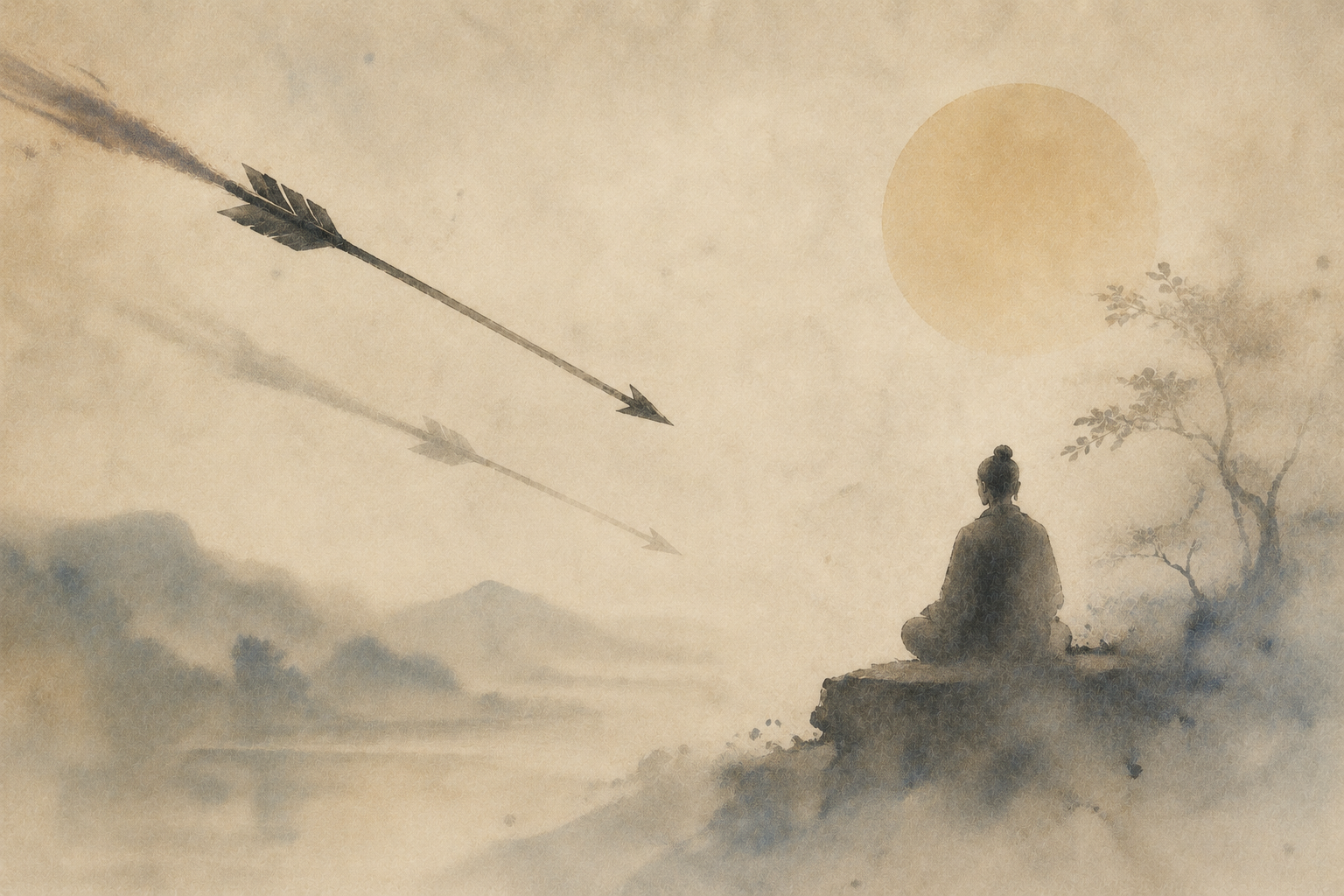
The Two Arrows in Buddhism: A Simple Story About Pain and Suffering
Quick Summary
- The “two arrows” in Buddhism separates unavoidable pain from optional suffering.
- The first arrow is the raw event: physical pain, loss, harsh words, disappointment.
- The second arrow is what we add: resistance, rumination, self-blame, stories, panic.
- The practice is not to deny pain, but to notice the second arrow forming.
- Small shifts—naming sensations, softening tension, loosening “why me?”—reduce suffering.
- This lens is practical for stress, conflict, anxiety spirals, and everyday frustration.
- Compassion grows when you see others are often reacting to their own second arrow.
Introduction
You already know pain happens; what’s confusing is why some moments hurt once and pass, while others keep hurting in your head long after the event is over. The “two arrows Buddhism” teaching is blunt about this: life throws the first arrow, but we often fire the second one into ourselves through the way we react, replay, and tighten around what happened. At Gassho, we focus on practical Buddhist ideas you can test in ordinary life, not beliefs you have to adopt.
A Clear Lens: Pain Is Real, Suffering Is Often Added
The two arrows in Buddhism is a simple story used to point at a difference that matters: pain versus suffering. Pain is the direct impact of an experience—an ache in the body, the sting of criticism, the drop in your stomach when plans fall apart. It’s immediate, and it’s not always negotiable.
The second arrow is what gets layered on top: the mental commentary, the resistance, the “this shouldn’t be happening,” the fear about what it means, and the looping replay. This second arrow can be loud or subtle. Sometimes it’s obvious (“I can’t handle this”), and sometimes it’s just a background clench that keeps the nervous system on guard.
This isn’t a moral judgment about reacting “wrong.” It’s a way of seeing experience with more precision. When you can tell the difference between the first arrow and the second, you gain options. You may not be able to remove the first arrow quickly, but you can often stop adding extra shots.
As a lens, the teaching invites one practical question: “What is the raw experience right now, and what am I adding?” That question alone can create space—enough to breathe, enough to respond, enough to be kind to yourself without pretending the pain isn’t there.
GASSHO
Ask and learn about Buddhism in daily life.
GASSHO is a Buddhist community app where you can learn Buddhist teachings and ask questions to the head priest of Kongosanmaiin Temple on Mount Koya.
What the Two Arrows Look Like in Everyday Moments
Imagine a headache arrives in the afternoon. The first arrow is the throbbing sensation, the pressure, the fatigue. The second arrow begins when the mind says, “Not now,” and then starts bargaining, blaming, and forecasting: “This will ruin my evening. I’m falling behind. Something must be wrong with me.”
Or consider a short, sharp comment from someone you care about. The first arrow is the immediate sting—heat in the face, a sinking feeling, a moment of shock. The second arrow is the inner courtroom: building a case, rehearsing comebacks, proving you’re right, proving they’re wrong, and replaying the scene until it becomes a whole identity story.
Often the second arrow shows up as body tension before it becomes words. The shoulders rise. The jaw tightens. The breath gets thin. Attention narrows to the problem, and everything else disappears. Even when the original pain is small, the contraction makes it feel total.
Noticing the second arrow doesn’t require special states. It can be as simple as catching a familiar pattern: the urge to check messages repeatedly after an awkward interaction, the impulse to scroll for distraction, the need to “fix” the feeling immediately, or the compulsion to explain yourself to someone who isn’t listening.
When you pause, you may find that the raw experience is surprisingly plain: pressure, warmth, sadness, disappointment, uncertainty. The suffering comes from the extra ingredients—resistance (“I can’t feel this”), personalization (“This proves I’m not enough”), and permanence (“This will never change”).
One helpful way to observe it is to separate sensations from sentences. Sensations are the first arrow. Sentences are often where the second arrow hides. You don’t have to force the sentences away; you can simply see them as mental events, not commands.
With practice, the moment you recognize “second arrow energy,” the system can soften a little. The pain may still be present, but it becomes more workable—less like a fight you must win, more like weather moving through.
Common Misreadings That Keep the Second Arrow Going
Misunderstanding 1: “The first arrow shouldn’t hurt if I’m doing it right.” The teaching doesn’t claim you can outsmart pain. Bodies get sick, people disappoint us, and loss lands heavily. The point is not invulnerability; it’s reducing the extra suffering that comes from tightening and spiraling.
Misunderstanding 2: “The second arrow means emotions are bad.” Emotions aren’t the enemy. The second arrow is not “feeling sadness” or “feeling anger.” It’s the added layer of resistance, self-attack, and compulsive story-making that turns a natural emotion into a prolonged struggle.
Misunderstanding 3: “If I notice the second arrow, I should suppress my thoughts.” Suppression is often just a disguised second arrow—another way of fighting what’s happening. Noticing is gentler: you acknowledge the thought, recognize its effect, and allow it to pass without feeding it.
Misunderstanding 4: “This teaching blames people for suffering.” The two arrows is not about blame; it’s about causality and choice. Many second-arrow reactions are conditioned and automatic, especially under stress. Seeing the pattern is meant to restore dignity and options, not to assign fault.
Misunderstanding 5: “The goal is to never get hit by the second arrow.” Everyone gets caught sometimes. The practical shift is shortening the duration: noticing sooner, recovering faster, and responding with less self-violence when you do react.
Why This Teaching Changes Ordinary Days
The two arrows in Buddhism matters because it gives you a map for stress that doesn’t depend on perfect circumstances. When you can identify the second arrow, you can stop treating every discomfort as an emergency. That alone reduces exhaustion.
It also improves relationships. Many conflicts are second-arrow collisions: one person’s fear meets another person’s defensiveness, and the original issue gets buried under tone, interpretation, and pride. Seeing the second arrow helps you respond to the actual moment instead of the story about the moment.
In decision-making, the teaching is quietly powerful. The first arrow might be uncertainty or disappointment. The second arrow is the frantic need to eliminate uncertainty immediately, which often leads to impulsive choices. When you can stay with the first arrow without adding the second, clarity tends to return on its own timeline.
Finally, it supports compassion—especially self-compassion. When you notice, “I’m adding a second arrow right now,” you can shift from self-criticism to care: “This is hard. Let me not make it harder.” That’s not indulgence; it’s skillful.
Conclusion
The two arrows Buddhism teaching doesn’t promise a pain-free life. It offers something more realistic: a way to meet pain without multiplying it. The first arrow will still arrive—through bodies, circumstances, and other people—but the second arrow is often optional, and it becomes more optional the moment you can see it. When you learn to separate sensations from stories, and pain from the fight against pain, suffering loosens its grip in very ordinary, very human moments.
Ask a Buddhist priest
Have a question about Buddhism?
In the GASSHO app, you can ask questions about Buddhist teachings, daily concerns, and how to understand Buddhism in everyday life.
Frequently Asked Questions
- FAQ 1: What are the two arrows in Buddhism?
- FAQ 2: What is the difference between pain and suffering in the two arrows Buddhism teaching?
- FAQ 3: Is the second arrow “my fault” according to Buddhism?
- FAQ 4: Does the two arrows Buddhism idea mean I should suppress emotions?
- FAQ 5: Can physical pain be the first arrow in Buddhism’s two arrows teaching?
- FAQ 6: What are examples of the second arrow in everyday life?
- FAQ 7: How do I notice the second arrow forming?
- FAQ 8: Is the first arrow always unavoidable in two arrows Buddhism?
- FAQ 9: How does the two arrows Buddhism teaching relate to anxiety?
- FAQ 10: How does the two arrows metaphor help with anger?
- FAQ 11: Is grief the first arrow or the second arrow in Buddhism?
- FAQ 12: Does two arrows Buddhism mean I should tolerate harmful situations?
- FAQ 13: What is a simple practice connected to the two arrows in Buddhism?
- FAQ 14: Can the two arrows Buddhism teaching improve relationships?
- FAQ 15: What is the main point of “two arrows Buddhism” in one sentence?
FAQ 1: What are the two arrows in Buddhism?
Answer: The first arrow is the unavoidable pain of an event (physical pain, loss, harsh words). The second arrow is the additional suffering created by our reaction—resistance, rumination, self-blame, and fearful stories.
Takeaway: Pain happens; the extra layer is often optional.
FAQ 2: What is the difference between pain and suffering in the two arrows Buddhism teaching?
Answer: Pain is the direct felt impact (sensations and immediate emotion). Suffering is what grows when the mind tightens around it—“This shouldn’t be,” “Why me,” “This will never end,” and repeated replaying.
Takeaway: Suffering is frequently pain plus resistance.
FAQ 3: Is the second arrow “my fault” according to Buddhism?
Answer: The two arrows metaphor is not about blame; it’s about noticing cause and effect. Second-arrow reactions are often conditioned habits, especially under stress, and noticing them is meant to restore choice and gentleness.
Takeaway: It’s about options, not guilt.
FAQ 4: Does the two arrows Buddhism idea mean I should suppress emotions?
Answer: No. Emotions can be part of the first arrow and are natural. The second arrow is the added struggle—pushing emotions away, attacking yourself for having them, or building endless stories that inflame them.
Takeaway: Feel the emotion; drop the fight with it.
FAQ 5: Can physical pain be the first arrow in Buddhism’s two arrows teaching?
Answer: Yes. Physical pain is a classic example of the first arrow. The second arrow is the mental and emotional escalation: fear, catastrophizing, resentment, and the tension of “I can’t stand this.”
Takeaway: The body hurts; the mind doesn’t have to add panic.
FAQ 6: What are examples of the second arrow in everyday life?
Answer: Replaying an argument for hours, turning a mistake into “I’m a failure,” assuming you know others’ intentions, doom-scrolling to escape discomfort, or tightening into “This must be fixed right now.”
Takeaway: The second arrow often looks like looping and urgency.
FAQ 7: How do I notice the second arrow forming?
Answer: Look for signs like body contraction (jaw, shoulders, shallow breath), repetitive thoughts, and the language of resistance (“shouldn’t,” “always,” “never”). Then ask: “What is the raw experience, and what am I adding?”
Takeaway: Catch the tightening early, before the story takes over.
FAQ 8: Is the first arrow always unavoidable in two arrows Buddhism?
Answer: Not every painful situation is unavoidable, but some pain is part of being alive (aging, illness, loss, disappointment). The teaching emphasizes that even when you can’t prevent the first arrow, you can often reduce the second.
Takeaway: You may not control pain, but you can influence suffering.
FAQ 9: How does the two arrows Buddhism teaching relate to anxiety?
Answer: Anxiety often starts with a first-arrow feeling (uncertainty, bodily activation). The second arrow is the mental escalation—worst-case scenarios, compulsive checking, and the belief that uncertainty is intolerable.
Takeaway: Anxiety grows when uncertainty is treated as danger.
FAQ 10: How does the two arrows metaphor help with anger?
Answer: The first arrow might be the sting of disrespect or disappointment. The second arrow is the fuel: rehearsing accusations, justifying retaliation, and turning a moment into a fixed identity (“They always…” “I’m always…”).
Takeaway: Anger is often intensified by the story that follows the sting.
FAQ 11: Is grief the first arrow or the second arrow in Buddhism?
Answer: Grief itself can be a first-arrow experience—deep, natural pain in response to loss. The second arrow appears when grief is met with self-judgment, comparison, or pressure to “be over it,” which adds extra suffering.
Takeaway: Grief is not a mistake; harshness about grief is often the second arrow.
FAQ 12: Does two arrows Buddhism mean I should tolerate harmful situations?
Answer: No. Dropping the second arrow doesn’t mean accepting harm or staying passive. It means responding from clarity rather than from spiraling reactivity, which can actually support firmer boundaries and wiser action.
Takeaway: Less reactivity can lead to stronger, cleaner action.
FAQ 13: What is a simple practice connected to the two arrows in Buddhism?
Answer: Try a brief pause: (1) name the first arrow (“tight chest,” “sadness,” “sting”), (2) notice the second-arrow story (“I can’t handle this”), and (3) soften one small thing (exhale, unclench, allow the feeling to be present for a moment).
Takeaway: Identify sensation, notice story, soften resistance.
FAQ 14: Can the two arrows Buddhism teaching improve relationships?
Answer: Yes. It helps you distinguish the first-arrow issue (what was said or done) from the second-arrow escalation (assumptions, mind-reading, rehearsed arguments). That separation makes it easier to speak directly and listen without defensiveness.
Takeaway: Address the moment, not the mental courtroom.
FAQ 15: What is the main point of “two arrows Buddhism” in one sentence?
Answer: The main point is that while pain is part of life, much of our suffering comes from the extra resistance and story we add—and that extra layer can be reduced through awareness.
Takeaway: You can’t always stop the first arrow, but you can often stop the second.