



The Tea Master and the Samurai: A Zen Story About Fear and Presence
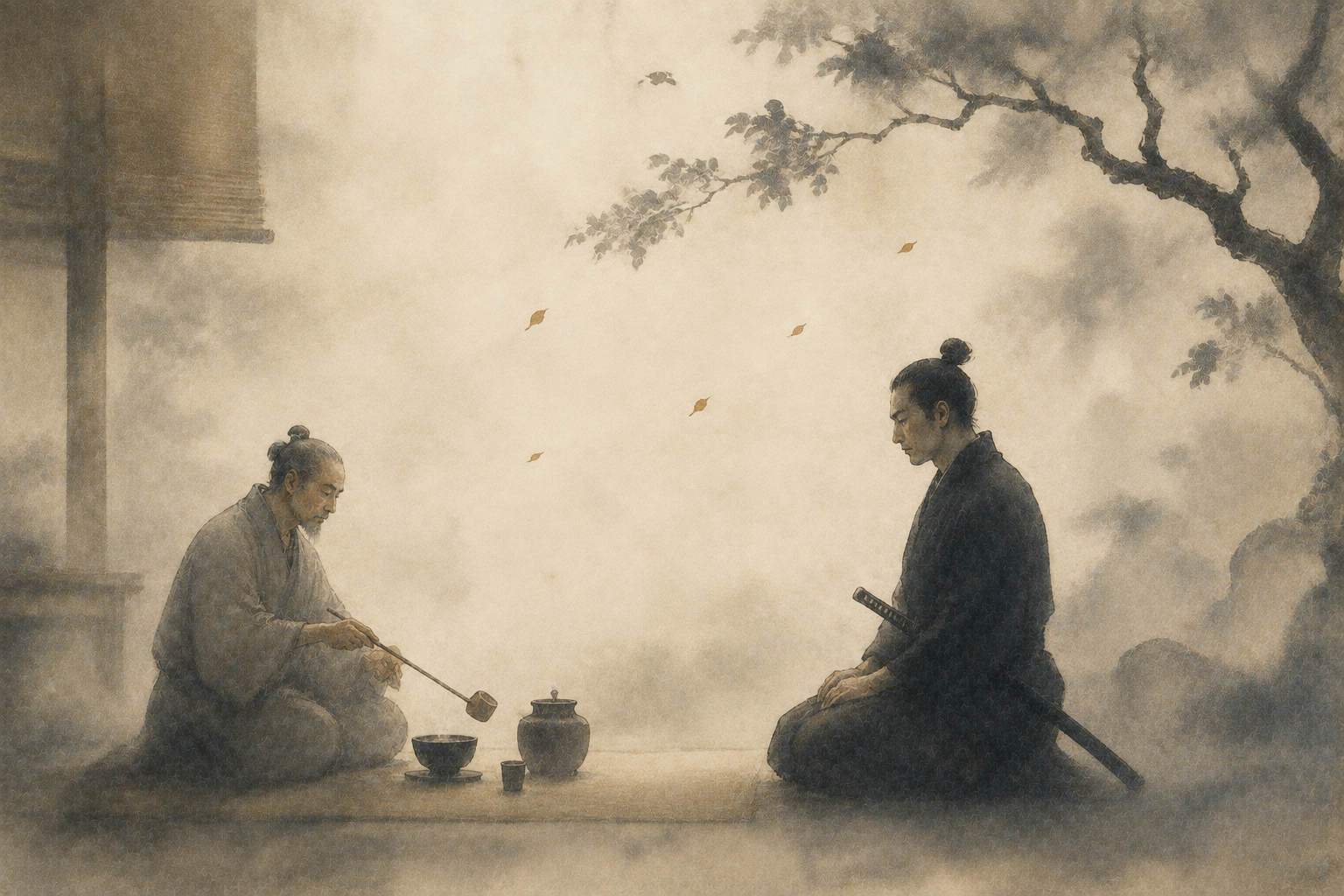
The Tea Master and the Samurai: A Zen Story About Fear and Presence
Quick Summary
- The tea master and samurai Zen story points to fear as a mental event, not a command.
- Presence isn’t a special mood; it’s attention returning to what’s actually happening.
- The “threat” often lives in images and predictions more than in the room itself.
- Small, ordinary actions (pouring, bowing, breathing) can steady the mind under pressure.
- The story isn’t about winning; it’s about meeting the moment without flinching away.
- Fear can be acknowledged without being obeyed.
- The lesson translates cleanly to modern stress: conflict, deadlines, and difficult conversations.
Introduction
You’ve probably heard some version of the tea master and samurai Zen story and felt unsure what it’s actually saying: is it praising bravery, dismissing fear, or romanticizing danger? The confusion usually comes from taking the samurai’s threat as the main point, when the real focus is the tea master’s relationship to his own mind in the middle of that threat. At Gassho, we translate Zen stories into practical, psychologically honest guidance without turning them into slogans.
In the classic telling, a samurai confronts a tea master, testing him with intimidation. The tea master doesn’t “defeat” the samurai with cleverness; he meets the situation with a grounded, simple presence. The power of the story is that it doesn’t require you to be fearless—it shows you what to do when fear is already here.
Read as a lens rather than a legend, the tea master and samurai Zen story becomes a study of attention: where it goes under pressure, how it narrows, and how it can return. The tea room is just a stage for something you’ve felt in your own life—when someone’s anger, authority, or unpredictability makes your mind start running ahead of reality.
GASSHO
Ask and learn about Buddhism in daily life.
GASSHO is a Buddhist community app where you can learn Buddhist teachings and ask questions to the head priest of Kongosanmaiin Temple on Mount Koya.
The central lens: fear as a story, presence as a choice
The core perspective in the tea master and samurai Zen story is simple: fear is often built from mental images, rehearsed outcomes, and self-protective narration. Those mental movements can be loud and convincing, but they are still movements of mind. The tea master’s “strength” is not the absence of fear; it’s the ability to see fear as something arising, not something that must be followed.
Presence, in this lens, isn’t mystical. It’s the act of returning attention to what is concretely happening: the weight of the body, the sound in the room, the next appropriate action. When attention returns to the immediate, the mind has less room to inflate the future into a certainty. The samurai’s blade (literal or symbolic) is real, but the mind’s extra commentary is optional.
The tea ceremony matters here because it’s made of clear, ordinary steps. A bowl is lifted. Water is poured. A gesture is completed. These are not distractions; they are anchors. The story suggests that when pressure rises, you don’t need a dramatic inner speech—you need a stable relationship with the next small reality.
Seen this way, the tea master and samurai Zen story is not a moral about “being tough.” It’s a practical lens: when fear appears, notice what part is sensation and what part is imagination, then place attention back into the simplest truthful thing you can do right now.
What it feels like in real life when fear meets attention
In ordinary life, fear often arrives before anything actually happens. A message comes in from a boss. A partner’s tone shifts. Someone’s silence feels loaded. The body tightens, and the mind starts producing a fast “movie” of what this could mean.
At first, attention tends to fuse with that movie. You don’t just have a thought; you live inside it. Your breathing changes. Your face changes. You start preparing arguments, apologies, or exits—sometimes without noticing you’ve left the room you’re standing in.
The tea master and samurai Zen story points to a different move: noticing the moment you’ve been pulled into prediction. Noticing doesn’t erase fear. It simply creates a small gap where you can choose what to do with your attention.
Then something very plain becomes possible: you feel your feet on the ground, you let the shoulders drop a fraction, you take in the actual expression on the other person’s face, you listen to the words that are truly being said (not the ones your mind is adding). The “threat” becomes more specific, less mythic.
From there, action becomes simpler. You ask one clarifying question instead of defending against five imagined accusations. You respond to the sentence that was spoken instead of the entire history you’re afraid is repeating. You slow down enough to choose a tone that doesn’t escalate the room.
Sometimes the situation really is tense. Presence doesn’t deny that. It just keeps you from multiplying the tension with extra mental noise. In the story’s terms, the tea master doesn’t “win” by overpowering the samurai; he stays close to reality, and that closeness itself changes the atmosphere.
And when you can’t fix the situation—when someone is committed to being harsh, or the outcome is uncertain—presence still matters. It keeps your dignity intact. It keeps your choices cleaner. It helps you do what is needed without adding unnecessary suffering on top of what is already hard.
Common misunderstandings that flatten the story
Misunderstanding 1: “The lesson is to be fearless.” The tea master and samurai Zen story is often retold as a bravery tale. But fearlessness is not required. The more realistic lesson is: fear can be present, and you can still act with steadiness.
Misunderstanding 2: “Presence means being passive.” Presence is not compliance. It’s clarity. A present response can include firm boundaries, a refusal, or leaving the situation. The difference is that the response comes from seeing clearly, not from panic.
Misunderstanding 3: “The tea ceremony is just aesthetic decoration.” In this story, the ceremony functions like a map of attention. The small forms are a way to keep the mind from scattering. It’s not about being fancy; it’s about being exact.
Misunderstanding 4: “The samurai is the villain and the tea master is the hero.” Zen stories often use characters as mirrors. The samurai can represent the mind’s aggression and urgency; the tea master can represent steadiness. The point isn’t to judge the characters—it’s to recognize these forces in yourself.
Misunderstanding 5: “If I’m present, I won’t feel anxiety.” Presence doesn’t guarantee comfort. It changes your relationship to discomfort. You may still feel the surge of adrenaline, but you’re less likely to be dragged into catastrophic narration.
Why this Zen story matters in modern pressure
The tea master and samurai Zen story stays relevant because modern life is full of “blades” that aren’t metal: performance reviews, public mistakes, social conflict, financial uncertainty, and the constant sense of being evaluated. The nervous system doesn’t care whether the threat is physical or social; it reacts, and the mind starts forecasting.
This story offers a grounded alternative to two common habits: collapsing (freezing, appeasing, avoiding) or escalating (attacking, proving, dominating). Presence is the third option: staying with what is true, then doing the next appropriate thing without adding extra drama.
It also reframes “strength.” Strength isn’t only intensity or confidence. Sometimes strength is the ability to keep your attention from being hijacked. Sometimes it’s the ability to speak one honest sentence instead of performing a personality.
And it’s practical. You can apply the story in a meeting by slowing your speech slightly. You can apply it in a difficult conversation by listening for what was actually said. You can apply it alone by noticing when your mind is rehearsing disaster and returning to one concrete task.
Most importantly, the story points to a kind of dignity that doesn’t depend on outcomes. Even if the samurai remains unpredictable, the tea master’s mind is not for sale. That is a form of freedom that translates well to everyday life.
Conclusion
The tea master and samurai Zen story isn’t asking you to become unshakable. It’s pointing to something more attainable and more honest: fear will arise, the mind will tell stories, and you can still return to the immediacy of what’s here. Presence is not a performance; it’s a repeated choice to meet the moment directly.
If you take one lesson from the story, let it be this: when pressure spikes, don’t argue with fear—locate what is real, do the next simple action, and let the rest of the mental noise pass without appointing it as your leader.
Ask a Buddhist priest
Have a question about Buddhism?
In the GASSHO app, you can ask questions about Buddhist teachings, daily concerns, and how to understand Buddhism in everyday life.
Frequently Asked Questions
- FAQ 1: What is the main lesson of the tea master and samurai Zen story?
- FAQ 2: Is the tea master and samurai Zen story about being fearless?
- FAQ 3: Why is a tea master used in the tea master and samurai Zen story?
- FAQ 4: What does the samurai symbolize in the tea master and samurai Zen story?
- FAQ 5: How does the tea master show presence in the tea master and samurai Zen story?
- FAQ 6: Is the tea master and samurai Zen story meant to be historically accurate?
- FAQ 7: What role does the tea ceremony play in the tea master and samurai Zen story?
- FAQ 8: How can I apply the tea master and samurai Zen story to anxiety at work?
- FAQ 9: Does the tea master and samurai Zen story encourage passivity?
- FAQ 10: What is the “fear and presence” contrast in the tea master and samurai Zen story?
- FAQ 11: Why do versions of the tea master and samurai Zen story differ?
- FAQ 12: What should I focus on when reading the tea master and samurai Zen story?
- FAQ 13: Is the tea master “enlightened” in the tea master and samurai Zen story?
- FAQ 14: How does the tea master and samurai Zen story relate to conflict conversations?
- FAQ 15: What is one practical takeaway from the tea master and samurai Zen story I can use today?
FAQ 1: What is the main lesson of the tea master and samurai Zen story?
Answer: The main lesson is that fear can arise without needing to control your actions; presence means returning attention to what is actually happening and responding from clarity rather than prediction.
Takeaway: Fear can be acknowledged without being obeyed.
FAQ 2: Is the tea master and samurai Zen story about being fearless?
Answer: Not really. Most readings treat it as a story about meeting fear directly—feeling it, noticing the mind’s exaggerations, and still acting with steadiness.
Takeaway: The point is steadiness with fear, not the absence of fear.
FAQ 3: Why is a tea master used in the tea master and samurai Zen story?
Answer: The tea master represents trained attention expressed through simple forms—small, deliberate actions that keep the mind close to the present moment under pressure.
Takeaway: Ordinary actions can anchor attention when stress rises.
FAQ 4: What does the samurai symbolize in the tea master and samurai Zen story?
Answer: Beyond being a character, the samurai often symbolizes intimidation, urgency, and the mind’s tendency to force outcomes—an external mirror for internal pressure.
Takeaway: The “threat” can be read as a mirror of inner reactivity.
FAQ 5: How does the tea master show presence in the tea master and samurai Zen story?
Answer: Presence is shown through composure and precision: staying with the immediate task, not feeding mental projections, and responding to what is real in the room rather than imagined futures.
Takeaway: Presence looks like attention returning to the next true step.
FAQ 6: Is the tea master and samurai Zen story meant to be historically accurate?
Answer: Many Zen stories function more like teaching parables than strict history; their value is in the psychological and practical insight they offer, not in documentary precision.
Takeaway: Treat it as a lens for experience, not a fact-check quiz.
FAQ 7: What role does the tea ceremony play in the tea master and samurai Zen story?
Answer: The tea ceremony highlights disciplined simplicity—clear steps that stabilize attention and reduce the mind’s tendency to spiral into fear-based narration.
Takeaway: Structure can support calm attention under stress.
FAQ 8: How can I apply the tea master and samurai Zen story to anxiety at work?
Answer: Use the story’s move: notice the mind’s predictions, return to immediate facts (the email, the agenda, the next sentence), and take one clean action instead of rehearsing worst-case outcomes.
Takeaway: Come back from prediction to the next concrete step.
FAQ 9: Does the tea master and samurai Zen story encourage passivity?
Answer: No. Presence can include firm boundaries and decisive action; it simply avoids acting from panic, ego-defense, or the need to dominate.
Takeaway: Calm clarity is not the same as doing nothing.
FAQ 10: What is the “fear and presence” contrast in the tea master and samurai Zen story?
Answer: Fear is the surge of sensation plus the mind’s added storyline; presence is the capacity to feel the surge while keeping attention rooted in what is actually occurring.
Takeaway: Presence changes your relationship to fear, not your humanity.
FAQ 11: Why do versions of the tea master and samurai Zen story differ?
Answer: Zen stories are often transmitted orally and adapted for emphasis; different versions may shift details while keeping the same core teaching about attention under threat.
Takeaway: Look for the consistent lesson, not perfect uniformity.
FAQ 12: What should I focus on when reading the tea master and samurai Zen story?
Answer: Focus on the inner mechanics: where attention goes when intimidation appears, how the mind builds a narrative, and what it looks like to return to the immediate moment.
Takeaway: Read it as a map of attention, not a tale of victory.
FAQ 13: Is the tea master “enlightened” in the tea master and samurai Zen story?
Answer: The story doesn’t require that interpretation. The tea master can be understood as someone practicing grounded attention—showing a human, repeatable way to meet fear.
Takeaway: The lesson works without labeling anyone as special.
FAQ 14: How does the tea master and samurai Zen story relate to conflict conversations?
Answer: It points to staying with what’s said and what’s needed now—listening carefully, speaking simply, and not letting imagined outcomes dictate your tone or words.
Takeaway: Respond to the real conversation, not the feared one.
FAQ 15: What is one practical takeaway from the tea master and samurai Zen story I can use today?
Answer: When you feel threatened or pressured, name what is factually happening, notice the mind’s extra story, and do one small, precise action that matches reality (one breath, one sentence, one task).
Takeaway: Precision in the present interrupts fear’s momentum.