



How the Six Realms Reflect Everyday States of Mind
Quick Summary
- The “six realms states of mind” can be read as everyday psychological climates, not distant mythology.
- Each realm describes a recognizable loop: what attention fixates on, what it fears, and what it craves.
- You can move through multiple realms in a single day, sometimes in a single conversation.
- The point isn’t labeling yourself; it’s noticing the moment a realm takes over your choices.
- Small interventions—pause, name the pull, soften the body, widen attention—often loosen the loop.
- Compassion becomes practical when you see others as “in a realm” rather than “being a problem.”
- Used gently, the six realms become a map for returning to balance without self-judgment.
Introduction
You might like the idea of the six realms, but the traditional imagery can feel too cosmic to apply when you’re just stressed at work, stuck in comparison online, or snapping at someone you love. The useful move is to treat the six realms as “six realms states of mind”: repeatable inner atmospheres that shape what you notice, what you assume, and how you react—often without permission. At Gassho, we focus on translating Buddhist maps into clear, everyday language you can actually use.
When these states are active, they don’t just color your mood; they narrow your options. You can feel as if you’re being reasonable while your attention is quietly locked into a single storyline: “I’m missing out,” “I’m under attack,” “Nothing is enough,” “I’m better than them,” “I just want comfort,” or “I can’t see a way forward.” Seeing the pattern doesn’t magically erase it, but it gives you a handle.
Reading the realms this way also makes them less moralistic. They aren’t “bad places” you deserve; they’re common human loops that arise under certain conditions—fatigue, fear, craving, pressure, loneliness, overstimulation. The question becomes practical: what realm is running right now, and what would help the mind widen again?
A Practical Lens for the Six Realms
As “six realms states of mind,” the realms describe how experience gets organized when the mind contracts around a particular drive. Each realm has a signature: a dominant emotion, a typical thought pattern, and a behavioral reflex. The realm isn’t the emotion itself; it’s the whole mini-world that emotion builds—complete with its own logic and selective memory.
Here’s a grounded way to hold the map. The realms are not a belief you must accept; they’re a set of metaphors for noticing. When you’re in a realm, attention tends to do three things: fixate (on a threat, a lack, a status marker), interpret (through a narrow story), and compel (toward a familiar reaction). The “realm” is that closed circuit.
In everyday terms, you can think of the six realms like six default modes the nervous system and mind slip into. They’re not permanent identities. You can be generous in the morning, competitive at noon, numb in the afternoon, and anxious at night. The map becomes useful when it helps you catch the shift earlier—before words are said, purchases are made, or relationships are strained.
Most importantly, the realms are relational. They affect how you see other people: as rivals, obstacles, resources, judges, or background noise. When you recognize a realm-state, you’re not trying to win against yourself; you’re learning to step out of a tunnel and return to a wider field of choice.
GASSHO
Ask and learn about Buddhism in daily life.
GASSHO is a Buddhist community app where you can learn Buddhist teachings and ask questions to the head priest of Kongosanmaiin Temple on Mount Koya.
How the Realms Show Up in Ordinary Moments
The “hell realm” state of mind often feels like pressure with no exit. The body tightens, time feels urgent, and the mind repeats a harsh soundtrack: “This is unbearable,” “I can’t handle this,” “It’s all going wrong.” In this state, even small friction—an email, a delay, a tone of voice—can land like an attack because the system is already overheated.
The “hungry ghost” state of mind is the feeling of reaching without arriving. You refresh, snack, scroll, shop, plan, or seek reassurance, but satisfaction doesn’t stick. Attention is trained on what’s missing, and the moment you get something, the mind moves the goalposts. It can look productive from the outside while feeling quietly desperate inside.
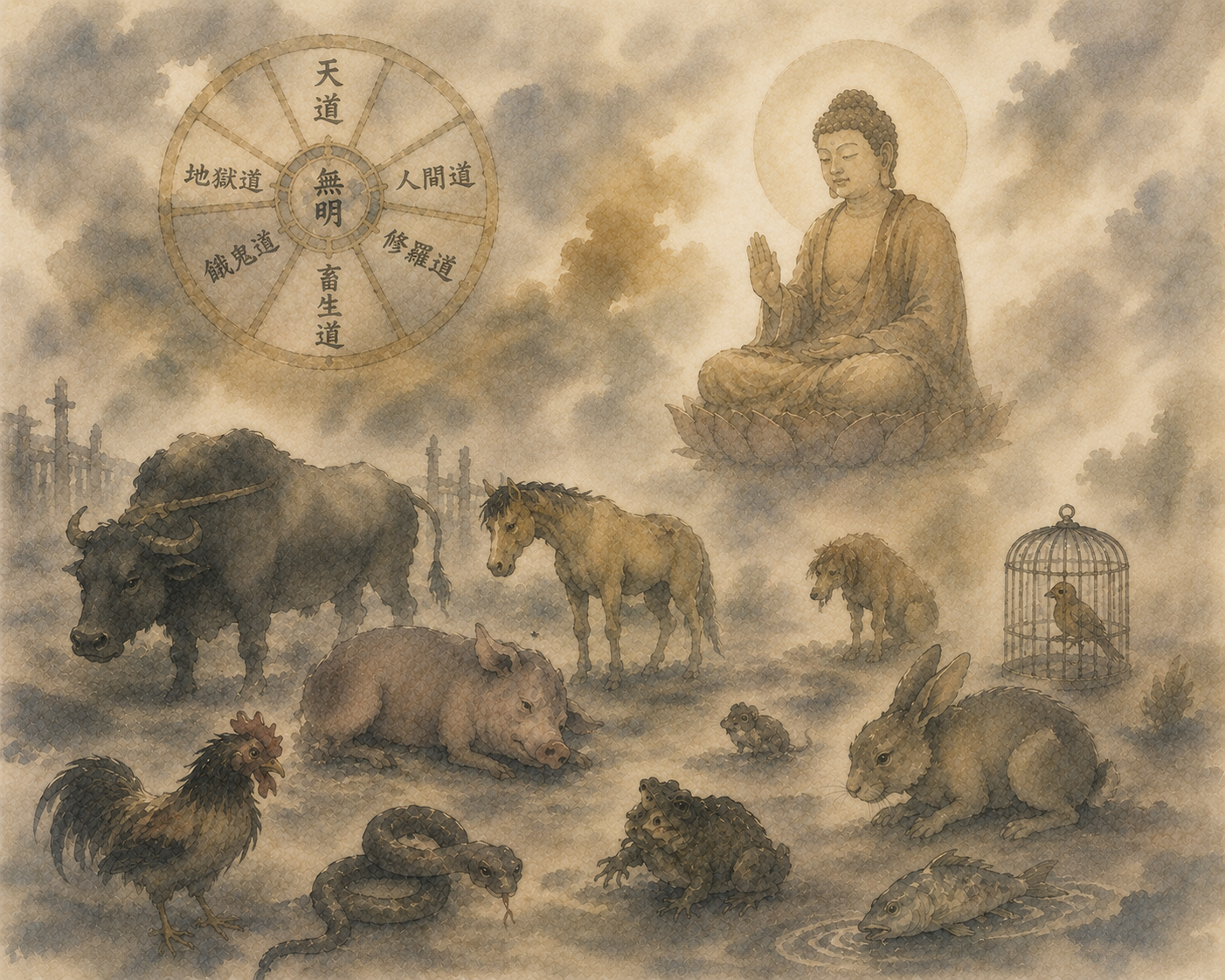
The “animal realm” state of mind is not an insult; it’s a description of going on autopilot. You narrow to comfort and habit: avoid discomfort, seek the familiar, conserve energy. In this state, curiosity drops. You might procrastinate, binge, or go numb—not because you’re lazy, but because the mind is prioritizing immediate safety and ease.
The “asura realm” (often described as jealousy or titanic competitiveness) shows up as comparison with heat. Someone else’s success feels personal. You rehearse arguments, track status, and scan for unfairness. Even when you “win,” the win doesn’t settle you, because the deeper drive is to secure worth through being above or ahead.
The “human realm” state of mind is the most workable because it includes friction without being consumed by it. You can feel desire and disappointment, but you can also reflect, learn, and adjust. Attention is flexible enough to notice consequences. This is the state where you can apologize sincerely, change a plan, or tell the truth without dramatizing it.
The “deva realm” (god realm) state of mind is pleasant, bright, and subtly risky. Things are going well, and the mind starts assuming they will keep going well. You may become a little insulated: less patient with inconvenience, less aware of others’ struggles, more attached to comfort and praise. The trap isn’t happiness; it’s the unconscious bargain: “I’ll be okay as long as this never changes.”
In real life, these states blend. A deva-like high can flip into hungry ghost grasping when it fades. Asura comparison can tip into hell-realm rage when you feel disrespected. The value of the map is noticing the pivot point: the moment the mind stops relating and starts defending a realm.
Common Misreadings That Make the Map Less Helpful
A frequent misunderstanding is treating the six realms states of mind as fixed personality types: “I’m a hungry ghost,” “They’re an asura.” That turns a momentary pattern into an identity and usually adds shame or blame. The map works better as a weather report: what’s happening now, what conditions feed it, and what helps it pass.
Another misreading is using the realms as a hierarchy for spiritual superiority. “Human realm good, animal realm bad” is too crude for lived experience. Autopilot can be protective when you’re overwhelmed; pleasure can be restorative; competitiveness can signal a need for recognition; craving can point to loneliness. The question isn’t which realm is “worse,” but whether the state is narrowing your freedom and kindness.
People also assume the goal is to stay in the “human realm” all the time. But minds fluctuate. The practical aim is earlier recognition and gentler recovery. If you can notice “asura energy is here” before you send the message, or “hungry ghost is driving” before you buy the thing, the map has done its job.
Finally, some readers dismiss the realms because they don’t want metaphysics. You don’t need metaphysics for this to work. You can treat the realms as a compact vocabulary for patterns of attention and reaction—one that helps you speak about inner life without making it overly clinical or overly mystical.
Why This View Changes Daily Life
Seeing the six realms states of mind in real time creates a small gap between impulse and action. That gap is where choice lives. Instead of “I must respond,” you get “A hell-realm surge is here,” or “This is hungry ghost reaching.” Naming the realm isn’t a trick; it’s a way of widening attention so the state is no longer the whole world.
This lens also improves relationships because it reduces personalization. When someone is sharp, defensive, or needy, you can still set boundaries, but you may stop treating their behavior as their entire character. “They’re in a realm” invites a different response: slower speech, fewer assumptions, more clarity. It doesn’t excuse harm; it supports wiser engagement.
On a practical level, each realm suggests a different kind of support. Hell realm often needs cooling and simplification: fewer inputs, slower breathing, smaller next steps. Hungry ghost often needs nourishment that actually lands: rest, honest connection, a single completed task, or a clean “enough.” Animal realm often needs gentle activation: light movement, daylight, one doable commitment. Asura realm often needs de-escalation of comparison: gratitude, perspective, and contact with what you value beyond winning. Deva realm often benefits from remembering change: appreciation without clinging, generosity, and humility.
Most of all, the map encourages responsibility without harshness. You can acknowledge, “This realm is here,” without concluding, “Something is wrong with me.” That shift tends to reduce secondary suffering—the extra pain created by fighting your own mind.
Conclusion
The six realms don’t have to be distant cosmology to be useful. Read as “six realms states of mind,” they become a clear, humane way to recognize the inner worlds you cycle through—pressure, craving, numbness, rivalry, workable humanity, and comfortable ease. You don’t need to force the mind into a perfect state; you only need to notice when a realm is narrowing your view.
Try using the map lightly for a week: once or twice a day, pause and ask which realm is most active right now. Then do one small thing that widens the field—soften the body, slow the pace, tell the truth, or choose “enough.” Over time, the realms become less like prisons and more like signposts pointing back to balance.
Ask a Buddhist priest
Have a question about Buddhism?
In the GASSHO app, you can ask questions about Buddhist teachings, daily concerns, and how to understand Buddhism in everyday life.
Frequently Asked Questions
- FAQ 1: What does “six realms states of mind” mean in everyday life?
- FAQ 2: Are the six realms states of mind permanent traits or temporary moods?
- FAQ 3: Can I be in more than one of the six realms states of mind at once?
- FAQ 4: How do I recognize the hell realm as a state of mind?
- FAQ 5: What is the hungry ghost realm as a state of mind?
- FAQ 6: What does the animal realm state of mind look like in daily routines?
- FAQ 7: How does the asura realm state of mind relate to jealousy and comparison?
- FAQ 8: What is the human realm as a state of mind, and why is it considered workable?
- FAQ 9: What is the deva realm state of mind in modern life?
- FAQ 10: How can I use the six realms states of mind without judging myself?
- FAQ 11: Do the six realms states of mind imply spiritual “levels” or progress?
- FAQ 12: What’s a quick way to shift out of a strong realm-state in the moment?
- FAQ 13: How do the six realms states of mind affect relationships?
- FAQ 14: Is it helpful to label other people with the six realms states of mind?
- FAQ 15: What’s the main benefit of viewing the six realms as states of mind?
FAQ 1: What does “six realms states of mind” mean in everyday life?
Answer: It means using the six realms as a map of common mental-emotional climates—like pressure, craving, numbness, competitiveness, balanced responsiveness, and comfortable ease—that can take over your attention and behavior in ordinary situations.
Takeaway: Treat the realms as repeatable mind-states, not distant mythology.
FAQ 2: Are the six realms states of mind permanent traits or temporary moods?
Answer: They’re best understood as temporary patterns that can arise and pass, sometimes many times in a day. They can feel convincing while they’re active, but they aren’t fixed identities.
Takeaway: A realm is a “mode,” not who you are.
FAQ 3: Can I be in more than one of the six realms states of mind at once?
Answer: Yes. You might notice a dominant realm with secondary tones from another—like deva comfort mixed with hungry ghost restlessness, or asura comparison tipping into hell-realm anger when threatened.
Takeaway: Real experience is blended; look for the strongest pull.
FAQ 4: How do I recognize the hell realm as a state of mind?
Answer: It often shows up as urgency, tightness, and a sense that something is unbearable or inescapable. Attention narrows to threat and fault, and the body may feel hot, clenched, or braced.
Takeaway: Hell realm is “no-exit pressure” plus a narrowed field of attention.
FAQ 5: What is the hungry ghost realm as a state of mind?
Answer: It’s the experience of reaching without arriving—wanting, refreshing, consuming, or seeking reassurance while satisfaction doesn’t last. The mind keeps locating “enough” just one step ahead.
Takeaway: Hungry ghost is craving that can’t settle.
FAQ 6: What does the animal realm state of mind look like in daily routines?
Answer: It often looks like autopilot: sticking to comfort, avoiding discomfort, and defaulting to habit. Curiosity and reflection drop, and you may feel foggy, inert, or narrowly focused on immediate ease.
Takeaway: Animal realm is “habit and safety first,” with reduced flexibility.
FAQ 7: How does the asura realm state of mind relate to jealousy and comparison?
Answer: Asura mind is energized by rivalry: scanning for status, fairness, and advantage. Someone else’s success can feel like your loss, and the mind rehearses arguments or strategies to regain position.
Takeaway: Asura realm is comparison with heat and a need to “win.”
FAQ 8: What is the human realm as a state of mind, and why is it considered workable?
Answer: Human realm mind includes desire and disappointment but keeps enough balance to learn, reflect, and choose. Attention is flexible, consequences are visible, and you can respond rather than only react.
Takeaway: Human realm is the zone where insight and adjustment are most available.
FAQ 9: What is the deva realm state of mind in modern life?
Answer: It’s a pleasant, comfortable state where things are going well and the mind subtly assumes it will continue. The risk is clinging to comfort, becoming less patient with inconvenience, or ignoring change until it arrives.
Takeaway: Deva realm isn’t “bad”—the trap is attachment to ease.
FAQ 10: How can I use the six realms states of mind without judging myself?
Answer: Use the realms as neutral labels for patterns: “This is hungry ghost energy,” “This is asura comparison.” Keep the tone observational, then choose one small stabilizing action (pause, breathe, simplify, connect, or rest).
Takeaway: Name the realm gently, then widen the field with one small step.
FAQ 11: Do the six realms states of mind imply spiritual “levels” or progress?
Answer: Not when used as states of mind. They describe recurring loops of attention and reaction, not a ladder. People shift among them depending on stress, support, sleep, relationships, and circumstances.
Takeaway: The realms are patterns to notice, not ranks to achieve.
FAQ 12: What’s a quick way to shift out of a strong realm-state in the moment?
Answer: Try a three-part reset: (1) name the realm-state quietly, (2) soften one area of the body (jaw, shoulders, belly), and (3) widen attention to include the room, sounds, and your next kind or practical action.
Takeaway: Label, soften, widen—then choose one sane next step.
FAQ 13: How do the six realms states of mind affect relationships?
Answer: Each realm changes what you assume about others: hell realm sees threats, hungry ghost seeks filling, asura compares, animal realm withdraws, deva realm overlooks, and human realm relates more directly. Recognizing the active realm can reduce escalation and improve communication.
Takeaway: When you see the realm, you stop treating the reaction as the whole truth.
FAQ 14: Is it helpful to label other people with the six realms states of mind?
Answer: It’s usually more helpful to apply the map to your own mind first. If you use it for others, do it privately and compassionately—“They may be in a tight realm-state”—without turning it into a diagnosis or a way to dismiss them.
Takeaway: Use the realms to increase empathy, not to categorize people.
FAQ 15: What’s the main benefit of viewing the six realms as states of mind?
Answer: The main benefit is choice. When you recognize a realm-state early, you’re less likely to act out its script and more likely to respond with clarity, restraint, and care—toward yourself and others.
Takeaway: The map is for regaining freedom in everyday moments.