



Sacred Buddhist Symbols and What They Represent
Quick Summary
- Sacred Buddhist symbols are best understood as practical reminders—visual cues that point attention toward qualities like clarity, compassion, and steadiness.
- Many symbols (lotus, wheel, stupa, vajra, endless knot) communicate “how to live” more than “what to believe.”
- The same symbol can carry different emphases depending on context, art style, and local culture, without losing its core meaning.
- Symbols work through repetition: seeing them often can gently shape intention, behavior, and the way you respond under stress.
- Respect matters: placement, handling, and use of sacred imagery can be done thoughtfully without needing to be “perfect.”
- Misreadings are common—especially treating symbols as lucky charms, secret codes, or purely decorative motifs.
- Learning a few core symbols deeply is more useful than memorizing dozens of names.
Introduction
You keep seeing sacred Buddhist symbols—on temple doors, statues, jewelry, tattoos, and social media—and the meanings feel either vague (“it’s spiritual”) or overly rigid (“it means exactly this”). The truth is more grounded: these symbols are designed to train attention and values, not to test your knowledge, and you can read them in a way that’s both respectful and practical. At Gassho, we focus on clear, experience-based explanations of Buddhist imagery without turning it into superstition or trivia.
Some symbols are immediately recognizable, like the lotus or the Dharma wheel. Others are subtle: a hand gesture, a footprint, a particular posture, or a geometric pattern that quietly repeats across cultures. When you learn what they represent, you start noticing how they function—like signposts that point the mind back to steadiness, ethical restraint, and compassion in the middle of ordinary life.
Below is a practical way to understand sacred Buddhist symbols: what they point to, how they affect your inner life, and how to avoid common misunderstandings—especially when these images show up outside traditional settings.
A Practical Lens for Reading Sacred Buddhist Symbols
A helpful way to approach sacred Buddhist symbols is to treat them as “attention tools.” They are not primarily decorations, nor are they puzzles with one correct answer. They are visual reminders that nudge the mind toward certain qualities: wakefulness, compassion, balance, humility, and the willingness to see things clearly.
In this lens, a symbol is less like a label and more like a prompt. The lotus doesn’t just “mean purity”; it prompts you to remember that clarity can grow in messy conditions. The Dharma wheel doesn’t just “mean Buddhism”; it prompts you to remember practice—how you speak, choose, and respond—moment by moment.
It also helps to accept that symbols are layered. A single image can hold multiple meanings without becoming confusing. The layers usually move from simple to subtle: a concrete picture (a flower, a wheel, a knot), a human value (patience, integrity, compassion), and then a lived insight (how clinging creates stress, how kindness changes perception, how attention steadies the heart).
Finally, context matters. The same sacred Buddhist symbol can be used in a temple, in art, or in personal life with different emphasis. Rather than forcing one fixed definition, it’s often more accurate to ask: “What quality is this image trying to evoke right now?”
How These Symbols Show Up in Everyday Experience
Seeing a sacred Buddhist symbol can create a small pause. That pause is the point. It interrupts autopilot—scrolling, rushing, reacting—and gives you a second to choose a better response.
For example, the Dharma wheel can function like a quiet reminder of direction. When you feel pulled into gossip, harsh speech, or impulsive decisions, the image can bring attention back to: “What’s the next skillful step?” Not perfect—just skillful.
The lotus often lands emotionally rather than intellectually. When life feels muddy—conflict at home, uncertainty at work, a mind that won’t settle—the lotus image can normalize the mess without romanticizing it. You notice the urge to escape, then you notice the possibility of staying present and acting cleanly anyway.
Symbols like the endless knot can highlight how quickly the mind weaves stories: “They disrespected me,” “I’m failing,” “This will never change.” The knot becomes a mirror for mental entanglement. You may not stop the story instantly, but you can see it sooner, and that earlier noticing reduces the force of the reaction.
When you encounter a stupa or a Buddha image, the effect can be surprisingly physical: shoulders soften, breathing slows, the face relaxes. This isn’t mystical; it’s conditioning in the best sense. Repeated exposure to calm, dignified imagery trains the nervous system toward steadiness.
Even hand gestures (mudras) can work this way. A gesture associated with fearlessness or generosity can remind you what you want to embody in the next conversation. You notice the impulse to defend yourself, and you experiment with a softer tone.
Over time, sacred Buddhist symbols can become less about “What does this mean?” and more about “What does this invite from me right now?” That shift—from collecting meanings to practicing qualities—is where symbols become genuinely useful.
Key Sacred Buddhist Symbols and What They Represent
Below are some of the most widely recognized sacred Buddhist symbols, described in a way that stays practical and respectful. Think of these as starting points rather than final definitions.
The Lotus (Padma)
Often associated with purity and awakening, the lotus grows from muddy water and opens toward light. As a lived reminder, it points to the possibility of clarity and kindness arising within imperfect conditions—without denying the mud.
The Dharma Wheel (Dharmachakra)
The wheel commonly represents the teachings in motion: guidance that is meant to be practiced, not merely admired. Its circular form suggests continuity and return—coming back again and again to ethical action, steady attention, and wise understanding.
The Stupa
A stupa is a sacred structure that often symbolizes the presence of awakened qualities and the path of cultivation. As a symbol, it can be read as “gathering and stabilizing”: collecting scattered attention and orienting life toward what is wholesome.
The Vajra (Dorje)
Frequently associated with indestructibility and clarity, the vajra points to a mind that can be firm without being aggressive. In everyday terms: stable values, clear perception, and the ability to meet difficulty without collapsing or hardening.
The Endless Knot
This interlaced pattern is often linked with interdependence and the way causes and conditions weave together. It can also reflect the mind’s tendency to tangle itself in loops—inviting you to notice where you can simplify, release, and respond more cleanly.
The Bodhi Tree and Bodhi Leaf
These images commonly represent awakening and the conditions that support it: shelter, patience, and steady presence. As a prompt, the Bodhi tree asks: “What supports my clarity today?”
The Buddha Image
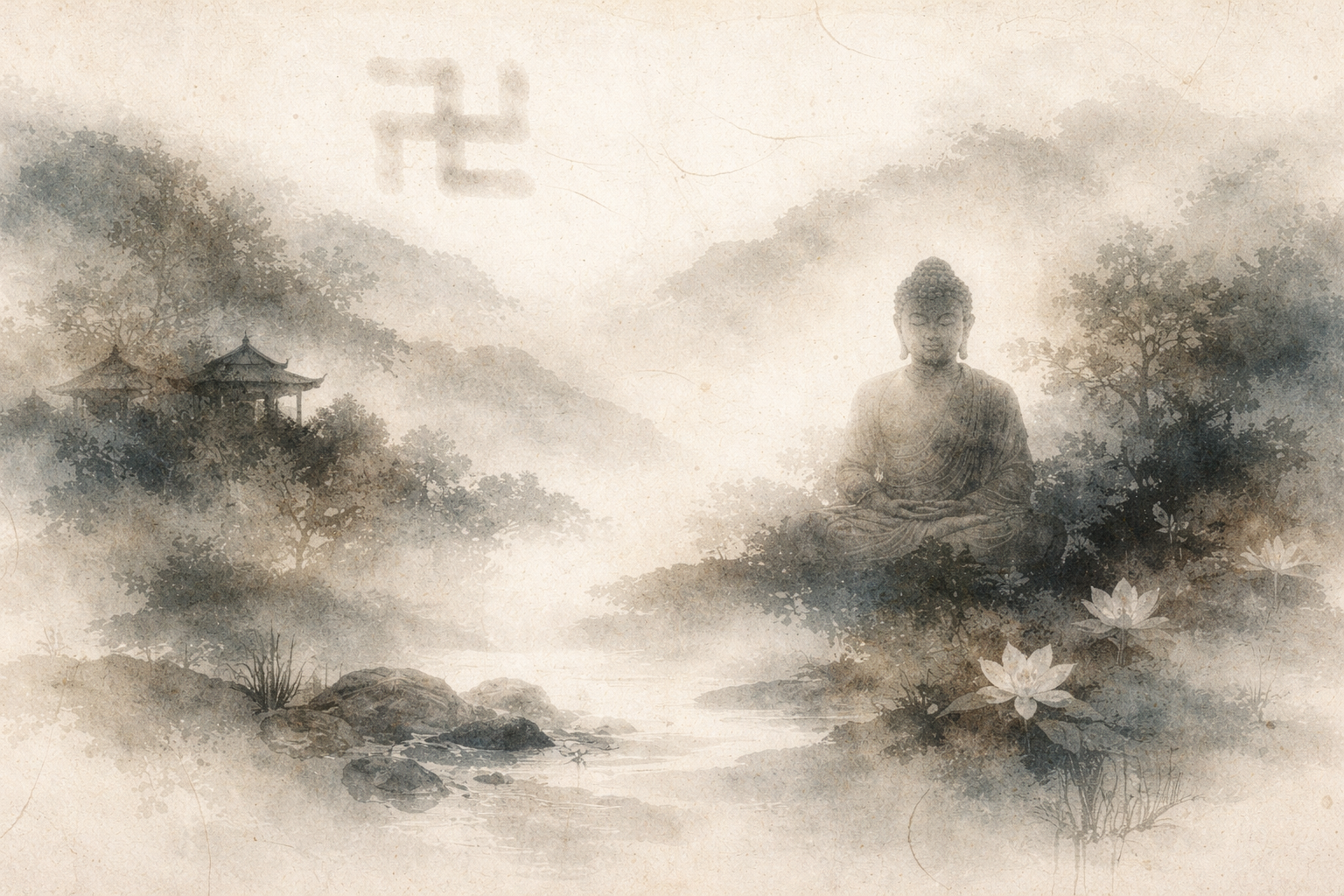
Rather than being a “god icon,” a Buddha image is often approached as a representation of awakened qualities—composure, compassion, and clear seeing. The posture and expression are part of the teaching: calm is possible; dignity is possible; kindness is possible.
Mudras (Sacred Hand Gestures)
Mudras communicate inner qualities through the body: reassurance, generosity, steadiness, teaching, or meditation. They work like a silent language—less about doctrine, more about embodiment.
The Lion
In Buddhist art, the lion can symbolize courage and the confident proclamation of truth. Practically, it can remind you that clarity doesn’t need to be timid, and compassion doesn’t need to be weak.
The Conch Shell
Often used as a symbol of the far-reaching sound of teachings, the conch can be read as “calling attention back.” In daily life, it points to the value of remembering what matters when you’re distracted.
Common Misunderstandings That Flatten the Meaning
Mistaking symbols for lucky charms. Sacred Buddhist symbols are sometimes treated like spiritual insurance—wear it, display it, and good things will happen. A more grounded reading is that symbols support intention and attention; they don’t replace choices, effort, or ethics.
Assuming every symbol has one fixed definition. People often search for a single “official” meaning. In practice, symbols carry a range of meanings shaped by context. The core function remains consistent: pointing the mind toward wholesome qualities.
Reducing sacred imagery to aesthetics. It’s fine to appreciate beauty, but when a symbol becomes only décor, its purpose is lost. Even a brief moment of recollection—“What does this invite me to embody?”—restores the symbol’s depth.
Over-mystifying everything. Not every detail is a secret code. Sometimes a lotus is simply a lotus used to evoke a simple truth: growth is possible. Keeping meanings practical prevents confusion and keeps the symbol connected to lived experience.
Using sacred Buddhist symbols without regard for respect. Misuse is often unintentional: placing sacred images in inappropriate locations, using them to shock, or treating them as disposable. Respect doesn’t require perfection; it requires care and a willingness to learn.
Why These Symbols Still Matter in Modern Life
Modern life is saturated with symbols already—logos, notifications, status markers—many of which train craving, comparison, and distraction. Sacred Buddhist symbols can serve as counter-symbols: reminders that train steadiness, restraint, and compassion.
They also offer a nonverbal way to reconnect with values. When you’re tired, stressed, or emotionally flooded, long explanations don’t land. A simple image can land. It can re-orient you faster than a paragraph of advice.
Symbols can support ethical life in a quiet way. A Dharma wheel on a desk can be a prompt before sending a sharp email. A lotus in a room can be a reminder to keep your dignity during conflict. The point isn’t to perform spirituality; it’s to remember your intention.
Finally, sacred Buddhist symbols can help you relate to tradition without needing to adopt an identity. You can let a symbol do its job—steadying attention and encouraging kindness—without turning it into a badge or a debate.
Conclusion
Sacred Buddhist symbols are most powerful when you treat them as living reminders rather than static definitions. Learn a few core images, notice what they evoke in you, and let them guide small choices: a calmer response, a kinder word, a clearer boundary, a more honest look at what’s happening inside.
If you want a simple next step, choose one symbol you already encounter—lotus, wheel, endless knot, stupa—and practice reading it as a prompt: “What quality is this asking me to embody today?”
Frequently Asked Questions
- FAQ 1: What makes a symbol “sacred” in sacred Buddhist symbols?
- FAQ 2: Are sacred Buddhist symbols meant to be worshipped?
- FAQ 3: What are the most common sacred Buddhist symbols?
- FAQ 4: What does the Dharma wheel represent as a sacred Buddhist symbol?
- FAQ 5: What does the lotus represent among sacred Buddhist symbols?
- FAQ 6: What does the endless knot mean as a sacred Buddhist symbol?
- FAQ 7: What does the vajra (dorje) represent in sacred Buddhist symbols?
- FAQ 8: What is the meaning of a stupa as a sacred Buddhist symbol?
- FAQ 9: Do sacred Buddhist symbols have the same meaning in every country?
- FAQ 10: Can sacred Buddhist symbols be used as decoration?
- FAQ 11: Is it disrespectful to wear sacred Buddhist symbols as jewelry?
- FAQ 12: Are tattoos of sacred Buddhist symbols considered appropriate?
- FAQ 13: How can I tell if a design is actually a sacred Buddhist symbol?
- FAQ 14: Why do sacred Buddhist symbols appear so often in Buddhist art?
- FAQ 15: What is a respectful way to learn sacred Buddhist symbols without turning them into superstition?
FAQ 1: What makes a symbol “sacred” in sacred Buddhist symbols?
Answer: In this context, “sacred” means the symbol is treated as worthy of respect because it points to awakening-related qualities (clarity, compassion, ethical restraint) and is used to support recollection and practice, not just decoration.
Takeaway: Sacred Buddhist symbols are respected because of what they are meant to evoke and train in the mind.
FAQ 2: Are sacred Buddhist symbols meant to be worshipped?
Answer: Many people relate to them with reverence, but the symbol itself is typically understood as a representation or reminder of qualities and teachings rather than a demand for worship. How it’s approached often depends on culture and personal devotion.
Takeaway: A sacred Buddhist symbol is usually a pointer and reminder, even when treated reverently.
FAQ 3: What are the most common sacred Buddhist symbols?
Answer: Common sacred Buddhist symbols include the lotus, Dharma wheel (Dharmachakra), stupa, endless knot, vajra (dorje), Bodhi tree/leaf, Buddha images, and mudras (hand gestures) depicted in art.
Takeaway: Start with a few widely seen sacred Buddhist symbols and learn their core themes.
FAQ 4: What does the Dharma wheel represent as a sacred Buddhist symbol?
Answer: The Dharma wheel commonly represents the teachings in motion—guidance meant to be practiced. It can also suggest continuity and returning again and again to wise understanding, ethical action, and steady attention.
Takeaway: The Dharma wheel points to practice and direction, not just identity.
FAQ 5: What does the lotus represent among sacred Buddhist symbols?
Answer: The lotus is often associated with purity and awakening because it rises from muddy water and blooms cleanly. Practically, it represents the possibility of clarity and compassion arising within imperfect conditions.
Takeaway: The lotus is a reminder that growth and clarity can appear even in “muddy” life situations.
FAQ 6: What does the endless knot mean as a sacred Buddhist symbol?
Answer: The endless knot is commonly linked with interdependence and the way causes and conditions connect. It can also reflect how the mind entangles itself in looping stories, inviting simplification and release.
Takeaway: The endless knot points to connectedness—and to noticing mental tangles sooner.
FAQ 7: What does the vajra (dorje) represent in sacred Buddhist symbols?
Answer: The vajra is often associated with indestructibility and clear, stable awareness. Symbolically, it can suggest firmness without aggression—values and clarity that remain steady under pressure.
Takeaway: The vajra points to resilient clarity rather than force.
FAQ 8: What is the meaning of a stupa as a sacred Buddhist symbol?
Answer: A stupa can symbolize awakened presence, reverence, and the path of cultivation. As a visual cue, it often functions as an “orientation symbol,” gathering attention and pointing life toward what is wholesome.
Takeaway: The stupa represents recollection and inner orientation.
FAQ 9: Do sacred Buddhist symbols have the same meaning in every country?
Answer: Core themes are often shared, but emphasis and interpretation can vary by region, art style, and local culture. The most reliable approach is to learn the common meaning and then consider the specific context where the symbol appears.
Takeaway: Sacred Buddhist symbols are consistent in purpose but flexible in expression.
FAQ 10: Can sacred Buddhist symbols be used as decoration?
Answer: They can be displayed aesthetically, but it’s best to do so with respect—avoiding trivializing placement or use meant to shock. If you display a sacred Buddhist symbol, consider treating it as a reminder of values rather than a mere pattern.
Takeaway: Decoration is possible, but respectful intention and placement matter.
FAQ 11: Is it disrespectful to wear sacred Buddhist symbols as jewelry?
Answer: It depends on the symbol, how it’s worn, and the cultural setting. Wearing sacred Buddhist symbols respectfully usually means avoiding contexts that degrade the image and being mindful that some depictions (especially Buddha images) may be sensitive in certain communities.
Takeaway: Wearing sacred Buddhist symbols can be respectful when done thoughtfully and context-aware.
FAQ 12: Are tattoos of sacred Buddhist symbols considered appropriate?
Answer: Appropriateness varies widely by culture and location. If you’re considering a tattoo of sacred Buddhist symbols, research the specific symbol, common taboos (such as placement), and how it may be perceived in Buddhist communities where you live or travel.
Takeaway: With sacred Buddhist symbols, tattoos require extra cultural care and informed choices.
FAQ 13: How can I tell if a design is actually a sacred Buddhist symbol?
Answer: Look for consistent identification across reputable sources (museum descriptions, temple references, academic or well-established Buddhist resources). Be cautious with viral “symbol meaning” charts, which often mix traditions or invent claims.
Takeaway: Verify sacred Buddhist symbols through reliable, cross-checked references.
FAQ 14: Why do sacred Buddhist symbols appear so often in Buddhist art?
Answer: Because symbols teach without words. In art and architecture, sacred Buddhist symbols function as visual prompts for recollection—helping viewers remember qualities to cultivate and patterns of mind to release.
Takeaway: Sacred Buddhist symbols are used in art to train attention and values through repeated seeing.
FAQ 15: What is a respectful way to learn sacred Buddhist symbols without turning them into superstition?
Answer: Focus on what the symbol invites you to practice (patience, clarity, compassion), learn the basic shared meanings, and avoid treating the image as a guarantee of luck or protection. Let the symbol be a reminder that supports your choices and conduct.
Takeaway: Read sacred Buddhist symbols as practice prompts, not magical objects.