



Rebirth Without Belief: How to Understand It
Quick Summary
- “Rebirth without belief” can be approached as a way of noticing how patterns repeat and reshape a life, not as a demand for metaphysical certainty.
- In this lens, “rebirth” points to how a moment of anger, fear, or craving can recreate a whole world in the mind—again and again.
- You don’t need to force faith or disbelief; you can simply observe what gets carried forward: habits, reactions, and stories.
- Small shifts—pausing before replying, softening a grudge, resting when tired—can feel like a new “life” beginning inside the same day.
- This view stays close to experience: attention narrows, opens, clings, releases, and the “self” changes with it.
- Misunderstandings often come from treating rebirth as either literal dogma or total nonsense, instead of a description of continuity.
- What matters most is what you can verify in ordinary moments: what repeats, what loosens, and what becomes possible.
Introduction
If the word “rebirth” makes you tense up—because you can’t honestly say you believe it, but you also don’t want to dismiss a whole tradition—you’re not alone, and you’re not being difficult. The confusion usually comes from thinking there are only two options: accept a supernatural claim, or reject the topic entirely; “rebirth without belief” is a third option that stays close to what can be seen in daily life. This approach is written in the plain, practice-adjacent language used on Gassho, without asking you to sign onto metaphysics.
In everyday terms, “belief” often means holding an idea in the mind and defending it when challenged. But many people are not looking for another idea to defend—they’re looking for a way to understand why the same suffering keeps reappearing in new forms: the same argument with a partner, the same dread before work, the same self-criticism at night.
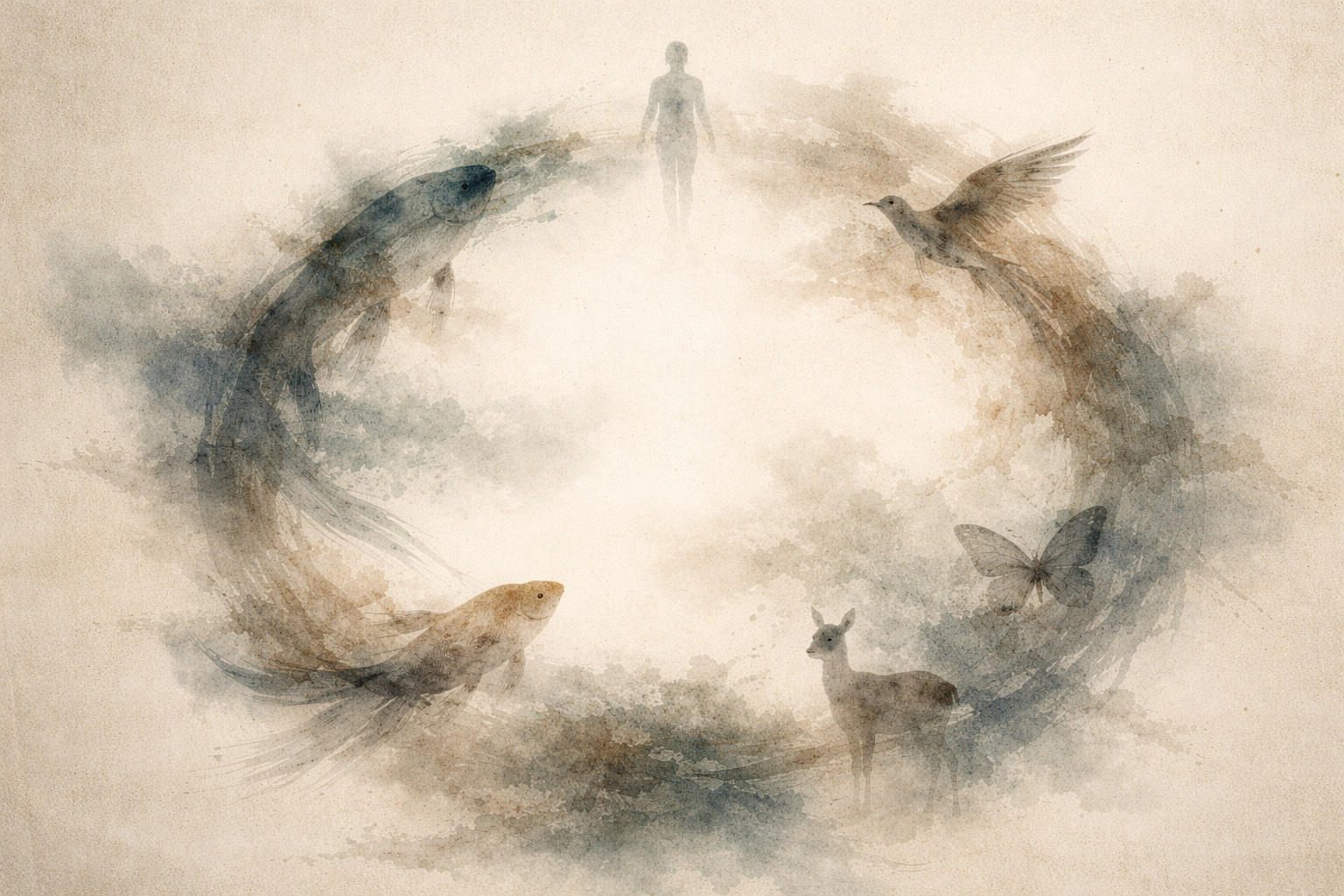
When rebirth is approached as a lens rather than a doctrine, it starts to sound less like a cosmic scoreboard and more like a description of continuity: what gets repeated, what gets reinforced, and what gets carried forward when no one is watching.
A Practical Lens for Rebirth Without Belief
“Rebirth without belief” can mean treating rebirth as something you notice rather than something you must agree with. The emphasis shifts from proving what happens after death to seeing what happens after a moment: after a harsh email, after a flash of jealousy, after a quiet kindness that changes the tone of a whole afternoon.
In ordinary life, a single reaction can recreate a familiar world. At work, one critical comment can instantly “rebirth” the old identity of being inadequate, and the mind begins living inside that identity as if it were the only truth available. In relationships, one remembered disappointment can “rebirth” suspicion, and suddenly every neutral detail looks like evidence.
This lens doesn’t require special vocabulary. It simply asks: what is being carried forward right now? Fatigue carried into a conversation becomes irritability. A grudge carried into a weekend becomes distance. A small moment of honesty carried into the next day becomes steadiness.
Seen this way, rebirth is not a belief you add on top of life. It is a way of noticing how life is already being remade—by attention, by habit, by what the mind repeats when it thinks no one will notice.
How Rebirth Shows Up in Ordinary Moments
Consider how quickly a mood becomes a world. You wake up slightly behind schedule, and the mind tightens. The day is “already ruined.” The body moves faster, the breath gets shallow, and the smallest obstacle feels personal. Nothing metaphysical is required to see it: a whole reality has been born from a few minutes of pressure.
Then notice how the same pattern can repeat with different costumes. One day it’s a meeting. Another day it’s a family text. Another day it’s a memory that arrives while washing dishes. The content changes, but the inner movement is familiar: contraction, story, defense. This is continuity—something being carried forward—without needing to turn it into a theory.
In conversation, rebirth can look like the instant you stop hearing the other person and start hearing your own inner prosecutor. The face stays calm, but inside there is a new “self” being born: the self who must win, the self who must not be wrong, the self who must not be seen as weak. The next sentence comes from that self, and the room subtly changes.
In fatigue, rebirth can look like the way tiredness becomes identity. It’s not just “I’m tired.” It becomes “I can’t handle anything,” or “No one helps me,” or “This is how my life is.” The mind doesn’t merely report a sensation; it builds a home around it and moves in.
In silence, rebirth can look like the urge to fill space. A quiet moment appears—waiting in line, sitting in a car, standing at the sink—and the hand reaches for the phone almost automatically. A familiar self is reborn: the self that needs stimulation, the self that can’t be alone with a simple moment. The movement is small, but the pattern is strong.
Sometimes rebirth is gentler. A sincere apology can “rebirth” trust where there was tension. A pause before replying can “rebirth” dignity in a conversation that was about to turn sharp. A simple act of cleaning a room can “rebirth” clarity when the mind felt scattered. The point is not to label these as spiritual achievements; it’s to see how quickly a life can change shape.
Over time, it becomes easier to recognize the moment a pattern begins—before it fully becomes “your personality” for the next hour. Noticing doesn’t erase anything. It just reveals that what feels solid is often a repeated construction, rebuilt so quickly it seems permanent.
Misunderstandings That Make Rebirth Feel Unusable
A common misunderstanding is that rebirth must be taken as a literal claim about what happens after death, and that anything less is a watered-down compromise. But “rebirth without belief” isn’t trying to win an argument; it’s trying to keep the inquiry honest. If certainty isn’t available, pretending it is tends to harden the mind rather than open it.
Another misunderstanding is swinging to the opposite extreme: treating rebirth as irrelevant because it can’t be proven in the usual way. In daily life, plenty of what matters is not “proven” first; it is recognized through repeated experience. The way resentment multiplies, the way kindness spreads, the way fear narrows perception—these are not abstract ideas, but patterns that can be seen.
It’s also easy to misunderstand rebirth as a story about becoming someone else, somewhere else, later. In lived experience, the more immediate question is how quickly “someone else” appears right here: the self who is patient, then the self who is defensive, then the self who is ashamed about being defensive. The shifts are ordinary, but they shape a life.
Finally, some people assume that if rebirth is framed without belief, it becomes merely psychological. But the point is not to reduce anything. It is to stay close to what can be observed: the way a moment conditions the next moment, and the way a life is quietly built from what is repeated.
Why This View Quietly Changes Daily Life
When rebirth is understood as continuity, everyday choices feel less isolated. A sharp remark isn’t just a sharp remark; it tends to reproduce a certain atmosphere, and that atmosphere tends to reproduce certain versions of you and others. A small restraint isn’t heroic; it simply interrupts a chain that would otherwise keep going.
This can show up in the smallest places: how a morning begins after checking messages, how the body feels after replaying an old argument, how a room feels after a quiet act of care. The “next moment” is not separate from the “previous moment,” and the mind learns this not as a lesson but as a lived fact.
In relationships, the idea becomes especially concrete. The same conflict can be reborn from the same tone of voice, the same timing, the same unspoken fear. And sometimes warmth is reborn just as simply—from listening a little longer than usual, or letting a silence be a silence.
Even in solitude, the continuity is intimate. The way you speak to yourself when you make a mistake tends to recreate the same inner climate. The way you allow a moment of quiet tends to recreate a different one. Nothing needs to be forced into certainty; it’s enough to notice what kind of world is being made, again and again, from ordinary causes.
Conclusion
Rebirth without belief can remain simple: this moment conditions the next, and a life is shaped by what is carried forward. The self that feels fixed is often a fresh construction, rebuilt from habit and attention. In the middle of an ordinary day, the Dharma can be checked quietly, by looking at what is being born right now.
Frequently Asked Questions
- FAQ 1: What does “rebirth without belief” actually mean?
- FAQ 2: Can I engage with rebirth without believing in an afterlife?
- FAQ 3: Is “rebirth without belief” just a psychological interpretation?
- FAQ 4: Does rebirth without belief contradict traditional Buddhist teachings?
- FAQ 5: How is rebirth without belief different from denial or skepticism?
- FAQ 6: What is being “reborn” if I don’t believe in a soul?
- FAQ 7: How does rebirth without belief relate to karma in daily life?
- FAQ 8: Can rebirth without belief help with anxiety or rumination?
- FAQ 9: Is rebirth without belief compatible with a scientific worldview?
- FAQ 10: Does rebirth without belief require meditation to make sense?
- FAQ 11: How can I talk about rebirth without belief with religious family or friends?
- FAQ 12: Does rebirth without belief reduce ethics to “self-help”?
- FAQ 13: What’s a simple everyday example of rebirth without belief?
- FAQ 14: If I don’t believe in rebirth, can I still take Buddhist practice seriously?
- FAQ 15: What is the main takeaway of rebirth without belief?
FAQ 1: What does “rebirth without belief” actually mean?
Answer: “Rebirth without belief” means approaching rebirth as a way to observe continuity in experience—how habits, reactions, and attention recreate a “world” from moment to moment—without requiring you to hold a fixed metaphysical position. It treats rebirth as something you can notice in daily life rather than something you must accept on faith.
Takeaway: Rebirth can be explored as an observable pattern of continuity, not a forced belief.
FAQ 2: Can I engage with rebirth without believing in an afterlife?
Answer: Yes. Rebirth without belief focuses on how the next moment is shaped by the previous one: how anger carries forward into speech, how fear carries forward into avoidance, how kindness carries forward into trust. This keeps the inquiry grounded in what you can verify, even if you remain undecided about afterlife claims.
Takeaway: You can work with rebirth as “what gets carried forward” without settling afterlife questions.
FAQ 3: Is “rebirth without belief” just a psychological interpretation?
Answer: It can sound psychological because it stays close to mind, behavior, and repetition, but the intent is simpler than a theory: it points to lived continuity. Whether you call it psychology or not, the practical question remains the same—what patterns keep reappearing, and how do they reshape your experience?
Takeaway: Labels matter less than seeing the repeating patterns directly.
FAQ 4: Does rebirth without belief contradict traditional Buddhist teachings?
Answer: Rebirth without belief doesn’t try to rewrite tradition; it simply chooses a modest entry point: what can be observed here and now. Many people start there—by examining continuity, cause and effect, and the way identity is rebuilt—without making their understanding depend on certainty about what happens after death.
Takeaway: It’s an entry point based on observation, not a declaration against tradition.
FAQ 5: How is rebirth without belief different from denial or skepticism?
Answer: Denial closes the topic; skepticism can become a reflex that dismisses before looking. Rebirth without belief keeps the question open while still engaging what is immediately visible: the way a mood becomes a worldview, the way a story becomes a self, and the way that self drives the next action.
Takeaway: It’s openness with attention, not rejection.
FAQ 6: What is being “reborn” if I don’t believe in a soul?
Answer: In rebirth without belief, what’s “reborn” can be understood as patterns: tendencies, reactions, and self-stories that reassemble again and again. For example, the “defensive self” can appear in one conversation, fade, then reappear in the next—without needing to posit a permanent soul behind it.
Takeaway: Rebirth can point to recurring patterns of selfing, not an unchanging entity.
FAQ 7: How does rebirth without belief relate to karma in daily life?
Answer: Rebirth without belief pairs naturally with karma understood as cause and effect in experience: what you repeat tends to strengthen, and what you strengthen tends to repeat. A harsh tone can “rebirth” conflict; a patient pause can “rebirth” a calmer conversation. The emphasis is on observable consequences, not cosmic bookkeeping.
Takeaway: Karma can be seen as the momentum that carries patterns forward.
FAQ 8: Can rebirth without belief help with anxiety or rumination?
Answer: It can help you recognize how anxiety is often “reborn” through repeated mental moves: replaying, predicting, tightening, and seeking certainty. Seeing the repetition doesn’t magically remove anxiety, but it can make the process less mysterious and less personal—more like a pattern than a verdict about you.
Takeaway: Anxiety often persists through repeatable loops that can be noticed.
FAQ 9: Is rebirth without belief compatible with a scientific worldview?
Answer: Many people find it compatible because it emphasizes observation and repeatability in everyday experience: how attention shapes perception, how habits reinforce behavior, and how conditions influence outcomes. It doesn’t ask science to certify metaphysics; it asks you to look carefully at what is happening in your own life.
Takeaway: It can fit a scientific temperament by staying close to what can be observed.
FAQ 10: Does rebirth without belief require meditation to make sense?
Answer: No. Meditation can make patterns easier to notice, but rebirth without belief can be seen in ordinary situations: how a stressful morning carries into meetings, how one comment carries into hours of self-talk, how a small kindness carries into the rest of the day’s tone.
Takeaway: The “evidence” is often already present in daily life.
FAQ 11: How can I talk about rebirth without belief with religious family or friends?
Answer: You can speak in shared, concrete terms: continuity, consequences, and what gets carried forward in character and relationships. Instead of debating afterlife claims, it may help to describe what you’re actually exploring—how repeated reactions recreate suffering, and how different responses recreate a different atmosphere.
Takeaway: Keep the conversation grounded in lived continuity rather than metaphysical debate.
FAQ 12: Does rebirth without belief reduce ethics to “self-help”?
Answer: It doesn’t have to. Seeing how actions “rebirth” certain outcomes can deepen ethical sensitivity: words shape trust, habits shape relationships, and inner attitudes shape what kind of person shows up. Ethics can remain about care and responsibility, even when approached without metaphysical certainty.
Takeaway: Ethics can be grounded in responsibility for what actions set in motion.
FAQ 13: What’s a simple everyday example of rebirth without belief?
Answer: You read a message and assume it’s critical. Instantly, irritation is “reborn,” and you reply sharply. The sharp reply “rebirths” tension in the relationship, which then “rebirths” more guardedness later. The chain is ordinary, but it shows continuity clearly.
Takeaway: A whole “world” can be reborn from a single interpretation and response.
FAQ 14: If I don’t believe in rebirth, can I still take Buddhist practice seriously?
Answer: Yes. Many people engage seriously by focusing on what can be tested in experience: suffering, its causes in reactivity, and the possibility of release in small moments. Rebirth without belief allows you to stay honest while still engaging the heart of the inquiry—how life is shaped by what the mind repeats.
Takeaway: Serious engagement can begin with what is directly verifiable.
FAQ 15: What is the main takeaway of rebirth without belief?
Answer: The main takeaway is that rebirth can be understood as continuity: patterns, reactions, and self-stories re-forming moment by moment and shaping a life. You don’t need to force belief; you can look at what is being carried forward today, and what kind of “next moment” it creates.
Takeaway: Rebirth can be approached as observable continuity, verified in daily life.