



Prayer vs Chanting in Buddhism: What’s the Difference?
Quick Summary
- Prayer in Buddhism often means expressing intention, gratitude, remorse, or aspiration—sometimes directed toward Buddhas and bodhisattvas, sometimes simply voiced as a vow.
- Chanting is the repeated recitation of a text, name, or mantra, used to steady attention and align the mind with wholesome qualities.
- Prayer tends to be personal and conversational; chanting tends to be rhythmic and structured.
- Both can be devotional, but both can also be practiced in a non-theistic way focused on training the heart and mind.
- Neither is “better”—they serve different needs: prayer for clarifying what matters, chanting for stabilizing attention.
- If you feel awkward “asking,” start with aspiration prayers or dedications; if you feel scattered, start with simple chanting.
- The most practical difference: prayer emphasizes meaning; chanting emphasizes repetition and embodiment.
Introduction
If “prayer” sounds like asking a higher power for favors, and “chanting” sounds like repeating foreign syllables you don’t understand, it’s easy to feel unsure about what Buddhism is actually doing with either practice. The clearer way to look at prayer vs chanting in Buddhism is this: both are methods for shaping attention and intention, but they do it through different kinds of language—one more personal, one more patterned. This is the approach we use at Gassho: practical, experience-based, and grounded in everyday practice.
People often get stuck on the question, “Do Buddhists pray to a god?” because the word “prayer” carries strong cultural baggage. In many Buddhist contexts, prayer is less about persuading an external being and more about voicing a direction for the heart: gratitude, remorse, protection, courage, compassion, or clarity.
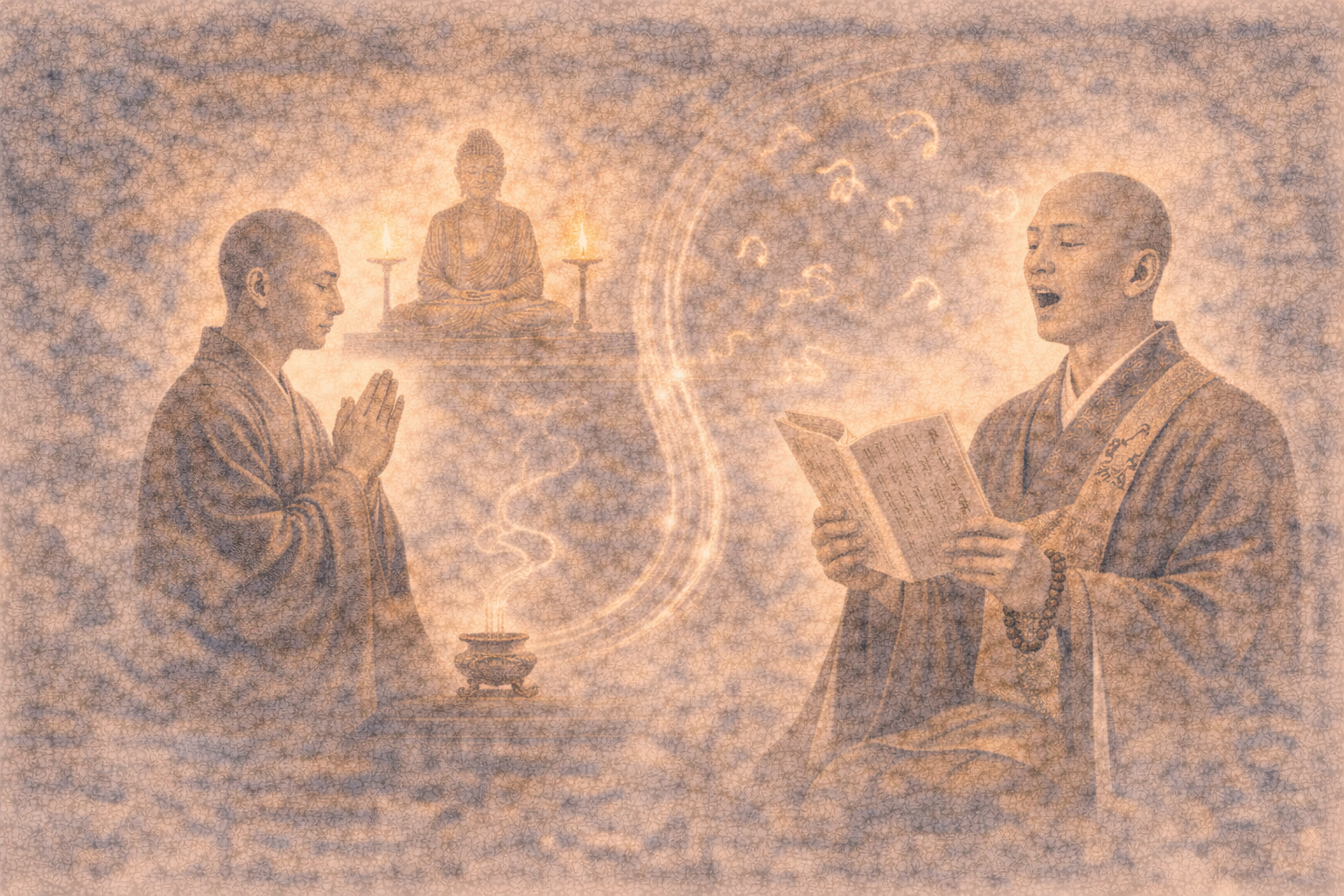
Chanting can look similar from the outside—voices, repetition, a shrine, incense—but the inner mechanics are different. Chanting uses rhythm and repetition to gather the mind, soften reactivity, and make certain values feel “close” rather than theoretical.
A Clear Lens for Prayer vs Chanting
A helpful lens is to treat both prayer and chanting as skillful uses of speech—not just speech you say out loud, but speech that shapes your inner world. In Buddhism, what you repeatedly say (and how you say it) can train what you repeatedly notice, and what you repeatedly notice can train how you repeatedly respond.
Prayer is usually meaning-forward. You’re naming what matters right now: “May I respond with patience,” “May this person be safe,” “I regret what I did,” “May I learn from this.” Even when prayer is directed toward Buddhas or bodhisattvas, it can function as a way of turning the mind toward wisdom and compassion—like facing a compass toward true north.
Chanting is usually repetition-forward. The content matters, but the method is the repetition itself: the steady cadence, the shared rhythm (if done with others), and the way the body joins the mind through breath and voice. Chanting can be a container that holds you when thinking is loud and scattered.
So the difference isn’t “one is religious and one is not.” The difference is the primary lever: prayer leans on intention and meaning; chanting leans on repetition and embodiment. In practice, they overlap—many chants are prayers, and many prayers are chanted—but the emphasis changes what you feel and what you train.
GASSHO
Ask and learn about Buddhism in daily life.
GASSHO is a Buddhist community app where you can learn Buddhist teachings and ask questions to the head priest of Kongosanmaiin Temple on Mount Koya.
How It Feels in Real Life
On an ordinary stressful morning, prayer often shows up as a direct inner statement: “Let me not take this out on anyone.” You might feel the mind narrow around a problem, and prayer widens it just enough to include your values. The words aren’t magic; the shift in orientation is the point.
Chanting in that same moment can feel less like “figuring it out” and more like “settling down.” The mind wants to run scenarios; the chant gives it one simple track to ride. You notice the urge to speed up, the urge to stop, the urge to judge yourself—and you return to the next line.
Prayer can also reveal what you actually want. Sometimes you think you want control, but when you try to pray, what comes out is, “May I accept what I can’t change.” That honesty is useful. It turns vague anxiety into a clear intention you can live from.
Chanting often reveals how the body participates in the mind. If you’re tense, the voice tightens. If you’re distracted, you lose your place. If you’re trying too hard, the rhythm becomes forced. Without analyzing anything, you get immediate feedback: this is what agitation feels like; this is what steadiness feels like.
When you’re grieving, prayer may come out as a simple dedication: “May their journey be peaceful; may my love be of benefit.” It gives the heart a way to move without needing a solution. The words can be plain, even clumsy, and still be sincere.
Chanting during grief can feel like being carried. The repetition reduces the pressure to “say the perfect thing.” You don’t have to invent language for the unspeakable; you borrow a form that has held human sorrow for a long time.
In both practices, what you’re really watching is the same: how quickly the mind contracts into self-centered urgency, and how gently it can be trained to return to something wider—care, clarity, restraint, courage. Prayer does it by naming the direction; chanting does it by rehearsing the direction until it becomes familiar.
Common Confusions That Make It Harder Than It Needs to Be
Misunderstanding 1: “Prayer means Buddhism is theistic.” Some Buddhist prayer is devotional, but “devotional” doesn’t automatically mean “creator god who grants requests.” Often, prayer functions as aspiration, confession, gratitude, or dedication—ways of shaping the heart rather than negotiating with the universe.
Misunderstanding 2: “Chanting is just superstition or empty ritual.” Chanting can be done mechanically, but it can also be a precise attention practice. Repetition, rhythm, and voice are powerful tools for stabilizing the mind—similar to how repeating a phrase can interrupt spiraling thoughts.
Misunderstanding 3: “If I don’t believe, I shouldn’t do either.” You don’t need to force belief to practice skillfully. You can treat prayer as stating intentions and values, and treat chanting as training attention and steadiness. Over time, the practices can clarify what you actually trust through experience, not pressure.
Misunderstanding 4: “One is advanced and the other is beginner.” Both are basic human technologies: meaning and repetition. Some days you need the honesty of prayer; other days you need the simplicity of chanting. The “right” choice is often the one that reduces reactivity and increases care.
Why the Difference Matters in Daily Practice
Knowing the difference helps you choose the right tool for the moment. If you’re emotionally tangled, prayer can cut through by naming one clean intention: “May I speak truthfully,” “May I not harm,” “May I forgive.” It turns a foggy mood into a direction.
If you’re mentally restless, chanting can be more effective than trying to “think your way” into calm. The structure does some of the work for you: breath, voice, rhythm, repetition. You don’t have to win an argument with your mind; you just return to the next line.
The difference also protects you from disappointment. If you treat prayer like a transaction—“I asked, so I should get”—you’ll likely feel let down. If you treat prayer as alignment—“I asked, so I remember what matters”—it becomes immediately useful, regardless of outcomes.
And if you treat chanting as a performance—perfect pronunciation, perfect tone—you’ll tense up. If you treat chanting as training—returning again and again—you’ll notice small, practical shifts: less rumination, more patience, more willingness to pause before reacting.
In everyday life, the simplest way to integrate both is to let prayer set the compass and chanting steady the steps. One clarifies the “why,” the other supports the “how.”
Conclusion
Prayer vs chanting in Buddhism isn’t a contest between two religious behaviors—it’s a practical distinction between two ways of training the heart-mind with language. Prayer emphasizes meaning, intention, and honest orientation; chanting emphasizes repetition, rhythm, and embodied steadiness. If you’re unsure where to start, begin with what you actually need today: clearer intention (prayer) or a steadier mind (chanting), and let experience—not assumptions—teach you the difference.
Ask a Buddhist priest
Have a question about Buddhism?
In the GASSHO app, you can ask questions about Buddhist teachings, daily concerns, and how to understand Buddhism in everyday life.
Frequently Asked Questions
- FAQ 1: What is the main difference between prayer vs chanting in Buddhism?
- FAQ 2: Do Buddhists “pray” the same way as in monotheistic religions?
- FAQ 3: Is chanting in Buddhism a form of prayer?
- FAQ 4: If I’m uncomfortable with prayer, can I just chant instead?
- FAQ 5: If I’m scattered, is chanting more effective than prayer?
- FAQ 6: If I’m emotionally overwhelmed, is prayer more helpful than chanting?
- FAQ 7: Are Buddhist prayers always directed to Buddhas or bodhisattvas?
- FAQ 8: Does chanting “work” if I don’t understand the language?
- FAQ 9: Is prayer in Buddhism the same as making wishes?
- FAQ 10: Is chanting just repetition, or does it have a purpose beyond that?
- FAQ 11: Can prayer and chanting be done silently, or must they be spoken aloud?
- FAQ 12: How do I choose between prayer vs chanting in Buddhism for a daily routine?
- FAQ 13: Is it “wrong” to ask for help in Buddhist prayer?
- FAQ 14: Can chanting replace meditation, or is it separate from meditation?
- FAQ 15: What’s a simple way to practice prayer vs chanting in Buddhism as a beginner?
FAQ 1: What is the main difference between prayer vs chanting in Buddhism?
Answer: Prayer is typically a personal expression of intention (aspiration, gratitude, remorse, dedication), while chanting is structured repetition of a text, name, or mantra used to steady attention and embody the teaching.
Takeaway: Prayer emphasizes meaning; chanting emphasizes repetition and rhythm.
FAQ 2: Do Buddhists “pray” the same way as in monotheistic religions?
Answer: Often not. Buddhist prayer may be devotional, but it frequently functions as aspiration and alignment of the mind rather than asking a creator god to intervene; the focus is on cultivating qualities like compassion and wisdom.
Takeaway: Buddhist prayer is commonly about inner orientation, not a transaction.
FAQ 3: Is chanting in Buddhism a form of prayer?
Answer: Sometimes. Many chants are prayers set to repetition, but chanting can also be purely recitative (memorized texts) or mantra practice aimed at stabilizing attention, even when it doesn’t feel like “asking” for anything.
Takeaway: Chanting can include prayer, but it can also be a separate attention practice.
FAQ 4: If I’m uncomfortable with prayer, can I just chant instead?
Answer: Yes. Chanting can be approached as a non-theistic practice of repetition and mindfulness; you can focus on breath, sound, and the intention behind the words without framing it as petitionary prayer.
Takeaway: Chanting offers a practical entry point when “prayer language” feels awkward.
FAQ 5: If I’m scattered, is chanting more effective than prayer?
Answer: Often, yes. Chanting gives the mind a single track—rhythm and repetition—so it can be easier than forming a coherent prayer when thoughts are racing.
Takeaway: Choose chanting when you need steadiness more than reflection.
FAQ 6: If I’m emotionally overwhelmed, is prayer more helpful than chanting?
Answer: It can be. Prayer can name what’s true right now (“May I meet this with patience,” “I’m afraid,” “May I not cause harm”), which can bring clarity and softness; chanting may then support you by carrying that intention through repetition.
Takeaway: Prayer can clarify the heart; chanting can help you stay with it.
FAQ 7: Are Buddhist prayers always directed to Buddhas or bodhisattvas?
Answer: No. Some prayers are directed outward in a devotional form, while others are vows, aspirations, or reflections that don’t require addressing any being at all.
Takeaway: Buddhist prayer can be devotional or simply intentional.
FAQ 8: Does chanting “work” if I don’t understand the language?
Answer: It can. Understanding supports meaning, but chanting also works through repetition, breath, and attention; many people learn a basic translation so the practice includes both rhythm and intention.
Takeaway: Meaning helps, but repetition itself can still train attention.
FAQ 9: Is prayer in Buddhism the same as making wishes?
Answer: Not exactly. Prayer can include hopes, but it’s often closer to setting an ethical and emotional direction—what you intend to embody—rather than wishing for outcomes you can’t control.
Takeaway: Buddhist prayer is usually aspiration and alignment, not wish-making.
FAQ 10: Is chanting just repetition, or does it have a purpose beyond that?
Answer: It’s repetition with a purpose: gathering attention, regulating emotion through breath and voice, and repeatedly turning the mind toward qualities like compassion, courage, and clarity.
Takeaway: Chanting is repetition used as mind-training.
FAQ 11: Can prayer and chanting be done silently, or must they be spoken aloud?
Answer: Both can be done aloud or silently. Out loud can help with steadiness and embodiment; silent practice can be more discreet and still effective if attention stays engaged.
Takeaway: Voice is optional; intention and attention are central.
FAQ 12: How do I choose between prayer vs chanting in Buddhism for a daily routine?
Answer: Use prayer to set intention (a short aspiration or dedication), then chant to stabilize and carry that intention. If time is short, pick the one that addresses your current state: prayer for clarity, chanting for steadiness.
Takeaway: Let your real need decide—clarify with prayer, steady with chanting.
FAQ 13: Is it “wrong” to ask for help in Buddhist prayer?
Answer: Not necessarily. Asking for help can be skillful when it’s paired with responsibility—asking for patience, courage, or protection while also committing to wise action and non-harm.
Takeaway: Asking can be wholesome when it supports ethical intention and effort.
FAQ 14: Can chanting replace meditation, or is it separate from meditation?
Answer: Chanting can be meditative because it trains sustained attention and reduces distraction, but it’s a different method than silent sitting; many people use chanting as preparation for, or complement to, quiet meditation.
Takeaway: Chanting can be meditation-like, and it often pairs well with silence.
FAQ 15: What’s a simple way to practice prayer vs chanting in Buddhism as a beginner?
Answer: Start with one sentence of prayer (an aspiration like “May I act with kindness today”), then chant a short phrase or verse for a few minutes, keeping attention on breath, sound, and the intention behind the words.
Takeaway: Begin simple—one clear intention, then steady repetition.