



What Does Nyorai Mean? The Japanese Buddhist Word for Tathagata
Quick Summary
- Nyorai (如来) is the Japanese Buddhist word commonly used for “Tathagata”, a title for a Buddha.
- In everyday English, it points to “the Buddha as one who has thus come (or thus gone)”—a way of indicating awakened reality without over-defining it.
- You’ll see Amida Nyorai, Dainichi Nyorai, Yakushi Nyorai, and Shaka Nyorai as names of specific Buddhas in Japanese.
- The word matters because it shifts attention from a personality to a quality of presence: clarity, steadiness, and non-grasping.
- “Nyorai” is not the same as bosatsu (bodhisattva) or myōō (wisdom king); it’s a different category of figure and meaning.
- Translations vary because “Tathagata” is intentionally subtle; no single English phrase fully captures it.
- A practical reading: “nyorai meaning” is less about dictionary certainty and more about a lens for how awakening is described in Japanese Buddhism.
Introduction
If you’ve looked up “nyorai meaning,” you’ve probably run into a frustrating mix of translations—“Thus Come One,” “Thus Gone One,” “one who comes from suchness”—and none of them feel like something you can actually use. The honest problem is that nyorai isn’t trying to be a neat definition; it’s a careful title meant to point at awakened reality without turning it into a concept you can hold. At Gassho, we focus on clear, practice-adjacent explanations of Buddhist language as it’s used in real life.
Nyorai (如来) is the Japanese reading of a term that corresponds to Sanskrit Tathāgata, a traditional epithet for the Buddha. In Japanese contexts, it functions both as a general title (“the Tathagata”) and as part of names for specific Buddhas you’ll see in temples, art, and chanting.
What makes the word tricky is also what makes it valuable: it points to awakening in a way that avoids the usual traps—hero worship, metaphysical speculation, or reducing enlightenment to a mood. “Nyorai” is a label that gestures toward a way of being, not a claim you’re supposed to argue about.
What “Nyorai” Points To as a Way of Seeing
As a lens, nyorai points to the Buddha not primarily as a historical person or a distant saint, but as the embodiment of a certain kind of knowing: direct, unforced, and not tangled up in self-protection. When Japanese texts or temple names use “Nyorai,” the emphasis is often on the quality of awakened presence rather than on biography.
The classic English renderings of Tathagata—“Thus Come One” and “Thus Gone One”—sound contradictory on purpose. They hint that awakening isn’t a thing you can pin down as “arrived” or “departed.” It’s closer to “in accord with how things are,” without needing to add extra stories.
That’s why “nyorai meaning” is best approached as pointing language. It suggests a mind that meets experience as it is—pleasant, unpleasant, or neutral—without immediately grabbing, rejecting, or spacing out. The word doesn’t demand that you accept a theory; it invites you to notice what happens when you stop fighting reality in small, ordinary moments.
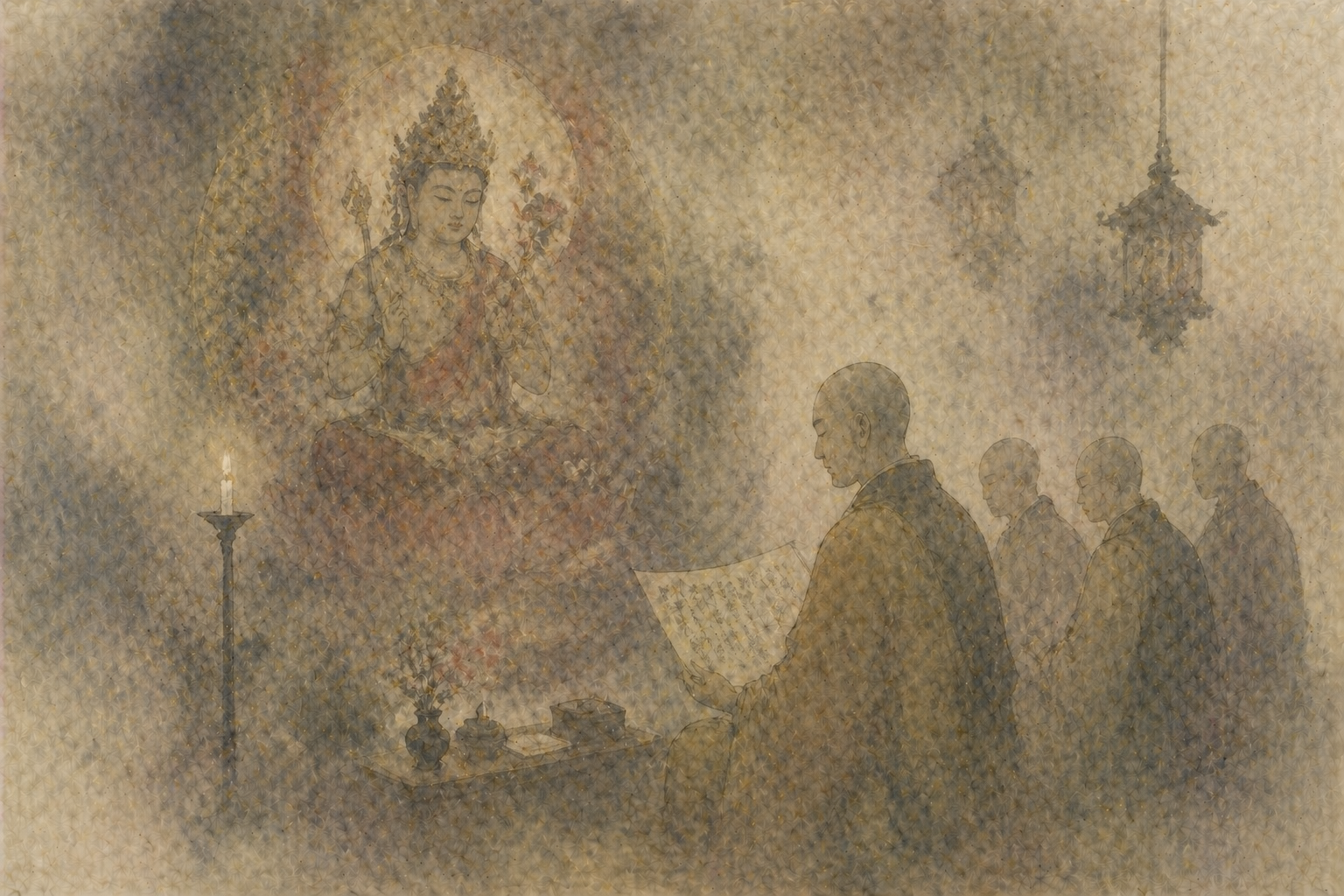
In Japanese Buddhism, you’ll also see nyorai used as a category in iconography and naming: Amida Nyorai, Dainichi Nyorai, Yakushi Nyorai, and Shaka Nyorai. Even when these refer to distinct figures, the title “Nyorai” keeps the focus on Buddhahood—awakening expressed in different forms—rather than on a single personality.
GASSHO
Ask and learn about Buddhism in daily life.
GASSHO is a Buddhist community app where you can learn Buddhist teachings and ask questions to the head priest of Kongosanmaiin Temple on Mount Koya.
How the Meaning of Nyorai Shows Up in Ordinary Moments
In daily life, the “nyorai” lens shows up when you notice how quickly the mind tries to secure itself. A small criticism lands, and attention narrows: you rehearse comebacks, you justify yourself, you search for proof that you’re right. The title “Nyorai” quietly points to another possibility: seeing the reaction clearly without being compelled to act it out.
Consider the moment you realize you’re multitasking out of anxiety. You open a tab, check a message, refresh a feed—anything to avoid the discomfort of not knowing. Reading “Nyorai” as “in accord with thusness” can be a reminder to return to what’s actually happening: the body’s tension, the urge to escape, the simple fact of uncertainty.
It can also show up in how you listen. When someone speaks and you’re already preparing your reply, you’re not really meeting them; you’re meeting your own strategy. The “nyorai meaning” points toward a kind of listening that doesn’t need to win. You still respond, but the response comes from contact rather than from defense.
In conflict, the mind often tries to turn the situation into a fixed story: “They always do this,” “I’m the kind of person who…,” “This will never change.” The Nyorai lens doesn’t magically solve the conflict, but it softens the compulsion to freeze reality into a verdict. You can address the issue while leaving room for things to be more fluid than your first interpretation.
Even in pleasant moments, grasping can creep in: you want the feeling to last, you fear it will fade, you start managing the experience. “Nyorai” points to a steadier intimacy—enjoyment without clinging, appreciation without panic. It’s not about becoming detached; it’s about not turning joy into a contract.
And in boring moments—waiting in line, washing dishes, walking to the train—the mind often checks out. The “thus” in Tathagata can be read as a nudge toward simple presence: this moment is also the path, not because it’s special, but because it’s real. The point isn’t to romanticize the mundane; it’s to stop treating your life as something that starts later.
Over time, “nyorai meaning” becomes less like a vocabulary question and more like a practical inquiry: what does it feel like to meet experience without adding extra resistance? You don’t need to claim any spiritual identity to test that question; you only need to notice what your mind is already doing.
Common Misreadings of “Nyorai”
One common misunderstanding is treating “Nyorai” as a proper name that means “a god.” In Japanese Buddhism, nyorai is a title for a Buddha—an awakened one—rather than a creator deity. The word is used with reverence, but its function is different from the idea of an all-powerful maker of the universe.
Another misreading is assuming the translation must be singular and literal: either “thus come” or “thus gone,” as if one must be correct and the other wrong. The ambiguity is part of the point. The term is designed to avoid turning awakening into a fixed object that can be captured by ordinary categories like coming and going.
People also confuse nyorai with other Japanese Buddhist titles. A bosatsu (bodhisattva) is not the same category as a nyorai, and a myōō (wisdom king) is different again. If you’re looking at temple statues or reading captions, these labels matter because they signal different roles and symbolic emphases.
Finally, it’s easy to over-philosophize the term and miss its practical use. “Nyorai meaning” doesn’t require you to settle metaphysical debates about ultimate reality. It can be read as a pointer toward how a mind looks when it’s not dominated by grasping, aversion, and confusion—something you can observe directly in your own reactions.
Why Knowing the Meaning of Nyorai Helps
Understanding nyorai helps you read Japanese Buddhist culture with less guesswork. When you see names like Amida Nyorai or Yakushi Nyorai, you’ll recognize that “Nyorai” is signaling Buddhahood—an awakened figure—rather than just being a decorative suffix.
It also changes how you relate to Buddhist language. Instead of treating terms as trivia, you can treat them as tools for attention. “Nyorai” points to a way of meeting life that is intimate and unforced: not numbing out, not clinging, not constantly negotiating with reality.
On a personal level, the word can soften the pressure to “be spiritual” in a performative way. If “Nyorai” is a title that gestures toward being aligned with “thusness,” then the practice is less about adopting an image and more about noticing where you’re adding extra struggle—and releasing it when you can.
And finally, it can make temple visits, art, and chants feel less opaque. You don’t need to decode everything, but knowing what “Nyorai” means gives you a stable reference point: this is language about awakening, expressed through forms that help people remember what matters.
Conclusion
The simplest answer to “nyorai meaning” is that Nyorai (如来) means Tathagata, a title for a Buddha in Japanese Buddhism. The more useful answer is that it’s a pointer: awakening described as being in accord with things as they are, beyond the usual mental habit of turning experience into something to grasp or reject.
If you keep that practical sense in view, the translations stop feeling like a puzzle you have to solve. “Thus come” and “thus gone” become reminders that the point isn’t to win a definition—it’s to see, in your own life, what changes when you meet each moment without adding extra resistance.
Ask a Buddhist priest
Have a question about Buddhism?
In the GASSHO app, you can ask questions about Buddhist teachings, daily concerns, and how to understand Buddhism in everyday life.
Frequently Asked Questions
- FAQ 1: What is the meaning of nyorai in Japanese Buddhism?
- FAQ 2: Does nyorai literally mean “Thus Come One” or “Thus Gone One”?
- FAQ 3: What does the kanji 如来 in nyorai mean?
- FAQ 4: Is nyorai the same as Buddha?
- FAQ 5: Why is nyorai used in names like Amida Nyorai?
- FAQ 6: What is the difference in meaning between nyorai and bosatsu?
- FAQ 7: Is nyorai a person, a concept, or a title?
- FAQ 8: How do you pronounce nyorai?
- FAQ 9: What does “Tathagata” mean in relation to nyorai meaning?
- FAQ 10: Does nyorai meaning change depending on the Buddha (Amida, Dainichi, Yakushi)?
- FAQ 11: Is nyorai meaning the same as “suchness”?
- FAQ 12: Why do dictionaries and websites give different nyorai meanings?
- FAQ 13: Is nyorai used in everyday Japanese outside Buddhism?
- FAQ 14: What does “Shaka Nyorai” mean, and how does it relate to nyorai meaning?
- FAQ 15: What is the simplest way to remember nyorai meaning?
FAQ 1: What is the meaning of nyorai in Japanese Buddhism?
Answer: Nyorai (如来) is the Japanese term used for “Tathagata,” a traditional title for a Buddha—an awakened one. It’s used both as a general epithet and as part of names like Amida Nyorai or Yakushi Nyorai.
Takeaway: Nyorai means “Tathagata,” a Buddha-title in Japanese.
FAQ 2: Does nyorai literally mean “Thus Come One” or “Thus Gone One”?
Answer: You’ll see both renderings because the underlying term (Tathagata) is interpreted in more than one way. The ambiguity is often treated as intentional, pointing beyond ordinary categories like coming and going.
Takeaway: Both translations appear; the term is meant to be subtle, not one-dimensional.
FAQ 3: What does the kanji 如来 in nyorai mean?
Answer: The kanji are read as nyo (如, “thus/like/as it is”) and rai (来, “come”). In Buddhist usage, the compound points to the Buddha as “one who is in accord with thusness,” rather than functioning as a simple everyday phrase.
Takeaway: The characters suggest “thus” + “come,” used as a Buddhist title with deeper nuance.
FAQ 4: Is nyorai the same as Buddha?
Answer: In many contexts, yes: nyorai is a title for a Buddha (an awakened one). However, “Buddha” can be used more broadly in English, while “Nyorai” is a specific Japanese Buddhist title used in names and classifications.
Takeaway: Nyorai is a Buddha-title, often used where English would say “the Buddha” or “a Buddha.”
FAQ 5: Why is nyorai used in names like Amida Nyorai?
Answer: In Japanese, “Nyorai” functions like a title indicating the figure is a Buddha. So “Amida Nyorai” means “Amida Buddha,” with “Nyorai” marking Amida’s status as a Buddha rather than a bodhisattva or another class of figure.
Takeaway: Nyorai in a name signals “this figure is a Buddha.”
FAQ 6: What is the difference in meaning between nyorai and bosatsu?
Answer: Nyorai refers to a Buddha (Tathagata), while bosatsu refers to a bodhisattva. In Japanese usage, these labels distinguish different roles and symbolic emphases in texts, chanting, and temple iconography.
Takeaway: Nyorai = Buddha-title; Bosatsu = bodhisattva-title.
FAQ 7: Is nyorai a person, a concept, or a title?
Answer: In Japanese Buddhism, nyorai is primarily a title (an epithet) used for a Buddha. It can refer to a specific Buddha when attached to a name (e.g., Shaka Nyorai) and also carries conceptual nuance about awakened presence.
Takeaway: Nyorai is mainly a title, sometimes referring to specific Buddhas by name.
FAQ 8: How do you pronounce nyorai?
Answer: It’s pronounced roughly “nyo-rai,” with two mora in Japanese: にょ (nyo) and らい (rai). The “nyo” is a blended sound, not “nee-yo.”
Takeaway: Say it as two beats: nyo-rai.
FAQ 9: What does “Tathagata” mean in relation to nyorai meaning?
Answer: “Tathagata” is the term commonly translated into Japanese as nyorai. It’s a traditional epithet for the Buddha, often explained with the sense of “thus come” or “thus gone,” pointing to awakening aligned with reality as it is.
Takeaway: Nyorai is the Japanese equivalent used for “Tathagata.”
FAQ 10: Does nyorai meaning change depending on the Buddha (Amida, Dainichi, Yakushi)?
Answer: The core meaning of nyorai as “Buddha/Tathagata” stays consistent, but the full name points to different Buddhas with different symbolic associations. “Nyorai” is the shared title; the first part of the name specifies which Buddha is being referenced.
Takeaway: Nyorai stays the same as a title; the specific Buddha name changes the reference.
FAQ 11: Is nyorai meaning the same as “suchness”?
Answer: Not exactly. “Suchness” is often used to translate a different term (often rendered as “thusness”), while nyorai is a title for the Buddha. That said, explanations of Tathagata/nyorai frequently connect the title to being “in accord with thusness.”
Takeaway: Nyorai is a Buddha-title, though it’s often explained using the language of “thusness.”
FAQ 12: Why do dictionaries and websites give different nyorai meanings?
Answer: Differences come from how translators interpret the underlying term (Tathagata), whether they emphasize literal kanji readings, and how much they try to preserve the term’s intentional ambiguity. Some sources prioritize “thus come,” others “thus gone,” and others explain the broader sense rather than choosing one phrase.
Takeaway: Variation is normal because the term is traditionally interpreted in multiple ways.
FAQ 13: Is nyorai used in everyday Japanese outside Buddhism?
Answer: In modern Japanese, nyorai is strongly associated with Buddhist usage (temples, statues, names, and texts). It’s not a common everyday word for “someone who comes” or “arrival.”
Takeaway: Nyorai is mainly a Buddhist term in contemporary Japanese.
FAQ 14: What does “Shaka Nyorai” mean, and how does it relate to nyorai meaning?
Answer: “Shaka Nyorai” means “Shakyamuni Buddha,” the historical Buddha, with nyorai functioning as the title “Tathagata/Buddha.” It’s a clear example of how “Nyorai” is used as a suffix indicating Buddhahood.
Takeaway: Shaka Nyorai shows nyorai used as a Buddha-title attached to a specific name.
FAQ 15: What is the simplest way to remember nyorai meaning?
Answer: Remember it as “Nyorai = Tathagata = Buddha-title.” If you want one extra layer, think: “a Buddha described as being in accord with how things are.”
Takeaway: Nyorai is the Japanese word used for “Tathagata,” a title for a Buddha.