



Mindfulness Apps and Buddhism: What Apps Can and Cannot Teach
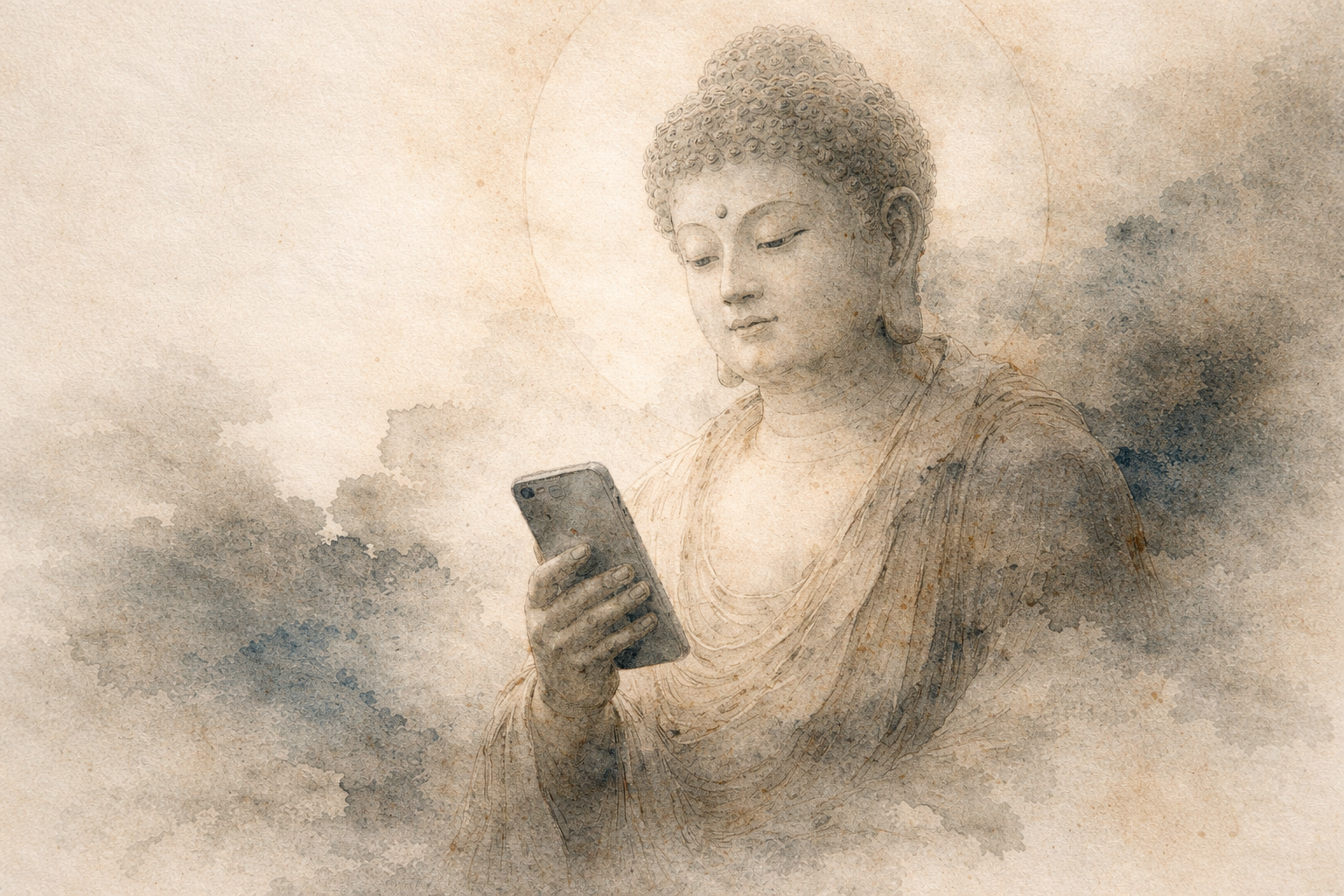
- A mindfulness meditation app can support attention and consistency, but it cannot replace the lived work of noticing reactivity in real moments.
- Apps are good at structure (timers, reminders, guided audio) and weak at context (your relationships, your habits, your blind spots).
- Buddhist practice points toward seeing experience clearly; an app can point, but it cannot do the seeing for you.
- Guided sessions can help you recognize distraction and return, yet daily life is where the same movements of mind actually show themselves.
- Progress metrics can quietly train striving; clarity often looks more like honest noticing than “leveling up.”
- The most helpful apps make space for silence and simplicity, rather than constant novelty and optimization.
- If an app leaves you more intimate with ordinary moments—work, fatigue, conversation—it is closer to the point.
Introduction
You downloaded a mindfulness meditation app to feel steadier, but now you’re unsure what it’s actually teaching: is it training attention, offering therapy-like relief, or pointing toward something Buddhism has been pointing toward for centuries? The confusion is reasonable—apps package inner life into sessions, streaks, and soothing voices, while real mindfulness shows up most clearly when nothing is packaged at all. Gassho writes about meditation with a practical, non-sectarian Buddhist lens grounded in everyday experience.
There is nothing wrong with using technology to support practice. The question is simpler and more honest: what can a mindfulness meditation app realistically help you notice, and what will it never be able to carry on your behalf?
A Buddhist Lens on What an App Can Point Toward
A useful way to look at a mindfulness meditation app is as a set of conditions. It can create a small container: a few minutes, a prompt, a voice, a bell. Within that container, you may notice the mind wandering and returning. That noticing is the heart of it—not the voice, not the technique, not the mood that sometimes follows.
From a Buddhist perspective, mindfulness is less like acquiring a special state and more like becoming familiar with what is already happening. The app can highlight the obvious—breathing, sound, body sensations—but the deeper value is recognizing how quickly experience turns into reaction: tightening, judging, rehearsing, resisting. That recognition is ordinary. It can happen while sitting, but it also happens while answering email or listening to someone you love.
Apps tend to present mindfulness as a clean activity you do “in a session.” But the mind does not divide itself that way. Irritation at work, impatience in traffic, and the urge to scroll late at night are not separate from meditation; they are the same mind in different lighting. A mindfulness meditation app can help you see the lighting more clearly for a few minutes, and that can matter.
What an app cannot provide is the full texture of your life: the specific ways you avoid discomfort, the patterns you repeat in relationships, the subtle pride that can appear when things feel “calm.” Those are not failures of the app. They are reminders that mindfulness is not a product delivered to you; it is a way of meeting experience that has to be verified in the middle of your own days.
How App-Based Mindfulness Shows Up in Real Moments
You start a session in your mindfulness meditation app and, for a few breaths, everything seems straightforward. Then a thought arrives—an unfinished task, a message you forgot to answer—and attention is suddenly elsewhere. When you notice that attention has drifted, there is often a small wave of commentary: “I’m bad at this,” or “I can’t focus.” The most important moment is not the drift. It is the instant you see the drift without needing to dramatize it.
Later, the same movement appears at work. You read a short email and feel a quick tightening in the chest. Before any clear story forms, the body is already leaning toward defense or urgency. If you have been sitting with an app, you might recognize that tightening as a familiar signal—something like the “bell” inside the body. Noticing it does not erase it. It simply makes it less invisible.
In conversation, the app’s guided phrases can echo in an unexpected way. Someone speaks, and you realize you are not listening; you are preparing your reply. The mind is rehearsing, correcting, scoring points, protecting an image. When that is seen, there can be a brief pause—sometimes only half a second—where listening becomes possible again. Nothing mystical happens. It is just a small return from the story to the sound of a human voice.
Fatigue is another place where app-based mindfulness becomes very honest. When you are tired, the mind wants quick comfort: snacks, scrolling, distraction, a mental vacation. A mindfulness meditation app might offer a “sleep” track or a calming body scan, and that can be supportive. But the more revealing moment is noticing the urge itself: how quickly the mind reaches for relief, and how it tries to outsource the feeling of being okay.
Silence can also change meaning. Many apps fill silence with reassurance, and sometimes that is exactly what a nervous system needs. But in quieter moments—waiting for water to boil, standing in an elevator, sitting in a parked car—silence can feel less like a feature and more like a mirror. Restlessness, boredom, and subtle anxiety become audible. If you have been practicing with an app, you may recognize that these are not interruptions; they are part of what is being known.
Even the app’s “success signals” show up in daily life. A streak can create pressure. A completed session can create a sense of being a “good meditator.” Missing a day can create guilt. These are not problems to solve; they are examples of how the mind turns anything—even mindfulness—into identity and performance. Seeing that tendency in the small world of an app can make it easier to recognize the same tendency in relationships, work, and self-talk.
And sometimes nothing special happens at all. You sit, you listen, you get distracted, you come back, and the session ends. That ordinariness is not a sign that the app “isn’t working.” It is closer to how life actually feels most of the time: unfinished, repetitive, and quietly revealing when it is met without needing it to be different.
Where Mindfulness Apps Commonly Get Misread
One common misunderstanding is that a mindfulness meditation app is supposed to produce calm on demand. Calm can happen, and it can be pleasant, but it is not always the most honest measure. Sometimes mindfulness looks like noticing how agitated you are, how quickly you judge yourself, or how strongly you want the session to “fix” the day. That can feel less rewarding, yet it is often more accurate.
Another misunderstanding is treating guidance as authority. A warm voice can sound like certainty, and a well-designed course can feel like a complete map of the mind. But guidance is still just guidance. The real material is your own experience: the way attention slips, the way the body tightens, the way craving and avoidance steer the day. An app can describe these patterns, but it cannot confirm them for you in the moment they occur.
It is also easy to confuse “more content” with “deeper practice.” Many apps offer endless tracks, themes, and challenges. Novelty can keep you engaged, but it can also keep you slightly entertained, always moving to the next thing. The mind that seeks a new track is the same mind that seeks a new tab, a new purchase, a new reassurance. Seeing that pattern is already part of mindfulness.
Finally, apps can be misunderstood as private self-improvement tools detached from how you treat people. Mindfulness is not only about what happens in your head; it shows itself in tone of voice, patience, honesty, and how you handle friction. If an app session feels separate from the way you speak when you are stressed, that separation is not a moral failure. It is simply the place where clarity has not yet become continuous.
What This Means in the Middle of an Ordinary Day
A mindfulness meditation app can be like a small bench on a long walk. You sit for a moment, you remember what it feels like to be present, and then you stand up and keep going. The bench matters, but the walk is still the walk: meetings, dishes, texts, misunderstandings, small kindnesses, and the constant background of wanting things to be easier.
In daily life, the most revealing moments are often unimpressive. The instant before you interrupt someone. The second you notice you are scrolling without interest. The way your shoulders rise when you open your inbox. These moments are not “outside meditation.” They are where the same attention trained in a session meets the world that actually shapes you.
Technology can support continuity simply by being present where you already are: your phone is near you when you wake up, when you commute, when you feel lonely at night. That closeness can be helpful, and it can also blur the line between support and dependency. Seeing that blur—without panic, without romance—is part of being honest about what tools can and cannot do.
Over time, the question becomes less about whether the app is “Buddhist enough” and more about whether it helps you meet experience with less avoidance. Not as a project. Just as a quiet shift in how the day is inhabited.
Conclusion
A mindfulness meditation app can offer a bell, a container, a few words that point. What matters is what is seen when the bell fades. In the plain movements of mind—grasping, resisting, returning—the Dharma is close enough to verify in a single ordinary day.
Frequently Asked Questions
- FAQ 1: What is a mindfulness meditation app?
- FAQ 2: Can a mindfulness meditation app really teach mindfulness?
- FAQ 3: What can a mindfulness meditation app help with most?
- FAQ 4: What can’t a mindfulness meditation app provide?
- FAQ 5: Are mindfulness meditation apps compatible with Buddhism?
- FAQ 6: Do mindfulness meditation apps replace a teacher or community?
- FAQ 7: Is guided meditation in a mindfulness meditation app better than silent practice?
- FAQ 8: How do I choose a mindfulness meditation app that fits my needs?
- FAQ 9: Are streaks and badges in a mindfulness meditation app helpful or harmful?
- FAQ 10: Can a mindfulness meditation app help with anxiety or stress?
- FAQ 11: What features matter most in a mindfulness meditation app for beginners?
- FAQ 12: How long should sessions be in a mindfulness meditation app?
- FAQ 13: Is it okay to use a mindfulness meditation app at night to fall asleep?
- FAQ 14: Do mindfulness meditation apps collect personal data?
- FAQ 15: Can I practice mindfulness without any mindfulness meditation app?
FAQ 1: What is a mindfulness meditation app?
Answer: A mindfulness meditation app is a mobile or desktop app that supports meditation through guided audio, timers, reminders, and structured courses. Most apps focus on training attention and awareness using short sessions that fit into daily schedules.
Takeaway: A mindfulness meditation app is a tool that provides structure and prompts for practice.
FAQ 2: Can a mindfulness meditation app really teach mindfulness?
Answer: A mindfulness meditation app can teach the basic cues—where to place attention, how to notice distraction, and how to return—because those are learnable through repetition. What it cannot fully “teach” is the personal, moment-to-moment recognition of your own habits in real situations, which only becomes clear in lived experience.
Takeaway: Apps can point and structure, but mindfulness is confirmed in direct experience.
FAQ 3: What can a mindfulness meditation app help with most?
Answer: Most people benefit from the consistency and simplicity an app provides: a set time, a clear start and end, and guidance that reduces uncertainty. Apps are especially helpful for building a routine, learning basic meditation formats, and remembering to pause during busy days.
Takeaway: The biggest benefit is often consistency, not a special experience.
FAQ 4: What can’t a mindfulness meditation app provide?
Answer: A mindfulness meditation app can’t fully account for your unique life context—relationships, long-term patterns, or the specific ways you avoid discomfort. It also can’t offer real-time human feedback when practice becomes confusing, emotionally intense, or tangled with personal history.
Takeaway: Apps are strong at guidance and weak at personal context.
FAQ 5: Are mindfulness meditation apps compatible with Buddhism?
Answer: Many mindfulness meditation apps are compatible with Buddhist practice in the sense that they train attention and encourage clear seeing of experience. Compatibility depends on how the app frames mindfulness—whether it supports honest observation or mainly sells calm, performance, or self-optimization.
Takeaway: An app can align with Buddhism when it points back to direct awareness.
FAQ 6: Do mindfulness meditation apps replace a teacher or community?
Answer: A mindfulness meditation app can’t replace the relational aspect of learning—being seen, asking questions, and receiving feedback shaped by your real circumstances. For many people, apps work best as a supplement: a steady support between conversations, classes, or community practice.
Takeaway: Apps can support practice, but they don’t replace human relationship and feedback.
FAQ 7: Is guided meditation in a mindfulness meditation app better than silent practice?
Answer: Guided meditation can be helpful when you’re learning the basics or when the mind feels scattered, because it offers a simple track to return to. Silent practice can reveal more of your own mental habits because there is less external structure. Many people use both depending on the day.
Takeaway: Guided and silent sessions each reveal different parts of attention and habit.
FAQ 8: How do I choose a mindfulness meditation app that fits my needs?
Answer: Look for an app whose tone feels steady rather than pushy, with clear beginner pathways, flexible session lengths, and options for less guidance over time. Practical considerations matter too: offline access, pricing transparency, and whether the app avoids overemphasizing metrics and “achievement.”
Takeaway: Choose an app that supports steadiness and simplicity, not constant novelty.
FAQ 9: Are streaks and badges in a mindfulness meditation app helpful or harmful?
Answer: They can be either, depending on how you relate to them. Streaks can support consistency, but they can also create pressure, guilt, or a performance mindset. If the app’s rewards make you more tense, they may be training striving more than mindfulness.
Takeaway: Metrics can motivate, but they can also quietly increase self-judgment.
FAQ 10: Can a mindfulness meditation app help with anxiety or stress?
Answer: Many people find that a mindfulness meditation app helps reduce stress by creating regular pauses, guiding attention to the body, and interrupting rumination. However, apps are not a substitute for professional care when anxiety is severe, persistent, or linked to trauma or panic symptoms.
Takeaway: Apps can support stress relief, but they aren’t a complete solution for serious anxiety.
FAQ 11: What features matter most in a mindfulness meditation app for beginners?
Answer: Beginners often benefit from short guided sessions, a simple timer, clear explanations without jargon, and a calm interface that doesn’t overwhelm. It also helps when an app offers basic variety (breath, body, sound) without pushing you into endless programs immediately.
Takeaway: For beginners, clarity and simplicity matter more than a huge library.
FAQ 12: How long should sessions be in a mindfulness meditation app?
Answer: Session length depends on your schedule and attention span; many apps offer 3–20 minute options for this reason. Short sessions can still be meaningful if they help you notice distraction and return, while longer sessions may offer more space to see subtle restlessness and reactivity.
Takeaway: The “right” length is the one that supports honest noticing without turning into a struggle.
FAQ 13: Is it okay to use a mindfulness meditation app at night to fall asleep?
Answer: Yes, many mindfulness meditation apps include sleep-focused meditations, body scans, or calming audio that can help the mind settle. If you notice you’re using sleep content to avoid uncomfortable feelings, that can also be useful information—something to notice gently rather than judge.
Takeaway: Sleep features can be supportive, and they can also reveal patterns of avoidance.
FAQ 14: Do mindfulness meditation apps collect personal data?
Answer: Many mindfulness meditation apps collect some data (account info, usage patterns, device identifiers), and policies vary widely. It’s worth reading the privacy policy, checking what can be turned off, and considering whether you’re comfortable with mood tracking or journaling features being stored in the cloud.
Takeaway: Treat privacy as part of choosing an app, not an afterthought.
FAQ 15: Can I practice mindfulness without any mindfulness meditation app?
Answer: Yes. A mindfulness meditation app is optional; mindfulness can be explored through simple sitting, walking, or quiet attention in daily activities. Apps can make starting easier, but the essential element is the direct noticing of experience as it unfolds.
Takeaway: The app is a support, not the source, of mindfulness.