



Karma vs Rebirth: What’s the Difference in Buddhism?
Quick Summary
- Karma is about intentional action and its effects; rebirth is about the continuation of a life-process after death.
- Karma is not “fate” or “cosmic punishment”; it’s a practical way to describe how habits shape experience.
- Rebirth is not the same as a soul moving bodies; it’s more like a causal stream continuing without a fixed self.
- You can work with karma right now by noticing intention, reaction, and the next choice.
- Rebirth matters in Buddhism mainly because it highlights continuity and responsibility beyond a single moment.
- Confusing karma with rebirth leads to common errors: victim-blaming, fatalism, and spiritual bypassing.
- The clean distinction: karma explains how causes shape outcomes; rebirth describes where that causal momentum can continue.
Introduction
You’re trying to separate two ideas that get mashed together in casual talk: karma and rebirth. People use “karma” to mean “what I deserve,” and “rebirth” to mean “my soul comes back,” and then everything gets confusing fast—especially when you’re just looking for a clear Buddhist view you can actually apply to life. At Gassho, we focus on plain-language Buddhism that stays close to lived experience and careful definitions.
In Buddhism, karma and rebirth are related, but they are not interchangeable. Karma is about the ethical and psychological momentum created by intention; rebirth is about the continuation of that momentum as conditions change, including at death.
If you keep the two concepts distinct, the topic becomes less mystical and more practical: you can see karma operating in your day-to-day mind, and you can understand rebirth as a way Buddhism talks about continuity without needing a permanent “me” inside it.
A Clear Lens: What Karma and Rebirth Point To
Karma (in a Buddhist sense) points to intentional action—what you do, say, and think on purpose—and the way those intentions condition future experience. It’s less about a cosmic scoreboard and more about cause-and-effect in the mind: repeated intentions become habits; habits shape perception; perception shapes choices; choices shape consequences.
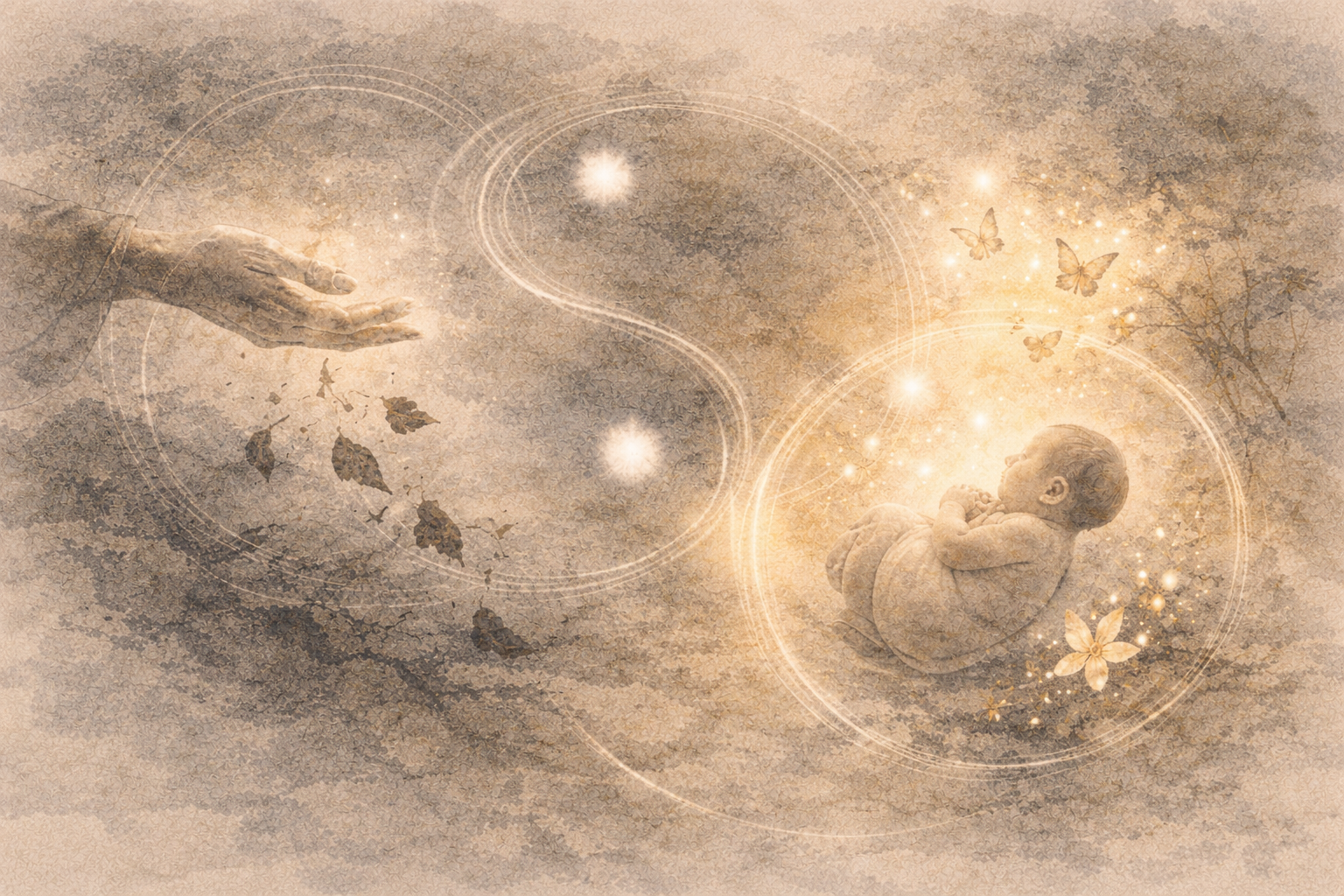
Rebirth points to continuity. Buddhism often describes life as a flow of conditions rather than a fixed entity. Rebirth, in that framing, is the continuation of a causal process when the conditions of one life end and new conditions arise. The key point is that something continues, but not as an unchanging soul that stays identical from life to life.
This is why “karma vs rebirth” is a useful comparison: karma describes the mechanism of conditioning (how intentions leave traces), while rebirth describes the scope of that conditioning (how far that momentum can carry). Karma can be discussed entirely within this lifetime; rebirth addresses what Buddhism says about continuity beyond death.
As a lens for experience, the pairing encourages two grounded questions: “What intention am I feeding right now?” (karma) and “What kind of momentum am I building that could outlast this moment?” (rebirth as continuity). You don’t have to force metaphysical certainty to use the lens; you can test the karma part immediately and hold the rebirth part as a wider frame.
GASSHO
Ask and learn about Buddhism in daily life.
GASSHO is a Buddhist community app where you can learn Buddhist teachings and ask questions to the head priest of Kongosanmaiin Temple on Mount Koya.
How the Difference Shows Up in Everyday Moments
Start with something ordinary: you read a message that feels dismissive. Before you reply, there’s a quick tightening in the body and a story forms: “They don’t respect me.” That story pushes an intention: to defend, to attack, or to withdraw.
When you hit “send” with irritation, the immediate result might be a spike of relief. But the longer result is often a strengthened habit: the mind learns, “This is how we handle discomfort.” That learning is karma in a very practical sense—an intention leaving a groove.
Now notice how karma is not only about what happens “to” you. It’s also about what gets built “in” you: the tendency to interpret tone as threat, the reflex to rehearse arguments, the readiness to blame. These are consequences that show up as perception and mood, not just external events.
Rebirth, by contrast, isn’t something you can point to in the same immediate way during a text exchange. But you can sense what the idea is pointing at: the mind is a continuity of patterns. Today’s irritation doesn’t vanish when the conversation ends; it can echo into the next hour, the next relationship, the next day.
In that sense, you can understand rebirth as a wider metaphor for “the next moment is born from this moment.” Each reaction conditions the next version of you that shows up. The “rebirth” of your mood, your identity-story, and your options happens repeatedly throughout a single day.
When you pause and choose a different response—maybe naming the feeling, taking a breath, asking a clarifying question—you’re not erasing the past. You’re changing the direction of momentum. That’s karma as something workable: intention becomes training, not punishment.
Seen this way, “karma vs rebirth” becomes less like a debate and more like a map: karma is the moment-to-moment steering, and rebirth is the reminder that steering has continuity—patterns persist unless they’re understood and gently redirected.
Common Mix-Ups That Create Unnecessary Confusion
Mix-up 1: “Karma means everything that happens is deserved.” This turns karma into moral blame. In Buddhism, karma is specifically tied to intention, and many events have multiple causes—biology, society, other people’s choices, randomness, and more. Reducing suffering to “you earned it” is both inaccurate and often cruel.
Mix-up 2: “Rebirth proves there must be a soul.” Buddhism often argues the opposite: experience continues without requiring a permanent, independent self. Rebirth is described as causal continuity—more like one candle lighting another than one identical flame traveling unchanged.
Mix-up 3: “Karma and rebirth are the same thing.” They connect, but they’re different categories. Karma is the ethical-psychological law of intentional action and result; rebirth is the continuation of the process that karma influences.
Mix-up 4: “If rebirth is true, my current life is just a test.” This can lead to neglecting present responsibilities. Buddhist practice emphasizes what’s happening now: how suffering arises, how it’s maintained, and how it can be eased through wiser action.
Mix-up 5: “Karma is instant.” Sometimes results are immediate (you speak harshly, tension rises). Sometimes they’re delayed (a habit shapes your relationships over years). Expecting instant payback makes karma look like superstition instead of conditioning.
Why the Distinction Matters for How You Live
When karma is confused with rebirth, people often swing between two extremes: anxiety (“I’m doomed by my past”) or denial (“none of this matters”). Separating them supports a middle approach: your past conditions you, but your present intention still matters.
Understanding karma as intention makes ethics feel less like rules and more like self-knowledge. You begin to notice which intentions lead to contraction—defensiveness, resentment, numbness—and which lead to steadiness—honesty, patience, care. This is not about being “good”; it’s about reducing unnecessary suffering.
Understanding rebirth as continuity (whether you take it literally, metaphorically, or as an open question) encourages responsibility without panic. What you repeat becomes what you carry. Even within one lifetime, you can see how patterns “reincarnate” as the same argument, the same avoidance, the same self-talk.
Practically, the distinction helps you focus on what’s actionable: you can’t control every outcome, but you can work with intention. You can’t rewrite the past, but you can stop feeding a pattern that keeps being reborn in your daily life.
Conclusion
Karma and rebirth are linked in Buddhism, but they answer different questions. Karma is about how intentional actions condition experience; rebirth is about how that conditioning can continue as life unfolds, including beyond death. Keep them distinct and the topic becomes clearer, kinder, and more useful: less about judgment, more about understanding momentum and choosing what you cultivate next.
Ask a Buddhist priest
Have a question about Buddhism?
In the GASSHO app, you can ask questions about Buddhist teachings, daily concerns, and how to understand Buddhism in everyday life.
Frequently Asked Questions
- FAQ 1: What is the simplest difference between karma and rebirth in Buddhism?
- FAQ 2: Is karma the cause of rebirth in Buddhism?
- FAQ 3: Does rebirth mean the same “person” comes back?
- FAQ 4: Is karma basically fate, while rebirth is reincarnation?
- FAQ 5: Can you believe in karma but not rebirth and still be aligned with Buddhism?
- FAQ 6: If rebirth is real, does karma guarantee you’ll be “rewarded” or “punished” in the next life?
- FAQ 7: How are karma and rebirth connected to the idea of no-self?
- FAQ 8: Is rebirth just another word for karma playing out?
- FAQ 9: If someone suffers, does Buddhism say it’s their karma from a past rebirth?
- FAQ 10: What role does intention play in karma compared to rebirth?
- FAQ 11: Can karma change, or is it fixed once created (especially regarding rebirth)?
- FAQ 12: Is rebirth necessary to make karma “fair”?
- FAQ 13: How can I observe karma without taking a position on rebirth?
- FAQ 14: What is the difference between rebirth and reincarnation when discussing karma?
- FAQ 15: If there is no permanent self, who receives karma across rebirth?
FAQ 1: What is the simplest difference between karma and rebirth in Buddhism?
Answer: Karma refers to intentional actions (thought, speech, and behavior) and the effects those intentions condition over time. Rebirth refers to the continuation of the life-process—cause and effect continuing as conditions change, traditionally including after death.
Takeaway: Karma is the conditioning mechanism; rebirth is the continuity of that conditioned process.
FAQ 2: Is karma the cause of rebirth in Buddhism?
Answer: In many Buddhist explanations, karma helps shape the conditions that continue in rebirth, because repeated intentions create momentum and tendencies. But karma is broader than rebirth: it also shapes your experience within this life, moment by moment.
Takeaway: Karma influences rebirth, but it also operates here and now.
FAQ 3: Does rebirth mean the same “person” comes back?
Answer: Buddhism generally describes rebirth as continuity without a permanent, unchanging self. What continues is a causal stream—patterns, tendencies, and conditions—rather than an identical soul that remains the same across lives.
Takeaway: Rebirth is continuity, not a fixed self returning unchanged.
FAQ 4: Is karma basically fate, while rebirth is reincarnation?
Answer: In Buddhism, karma is not fate; it’s intention and its conditioning effects, leaving room for change through present choices. Rebirth is not necessarily “reincarnation” in the sense of a soul migrating; it’s the continuation of causes and conditions into new life circumstances.
Takeaway: Karma isn’t destiny, and rebirth isn’t a soul-transfer story.
FAQ 5: Can you believe in karma but not rebirth and still be aligned with Buddhism?
Answer: Many people start by working with karma as a practical observation: intentions shape habits and outcomes. Rebirth is traditionally part of Buddhist worldview, but some practitioners hold it as an open question while focusing on what can be verified in experience—how actions condition suffering and ease.
Takeaway: Karma is immediately testable; rebirth can be held with humility while practicing.
FAQ 6: If rebirth is real, does karma guarantee you’ll be “rewarded” or “punished” in the next life?
Answer: Buddhism frames karma less as reward/punishment and more as natural consequence: intentions condition tendencies and circumstances. Results are not always immediate, not always simple, and not always traceable to a single cause, so it’s not a neat moral accounting system.
Takeaway: Karma is conditioning, not a cosmic courtroom—whether in this life or a future one.
FAQ 7: How are karma and rebirth connected to the idea of no-self?
Answer: No-self points to the absence of a permanent, independent “me” inside experience. Karma can still function because intentions and habits arise dependently and leave effects; rebirth can still be described because continuity can occur through causes and conditions without requiring an unchanging soul.
Takeaway: No-self doesn’t cancel karma or rebirth; it changes how continuity is understood.
FAQ 8: Is rebirth just another word for karma playing out?
Answer: Not exactly. Karma is the pattern of intentional action and its effects; rebirth is the continuation of the process in which those effects can manifest. Karma can “play out” within one life, while rebirth refers to the broader continuity of the process across changing conditions.
Takeaway: Karma explains the effects; rebirth describes the ongoing continuity where effects can appear.
FAQ 9: If someone suffers, does Buddhism say it’s their karma from a past rebirth?
Answer: Buddhism cautions against simplistic conclusions about why a specific person suffers. Many conditions contribute to suffering, and using karma/rebirth to explain someone’s pain can become victim-blaming. The more practical focus is how to respond skillfully and reduce suffering now.
Takeaway: Karma and rebirth aren’t tools for judging others’ suffering.
FAQ 10: What role does intention play in karma compared to rebirth?
Answer: Intention is central to karma: it’s what makes an action karmically significant in Buddhist terms. Rebirth is not “caused by intention” in a single moment, but the overall momentum of intentions and habits is part of what conditions how continuity unfolds.
Takeaway: Intention is the engine of karma and a major influence on what continues.
FAQ 11: Can karma change, or is it fixed once created (especially regarding rebirth)?
Answer: Buddhism emphasizes that present actions matter. Past karma conditions tendencies and circumstances, but it doesn’t remove agency in the present. By changing intentions and responses now, you change what you reinforce—and that changes the momentum that would otherwise continue, including in the context of rebirth.
Takeaway: Karma conditions you, but it doesn’t imprison you; new intentions matter.
FAQ 12: Is rebirth necessary to make karma “fair”?
Answer: Buddhism doesn’t present karma primarily as a fairness doctrine. Karma is about causality and conditioning, not guaranteeing that life outcomes look fair by human standards. Rebirth can be part of a broader explanation of continuity, but karma doesn’t require a “fairness” premise to be meaningful in daily practice.
Takeaway: Karma isn’t mainly about fairness; it’s about cause-and-effect in intention.
FAQ 13: How can I observe karma without taking a position on rebirth?
Answer: Watch the sequence: trigger → feeling → story → intention → action → aftertaste. Notice how certain intentions (resentment, grasping, avoidance) reliably condition agitation, while others (honesty, restraint, kindness) condition steadiness. This is karma as observable conditioning, independent of any conclusion about rebirth.
Takeaway: You can test karma directly by tracking intention and its “aftertaste.”
FAQ 14: What is the difference between rebirth and reincarnation when discussing karma?
Answer: “Reincarnation” often implies a stable soul or essence that inhabits new bodies. “Rebirth” in Buddhism typically emphasizes causal continuity without an unchanging self. Karma fits this by describing how intentions condition the stream of experience, rather than how a soul collects rewards and punishments.
Takeaway: Rebirth is usually framed as continuity of causes, not a soul’s journey.
FAQ 15: If there is no permanent self, who receives karma across rebirth?
Answer: Buddhism answers this by pointing to continuity without identity: effects occur in the same causal stream that produced the causes, even if there is no fixed “owner” of the stream. It’s like how your actions yesterday shape your life today—continuous, connected, but not a separate, permanent entity.
Takeaway: Karma “lands” in the ongoing stream of conditions, not in an unchanging self.