



Is the Buddha a God, or Something Else?
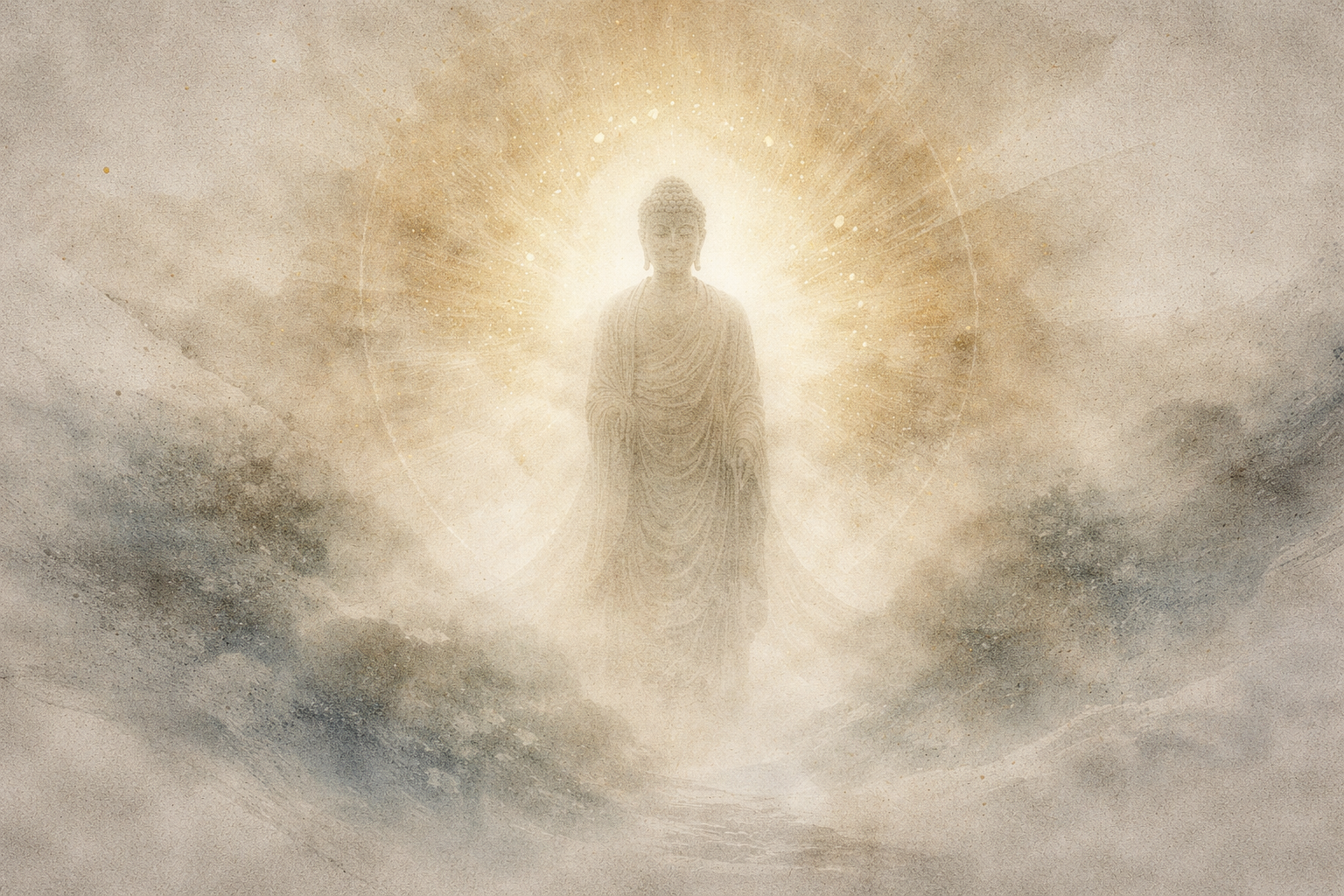
Quick Summary
- In most Buddhist contexts, the Buddha is not “the god Buddha,” but a human being who woke up to how suffering works.
- Calling the Buddha a god often comes from translating Buddhist devotion into familiar religious categories.
- “Buddha” points less to a supernatural identity and more to a way of seeing experience clearly.
- Respect, gratitude, and ritual can exist without the idea of a creator deity.
- The question matters because it changes what you expect: rescue from outside vs. understanding from within.
- In daily life, this view shows up as noticing reactions, softening certainty, and meeting moments more directly.
- You can relate to the Buddha as a teacher, symbol, and mirror—without forcing the label “god.”
Introduction
If you keep seeing phrases like “the god Buddha,” it can feel like you’re missing something basic: is Buddhism secretly about worshiping a deity, or is that a misunderstanding that got repeated until it sounded true? The confusion is understandable because statues, offerings, and reverent language can look like “god talk” from the outside, even when the underlying meaning is different. This explanation is written from a Zen-informed, practice-first perspective that stays close to ordinary experience rather than theology.
People often ask this question because they’re trying to orient themselves: what kind of relationship is Buddhism inviting—prayer to a higher power, or attention to the mind that’s already here? The answer changes the emotional tone of the whole path. If the Buddha is a god, the center of gravity is devotion to an external being; if the Buddha is something else, the center of gravity is seeing clearly what drives stress, conflict, and relief in everyday life.
It also doesn’t help that the word “Buddha” gets used in multiple ways. Sometimes it refers to a historical person. Sometimes it refers to an image on an altar. Sometimes it functions like a verb—“awake”—more than a name. When those meanings blur together, “the god Buddha” can sound plausible even if it doesn’t match what many Buddhists actually mean.
A Clear Lens: What “Buddha” Points To
A grounded way to approach “the god Buddha” question is to treat it less like a quiz about correct labels and more like a lens for understanding what Buddhism emphasizes. In many Buddhist settings, the Buddha is not presented as a creator who controls the universe, but as someone who understood the patterns of clinging, fear, and confusion that shape human life. The emphasis is on insight into experience, not authority over reality.
That difference shows up in the kind of hope being offered. A god-framework often implies intervention: a higher being can fix what you cannot. A Buddha-framework more often implies recognition: what feels fixed and personal can be seen as a pattern, and patterns can be understood. It’s less “someone will save me” and more “this can be seen clearly.”
In ordinary terms, it’s like the difference between waiting for a manager to solve a workplace problem and learning to see the dynamics that keep the problem repeating. The second approach doesn’t deny help or community, but it shifts the focus from external power to direct understanding. The Buddha, in this sense, functions like a reference point for clarity rather than a ruler of outcomes.
Even devotion can fit inside this lens without turning the Buddha into a god. Respect can be a way of remembering what matters when you’re tired, reactive, or lost in your own story. A bow can be less about “worshiping a deity” and more about acknowledging something simple: the mind can wake up, and life can be met without so much struggle.
How This Question Feels in Real Life
In daily life, “Is the Buddha a god?” often appears as a quieter question: “Am I supposed to believe in something outside myself to get through this?” When work is overwhelming, it’s natural to want a powerful figure who can make things easier. The mind looks for a lever—something to pull that will change the situation without requiring you to face the discomfort directly.
But there’s another kind of relief that doesn’t depend on outside control. It’s the relief of noticing what’s happening as it happens: the tightening in the chest before an email reply, the rehearsed argument in the head, the way fatigue makes everything feel personal. In that moment, “Buddha” can feel less like a being and more like a reminder to see clearly.
In relationships, the “god Buddha” idea can show up as a subtle expectation that someone—anyone—should guarantee fairness. When a conversation goes badly, the mind wants a cosmic referee. Yet what’s often available first is simpler: noticing the urge to be right, the fear of being misunderstood, the way a single phrase can hook the whole body. Seeing that doesn’t solve the relationship like magic, but it changes the texture of the moment.
In silence, the question can flip. Instead of “Who is the Buddha?” it becomes “What is this mind that keeps producing commentary?” You sit down, and within seconds there’s planning, judging, remembering, and replaying. If the Buddha were a god, the solution might be to appeal upward. If the Buddha is a pointer to awakening, the interest turns toward the movement itself—how thoughts arise, how they persuade, how they fade.
During stress, people sometimes use “Buddha” the way they use “God,” as a word that holds them together. That’s not necessarily wrong; it’s human. The important detail is what happens next. Does the word become a way to avoid feeling what’s here, or does it become a way to stay present with what’s here—grief, irritation, uncertainty—without immediately turning it into a story?
Even seeing a Buddha statue can trigger the same fork in the road. One person sees a god-image and feels distance: “I don’t belong here.” Another person sees a symbol of steadiness and feels closeness: “This is possible.” The object is the same; the inner interpretation changes everything. The lived experience is less about metaphysics and more about what the mind does with symbols.
And on ordinary, tired evenings, the question becomes practical. If you’re exhausted and short-tempered, a god-model can feel like pressure—another being to please. A Buddha-model can feel like permission to be honest: this is what irritation feels like, this is how it speaks, this is how quickly it claims the whole world. Nothing supernatural is required for that recognition, only attention.
Where “The God Buddha” Idea Commonly Gets Stuck
One common misunderstanding comes from equating reverence with theism. If you grew up where candles, incense, and bowed heads only appear around a god, then Buddhist forms can look like a direct match. But outward forms don’t always carry the same inner meaning. Sometimes they’re cultural. Sometimes they’re psychological—ways to steady the heart and remember what you value.
Another sticking point is language. People say “pray to Buddha” or “ask Buddha for help,” and it sounds like a god relationship. Often, what’s happening is closer to speaking from the best part of oneself, or leaning on a symbol of clarity when the mind is scattered. In everyday life, people do this with a deceased parent’s photo or a mentor’s remembered advice without believing that person controls the universe.
A third misunderstanding is assuming the only alternatives are “god” or “nothing.” Many people feel that if the Buddha isn’t a god, then Buddhism must be cold or purely intellectual. But the middle ground is very human: gratitude, humility, and aspiration can exist without a creator deity. You can feel devotion without outsourcing responsibility for your life.
Finally, the mind likes clean categories, especially when tired. “God” is a familiar box, and unfamiliar traditions get pushed into it. That’s not a moral failure; it’s a habit of simplifying. Over time, the question can soften from “Which label is correct?” to “What does this view do to my attention, my reactions, and my way of meeting the day?”
Why This Distinction Touches Everyday Choices
When the Buddha is imagined as a god, it’s easy to wait for life to be arranged from elsewhere. That waiting can be subtle: postponing a difficult conversation, hoping anger will disappear on its own, expecting clarity to arrive without looking closely at confusion. The “god Buddha” frame can unintentionally turn awakening into something granted rather than something noticed.
When the Buddha is understood more as “awake,” the focus shifts to what’s already happening in small moments. A tense commute becomes a place where impatience is seen. A disagreement becomes a place where defensiveness is felt in the body. A quiet morning becomes a place where the mind’s urge to fill space is noticed. Nothing grand is required for these moments to matter.
This distinction also changes how compassion feels. If a god is in charge, compassion can become conditional: people “should” be different because the world “should” be fair. If awakening is the emphasis, compassion can look more like realism—seeing how fear and habit drive behavior, including your own. That realism doesn’t excuse harm, but it softens the extra layer of hatred that often rides on top of pain.
Over time, the question “Is the Buddha a god?” becomes less of a debate and more of a mirror. It reflects what you’re reaching for in the middle of life: control, reassurance, certainty—or a steady willingness to see what is actually here.
Conclusion
When “the god Buddha” is held lightly, the question opens rather than closes. In the middle of ordinary life, what matters is what can be seen directly: grasping, resistance, and the quiet possibility of release. The Dharma does not require a creator to be intimate. It asks only for this moment to be met as it is.
Frequently Asked Questions
- FAQ 1: Is “the god Buddha” an accurate description of the Buddha?
- FAQ 2: If the Buddha isn’t a god, who was he?
- FAQ 3: Why do some people call Buddha a god?
- FAQ 4: Do Buddhists worship the Buddha like a god?
- FAQ 5: Is the Buddha a creator god in Buddhism?
- FAQ 6: Can you pray to the Buddha, and does that make him a god?
- FAQ 7: Are Buddha statues idols of “the god Buddha”?
- FAQ 8: Is believing in “the god Buddha” required to be Buddhist?
- FAQ 9: Is the Buddha considered divine or supernatural?
- FAQ 10: What’s the difference between respecting the Buddha and treating him as a god?
- FAQ 11: Did the Buddha claim to be a god?
- FAQ 12: How should beginners understand the phrase “the god Buddha” online?
- FAQ 13: Is “the god Buddha” the same as Budai (the Laughing Buddha)?
- FAQ 14: Does Buddhism have gods even if the Buddha isn’t “the god Buddha”?
- FAQ 15: What’s a respectful way to talk about the Buddha without calling him a god?
FAQ 1: Is “the god Buddha” an accurate description of the Buddha?
Answer: In most Buddhist contexts, “the god Buddha” is not an accurate description. The Buddha is generally understood as an awakened teacher rather than a creator deity who rules the world. The word “Buddha” points to awakening (being “awake” to how suffering and relief work) more than to a divine status.
Takeaway: “Buddha” is usually treated as awakened understanding, not a god-identity.
FAQ 2: If the Buddha isn’t a god, who was he?
Answer: The Buddha is commonly understood as a human being who realized a clear way of seeing experience—especially the habits that create distress and the possibility of release from them. Rather than being worshiped as a supreme deity, he is often approached as a teacher and an example of what clarity looks like in human life.
Takeaway: The Buddha is typically regarded as an awakened human teacher, not “the god Buddha.”
FAQ 3: Why do some people call Buddha a god?
Answer: People may call Buddha a god because Buddhist devotion can resemble the outward forms of theistic religion—statues, offerings, chanting, and reverent language. Another reason is translation and cultural blending: when Buddhism moves into new cultures, familiar words like “god” get used as shortcuts, even if they don’t match the original intent.
Takeaway: “The god Buddha” often comes from cultural translation, not from Buddhism’s central framing.
FAQ 4: Do Buddhists worship the Buddha like a god?
Answer: Some Buddhists express devotion toward the Buddha, but devotion does not always mean “worshiping a god” in the creator-deity sense. For many, bows and offerings are ways of expressing gratitude, humility, and remembrance of awakening, rather than asking a divine being to control events.
Takeaway: Devotion can be present without turning the Buddha into “the god Buddha.”
FAQ 5: Is the Buddha a creator god in Buddhism?
Answer: The Buddha is not generally presented as a creator god who made the universe or who governs reality by decree. Buddhism tends to emphasize cause-and-effect in experience and the possibility of awakening, rather than a single divine creator figure.
Takeaway: Buddhism usually does not frame the Buddha as a creator, so “the god Buddha” is misleading.
FAQ 6: Can you pray to the Buddha, and does that make him a god?
Answer: Some people do direct prayers or requests toward the Buddha, but that practice doesn’t automatically mean the Buddha is considered a god. Often it functions as a way to steady the heart, express aspiration, or remember clarity during difficulty—similar to speaking to a symbol of wisdom rather than appealing to a creator who intervenes.
Takeaway: Prayer-like language can exist without implying “the god Buddha.”
FAQ 7: Are Buddha statues idols of “the god Buddha”?
Answer: Buddha statues are commonly used as reminders of awakening, steadiness, and compassion, not necessarily as idols of “the god Buddha.” For many practitioners, the statue is a visual cue that points back to qualities of mind and heart, rather than an object believed to possess divine power on its own.
Takeaway: A Buddha image is often a reminder, not proof that the Buddha is a god.
FAQ 8: Is believing in “the god Buddha” required to be Buddhist?
Answer: Belief in “the god Buddha” is not generally required. Many people engage Buddhism as a path of understanding suffering and cultivating clarity without adopting a creator-god belief. What matters more is how one relates to experience—how reactivity, grasping, and ease are understood in daily life.
Takeaway: Buddhism typically doesn’t require belief in a god-Buddha.
FAQ 9: Is the Buddha considered divine or supernatural?
Answer: Different cultures describe the Buddha with varying degrees of reverence, and some stories use extraordinary imagery. Still, the most common framing is that the Buddha is “awake” rather than a god—someone who embodies deep understanding. Whether one interprets traditional stories literally or symbolically, the core emphasis remains awakening and the end of suffering.
Takeaway: The Buddha is most often treated as awakened, not as “the god Buddha.”
FAQ 10: What’s the difference between respecting the Buddha and treating him as a god?
Answer: Respecting the Buddha often means honoring awakening as a human possibility and valuing the teachings that point to clarity. Treating the Buddha as a god usually implies a being with ultimate power who can grant favors or control outcomes. The difference is subtle in appearance but significant in expectation: remembrance and aspiration versus divine intervention.
Takeaway: Respect points inward to clarity; “the god Buddha” points outward to control.
FAQ 11: Did the Buddha claim to be a god?
Answer: The Buddha is generally portrayed as emphasizing awakening and understanding rather than claiming to be a creator god. The central message is typically about seeing clearly and ending suffering, not about establishing himself as a divine ruler of the cosmos.
Takeaway: The Buddha is usually presented as awakened, not self-declared “the god Buddha.”
FAQ 12: How should beginners understand the phrase “the god Buddha” online?
Answer: Beginners can treat “the god Buddha” as a common internet shorthand that may reflect misunderstanding, translation habits, or mixed religious framing. A more accurate starting point is: the Buddha is a figure of awakening and a teacher, and Buddhist practice often emphasizes direct seeing over belief in a creator deity.
Takeaway: Online phrasing can be sloppy; the traditional emphasis is awakening, not a god.
FAQ 13: Is “the god Buddha” the same as Budai (the Laughing Buddha)?
Answer: “The god Buddha” is not the same as Budai. Budai (often called the Laughing Buddha) is a distinct figure in popular culture and temple imagery, and he is frequently confused with the historical Buddha in modern décor and internet posts. That confusion can reinforce the mistaken idea that there is a single “god Buddha” figure behind all Buddha images.
Takeaway: Many “Buddha” images online refer to different figures, which fuels the “god Buddha” confusion.
FAQ 14: Does Buddhism have gods even if the Buddha isn’t “the god Buddha”?
Answer: Some Buddhist cultures include references to gods or heavenly beings, but that does not automatically make the Buddha “the god Buddha.” Even where such beings appear, the Buddha is typically treated as awakened and as a teacher, with the central focus remaining on understanding suffering and its cessation.
Takeaway: Gods may appear in some contexts, but the Buddha is not usually framed as the supreme god.
FAQ 15: What’s a respectful way to talk about the Buddha without calling him a god?
Answer: A respectful approach is to refer to the Buddha as “the awakened one,” “a teacher,” or “the Buddha (an awakened teacher),” depending on context. This keeps the tone reverent without importing the creator-deity meaning that “the god Buddha” often implies.
Takeaway: You can be respectful and precise by emphasizing awakening rather than divinity.