



The Hungry Ghost Story: What It Teaches About Desire and Attachment
Quick Summary
- The hungry ghost story in Buddhism points to what desire feels like when it can’t be satisfied.
- It works as a mirror for everyday attachment: scrolling, snacking, status-seeking, and “just one more.”
- The lesson isn’t “desire is bad,” but that craving narrows attention and multiplies dissatisfaction.
- Relief starts by noticing the moment craving forms, not by winning a battle against it.
- Small shifts—pause, name the urge, soften the body, choose one clean action—change the whole cycle.
- Compassion matters because hungry-ghost energy often hides shame and fear underneath.
- The story is most useful when applied gently to daily life, not used to judge yourself or others.
Introduction
If the “hungry ghost story” in Buddhism confuses you, it’s usually because it sounds like either a spooky folktale or a literal afterlife claim—while what you actually want is the practical point: why desire can feel endless, even when you keep getting what you want. The hungry ghost image is blunt on purpose: it describes the lived texture of craving—tight, urgent, repetitive, and strangely unsatisfying—so you can recognize it in yourself without moral drama. This article is written for Gassho, a Zen/Buddhism site focused on clear, everyday application.
The Hungry Ghost Story as a Lens on Craving
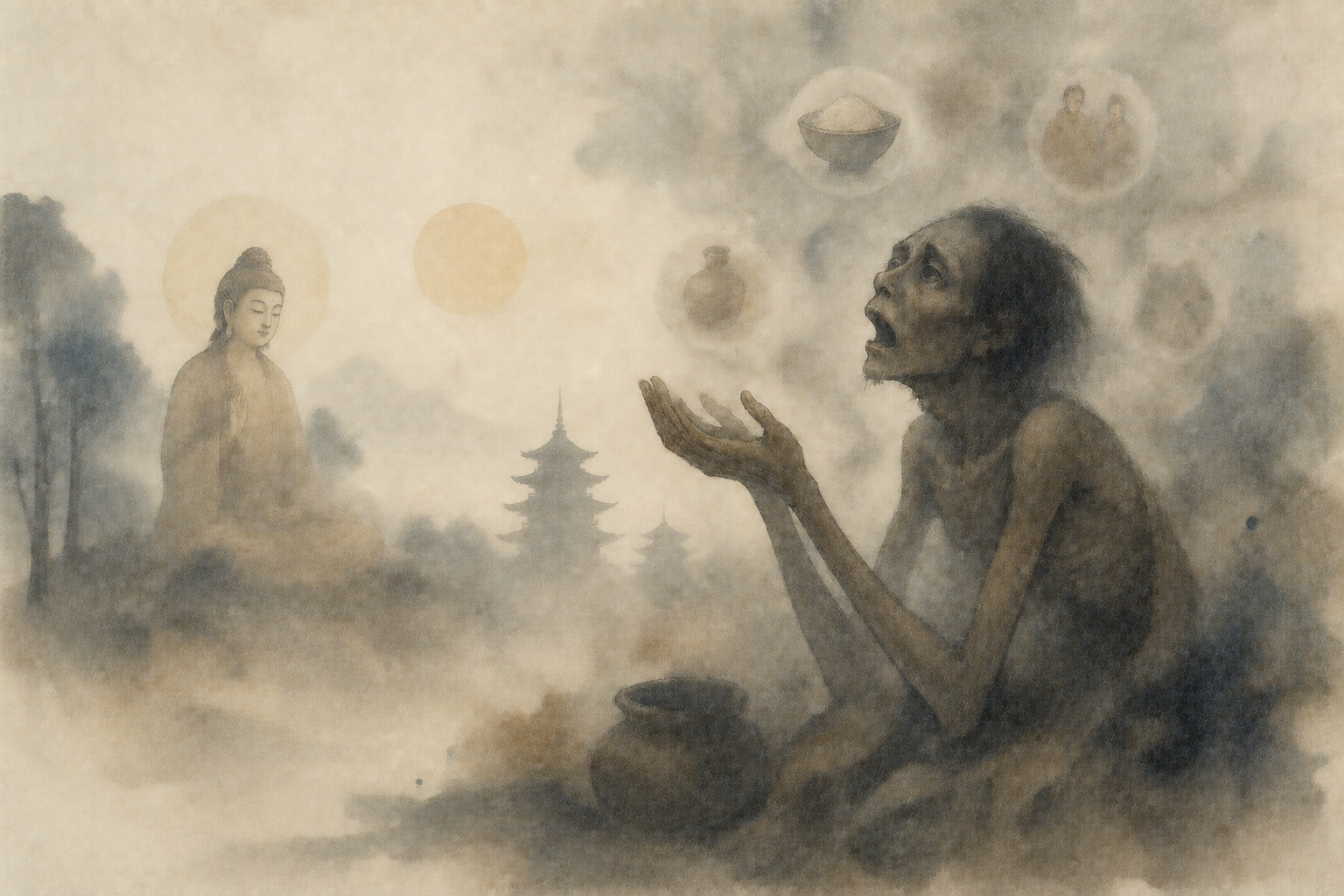
In the hungry ghost story in Buddhism, a “hungry ghost” is often portrayed as a being with a huge appetite and a painfully limited ability to take in nourishment—sometimes shown with a swollen belly and a narrow throat. Whether you take that imagery literally or symbolically, the point is easy to test in ordinary life: craving can be intense while satisfaction stays thin.
As a lens, the story highlights a specific pattern: the mind locks onto an object (food, attention, approval, certainty, entertainment), promises relief if you get it, and then—after you get it—moves the goalposts. The “ghost” part isn’t about horror; it’s about insubstantiality. The relief you chase keeps dissolving, so you chase again.
This is not a belief system you have to adopt. It’s more like a diagnostic image for experience. When you’re caught in hungry-ghost energy, the world feels slightly reduced: fewer options, less patience, less contact with what’s already okay. The story gives you a way to name that narrowing without turning it into a personal failure.
Most importantly, the hungry ghost story doesn’t say “never want anything.” It points to the difference between simple desire (healthy preference, clear intention) and compulsive craving (the sense that you must have something now to be okay). The teaching aims at freedom: being able to want without being owned by wanting.
GASSHO
Ask and learn about Buddhism in daily life.
GASSHO is a Buddhist community app where you can learn Buddhist teachings and ask questions to the head priest of Kongosanmaiin Temple on Mount Koya.
How Hungry-Ghost Desire Shows Up in Daily Life
You can recognize hungry-ghost desire by how it recruits your attention. One moment you’re fine, the next you’re pulled: a notification, a thought about food, a comparison with someone else, a sudden need to “fix” your mood. The pull is not just mental; it often comes with a body signature—tight jaw, forward-leaning posture, shallow breath.
Then comes the story-making. The mind produces a small, persuasive script: “After this, I’ll settle.” “I deserve this.” “I can’t stand this feeling.” The script isn’t evil; it’s just a habit of seeking quick relief. The hungry ghost story helps you see that the script is part of the hunger, not proof that the object will satisfy it.
In ordinary situations, this can look like eating past fullness because the taste is comforting, or checking messages repeatedly because silence feels like rejection. It can look like buying something not for its use, but for the brief identity boost. It can look like rehashing an argument because being “right” feels like safety.
Notice the moment of contact: you get the thing—one more video, one more compliment, one more snack—and there’s a flicker of relief. But it’s thin. The relief doesn’t land deeply because the nervous system is still braced. So the mind concludes, “Not enough,” and reaches again.
Another common feature is urgency mixed with dissatisfaction. Even pleasant experiences can be contaminated by the pressure to extend them. You’re not simply enjoying; you’re managing. You’re trying to secure a feeling that, by nature, can’t be secured.
When you start observing this, the goal isn’t to shame yourself out of it. Shame usually intensifies hungry-ghost behavior because it adds another discomfort that needs to be escaped. The more useful move is to become curious about the sequence: trigger, tightening, story, reaching, brief relief, renewed hunger.
Even a small pause changes the pattern. If you can feel the urge as sensation—heat, pressure, restlessness—without immediately obeying it, you create a gap. In that gap, you may still choose the action (eat, scroll, speak), but it becomes a choice rather than a compulsion. That shift is the practical heart of the hungry ghost story in Buddhism.
Common Misreadings of the Hungry Ghost Story
One misunderstanding is treating the hungry ghost story as a threat: “If you desire things, you’ll become a hungry ghost.” Used that way, it becomes moral intimidation, and it usually backfires. Fear can suppress behavior for a while, but it doesn’t teach you how craving actually works in your mind and body.
Another misunderstanding is swinging to the opposite extreme: “Desire is the enemy, so I should feel nothing.” That tends to create a brittle, performative detachment. The story is pointing at compulsive grasping, not at the natural human capacity to enjoy, care, and prefer.
A third misunderstanding is using the hungry ghost label on other people. It’s tempting to diagnose someone else’s consumerism, addiction, or neediness. But the teaching is most effective when it’s applied inwardly and gently: “Where is my attention getting trapped? What am I trying to soothe?”
Finally, some people assume the story is only about extreme cases. In practice, hungry-ghost energy is often subtle: the constant background itch to optimize, to be seen, to stay entertained, to avoid quiet. The story earns its value precisely because it describes the everyday version so clearly.
Why This Teaching Helps with Desire and Attachment
Attachment is often misunderstood as “loving things too much.” In daily life, it’s closer to “needing a particular outcome to feel okay.” The hungry ghost story gives you a vivid way to spot that need as it forms, before it hardens into action and regret.
It also reframes the problem from “I’m weak” to “This is a pattern.” Patterns can be studied. When you see the mechanics—tightening, story, reaching—you can respond with small, realistic interventions: slow down the next click, take one full breath, relax the shoulders, drink water, step outside, or simply wait 30 seconds and feel what the urge is asking you to avoid.
Another reason it matters is relational. Hungry-ghost craving doesn’t stay private; it leaks into how we speak, demand, and bargain. When you’re chasing reassurance, you can turn people into vending machines for comfort. Seeing the hungry-ghost pattern helps you ask for what you need more cleanly—or recognize when no amount of reassurance will be enough because the hunger is internal.
Finally, the story supports compassion. If craving is a form of suffering, then the person caught in it (including you) isn’t a villain. That doesn’t excuse harmful behavior, but it changes the tone of your response: less contempt, more clarity, more steadiness. In that atmosphere, letting go becomes possible without self-attack.
Conclusion
The hungry ghost story in Buddhism isn’t mainly about monsters—it’s about the familiar moment when wanting turns into needing, and needing turns into restlessness. The teaching is practical: notice the tightening, notice the script, and experiment with a pause that lets you choose rather than react. Over time, the story becomes less like a myth and more like a mirror: it shows you where attachment is operating, and it points to a simpler kind of satisfaction—one that doesn’t depend on endless reaching.
Ask a Buddhist priest
Have a question about Buddhism?
In the GASSHO app, you can ask questions about Buddhist teachings, daily concerns, and how to understand Buddhism in everyday life.
Frequently Asked Questions
- FAQ 1: What is the hungry ghost story in Buddhism?
- FAQ 2: Is the hungry ghost story meant to be taken literally or symbolically?
- FAQ 3: What does the hungry ghost story teach about desire?
- FAQ 4: How is the hungry ghost story connected to attachment in Buddhism?
- FAQ 5: Why are hungry ghosts often described with a narrow throat?
- FAQ 6: What emotions are associated with the hungry ghost story in Buddhism?
- FAQ 7: Is the hungry ghost story only about greed for money or food?
- FAQ 8: How can I recognize “hungry ghost” behavior in myself?
- FAQ 9: Does the hungry ghost story say desire is bad?
- FAQ 10: What is a simple practice inspired by the hungry ghost story in Buddhism?
- FAQ 11: How does the hungry ghost story relate to addiction?
- FAQ 12: Are hungry ghosts the same as demons in Buddhism?
- FAQ 13: What does the hungry ghost story suggest about consumerism and “more”?
- FAQ 14: How can the hungry ghost story help with relationships?
- FAQ 15: What is the main lesson of the hungry ghost story in Buddhism?
FAQ 1: What is the hungry ghost story in Buddhism?
Answer: The hungry ghost story in Buddhism describes beings driven by intense hunger and thirst that can’t be satisfied, often depicted with a large belly and a narrow throat. Many readers use it as a symbolic teaching about craving: the more you grasp for relief, the less it truly lands.
Takeaway: It’s a vivid image for the felt experience of endless wanting.
FAQ 2: Is the hungry ghost story meant to be taken literally or symbolically?
Answer: Different Buddhists relate to the hungry ghost story in different ways, but the teaching works even if you treat it purely as a metaphor. Symbolically, it points to a recognizable psychological loop: urge → reaching → brief relief → renewed urge.
Takeaway: You don’t have to settle metaphysics to learn from the story.
FAQ 3: What does the hungry ghost story teach about desire?
Answer: It teaches that desire becomes painful when it turns into compulsive craving—when your well-being feels dependent on getting (or avoiding) something right now. The story highlights how craving narrows attention and makes satisfaction feel strangely thin.
Takeaway: The issue isn’t wanting; it’s being owned by wanting.
FAQ 4: How is the hungry ghost story connected to attachment in Buddhism?
Answer: In the hungry ghost story, the “hunger” reflects attachment as a felt need: “I must have this to be okay.” Attachment here isn’t love or enjoyment; it’s the clinging that makes your mind contract around one outcome as the only acceptable one.
Takeaway: Attachment shows up as inner pressure, not just as preference.
FAQ 5: Why are hungry ghosts often described with a narrow throat?
Answer: The narrow throat in the hungry ghost story symbolizes the frustration of craving: even when something is obtained, it can’t be fully “taken in.” It’s an image for why gratification doesn’t necessarily become nourishment.
Takeaway: Getting what you want isn’t the same as being satisfied.
FAQ 6: What emotions are associated with the hungry ghost story in Buddhism?
Answer: The story is commonly associated with restlessness, dissatisfaction, envy, and a persistent sense of lack. Underneath, it can also point to fear, loneliness, or shame—feelings that craving tries to cover over with quick relief.
Takeaway: Hungry-ghost craving often protects a more tender feeling.
FAQ 7: Is the hungry ghost story only about greed for money or food?
Answer: No. In Buddhism, the hungry ghost story can apply to any form of insatiable grasping: attention, validation, certainty, entertainment, control, or being “right.” The object changes, but the pattern of never-enough stays similar.
Takeaway: The story is about the structure of craving, not one specific craving.
FAQ 8: How can I recognize “hungry ghost” behavior in myself?
Answer: Look for urgency, narrowing attention, and the sense that you can’t rest until you get something. Common signs include compulsive checking, mindless snacking, doomscrolling, or repeatedly seeking reassurance—followed by only brief relief.
Takeaway: The clue is the cycle: reach, relief, repeat.
FAQ 9: Does the hungry ghost story say desire is bad?
Answer: Not necessarily. The hungry ghost story targets compulsive craving and clinging, not ordinary desire or enjoyment. The practical message is to notice when wanting becomes a demand that you can’t be okay without.
Takeaway: It’s about freedom with desire, not the elimination of desire.
FAQ 10: What is a simple practice inspired by the hungry ghost story in Buddhism?
Answer: When an urge appears, pause for one breath and feel the body sensations of craving (tightness, heat, buzzing). Name it quietly (“craving,” “reaching,” “not enough”), then choose one deliberate action—either engage consciously or step back for a minute.
Takeaway: A small pause turns compulsion into choice.
FAQ 11: How does the hungry ghost story relate to addiction?
Answer: The hungry ghost story is often used as a compassionate metaphor for addictive loops: intense wanting paired with diminishing satisfaction. It can help people describe the inner experience without moralizing, while still acknowledging that the pattern can be harmful and may require support.
Takeaway: The story can reduce shame and clarify the craving cycle.
FAQ 12: Are hungry ghosts the same as demons in Buddhism?
Answer: In the hungry ghost story, hungry ghosts are typically portrayed as beings defined by craving and deprivation, not as evil forces whose purpose is to harm. The emphasis is on suffering caused by grasping, rather than on a battle against a malevolent enemy.
Takeaway: Hungry ghosts represent suffering patterns more than “evil.”
FAQ 13: What does the hungry ghost story suggest about consumerism and “more”?
Answer: The hungry ghost story fits consumerism when “more” is used to chase a stable sense of enough. Buying, upgrading, and optimizing can become a form of reaching that never resolves the underlying feeling of lack.
Takeaway: The problem isn’t having things; it’s using things to patch inner emptiness.
FAQ 14: How can the hungry ghost story help with relationships?
Answer: It can help you notice when you’re asking a partner or friend to constantly regulate your anxiety—seeking endless reassurance, attention, or control. Seeing the hungry-ghost pattern supports cleaner requests, better boundaries, and less pressure on others to “fix” your feelings.
Takeaway: Recognizing craving reduces relational strain.
FAQ 15: What is the main lesson of the hungry ghost story in Buddhism?
Answer: The main lesson is that craving promises satisfaction but often produces more craving, because it doesn’t address the underlying discomfort driving the reach. By noticing the pattern early and responding with awareness and compassion, attachment loosens and life feels less “never enough.”
Takeaway: See the craving loop clearly, and you’re no longer trapped inside it.