



Buddhist Hand Gestures Meaning: How to Read Mudras in Statues
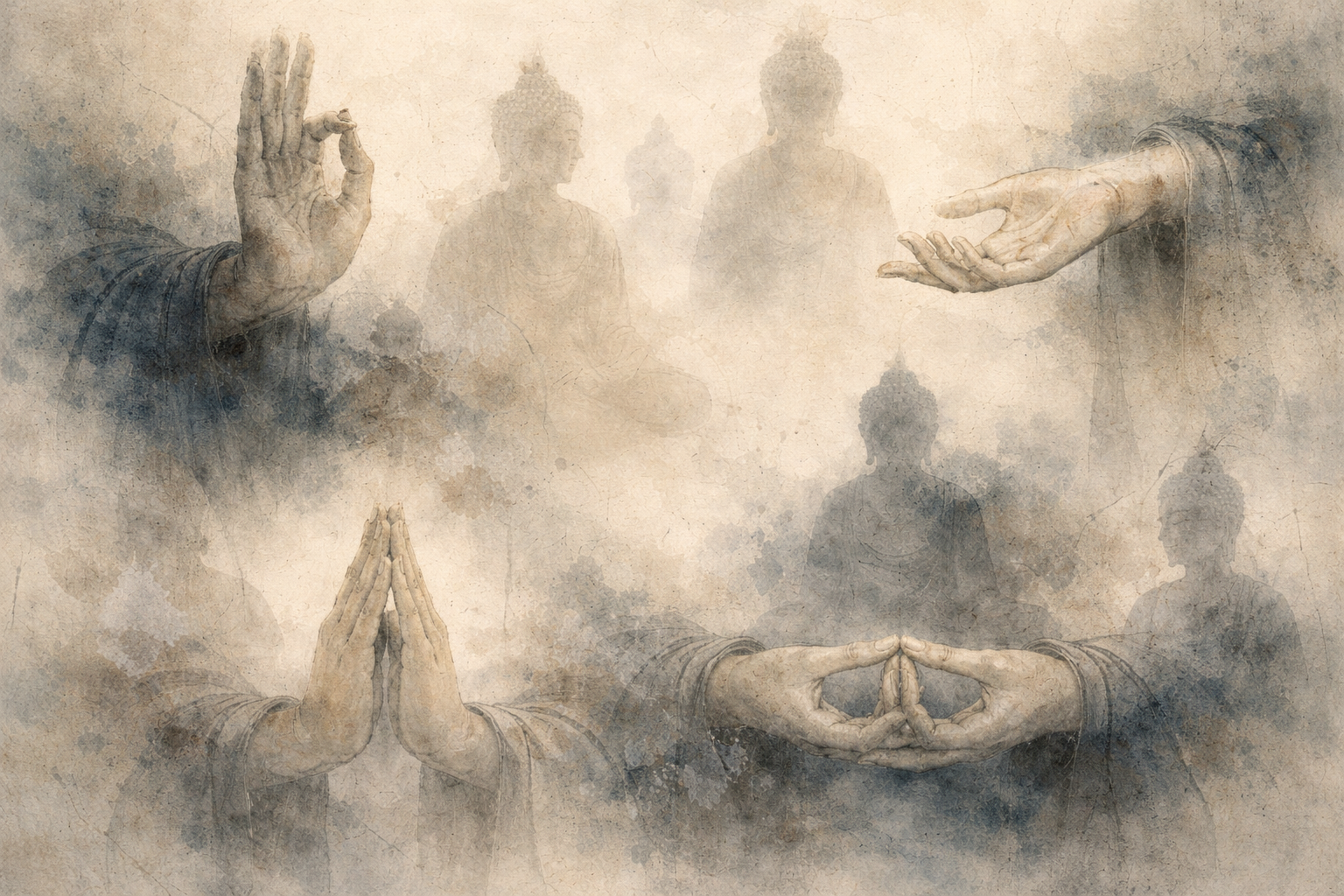
Quick Summary
- Buddhist hand gestures (mudras) are visual “verbs” that show what a figure is doing: teaching, protecting, meditating, giving, or witnessing.
- Read a mudra by checking palm direction, finger contact, hand height, and whether one or both hands are used.
- Context matters: the same gesture can shift meaning depending on the figure, posture, and surrounding symbols.
- Common mudras to recognize quickly: meditation (dhyana), teaching (dharmachakra), earth-touching (bhumisparsha), fearlessness (abhaya), giving (varada).
- Don’t over-literalize: mudras are not secret codes; they’re cues for attention and attitude.
- When you’re unsure, describe what you see first, then compare to a small set of likely options.
- Use mudras as a way to slow down and look carefully, not as a test you can fail.
How to Read Buddhist Hand Gestures in Statues and Images
You’re looking at a statue or a painting and the hands feel like the whole message—yet you can’t tell if the figure is blessing, teaching, meditating, or doing something else entirely. The confusion usually comes from trying to match one “official” meaning to a gesture without noticing the small physical details that actually carry the meaning. I write for Gassho, a Zen/Buddhism site focused on clear, practical ways to read Buddhist imagery without turning it into trivia.
GASSHO
Ask and learn about Buddhism in daily life.
GASSHO is a Buddhist community app where you can learn Buddhist teachings and ask questions to the head priest of Kongosanmaiin Temple on Mount Koya.
A Simple Lens: Mudras as Actions, Not Codes
A helpful way to read Buddhist hand gestures in statues and images is to treat them as actions being performed rather than symbols to decode. A mudra often answers a basic question: what is this figure doing right now—calming, teaching, reassuring, offering, or calling something to witness?
This lens keeps you grounded in what you can actually see. Instead of starting with a name, start with form: are the palms open or closed, facing outward or inward, raised or lowered, touching or separated? Those choices tend to map to a small set of human actions we already understand: “stop,” “come closer,” “here,” “I offer,” “I hold,” “I explain.”
It also helps to remember that Buddhist art is made for viewing, not for passing an exam. Artists repeat recognizable gestures so viewers can feel the mood and intention quickly. The gesture is a cue for attention—an invitation to meet the image with the same steadiness, kindness, or clarity it depicts.
Finally, mudras rarely stand alone. They work with posture, facial expression, objects (like a bowl or lotus), and the setting. Reading the hands well means reading them as part of a whole scene.
What You Notice When You Look Slowly
When you first glance at a statue, your mind wants to label it fast: “blessing,” “praying,” “meditating.” That impulse is normal, but it often skips the details that make the gesture readable. If you pause for ten seconds, the hands start to look less like a vague sign and more like a precise posture.
You might notice the palm direction first. A palm facing outward can feel like reassurance or protection, while palms turned upward can feel like receiving or offering. Even before you know any Sanskrit terms, your body understands these as human gestures.
Then you may catch the “contact points.” Are the thumbs touching? Are the index fingers forming a circle? Are the hands resting in the lap, or is one hand reaching down? Small contacts are often the difference between “meditation” and “teaching,” or between “offering” and “granting.”
Height and placement change the tone. A hand raised near the chest reads differently than a hand lowered near the knee. A gesture centered at the heart area can suggest communication or instruction, while a gesture anchored low can suggest grounding, stability, or witness.
You may also notice asymmetry. Many images use one hand to express the outward relationship (reassuring, giving, calling) and the other hand to express inward steadiness (resting, holding, centering). Seeing that “two-direction” dynamic can make a confusing pose suddenly coherent.
Context quietly steers interpretation. The same open palm can be “fearlessness” in one image, or a more general “peace” gesture in another, depending on who the figure is and what else is present. If the figure holds an object, sits on a lotus, stands in a protective stance, or is surrounded by attendants, the hands are usually supporting that broader message.
Over time, you start trusting description over guessing. “Right hand down, fingers extended toward the earth; left hand in lap” is more useful than “some kind of blessing.” Description keeps you honest, and it makes it easier to compare what you see to common mudras.
A Practical Method to Identify Common Mudras
If you want a reliable way to read Buddhist hand gestures in statues and images, use a short checklist and narrow the options. Most depictions you’ll encounter in temples, museums, books, and online galleries cluster around a handful of widely repeated mudras.
- Step 1: Count hands and note symmetry. One hand active and one resting often signals “outward function + inward stability.” Two hands doing the same thing often signals a single unified action.
- Step 2: Check palm direction. Outward-facing palm often reads as reassurance/protection; upward-facing palm often reads as offering/receiving; inward-facing palms often read as centering/holding.
- Step 3: Look for finger “locks.” Thumb-to-index circles, interlaced fingers, or thumbs touching can be the key identifier.
- Step 4: Locate the gesture on the body. Near the knee, in the lap, at the heart, or near the face each suggests a different emphasis.
- Step 5: Use the scene as a tie-breaker. Posture, objects, and companions often confirm the most likely reading.
With that method, here are several mudras you can often identify with high confidence:
- Dhyana (meditation) mudra: Both hands rest in the lap, palms up, often with the right hand on top of the left; thumbs may touch lightly. Read it as collected attention and steadiness.
- Abhaya (fearlessness) mudra: One hand raised with palm outward, fingers up. Read it as reassurance, protection, and “you can relax.”
- Varada (giving) mudra: One hand lowered with palm outward or slightly upward, fingers extended. Read it as offering, generosity, or granting.
- Bhumisparsha (earth-touching) mudra: One hand reaches down toward the earth, often touching the ground; the other hand usually rests in the lap. Read it as witness, groundedness, and calling reality itself to confirm what’s true.
- Dharmachakra (turning the wheel of teaching) mudra: Hands held near the chest with finger circles (often thumb and index touching) in a teaching-like configuration. Read it as explanation, transmission, and clarifying the path.
- Vitarka (discussion/teaching) mudra: A hand raised with thumb and index forming a circle, other fingers extended. Read it as instruction, reasoning, or pointing out a principle.
These names are useful, but the real skill is recognizing the physical pattern and the human action it resembles. Once you can describe the pattern, you can look up the name later without losing the thread of what you’re seeing.
Common Misreadings That Create Confusion
Assuming every gesture means “blessing.” Many open-hand gestures get flattened into “blessing” in casual descriptions. In Buddhist imagery, open palms can indicate reassurance, generosity, welcome, or teaching depending on placement and the other hand.
Ignoring the second hand. People often focus on the dramatic hand (raised or reaching) and miss the quieter one. The resting hand in the lap, the hand holding an object, or the hand forming a circle can completely change the reading.
Forgetting that artists vary details. Mudras are standardized enough to be recognizable, but not so rigid that every statue matches a diagram. Finger spacing, wrist angle, and hand height can shift with region, era, and artistic style. Look for the core structure, not perfect geometry.
Over-claiming certainty from a low-quality image. In photos, shadows and cropping can hide finger contact. If you can’t see the fingertips clearly, keep your conclusion tentative and describe what’s visible.
Treating mudras as secret messages. A mudra is not a hidden password. It’s a visible cue that supports contemplation: “this is what calm looks like,” “this is what giving looks like,” “this is what clarity looks like.” When you read it that way, the image becomes usable rather than mysterious.
Why Reading Mudras Changes How You Relate to Buddhist Art
Learning how to read Buddhist hand gestures in statues and images makes viewing slower and more intimate. Instead of scanning for a label, you start noticing posture, mood, and intention—things that are easy to miss when you only want the “right answer.”
It also gives you a practical vocabulary for your own attention. When you recognize “reassurance” in an outward palm, you can feel what reassurance is like in your body. When you recognize “offering” in a lowered open hand, you can sense the difference between giving and grasping.
In everyday life, this becomes a gentle training in reading nonverbal communication. You get better at noticing subtle cues—openness, tension, steadiness—without rushing to judgment. That same skill helps you meet people (and yourself) with a little more patience.
Finally, mudras can keep Buddhist imagery from becoming decorative. The hands are doing something. When you see the action clearly, the image stops being a distant religious object and becomes a mirror for how a human mind can respond: calmly, clearly, generously, or without fear.
Conclusion
To read Buddhist hand gestures well, start with what’s visible: palm direction, finger contact, hand height, and the relationship between the two hands. Then let the broader context confirm your best guess. The goal isn’t to memorize a catalog—it’s to see the gesture as a human action that points to a quality of mind you can recognize right now.
Ask a Buddhist priest
Have a question about Buddhism?
In the GASSHO app, you can ask questions about Buddhist teachings, daily concerns, and how to understand Buddhism in everyday life.
Frequently Asked Questions
- FAQ 1: What are Buddhist hand gestures in statues and images called?
- FAQ 2: How can I read a mudra if I don’t know the figure’s name?
- FAQ 3: What does the raised open palm mean in Buddhist statues?
- FAQ 4: What does the hand touching the ground mean?
- FAQ 5: How do I recognize the meditation mudra in images?
- FAQ 6: What does a lowered open hand gesture mean on a Buddhist statue?
- FAQ 7: What does it mean when the thumb and index finger form a circle?
- FAQ 8: How do I tell dharmachakra mudra from vitarka mudra in pictures?
- FAQ 9: Do mudras have one fixed meaning across all Buddhist art?
- FAQ 10: What should I look at first when trying to read Buddhist hand gestures in an image?
- FAQ 11: Why do some statues show one hand active and the other resting?
- FAQ 12: Can I accurately read mudras from low-resolution photos online?
- FAQ 13: Are prayer hands (palms together) a common Buddhist mudra in statues?
- FAQ 14: How do I avoid over-interpreting Buddhist hand gestures?
- FAQ 15: What’s the quickest way to learn how to read Buddhist hand gestures in statues and images?
FAQ 1: What are Buddhist hand gestures in statues and images called?
Answer: They’re commonly called mudras, which are specific hand positions used in Buddhist art to show an action or intention such as teaching, meditation, reassurance, offering, or witnessing.
Takeaway: “Mudra” is the main term for Buddhist hand gestures you see in images.
FAQ 2: How can I read a mudra if I don’t know the figure’s name?
Answer: Start by describing the hands: palm direction (outward/upward/inward), finger contact (thumb touching index, hands joined, etc.), and placement (lap, chest, knee). Then match that structure to a few common mudras rather than trying to identify the deity first.
Takeaway: Read the physical shape first; identification can come later.
FAQ 3: What does the raised open palm mean in Buddhist statues?
Answer: A raised hand with the palm facing outward is often the abhaya (fearlessness) mudra, associated with reassurance, protection, and calming fear. Confirm by checking that the fingers are generally upright and the gesture is clearly presented outward.
Takeaway: Raised outward palm usually signals reassurance or protection.
FAQ 4: What does the hand touching the ground mean?
Answer: A hand reaching down toward the earth (often near the knee, sometimes touching the ground) is typically the bhumisparsha or “earth-touching” mudra. It’s commonly read as calling the earth to witness, emphasizing groundedness and unwavering resolve.
Takeaway: Downward earth-touching hand often indicates witness and grounding.
FAQ 5: How do I recognize the meditation mudra in images?
Answer: Look for both hands resting in the lap, palms up, often with the right hand placed on top of the left, and sometimes with the thumbs lightly touching. This is commonly called the dhyana (meditation) mudra.
Takeaway: Hands in lap, palms up, usually points to meditation/collectedness.
FAQ 6: What does a lowered open hand gesture mean on a Buddhist statue?
Answer: A lowered hand with an open palm and relaxed fingers is often the varada mudra, commonly read as giving, generosity, or granting. Check whether the palm is presented outward or slightly upward, and whether the overall pose feels “offering.”
Takeaway: Lowered open palm often suggests offering or generosity.
FAQ 7: What does it mean when the thumb and index finger form a circle?
Answer: A thumb-and-index circle can indicate a teaching or explanation gesture, often associated with vitarka mudra (discussion/teaching). The meaning depends on where the hand is held (often near the chest or shoulder) and what the other hand is doing.
Takeaway: Thumb-index circle frequently points to teaching or clarifying.
FAQ 8: How do I tell dharmachakra mudra from vitarka mudra in pictures?
Answer: Dharmachakra (“turning the wheel of teaching”) usually uses both hands near the chest in a more structured teaching configuration, often with circles formed by fingers. Vitarka is more commonly a single-hand teaching/discussion gesture. If both hands are actively “teaching” at the heart area, dharmachakra is more likely.
Takeaway: Two-hand chest-level teaching often suggests dharmachakra; one-hand teaching often suggests vitarka.
FAQ 9: Do mudras have one fixed meaning across all Buddhist art?
Answer: Not always. Many mudras have a common core meaning, but details can vary by region, era, and artistic convention. The safest approach is to read the gesture’s basic action (reassuring, offering, teaching, witnessing) and then refine using context.
Takeaway: Mudras are consistent enough to recognize, but context still matters.
FAQ 10: What should I look at first when trying to read Buddhist hand gestures in an image?
Answer: Start with three things: (1) palm direction, (2) finger contact (touching, circling, interlacing), and (3) placement on the body (lap, chest, knee). Those features narrow the possibilities quickly even if the image is unfamiliar.
Takeaway: Palm direction + finger contact + placement is the fastest reading method.
FAQ 11: Why do some statues show one hand active and the other resting?
Answer: In many images, one hand communicates outwardly (reassuring, giving, calling to witness) while the other expresses inward steadiness (resting in the lap, holding an object, or centering). Reading both hands together often reveals the full “sentence” of the pose.
Takeaway: One hand can show outward relationship while the other shows inner stability.
FAQ 12: Can I accurately read mudras from low-resolution photos online?
Answer: Sometimes, but finger contact is often the first detail to disappear in low-resolution images or harsh lighting. If you can’t clearly see fingertips and palm orientation, keep your interpretation tentative and rely more on placement and overall posture.
Takeaway: If you can’t see the fingers clearly, treat your mudra reading as a best guess.
FAQ 13: Are prayer hands (palms together) a common Buddhist mudra in statues?
Answer: Yes, palms together can appear as a gesture of reverence or greeting (often called anjali). In images, it may indicate devotion, respect, or a moment of request or acknowledgment, depending on the figure and scene.
Takeaway: Palms together usually reads as reverence or respectful greeting in Buddhist imagery.
FAQ 14: How do I avoid over-interpreting Buddhist hand gestures?
Answer: Stick to what you can verify visually, describe the gesture plainly, and choose the simplest fitting meaning (teaching, reassurance, offering, meditation, witness). If multiple mudras seem possible, note the ambiguity instead of forcing certainty.
Takeaway: Describe first, interpret second, and allow uncertainty when details are unclear.
FAQ 15: What’s the quickest way to learn how to read Buddhist hand gestures in statues and images?
Answer: Learn a small core set (dhyana, abhaya, varada, bhumisparsha, dharmachakra/vitarka), then practice by describing real images: palm direction, finger contact, and placement. Repetition with careful looking builds recognition faster than memorizing long lists.
Takeaway: Master a few common mudras and practice careful description to improve quickly.