



How to Create a Simple Buddhist Altar at Home
Quick Summary
- A simple Buddhist altar at home is a small, consistent place that supports attention, gratitude, and ethical intention.
- You only need a clean surface, one meaningful focal point, and a few optional offerings—simplicity is the point.
- Choose a location you can keep tidy and visit daily, even for one minute.
- Set it up with safety in mind: stable items, careful candle use, and respectful placement.
- Create a short routine: arrive, bow (or pause), offer (or simply breathe), and dedicate the benefit.
- Keep it alive by refreshing water/flowers, wiping dust, and returning when you feel scattered.
- If you share a home, you can make an altar that is discreet, inclusive, and non-performative.
Introduction
You want to create a simple Buddhist altar at home, but you don’t want it to feel like a museum display, a shopping list, or a performance for an imagined “right way.” The real challenge is choosing what matters, placing it with care, and building a routine you’ll actually return to when life is busy. At Gassho, we focus on practical, respectful home practice that fits real homes and real schedules.
A home altar doesn’t need to be large, expensive, or elaborate. It needs to be clear enough that your mind recognizes it as a cue: “pause here.” If you can create that cue—visually simple, emotionally steady—you’ve already built the heart of the altar.
Think of the altar as a small agreement with yourself: this corner is for remembering what you value. The objects are not the point; the relationship you build with attention, humility, and care is the point.
A Simple Lens: What a Home Altar Is For
A simple Buddhist altar at home is best understood as a support for attention rather than a statement of identity. It’s a place where you practice stopping, noticing, and aligning your actions with your intentions. The altar is not there to impress anyone; it’s there to help you remember.
Seen this way, the “right” setup is the one that reliably invites you to soften your urgency. A clean surface, a single focal point, and a small gesture of care (like fresh water) can do more than a crowded arrangement that you avoid because it feels complicated.
The objects on an altar function like gentle symbols. They can represent awakening, compassion, and clarity, but they don’t have to carry mystical weight. Their practical job is to turn your mind toward steadiness: “Here, I practice being less reactive and more awake.”
Finally, a home altar is also a training in respect—respect for your time, your space, and your own capacity to begin again. Even if you miss days, the altar remains a quiet invitation to return without drama.
GASSHO
Ask and learn about Buddhism in daily life.
GASSHO is a Buddhist community app where you can learn Buddhist teachings and ask questions to the head priest of Kongosanmaiin Temple on Mount Koya.
How It Feels in Everyday Life
You walk past the altar on the way to make coffee, and something in you remembers to slow down. Not because you force it, but because the space is visually calm and familiar. The mind recognizes a pattern: “This is where I pause.”
On a stressful day, you might stand there for ten seconds—no incense, no long recitation—just a breath and a small bow or nod. The body learns that it can shift gears without needing perfect conditions. The altar becomes a doorway into a different pace.
Sometimes you’ll notice a subtle urge to “do it right.” You might rearrange objects repeatedly, or feel that you need more items before you can begin. The altar practice, done simply, reveals that urge as just another form of restlessness—something you can see, name, and release.
When you place fresh water or a flower, the action is small but precise. You feel the difference between rushing and placing. That difference is the practice: attention expressed through ordinary movement.
Over time, the altar can become a place where emotions are allowed to be present without being acted out. You might arrive irritated, anxious, or tired, and simply acknowledge it. The space doesn’t fix your life; it gives you a moment to stop feeding the spin.
In shared homes, you may become more considerate: keeping the area tidy, choosing a discreet spot, or using a battery candle instead of an open flame. The altar quietly trains you to balance your inner life with the reality of other people.
And on good days, it’s just a warm check-in. You pause, feel grateful, and move on. The altar doesn’t need to be dramatic to be meaningful.
Setting Up Your Altar: A Simple, Respectful Method
If you want to know how to create a simple Buddhist altar at home, start with what you can maintain. The best altar is the one you can keep clean, safe, and easy to approach.
Step 1: Choose a stable, quiet location. A shelf, small table, or the top of a dresser works well. Pick a place you naturally pass by, but not where clutter piles up. If possible, avoid the floor; if you must use a low surface, keep it clearly separate from everyday storage.
Step 2: Keep the surface clean and simple. Wipe it down. Remove unrelated items. This is less about “purity” and more about reducing visual noise so your attention can settle quickly.
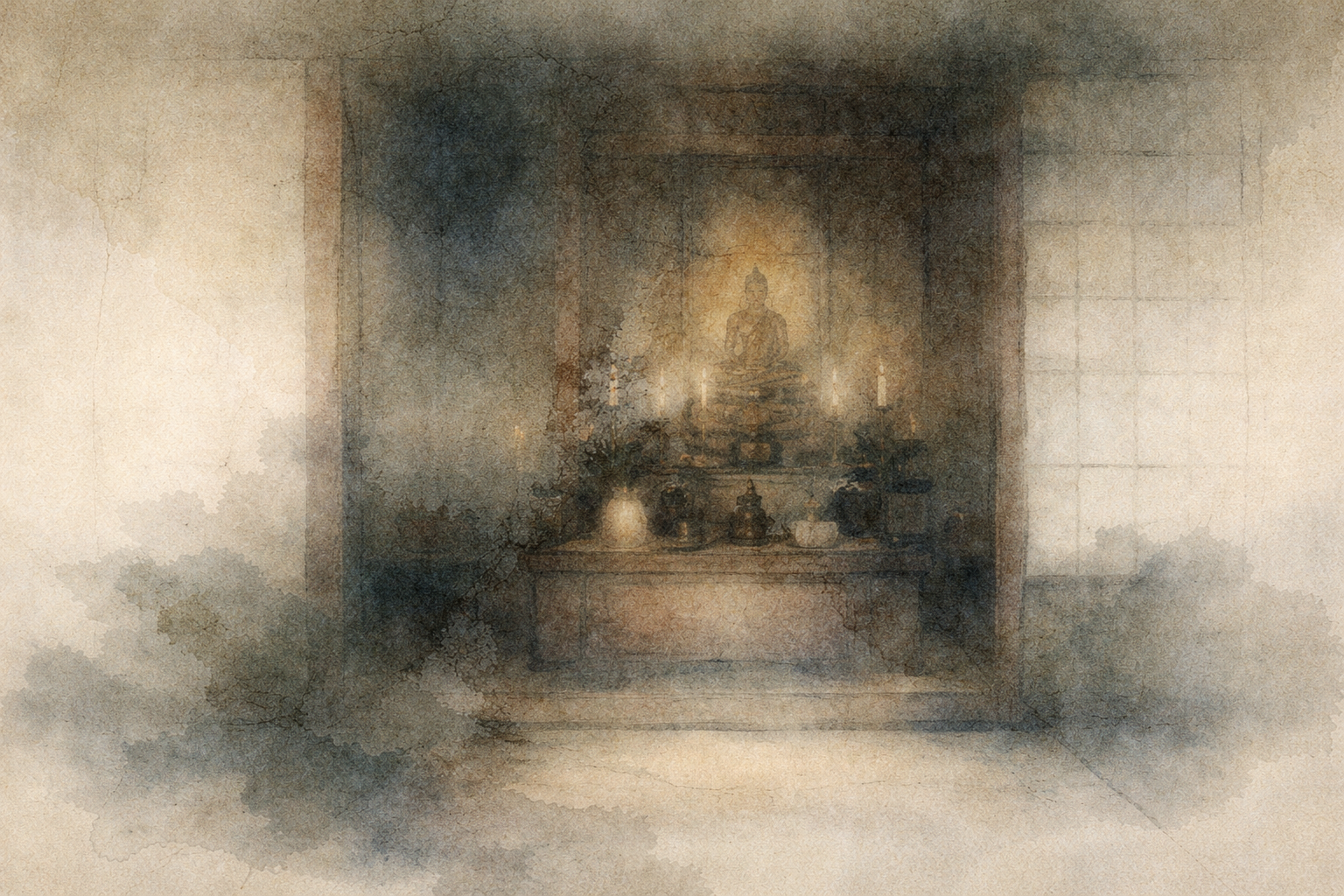
Step 3: Add one central focal point. This can be a small Buddha image, a simple statue, or a respectful print. If you don’t have an image, you can use a candle or a small, neutral object that reminds you of clarity and compassion. The key is that it feels steady to you, not decorative in a random way.
Step 4: Add one or two offerings (optional, but helpful). A small cup of water is the simplest offering and easy to refresh. Flowers are also common if you can keep them fresh. If you use a candle or incense, prioritize safety and ventilation.
Step 5: Create a tiny routine you can repeat. For example: arrive, pause for one breath, bow or place hands together, offer water, and sit or stand quietly for one minute. Consistency matters more than length.
Step 6: Maintain it lightly. Refresh water daily or when you remember. Dust weekly. Remove wilted flowers promptly. A neglected altar can become a source of guilt; a lightly maintained altar stays inviting.
Common Misunderstandings That Make It Harder
“I need the perfect items before I can start.” This is the most common trap. Start with a clean surface and one focal point. Let the altar grow slowly, if it grows at all.
“If I don’t do rituals, an altar is pointless.” A home altar can be as simple as a place to pause and remember your intentions. Ritual is optional; sincerity is not.
“More objects means more devotion.” Often, more objects means more distraction and more maintenance. A simple altar is not “less spiritual”; it’s often more usable.
“I’m not Buddhist enough to have an altar.” If your intention is respectful and your practice is grounded, a simple altar can support you regardless of labels. Treat it as a practice space, not a badge.
“It has to look a certain way.” Homes differ. Budgets differ. Family situations differ. The altar should fit your life while still feeling clearly set apart from ordinary clutter.
Why a Small Altar Can Change Your Day
A simple Buddhist altar at home matters because it makes your values visible. When life gets loud, you don’t have to search for meaning—you just walk to a familiar place and pause. That pause interrupts automatic reactions and gives you a chance to choose your next action.
It also builds continuity. Even if you only stop for a minute, you’re reinforcing a daily thread of attention. Over weeks and months, that thread becomes a quiet kind of stability that doesn’t depend on mood.
Finally, the altar can soften the way you relate to your own mind. You learn to return without self-criticism: wipe the surface, refresh the water, take one breath, begin again. That “begin again” is a practical compassion you can carry into conversations, work, and family life.
Conclusion
If you’re learning how to create a simple Buddhist altar at home, aim for something you can keep clean, safe, and easy to approach. Choose one steady focal point, add one small act of care, and repeat a short routine. The altar doesn’t need to be elaborate to be real—it needs to be used.
Start today with what you already have: clear a small space, place one meaningful object, and pause for one breath. Let simplicity do its work.
Ask a Buddhist priest
Have a question about Buddhism?
In the GASSHO app, you can ask questions about Buddhist teachings, daily concerns, and how to understand Buddhism in everyday life.
Frequently Asked Questions
- FAQ 1: What is the simplest setup for a Buddhist altar at home?
- FAQ 2: Where should I place a simple Buddhist altar in my house?
- FAQ 3: Do I need a Buddha statue to create a simple Buddhist altar at home?
- FAQ 4: What offerings are appropriate for a simple Buddhist altar at home?
- FAQ 5: How do I keep a home Buddhist altar simple and not cluttered?
- FAQ 6: How often should I refresh water or offerings on a simple Buddhist altar at home?
- FAQ 7: Can I create a simple Buddhist altar at home if I live in a small apartment?
- FAQ 8: Is it disrespectful to place a Buddhist altar in a bedroom?
- FAQ 9: What should I do at my simple Buddhist altar each day?
- FAQ 10: Do I need incense or candles for a simple Buddhist altar at home?
- FAQ 11: How can I create a simple Buddhist altar at home if my family or roommates are not Buddhist?
- FAQ 12: What if I can’t keep my Buddhist altar perfectly clean all the time?
- FAQ 13: Can I use a photo or printed image instead of a statue on a simple Buddhist altar at home?
- FAQ 14: How do I set up a simple Buddhist altar at home on a budget?
- FAQ 15: What should I avoid when creating a simple Buddhist altar at home?
FAQ 1: What is the simplest setup for a Buddhist altar at home?
Answer: The simplest setup is a clean, dedicated surface with one focal point (such as a Buddha image or a respectful print) and one small offering like a cup of fresh water. Keep it uncluttered so it’s easy to approach daily.
Takeaway: Clean surface + one focal point + one simple offering is enough.
FAQ 2: Where should I place a simple Buddhist altar in my house?
Answer: Place it somewhere stable, relatively quiet, and easy to keep tidy—like a shelf, small table, or dresser top. Choose a spot you can visit consistently, and avoid areas where random items accumulate.
Takeaway: Pick a location you can keep clean and return to often.
FAQ 3: Do I need a Buddha statue to create a simple Buddhist altar at home?
Answer: No. A statue can be helpful, but a respectful image, print, or another simple focal point that reminds you of clarity and compassion can work. The key is that it supports your intention and feels respectful to you.
Takeaway: A meaningful focal point matters more than a specific object.
FAQ 4: What offerings are appropriate for a simple Buddhist altar at home?
Answer: The most common simple offerings are fresh water, a candle (or safe light), incense (if you can ventilate), and flowers. Choose what you can maintain without stress; even just water is a complete, simple offering.
Takeaway: Offer what you can refresh easily—water alone is enough.
FAQ 5: How do I keep a home Buddhist altar simple and not cluttered?
Answer: Limit the altar to a few items with clear purpose: one focal point and one to three supporting items (like water, a small candle, or flowers). Remove unrelated objects, and avoid adding items you don’t plan to maintain.
Takeaway: Fewer items usually makes the altar more usable.
FAQ 6: How often should I refresh water or offerings on a simple Buddhist altar at home?
Answer: Refresh water daily if possible, or as often as you realistically remember. Flowers should be replaced when they wilt. The goal is a space that feels cared for, not a strict rule that creates guilt.
Takeaway: Refresh regularly, but keep it sustainable.
FAQ 7: Can I create a simple Buddhist altar at home if I live in a small apartment?
Answer: Yes. A small shelf, a corner of a desk, or the top of a narrow cabinet can work. The “altar” is defined by being dedicated and kept clear, not by size.
Takeaway: A small, dedicated space is still a real altar.
FAQ 8: Is it disrespectful to place a Buddhist altar in a bedroom?
Answer: It’s not automatically disrespectful, especially if that’s the only workable space. Keep the altar clean, elevated if possible, and clearly separate from clutter. What matters most is the care and intention you bring to the space.
Takeaway: Bedrooms can work if the altar is kept tidy and distinct.
FAQ 9: What should I do at my simple Buddhist altar each day?
Answer: Keep it short: arrive, pause for one breath, make a small gesture of respect (like hands together or a bow), and sit or stand quietly for a minute. If you use offerings, refresh water or light a candle safely, then dedicate the benefit to others.
Takeaway: A one-minute daily routine is enough to make it living practice.
FAQ 10: Do I need incense or candles for a simple Buddhist altar at home?
Answer: No. They can be meaningful, but they’re optional. If you do use them, prioritize safety and ventilation; a simple altar can be complete with just a focal point and fresh water.
Takeaway: Incense and candles are optional—simplicity is valid.
FAQ 11: How can I create a simple Buddhist altar at home if my family or roommates are not Buddhist?
Answer: Choose a discreet location, keep the design minimal, and avoid taking over shared space. A small shelf with a calm focal point and a cup of water can be respectful without feeling intrusive to others.
Takeaway: Keep it minimal, tidy, and considerate of shared living.
FAQ 12: What if I can’t keep my Buddhist altar perfectly clean all the time?
Answer: Perfection isn’t required. When you notice dust or clutter, treat cleaning as part of the practice: remove unrelated items, wipe the surface, and reset gently. The point is returning, not judging yourself.
Takeaway: Resetting the altar is practice, not a failure.
FAQ 13: Can I use a photo or printed image instead of a statue on a simple Buddhist altar at home?
Answer: Yes. A framed print or photo can be a clear, respectful focal point and often fits better in small spaces. Place it securely and keep the area around it uncluttered.
Takeaway: A simple image can serve as a complete focal point.
FAQ 14: How do I set up a simple Buddhist altar at home on a budget?
Answer: Start with what you already have: a cleared shelf, a printed image, and a clean cup for water. Add items slowly only if they genuinely support your routine. The most important “investment” is consistency, not decoration.
Takeaway: Use what you have and keep the focus on daily use.
FAQ 15: What should I avoid when creating a simple Buddhist altar at home?
Answer: Avoid clutter, unsafe flames, placing the altar where it will be constantly disturbed, and treating it like a display shelf for random items. Also avoid making it so complicated that you stop using it.
Takeaway: Keep it safe, clear, and easy to return to.