



How Karma Works in Buddhism: Cause, Effect, and Intention
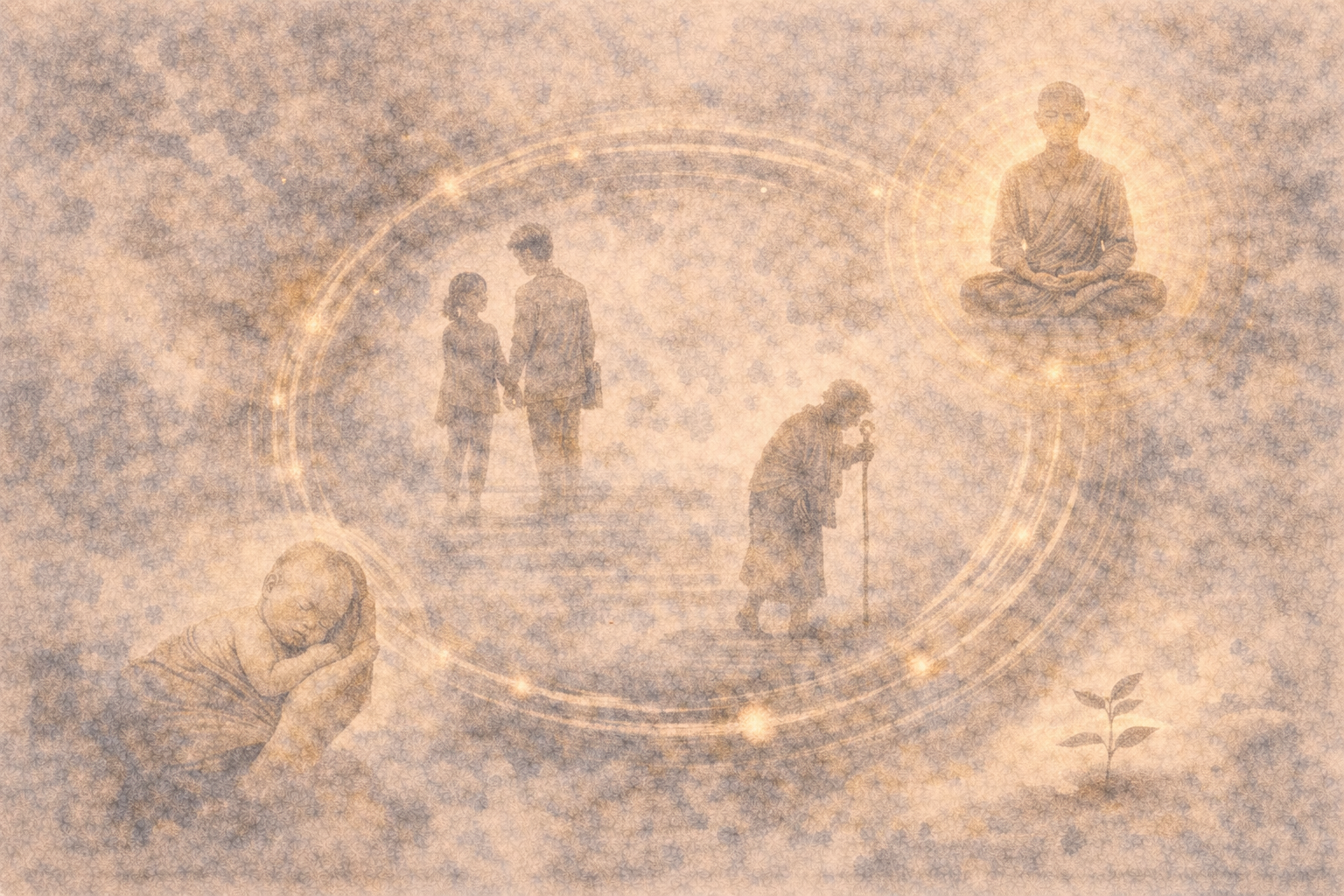
Quick Summary
- In Buddhism, karma is about intentional action and its results, not cosmic reward and punishment.
- Intention (what you mean and why) is the engine that makes an action karmically “active.”
- Karmic results often show up as habits, perceptions, and reactions—not just external events.
- Cause and effect is complex: many conditions shape outcomes, so karma is not simple fate.
- You can change karma in real time by noticing, pausing, and choosing a different response.
- “Good” karma tends to reduce inner friction; “bad” karma tends to increase it through reactivity.
- Understanding karma is practical: it helps you take responsibility without blaming yourself.
Introduction: The Confusion Around Karma Is Understandable
If “karma” feels like a vague rule that says you deserve whatever happens to you, you’re not alone—and that version is both unhelpful and inaccurate. In Buddhism, karma is less about what the universe does to you and more about what your mind learns to do next: how intention shapes action, how action shapes habit, and how habit shapes the way life is experienced. Gassho writes about Buddhist ideas as practical lenses for everyday life, with an emphasis on clarity and lived experience.
The keyword phrase “how karma works in Buddhism” points to three pieces that need to be held together: cause, effect, and intention. If you remove intention, karma becomes superstition. If you remove cause and effect, it becomes mere self-help. If you remove the lived, moment-to-moment level, it becomes philosophy that never touches your actual day.
This is why Buddhist karma is often best understood as a training-oriented view: it highlights what you can influence (your intentions and responses) while acknowledging what you can’t control (the full web of conditions that shape outcomes).
Karma as a Practical Lens on Cause, Effect, and Intention
In Buddhism, karma (often explained as “action”) is primarily about intentional actions of body, speech, and mind. The key point is not that every event is your fault, but that intentional patterns have consequences—especially in the way they condition your future tendencies. When an action is driven by a clear intention, it leaves a kind of imprint: it makes similar actions more likely, and it shapes how you interpret what happens next.
Cause and effect here is not a single straight line. One intention leads to an action, but the results depend on many conditions: timing, context, other people’s choices, your own history, and countless factors you can’t see. Karma is one condition among many. This matters because it prevents the common mistake of turning karma into fatalism (“everything is predetermined”) or moral accounting (“you always get exactly what you deserve”).
Intention is central because it’s where freedom begins. Two people can do the same outward act with very different inner motives—care, fear, pride, resentment, generosity—and those motives shape what the act reinforces inside them. In this lens, karma is not a belief you must accept; it’s a way of noticing how inner movements become outer behavior, and how outer behavior trains the inner world.
Seen this way, karma is less like a cosmic scoreboard and more like momentum. What you repeatedly intend and do becomes easier to intend and do again. Over time, that momentum can feel like “this is just who I am,” even though it began as a series of small choices and reactions.
GASSHO
Ask and learn about Buddhism in daily life.
GASSHO is a Buddhist community app where you can learn Buddhist teachings and ask questions to the head priest of Kongosanmaiin Temple on Mount Koya.
How Karma Shows Up in Ordinary Moments
Start with something simple: you receive a message that feels dismissive. Before you even reply, the mind produces a story—“They don’t respect me”—and the body tightens. If you respond immediately, the intention might be to defend, to win, or to punish. That intention shapes the words you choose, the tone you take, and the relationship you create in the next hour.
Now notice the internal effect. After sending a sharp reply, there’s often a residue: agitation, replaying the conversation, planning the next argument. Even if the other person apologizes, the mind may stay primed for conflict. This is a karmic result that doesn’t require any mystical explanation—your action strengthened a pattern of reactivity.
Or take the opposite: you pause. You feel the heat of irritation, but you let it be present without immediately acting it out. The intention shifts from “I must strike back” to “I want to respond clearly.” You might ask a question instead of making an accusation. The external outcome may still be imperfect, but internally something different is trained: patience, steadiness, and the ability to stay with discomfort.
Karma also appears in how attention is directed. If you repeatedly feed resentment, attention becomes skilled at finding insults. If you repeatedly practice appreciation, attention becomes skilled at noticing support. This isn’t about forcing positivity; it’s about recognizing that what you rehearse becomes your default lens.
Small everyday choices matter because they are repeatable. The intention behind a “harmless” exaggeration, a sarcastic comment, or a quiet act of honesty is not small to the mind—it’s training data. Over time, the mind learns what it can get away with, what it must hide, and what it can face directly.
Even when nothing dramatic happens outside, karma is still working internally. If you act from generosity, you often feel more connected and less cramped. If you act from greed or spite, you often feel more separate and more tense. These are immediate cause-and-effect loops that can be observed without adopting any special worldview.
And when you do meet consequences in the world—trust gained or lost, opportunities opened or closed—Buddhism encourages a grounded reading: not “I’m being rewarded,” but “patterns have effects, and I can learn from them.” That learning is where the teaching becomes practical.
Common Misunderstandings That Make Karma Feel Harsh
One misunderstanding is that karma means “everything happens for a reason” or “everything is deserved.” Buddhism doesn’t require that conclusion. Many things happen due to impersonal conditions: biology, weather, economics, other people’s decisions, accidents. Karma is about the ethical and psychological force of intention within that larger field, not a total explanation for every event.
Another misunderstanding is that karma is instant and obvious. Sometimes the most important results are subtle: a mind that becomes more suspicious, a heart that becomes less available, a habit of avoidance that quietly shrinks your life. Conversely, a kind action may not “pay off” externally, yet it can still strengthen integrity and reduce inner conflict.
A third misunderstanding is that karma is only about big moral moments. In practice, it’s often the repeated micro-intentions—how you speak when tired, how you handle envy, how you relate to discomfort—that shape your character. The teaching can feel demanding if you treat it as perfectionism; it becomes workable when you treat it as training.
Finally, karma is sometimes used as a way to judge others: “They must have done something to deserve this.” That move usually creates distance and blame. A more faithful application is inward and compassionate: “What intention is operating in me right now, and what does it lead to?”
Why Understanding Karma Changes Daily Life
When you understand how karma works in Buddhism, responsibility becomes cleaner. You don’t have to control everything; you focus on what you’re actually doing with your mind, speech, and body. This reduces helplessness without turning life into a self-blame project.
It also makes ethics feel less like rules and more like cause-and-effect intelligence. If harsh speech reliably creates fear and defensiveness, you don’t need a commandment to see it’s unskillful. If honesty reliably reduces mental strain, you don’t need a reward to value it. Karma reframes ethics as the art of reducing suffering—yours and others’—through wiser intention.
On a stressful day, this view offers a simple checkpoint: “What am I feeding right now?” Feeding irritation tends to multiply irritation. Feeding clarity tends to multiply clarity. You may not be able to choose your first reaction, but you can often choose what you do next—and that “next” is where karmic momentum is shaped.
Over time, this changes relationships. People feel the difference between being used as targets for your moods and being met with steadiness. Even when conflict is unavoidable, intention can shift from winning to understanding, from punishing to setting boundaries, from proving to listening.
Conclusion: Karma Is Momentum You Can Work With
Karma in Buddhism is not a supernatural threat and not a guarantee that life will be fair. It’s a practical way to see how intention becomes action, how action becomes habit, and how habit shapes the texture of experience. The point isn’t to obsess over the past; it’s to notice the present—because the present is where intention can be clarified and momentum can change.
If you keep the focus on what’s observable—your motives, your reactions, your patterns—karma becomes less mysterious and more useful. Cause and effect stops being a slogan and becomes a daily experiment in living with a little more care.
Ask a Buddhist priest
Have a question about Buddhism?
In the GASSHO app, you can ask questions about Buddhist teachings, daily concerns, and how to understand Buddhism in everyday life.
Frequently Asked Questions
- FAQ 1: How karma works in Buddhism—does it mean “what goes around comes around”?
- FAQ 2: What role does intention play in how karma works in Buddhism?
- FAQ 3: Is karma in Buddhism the same as fate?
- FAQ 4: Does Buddhism teach that everything that happens to you is your karma?
- FAQ 5: How does karma work in Buddhism in everyday life, not just in theory?
- FAQ 6: If intention matters most, do outcomes matter in Buddhist karma?
- FAQ 7: How does karma work in Buddhism with thoughts—do thoughts create karma?
- FAQ 8: Is karma in Buddhism a punishment or reward system?
- FAQ 9: How long does it take for karma to “ripen” in Buddhism?
- FAQ 10: Can you change your karma according to Buddhism?
- FAQ 11: How does karma work in Buddhism with relationships and conflict?
- FAQ 12: Does Buddhism say “good karma” guarantees good things will happen?
- FAQ 13: How does karma work in Buddhism without a permanent self?
- FAQ 14: Is it wrong to tell someone their suffering is “their karma” in Buddhism?
- FAQ 15: What is the simplest way to observe how karma works in Buddhism today?
FAQ 1: How karma works in Buddhism—does it mean “what goes around comes around”?
Answer: Not exactly. Buddhism emphasizes that karma is intentional action and the tendencies and results it conditions. Some actions do lead to clear external consequences, but many karmic effects show up internally as habits, perceptions, and reactive patterns rather than a neat “payback” event.
Takeaway: Karma is about intention shaping future experience, not guaranteed cosmic payback.
FAQ 2: What role does intention play in how karma works in Buddhism?
Answer: Intention is central because it’s what makes an action karmically significant. The same outward behavior can condition very different results depending on whether it’s driven by care, fear, greed, or hostility. Intention also shapes what the mind learns to repeat.
Takeaway: In Buddhism, intention is the “engine” of karma.
FAQ 3: Is karma in Buddhism the same as fate?
Answer: No. Karma is one set of causes among many conditions that influence what happens. Buddhism does not frame life as predetermined; it highlights that present choices and intentions matter, even within limits you can’t control.
Takeaway: Karma is conditional influence, not fixed destiny.
FAQ 4: Does Buddhism teach that everything that happens to you is your karma?
Answer: No. Many experiences arise from impersonal conditions like health, environment, and other people’s actions. Karma explains how intentional actions condition results, but it is not used as a total explanation for every event.
Takeaway: Not everything is “your karma”; karma is not a universal blame tool.
FAQ 5: How does karma work in Buddhism in everyday life, not just in theory?
Answer: It shows up as feedback loops: reacting with anger makes anger easier to repeat; responding with patience strengthens patience. Over time, these loops shape your default tone, your relationships, and how stressful situations feel from the inside.
Takeaway: Karma is visible as repeatable patterns in ordinary moments.
FAQ 6: If intention matters most, do outcomes matter in Buddhist karma?
Answer: Outcomes matter, but they’re not fully controllable. Buddhism places strong emphasis on intention because it’s what you can directly train, while also encouraging you to learn from results and adjust your behavior when harm occurs.
Takeaway: Train intention, learn from outcomes, and accept complexity.
FAQ 7: How does karma work in Buddhism with thoughts—do thoughts create karma?
Answer: Yes, mental actions matter, especially when they are intentional and repeatedly cultivated (like resentment, cruelty, or generosity). Even before speech or behavior, repeatedly feeding certain thoughts conditions attention and makes related actions more likely.
Takeaway: Repeated intentional thinking can be karmically shaping.
FAQ 8: Is karma in Buddhism a punishment or reward system?
Answer: It’s not framed as a judging force that punishes or rewards. Karma is described as cause and effect: certain intentions and actions tend to produce certain kinds of results, especially in the mind’s habits and the suffering or ease that follows.
Takeaway: Karma is causal conditioning, not divine judgment.
FAQ 9: How long does it take for karma to “ripen” in Buddhism?
Answer: There isn’t a single timeline. Some results are immediate (regret, agitation, trust gained or lost), while others unfold later as habits strengthen and circumstances shift. Buddhism treats karmic timing as complex and condition-dependent.
Takeaway: Karmic results can be immediate or delayed, depending on conditions.
FAQ 10: Can you change your karma according to Buddhism?
Answer: Yes—because karma is shaped by present intention and action. You can’t erase the past, but you can weaken unhelpful momentum by pausing, choosing different responses, and repeatedly cultivating more skillful intentions.
Takeaway: Karma is workable because present choices condition future tendencies.
FAQ 11: How does karma work in Buddhism with relationships and conflict?
Answer: Intention shapes tone, timing, and the willingness to listen—each of which conditions trust or defensiveness. Repeated patterns (sarcasm, avoidance, honesty, repair) become the “normal” way a relationship functions, which is a clear karmic effect.
Takeaway: Relationship karma is built through repeated intentions in communication.
FAQ 12: Does Buddhism say “good karma” guarantees good things will happen?
Answer: No guarantee. Skillful intentions tend to reduce inner conflict and support wiser choices, but external outcomes still depend on many conditions. Buddhism emphasizes practice and responsibility rather than promises of perfect results.
Takeaway: Good karma supports well-being, but it doesn’t control the whole world.
FAQ 13: How does karma work in Buddhism without a permanent self?
Answer: Buddhism describes continuity through changing processes: intentions condition habits, habits condition perceptions and actions, and those condition further experience. Karma doesn’t require a fixed “soul”; it relies on causal continuity—like one moment influencing the next.
Takeaway: Karma works through conditioned continuity, not an unchanging self.
FAQ 14: Is it wrong to tell someone their suffering is “their karma” in Buddhism?
Answer: It’s usually unhelpful and often harmful. Buddhism encourages compassion and careful speech; using karma to explain someone’s pain can become blame and speculation. A more skillful approach is to focus on what reduces suffering now.
Takeaway: Karma is best applied inwardly, with humility and compassion.
FAQ 15: What is the simplest way to observe how karma works in Buddhism today?
Answer: Watch one loop: trigger → intention → action → aftertaste. Notice how a reactive intention leaves agitation and repetition, while a clearer intention leaves less inner friction. Repeating this observation makes karma less abstract and more directly knowable.
Takeaway: Observe the immediate “aftertaste” of intention to see karma in action.