



How Buddhist Symbols Help Connect Art, Ritual, and Practice
Quick Summary
- Buddhist symbols work best when you treat them as “attention tools,” not decorations or secret codes.
- Art gives a symbol a visible form, ritual gives it a repeatable use, and practice gives it a lived meaning.
- A symbol can stabilize attention by offering a simple, consistent “place to return” with the eyes, hands, or mind.
- Repeated contact (seeing, bowing, chanting, offering) turns a symbol into a cue for values like compassion and clarity.
- Misunderstandings happen when symbols are treated as magical objects or as “just art” with no inner function.
- You don’t need to adopt a new identity to use symbols skillfully; you need a clear intention and gentle consistency.
- The most helpful question is: “What does this symbol train me to notice, release, or remember right now?”
Introduction
You can stand in front of a lotus, a wheel, or a serene Buddha image and still feel unsure what you’re supposed to do with it—admire it, believe something about it, or perform a ritual you don’t fully understand. That confusion is reasonable: Buddhist symbols sit at the crossroads of art, ritual, and inner practice, and if you pull one piece away from the others, the symbol can feel either empty (just decoration) or intimidating (like a religious test you might fail). At Gassho, we focus on practical, experience-based ways to understand Buddhist culture without requiring you to “join” anything.
The key is to see symbols as functional: they are designed to shape attention, memory, and intention. Art gives you a stable form to meet with your senses. Ritual gives you a repeatable way to relate to that form. Practice is what happens inside you—how your mind responds, settles, resists, softens, or clarifies in that repeated meeting.
When these three work together, a symbol becomes less like a message you must decode and more like a handle you can hold—something that helps you return to what matters when you’re distracted, reactive, or numb.
A Practical Lens for Understanding Buddhist Symbols
A helpful way to approach Buddhist symbols is to treat them as “training devices” for the heart and mind. Not devices in a mechanical sense, but in the sense that they give your attention a shape. The mind is already symbol-making all day long—turning events into stories, people into labels, and feelings into judgments. Buddhist symbols simply make that process visible and usable.
In this lens, art is not separate from practice. A painted mandala, a carved statue, or a simple altar arrangement is a carefully chosen set of cues: symmetry, posture, gesture, color, and placement all guide perception. You don’t need to “believe in” the object for it to influence your attention; you only need to notice what it invites you to do—slow down, look steadily, remember kindness, or recognize impermanence.
Ritual then turns that invitation into a rhythm. Bowing, offering incense, lighting a candle, chanting, or circumambulating are not meant to impress anyone. They are structured repetitions that make it easier to return—again and again—to a chosen orientation of mind. The symbol anchors the ritual so it doesn’t drift into vague self-improvement; the ritual animates the symbol so it doesn’t remain a static image.
Practice is the inner side of the same movement: noticing what arises in you as you meet the symbol and the ritual. Do you rush? Do you perform? Do you resist? Do you soften? Over time, the symbol becomes less about what it “means” in a dictionary and more about what it reliably evokes in your awareness—clarity, humility, gratitude, steadiness, or compassion.
GASSHO
Ask and learn about Buddhism in daily life.
GASSHO is a Buddhist community app where you can learn Buddhist teachings and ask questions to the head priest of Kongosanmaiin Temple on Mount Koya.
How Symbols Show Up in Ordinary Experience
Imagine walking into a quiet room and seeing a simple image—perhaps a Buddha figure, a wheel motif, or a lotus design. Before you think anything, your body already responds: your pace changes, your voice lowers, your eyes settle. This is one of the most basic ways symbols connect art and practice: they shift the “default mode” of your attention without needing a lecture.
Then the mind starts narrating. You might think, “I don’t know what I’m doing,” or “This is beautiful,” or “This feels religious.” Those thoughts are not problems to eliminate; they are the practice material. The symbol is functioning as a mirror: it reveals your habits of interpretation—how quickly you judge, how easily you compare yourself, how often you look for the “right” response.
Ritual adds a small, deliberate action—lighting incense, placing hands together, bowing, or reciting a short verse. The action is simple on purpose. When you repeat it, you begin to notice the micro-moments: the urge to rush, the desire to get it perfect, the self-consciousness of being seen, or the relief of having a clear next step. The symbol holds the center so the action doesn’t feel random.
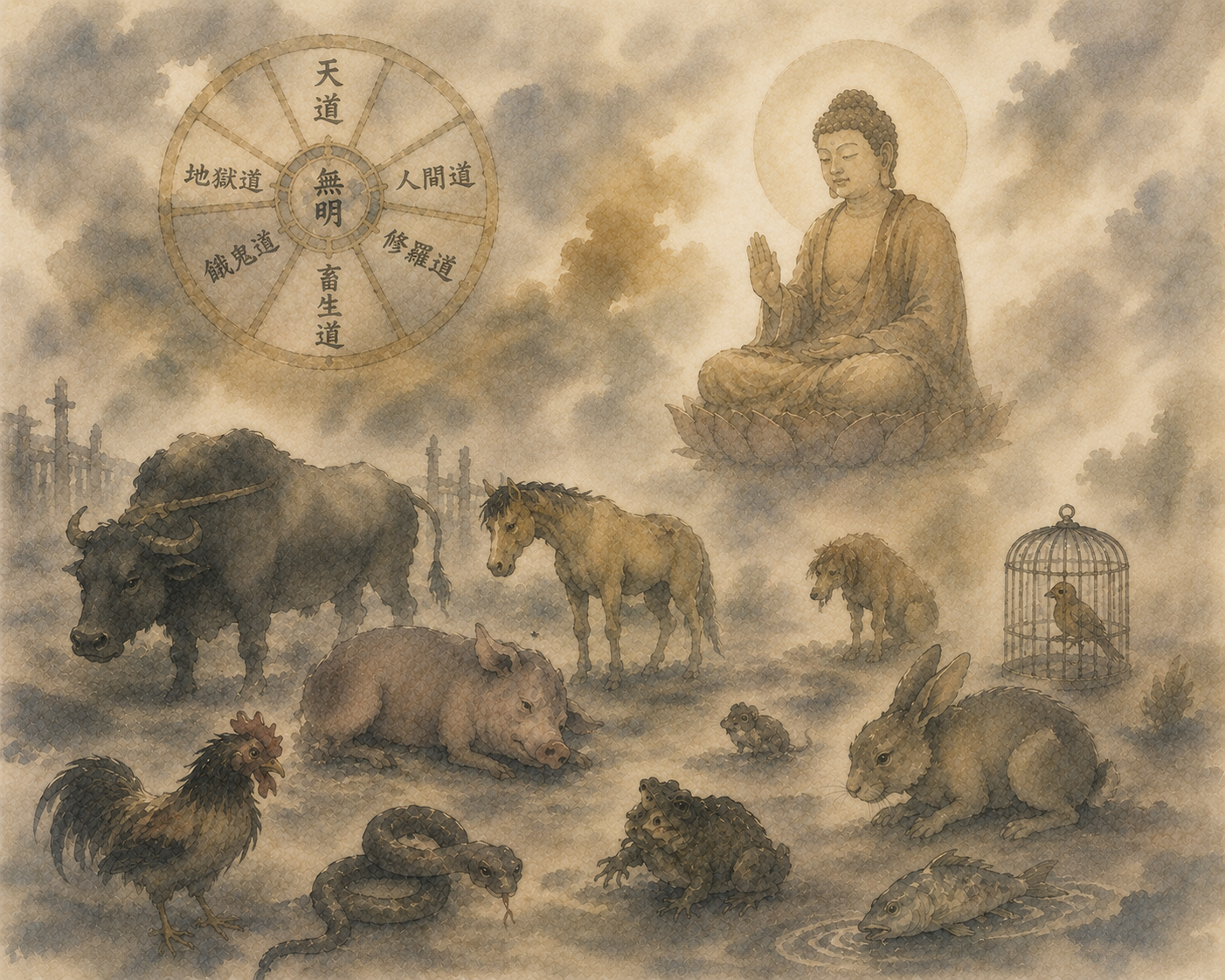
Over time, a symbol can become a cue for returning. You see the lotus and remember: “Let the muddy feeling be here; don’t add extra drama.” You see the wheel and remember: “Actions have consequences; choose carefully.” You see a calm seated figure and remember: “Posture matters; soften the jaw; feel the breath.” The point is not that the symbol forces a mood, but that it offers a reliable reminder when your mind is scattered.
This is also where art matters. A well-made image has a kind of steadiness: it doesn’t argue with you, it doesn’t demand, it doesn’t chase your attention like a screen. It simply remains. That “remaining” is practice-friendly. It gives you a chance to experience attention as something you can place and replace, rather than something that is always stolen.
In daily life, you may notice the same mechanism outside formal settings. A small symbol on a keychain, a print on a wall, or a motif in a notebook can interrupt autopilot. You pause for half a second. You remember your intention. You choose a slightly kinder tone in an email, or you stop yourself from escalating an argument. The symbol is not doing magic; it is doing what good design does—making the helpful choice easier to recall.
Even when nothing “special” happens, the repetition itself is meaningful. You meet the same symbol on a good day and a bad day. You notice how your interpretation changes. That change is the living connection between art (stable form), ritual (repeatable contact), and practice (shifting inner response).
Common Misunderstandings That Break the Connection
One common misunderstanding is treating symbols as supernatural guarantees: “If I display this, I’ll be protected,” or “If I do the ritual correctly, I’ll get a specific outcome.” While symbols can feel protective because they steady the mind, turning them into vending machines usually increases anxiety and performance pressure. The more you chase results, the less you can actually meet the symbol with a clear, receptive attention.
The opposite misunderstanding is dismissing symbols as “just art.” If you only approach a symbol aesthetically, you may miss its practical role as a cue for ethical and attentional training. Beauty can be part of the function, but the deeper purpose is often behavioral: to help you remember what you value when you’re tempted to forget.
Another snag is thinking there is one correct interpretation you must memorize. In reality, symbols often work on multiple levels: visual (shape and color), emotional (tone and mood), ethical (values), and practical (what you do with your body and attention). A symbol can be historically rich and still be personally usable in a simple way: “This reminds me to pause.”
Finally, people sometimes separate ritual from inner practice: either doing rituals mechanically with no attention, or trying to do “pure practice” while rejecting any form. Both extremes can be limiting. Ritual without attention becomes empty repetition; attention without any form can become vague and inconsistent. Symbols help bridge this by giving attention something steady to meet, and giving ritual a reason to be repeated.
Why This Connection Matters in Daily Life
When art, ritual, and practice are connected, symbols become a quiet support for the moments that actually shape your life: how you speak when you’re irritated, how you listen when you’re bored, how you respond when you feel judged, and how you act when nobody is watching. A symbol is not an escape from ordinary life; it is a way of bringing ordinary life into clearer view.
Symbols also help with consistency. Many people want to live with more patience or compassion, but forget as soon as stress hits. A visible symbol can function like a “bookmark” in the day—something that brings you back to your chosen direction without needing a long internal debate.
Ritual matters here because it turns values into embodied habits. Lighting a candle can become a daily reminder to bring light to confusion. Offering can become a reminder to loosen grasping. Bowing can become a reminder to soften pride. These are not grand gestures; they are small trainings that accumulate through repetition.
Art matters because it gives the training a home. A thoughtfully placed image or motif creates a small “field” of attention in your environment. In a world designed to fragment focus, that kind of stable visual anchor can be surprisingly powerful.
Practice matters because it keeps everything honest. If a symbol makes you feel superior, it’s a cue to notice that. If it makes you feel comforted, it’s a cue to notice what you were needing. If it makes you feel nothing, it’s a cue to notice numbness without forcing an experience. The connection works when you keep returning to what is actually happening in your mind and body.
Conclusion
Buddhist symbols connect art, ritual, and practice by giving attention a stable form, giving action a repeatable rhythm, and giving inner life a clear mirror. You don’t have to treat symbols as magical, and you don’t have to reduce them to decoration. If you approach them as practical cues—ways to remember what matters and to notice what arises—symbols become less mysterious and more useful.
The simplest way to begin is gentle and concrete: choose one symbol you already encounter, pair it with one small action, and observe what it does to your attention. The connection is not something you “figure out” once; it’s something you learn through repeated, ordinary contact.
Ask a Buddhist priest
Have a question about Buddhism?
In the GASSHO app, you can ask questions about Buddhist teachings, daily concerns, and how to understand Buddhism in everyday life.
Frequently Asked Questions
- FAQ 1: How do Buddhist symbols connect art, ritual, and practice in one experience?
- FAQ 2: Are Buddhist symbols meant to be decoded like hidden messages?
- FAQ 3: What makes a Buddhist symbol “work” during ritual?
- FAQ 4: How can Buddhist art be part of practice without turning it into “idol worship”?
- FAQ 5: Why do repeated gestures (like bowing or offering) matter if the symbol already “means” something?
- FAQ 6: What are examples of Buddhist symbols that commonly bridge art and ritual?
- FAQ 7: How do Buddhist symbols influence attention during practice?
- FAQ 8: Can a Buddhist symbol still be helpful if I don’t know its traditional background?
- FAQ 9: How do symbols help connect inner practice with ethical behavior?
- FAQ 10: What’s the difference between using a symbol as decoration and using it as practice?
- FAQ 11: Do Buddhist symbols have one fixed meaning across all contexts?
- FAQ 12: How can I respectfully engage Buddhist symbols in my home without turning it into performance?
- FAQ 13: How do Buddhist symbols support chanting or recitation practices?
- FAQ 14: What should I do if a Buddhist symbol triggers discomfort or skepticism?
- FAQ 15: How can I tell whether a Buddhist symbol is deepening my practice rather than becoming a superstition?
FAQ 1: How do Buddhist symbols connect art, ritual, and practice in one experience?
Answer: Art provides a visible form (an image, motif, or arrangement), ritual provides a repeated way of engaging it (bowing, offering, chanting, circumambulating), and practice is the inner effect (how attention steadies, how reactivity softens, what values are remembered). The “connection” is the loop: you meet the form, you enact a simple gesture, and you observe the mind that appears.
Takeaway: A symbol becomes most meaningful when it is seen, used, and inwardly noticed.
FAQ 2: Are Buddhist symbols meant to be decoded like hidden messages?
Answer: They can be studied historically, but in lived practice they function more like cues than codes. A symbol is often designed to guide attention and evoke qualities (steadiness, compassion, clarity) rather than deliver a single “correct” translation.
Takeaway: Treat symbols as practical prompts, not puzzles you must solve.
FAQ 3: What makes a Buddhist symbol “work” during ritual?
Answer: Consistency and intention. When the same symbol is met in the same way over time, it becomes an attentional anchor. The ritual supplies repetition; the symbol supplies a stable focus; your intention supplies direction (what you are trying to remember or embody).
Takeaway: Repetition plus clear intention turns a symbol into a reliable inner cue.
FAQ 4: How can Buddhist art be part of practice without turning it into “idol worship”?
Answer: By relating to the image as a representation and a training aid rather than a deity that demands belief. You can use the artwork to cultivate attention and values—like calm posture, humility, or compassion—while staying grounded in what the encounter does to your mind.
Takeaway: The practice is in how attention and intention are shaped, not in worshiping an object.
FAQ 5: Why do repeated gestures (like bowing or offering) matter if the symbol already “means” something?
Answer: Meaning in the abstract doesn’t always change behavior. Repeated gestures embody meaning so it becomes a habit of attention. The symbol keeps the gesture oriented; the gesture keeps the symbol from staying purely conceptual.
Takeaway: Ritual turns symbolic meaning into something you can actually practice with your body.
FAQ 6: What are examples of Buddhist symbols that commonly bridge art and ritual?
Answer: Common examples include the lotus (purity amid difficulty), the Dharma wheel (practice and ethical direction), mandalas (ordered attention), and hand gestures in Buddha images (specific qualities like reassurance or teaching). These appear in art and are often referenced or centered in ritual settings.
Takeaway: Many symbols are designed to be both seen and used, not only admired.
FAQ 7: How do Buddhist symbols influence attention during practice?
Answer: They offer a stable, simple object for the mind to return to. When attention wanders, the symbol provides a nonverbal reminder of your intention. Over time, the symbol can trigger a quick internal reset—slowing down, softening tension, or remembering a value.
Takeaway: Symbols can function as “return points” for attention in everyday practice.
FAQ 8: Can a Buddhist symbol still be helpful if I don’t know its traditional background?
Answer: Yes. Traditional context can deepen appreciation, but a symbol can still serve as a practical cue: “pause,” “be kind,” “don’t cling,” “act carefully.” You can start with a simple, honest relationship and learn more over time if it feels supportive.
Takeaway: You can begin with direct experience and add study later.
FAQ 9: How do symbols help connect inner practice with ethical behavior?
Answer: Symbols often stand for qualities you want to remember under pressure—patience, compassion, restraint, clarity. When a symbol is placed where you’ll see it and paired with a small ritual action, it becomes a prompt to choose a wiser response in real situations.
Takeaway: Symbols can bridge intention and action by reminding you at the moment of choice.
FAQ 10: What’s the difference between using a symbol as decoration and using it as practice?
Answer: Decoration is passive: it’s present but not engaged. Practice is active: you intentionally relate to the symbol in a repeated way and observe its effect on attention and behavior. The object may look the same, but your relationship to it is different.
Takeaway: The difference is not the symbol itself, but the way you meet it.
FAQ 11: Do Buddhist symbols have one fixed meaning across all contexts?
Answer: Not usually. A symbol can carry layers: visual design, cultural history, ritual function, and personal resonance. Context matters—where it appears, how it’s used, and what intention it supports in practice.
Takeaway: Symbols are often multi-layered; context and use shape meaning.
FAQ 12: How can I respectfully engage Buddhist symbols in my home without turning it into performance?
Answer: Keep it simple and sincere: choose one symbol, place it thoughtfully, and pair it with a small, repeatable action (a moment of silence, a short dedication, a gesture of gratitude). Let the symbol remind you to practice qualities you value, rather than trying to create an impressive “spiritual” atmosphere.
Takeaway: Respect shows up as simplicity, consistency, and honest intention.
FAQ 13: How do Buddhist symbols support chanting or recitation practices?
Answer: A symbol can provide a visual anchor that steadies attention while sound and rhythm unfold. The voice engages the body; the symbol engages the eyes and meaning; together they make it easier to stay present and remember the purpose of the recitation.
Takeaway: Symbols can stabilize and orient the mind during vocal ritual.
FAQ 14: What should I do if a Buddhist symbol triggers discomfort or skepticism?
Answer: Start by noticing the reaction without forcing yourself to override it. Ask what the symbol represents to you right now (authority, religion, beauty, pressure, comfort) and whether a simpler form of engagement would help (quiet looking, a brief pause, or learning the basic context). You can keep the practice grounded in observation rather than belief.
Takeaway: Discomfort can be part of the practice when met with curiosity and steadiness.
FAQ 15: How can I tell whether a Buddhist symbol is deepening my practice rather than becoming a superstition?
Answer: A helpful sign is whether it increases clarity and responsibility: you become more attentive, more ethical, and less reactive. Superstition tends to increase fear and bargaining (“If I do X, I must get Y”). A practice-oriented relationship makes you more present and less dependent on outcomes.
Takeaway: If a symbol supports clarity and wise action, it’s connecting art, ritual, and practice in a healthy way.