



How Buddhist Symbols Changed as Buddhism Spread Across Countries
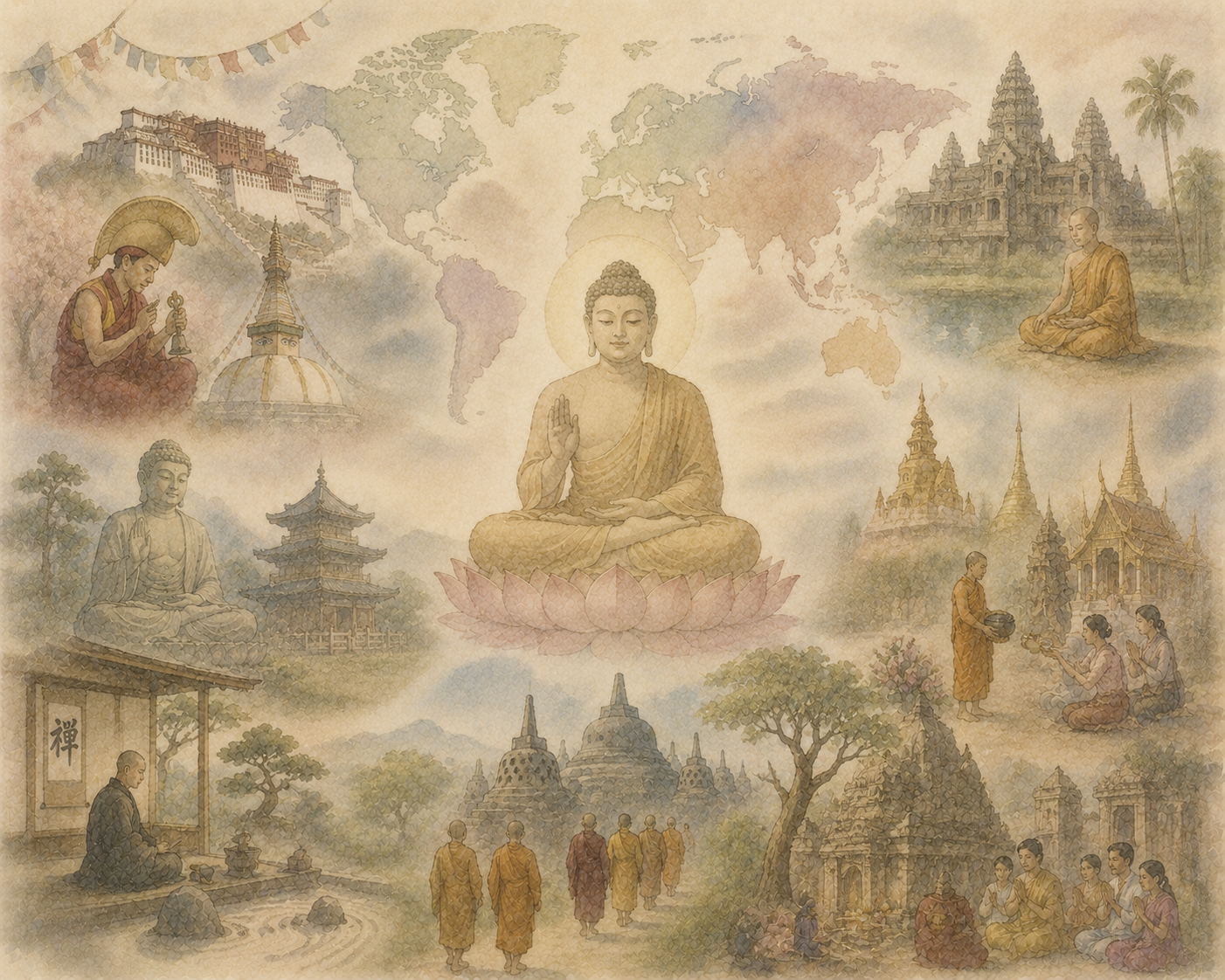
Quick Summary
- Buddhist symbols didn’t “drift” randomly; they adapted to local languages of art, politics, and daily life.
- Early Buddhism often used indirect symbols (footprints, empty throne) before widespread Buddha images appeared.
- As Buddhism moved across countries, familiar local motifs reshaped halos, robes, postures, and sacred architecture.
- Some symbols stayed stable (the wheel, lotus), but their emphasis and styling changed by region.
- Trade routes and patronage mattered: what rulers funded and what artisans could make shaped what became “standard.”
- New environments changed materials and scale, from stone stupas to wood temples to painted scrolls.
- Reading symbols well means asking: “What problem did this image solve for people here?”
How Buddhist Symbols Changed as Buddhism Spread Across Countries
You’re looking at a Buddhist symbol from another country and it feels both familiar and strangely different—like the same message is being spoken in a new accent. That confusion is reasonable: Buddhist symbols changed because they had to communicate across new cultures, new materials, and new expectations about what sacred art should do. At Gassho, we focus on practical, historically grounded ways to read Buddhist imagery without turning it into a trivia contest.
The key is to stop treating symbols as fixed “logos” and start seeing them as living tools for attention, memory, and meaning.
GASSHO
Ask and learn about Buddhism in daily life.
GASSHO is a Buddhist community app where you can learn Buddhist teachings and ask questions to the head priest of Kongosanmaiin Temple on Mount Koya.
A Clear Lens for Understanding Symbol Change
Buddhist symbols change the way spoken language changes: the core intent can remain recognizable while the form adjusts to local habits. When Buddhism entered a new country, it didn’t arrive in a vacuum. It met existing visual vocabularies—royal insignia, folk motifs, temple architecture, and ideas about what a holy figure should look like. Symbols shifted so that ordinary people could “read” them quickly and feel oriented toward practice.
It helps to think of symbols as prompts for the mind. A wheel, a lotus, a stupa, a hand gesture—each one points attention toward something: teaching, purity, remembrance, protection, generosity, steadiness. When a symbol travels, the prompt stays, but the packaging changes. Artists choose different proportions, materials, colors, and surrounding motifs so the prompt works in that place.
Another driver is function. Some symbols are meant for public devotion, some for teaching stories, some for marking sacred space, and some for private contemplation. As Buddhism spread, the balance of these functions changed. A region with strong temple patronage might emphasize monumental architecture; a region with portable devotional culture might emphasize small icons, amulets, or painted scrolls.
Finally, change doesn’t always mean replacement. Often it’s layering: older symbols remain, but new ones become prominent, or the same symbol gains a new “accent” through local aesthetics. The result is not one global set of images, but a family resemblance across countries.
How Symbol Shifts Show Up in Ordinary Looking
When you stand in front of Buddhist art from different countries, your attention naturally searches for anchors: “Is that the Buddha? Is that a lotus? Why does the halo look like flames here but like a simple circle there?” That searching is the mind trying to stabilize meaning. Symbols are doing their job when they help attention settle rather than scatter.
You might notice that some regions emphasize narrative detail—many figures, many gestures, dense backgrounds—while others emphasize stillness and simplicity. Neither is “more correct.” They are different solutions to the same human issue: how to keep the mind close to what matters without getting lost.
Sometimes the change is subtle: the drape of a robe, the shape of an ushnisha, the length of earlobes, the style of a throne. Your reaction might be, “This feels more human,” or “This feels more cosmic,” or “This feels more royal.” Those reactions are clues about what the local culture associated with authority, compassion, and sanctity.
Other times the change is structural. A stupa in one country may be a solid mound you circumambulate; elsewhere it becomes a tall, multi-tiered form that organizes the skyline. Your body responds differently: walking around a mound is rhythmic and grounding; looking up at a tower is uplifting and orienting. The symbol is shaping experience through space.
You may also notice how protective imagery varies. In some places, guardians look like local warriors; in others, they look like spirits from older traditions. The internal process here is simple: fear and uncertainty are universal, but the “face” of protection is culturally specific. The symbol changes so reassurance lands in the gut, not just in the intellect.
Even color can shift the felt sense. Gold might signal royal patronage and radiance; deep blues might signal vastness and depth; white might signal purity and mourning depending on local norms. Your mind reads these cues instantly, often before you can explain them. That’s why symbols evolve: they work at the speed of perception.
When you catch yourself judging—“This one is authentic, that one is corrupted”—it can help to pause and ask a gentler question: “What did this community need the symbol to do?” That question turns comparison into understanding.
Common Misreadings That Flatten the Story
One common misunderstanding is assuming there was a single original “Buddhist art style” that later cultures diluted. In reality, Buddhism spread over centuries through trade, migration, translation, and patronage. Symbols were never frozen; they were always in conversation with local life.
Another misreading is treating every difference as a doctrinal dispute. Many changes are practical: available pigments, climate, building materials, and the skills of local artisans. A wooden temple tradition will produce different sacred spaces than a stone-carving tradition, even if the intention is similar.
It’s also easy to assume symbols are merely decorative. But in Buddhist contexts, decoration often has a job: to guide attention, to mark thresholds, to encode teachings in memorable form, or to create an atmosphere that supports ethical and contemplative life.
Finally, people sometimes read symbols as if they must mean the same thing everywhere. Some meanings are widely shared, but emphasis shifts. A lotus might foreground purity in one place and spiritual unfolding in another. The symbol hasn’t “changed into something else”; it has become more specific to local ways of speaking about the same human concerns.
Why These Changes Matter Beyond Museums
Understanding how Buddhist symbols changed as Buddhism spread across countries helps you avoid shallow authenticity tests. Instead of asking, “Which version is the real one?” you learn to ask, “What is this symbol trying to awaken in the viewer?” That shift is practical: it makes your encounter with Buddhist imagery less argumentative and more attentive.
It also builds cultural humility. When you see how Buddhism adapted respectfully (and sometimes strategically) to local contexts, you become less likely to treat your own preferred style as universal. That humility is not academic; it’s a daily-life skill for living among differences without tightening into defensiveness.
On a personal level, noticing symbol change trains a useful kind of flexibility. You learn to separate essence from packaging: the same reminder can arrive through different aesthetics. That’s a transferable skill when life changes the “form” of your routines, relationships, or identity.
And if you practice in a multicultural environment, this understanding reduces friction. People often attach to the look of their inherited symbols. Seeing the long history of adaptation makes it easier to respect multiple expressions without feeling that something important is being lost.
Conclusion
Buddhist symbols changed as Buddhism spread across countries because symbols are meant to work—quickly, emotionally, and socially—not just to preserve a single historical style. When you view these changes as skillful translation rather than distortion, the diversity of Buddhist imagery becomes easier to read: a shared set of human concerns expressed through local eyes, local hands, and local materials.
Ask a Buddhist priest
Have a question about Buddhism?
In the GASSHO app, you can ask questions about Buddhist teachings, daily concerns, and how to understand Buddhism in everyday life.
Frequently Asked Questions
- FAQ 1: Why did Buddhist symbols change as Buddhism spread across countries?
- FAQ 2: What are examples of early Buddhist symbols before Buddha statues became common?
- FAQ 3: How did the Buddha image itself change across different countries?
- FAQ 4: How did the lotus symbol change as Buddhism spread across countries?
- FAQ 5: How did the Dharma wheel (Dharmachakra) change across regions?
- FAQ 6: How did stupas change as Buddhism spread across countries?
- FAQ 7: What is the relationship between stupas and pagodas in the spread of Buddhist symbols?
- FAQ 8: How did Buddhist hand gestures (mudras) change across countries?
- FAQ 9: Why do halos and aureoles look different in Buddhist art from different countries?
- FAQ 10: How did protective figures and guardian symbols change as Buddhism spread?
- FAQ 11: Did Buddhist symbols change because of local religions and folk traditions?
- FAQ 12: How did trade routes influence the way Buddhist symbols changed across countries?
- FAQ 13: Are there Buddhist symbols that stayed mostly consistent across countries?
- FAQ 14: How can I tell whether a Buddhist symbol is local adaptation or a completely different meaning?
- FAQ 15: What’s a respectful way to interpret Buddhist symbols from countries other than my own?
FAQ 1: Why did Buddhist symbols change as Buddhism spread across countries?
Answer: They changed to communicate effectively in new cultural settings—using local artistic styles, materials, and familiar visual cues—while still pointing to recognizable Buddhist themes like awakening, compassion, and remembrance.
Takeaway: Symbol change is often a form of translation, not a loss of meaning.
FAQ 2: What are examples of early Buddhist symbols before Buddha statues became common?
Answer: Early Buddhist art often used indirect symbols such as the Dharma wheel, footprints, the Bodhi tree, an empty throne, and stupas to represent the Buddha and his teaching without depicting a human figure.
Takeaway: Some of the oldest Buddhist symbols are “aniconic” and rely on suggestion.
FAQ 3: How did the Buddha image itself change across different countries?
Answer: The Buddha’s facial features, robe style, posture, and proportions often reflect local aesthetics and ideals of holiness—ranging from more naturalistic human forms to more stylized, transcendent presentations depending on region and era.
Takeaway: The “same” Buddha image can look different because cultures visualize dignity differently.
FAQ 4: How did the lotus symbol change as Buddhism spread across countries?
Answer: The lotus remained a core motif, but its artistic treatment shifted—petal shapes, colors, and how the figure sits or stands on the lotus vary with local art traditions and what the lotus was meant to emphasize (purity, unfolding, or sacred birth).
Takeaway: The lotus stayed recognizable, but its visual “accent” changed by place.
FAQ 5: How did the Dharma wheel (Dharmachakra) change across regions?
Answer: The wheel’s basic idea stayed stable, but details like the number and style of spokes, the rim design, and accompanying animals or floral patterns often reflect local symbolism and craftsmanship traditions.
Takeaway: Small design differences can signal where and when a wheel motif was made.
FAQ 6: How did stupas change as Buddhism spread across countries?
Answer: Stupas adapted to local building methods and aesthetics, evolving from rounded mounds into regionally distinct forms—sometimes becoming taller, tiered, or tower-like structures that fit local skylines and temple complexes.
Takeaway: Stupas show how a shared sacred idea can become many architectural forms.
FAQ 7: What is the relationship between stupas and pagodas in the spread of Buddhist symbols?
Answer: Pagodas are often understood as regional architectural developments of the stupa concept, shaped by local tower-building traditions and materials, while still serving related functions like housing relics and marking sacred space.
Takeaway: Pagodas can be read as a localized expression of stupa symbolism.
FAQ 8: How did Buddhist hand gestures (mudras) change across countries?
Answer: Many mudras remained widely shared, but their popularity, styling, and combinations with other symbols changed. Local artistic conventions influenced finger shapes, arm positions, and how clearly a gesture is emphasized for viewers.
Takeaway: Mudras are consistent in theme, but their visual presentation varies regionally.
FAQ 9: Why do halos and aureoles look different in Buddhist art from different countries?
Answer: Halos adapted to local visual languages for radiance and sanctity—appearing as simple discs, layered rings, flame patterns, or elaborate mandorlas—depending on what styles best conveyed sacred presence in that culture.
Takeaway: Halo designs are a clear example of local aesthetics shaping a shared symbol.
FAQ 10: How did protective figures and guardian symbols change as Buddhism spread?
Answer: Guardians often took on local “faces,” borrowing from regional warrior imagery, spirit traditions, and court iconography. The protective function stayed similar, but the visual form shifted to match what people already associated with strength and safety.
Takeaway: Protection is universal; the imagery of protection is culturally specific.
FAQ 11: Did Buddhist symbols change because of local religions and folk traditions?
Answer: Yes. As Buddhism entered new regions, it interacted with existing religious art and folk motifs. This often led to blended iconography, new decorative elements, and reinterpreted visual cues that helped Buddhism feel intelligible and present in local life.
Takeaway: Symbol change often reflects cultural contact rather than simple replacement.
FAQ 12: How did trade routes influence the way Buddhist symbols changed across countries?
Answer: Trade routes moved artists, patrons, pigments, metals, and ideas. As objects and styles traveled, symbols were copied, adapted, and recombined, creating regional hybrids that reflect both local tastes and international exchange.
Takeaway: The spread of symbols followed the same networks that spread goods and art techniques.
FAQ 13: Are there Buddhist symbols that stayed mostly consistent across countries?
Answer: Many core motifs—like the wheel, lotus, stupa-related forms, and certain narrative scenes—remain broadly recognizable. What changes most is emphasis, styling, and the surrounding visual context rather than the basic identity of the symbol.
Takeaway: Continuity is real, but it often lives in the motif more than the exact design.
FAQ 14: How can I tell whether a Buddhist symbol is local adaptation or a completely different meaning?
Answer: Look for the symbol’s function (devotional, protective, teaching, memorial), its placement (altar, gateway, reliquary, manuscript), and repeated pairings (lotus with purity themes, wheel with teaching themes). Local adaptation usually preserves function even when style changes.
Takeaway: Function and context are often more reliable than surface appearance.
FAQ 15: What’s a respectful way to interpret Buddhist symbols from countries other than my own?
Answer: Start by assuming the symbol was designed to help real people practice—then ask what local materials, aesthetics, and social needs shaped it. Avoid ranking versions as “pure” or “corrupt,” and focus on what the symbol is prompting in attention and conduct.
Takeaway: Respectful interpretation combines curiosity, context, and humility.