



How Buddhist Ideas Show Up in Japanese Daily Etiquette
How Buddhist Ideas Show Up in Japanese Daily Etiquette
Quick Summary
- Japanese etiquette often expresses Buddhist-flavored values like humility, awareness, and care for others without explicitly “being religious.”
- Small rituals—bows, greetings, gift-giving, and tidying—can be read as training in attention and reducing self-centeredness.
- Many manners prioritize harmony by softening speech, anticipating needs, and avoiding unnecessary friction.
- Respect for space and objects (shoes off, clean entrances, orderly presentation) reflects a mindset of reverence and interdependence.
- Apologies and gratitude are often used as relationship maintenance, not just admissions of fault or polite “thank yous.”
- Food etiquette highlights appreciation for effort and conditions that made the meal possible.
- Understanding these patterns helps you act naturally in Japan without overthinking every rule.
Introduction: Etiquette That Feels “Deeper” Than Rules
If Japanese daily etiquette sometimes feels like a maze of tiny rules—bow here, phrase it that way, don’t impose, don’t stand out—you’re not alone, and you’re not imagining the “spiritual” undertone. A lot of what looks like strict formality is actually a practical way to train attention, reduce ego-friction, and protect the emotional weather of a shared space, which is why it can feel quietly Buddhist even when nobody mentions Buddhism. At Gassho, we focus on how Buddhist ideas show up in ordinary life without turning them into dogma.
It also helps to be clear about what this is and isn’t: etiquette in Japan comes from many streams—history, social structure, aesthetics, and local customs—so it’s not “Buddhism in disguise.” But Buddhist ideas have been part of Japan’s cultural air for centuries, and they often echo through everyday manners as a kind of lived training: less grasping, more awareness, more care.
When you look at etiquette through this lens, the point shifts. Instead of “perform the correct behavior so you don’t get judged,” it becomes “use small behaviors to make life smoother for everyone, including you.” That shift alone can make Japanese manners feel less stressful and more human.
GASSHO
Ask and learn about Buddhism in daily life.
GASSHO is a Buddhist community app where you can learn Buddhist teachings and ask questions to the head priest of Kongosanmaiin Temple on Mount Koya.
A Practical Lens: Less Self, More Awareness, More Care
A helpful way to understand how Buddhist ideas show up in Japanese daily etiquette is to treat etiquette as a training in attention. Not mystical attention—just the ordinary skill of noticing what’s happening, noticing other people, and noticing the impact of your presence. Many manners are built to interrupt autopilot and bring you back to “What does this moment require?”
Another part of the lens is “softening the self.” In Buddhist-influenced cultures, there’s often suspicion toward loud self-assertion—not because individuality is evil, but because unchecked self-focus creates friction. Etiquette offers a socially acceptable way to downshift the ego: you bow, you use modest language, you let others go first, you avoid cornering someone into saying yes.
A third part is interdependence: the sense that your comfort depends on countless visible and invisible supports—other people’s labor, shared infrastructure, timing, and cooperation. Etiquette becomes a way of acknowledging those supports. Gratitude, careful handling of objects, and clean shared spaces aren’t just “nice”; they’re a recognition that you’re living inside a web of conditions.
Put together, this lens explains why Japanese etiquette can feel both gentle and demanding. It asks for constant micro-adjustments: not to be perfect, but to be considerate, aware, and less reactive.
How These Ideas Feel in Everyday Moments
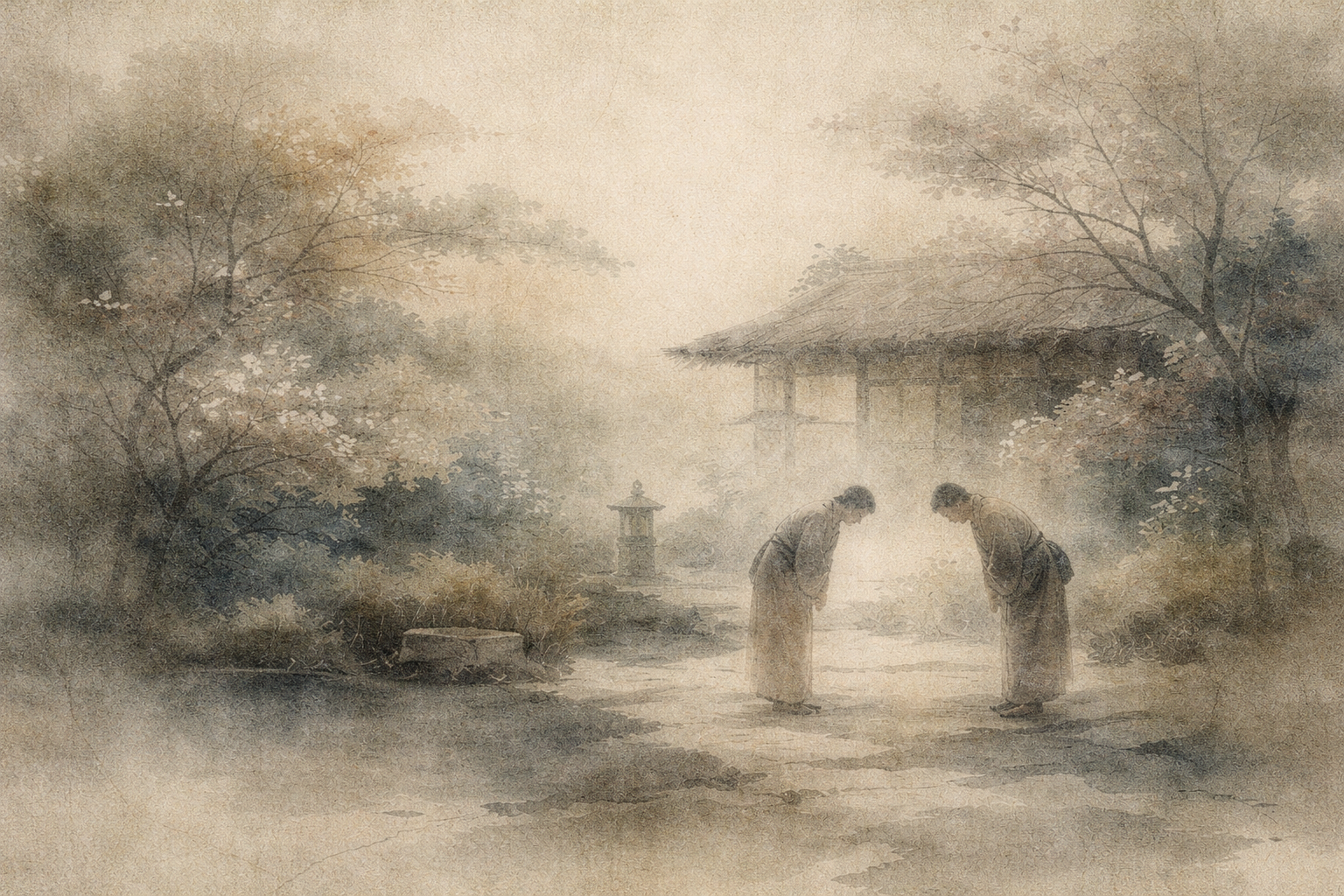
Start with greetings. A bow is simple, but it changes your inner posture: you physically lower yourself, even briefly, and that motion can reduce the impulse to dominate the interaction. You may notice your tone soften, your pace slow, and your attention widen to include the other person’s comfort.
Then there’s the habit of not “taking up the room.” On trains, in elevators, in narrow streets, people often minimize their footprint—bags held close, voices lowered, movements contained. Internally, this can feel like a constant check: “Am I spilling into others?” It’s not self-hatred; it’s awareness of shared space.
Consider indirect speech. Phrases that sound vague to outsiders can function as a pressure-release valve. Instead of forcing a direct refusal that creates embarrassment, you give the relationship room to breathe. The internal process is subtle: you notice the urge to be blunt, you notice the likely impact, and you choose a softer route.
Apologies work similarly. In many Japanese contexts, saying sorry can mean “I recognize the inconvenience” more than “I confess wrongdoing.” The inner movement is a shift from defending your self-image to protecting the relationship. You let go of the need to be seen as perfectly right, and you prioritize repair.
Gift-giving and receiving can also feel like practice. The wrapping, the two-handed offering, the modest words—these slow the exchange down. They turn a transaction into a moment of mutual recognition. Internally, you may notice how quickly the mind wants to rush, and how the ritual invites you to be present and respectful.
Food etiquette is another everyday training. Saying itadakimasu before eating and gochisousama after isn’t just “polite Japanese.” It can be felt as a brief pause that acknowledges conditions: the people who cooked, the ingredients, the time, the effort, the life involved. Even if you don’t hold any religious view, the pause can reduce mindless consumption.
Finally, notice cleaning and order. Taking shoes off, keeping entrances tidy, returning items neatly, and cleaning shared spaces can feel like respect made visible. Internally, it’s a move from “this is beneath me” to “this is part of belonging.” The action trains humility and care without needing a speech about values.
Common Misreadings That Make Etiquette Feel Harder
One misunderstanding is thinking Japanese etiquette is mainly about rigid hierarchy. Hierarchy exists, but many manners function more like harm-reduction: they prevent social collisions, protect privacy, and keep interactions smooth. If you only see rank, you miss the everyday compassion embedded in “not imposing.”
Another misreading is assuming indirectness equals dishonesty. Often it’s closer to non-harm: a way to avoid cornering someone, embarrassing them, or escalating conflict. It can be frustrating if you expect direct answers, but it’s frequently an attempt to preserve dignity on both sides.
A third misunderstanding is treating etiquette as performance. If you copy gestures without the underlying intention—care, awareness, restraint—it can feel stiff and exhausting. When the intention is present, even imperfect etiquette tends to land better because people can feel the respect behind it.
Finally, it’s easy to romanticize and claim “Japan is Buddhist, therefore everyone is mindful.” Daily life is still daily life: people get stressed, impatient, and distracted. The point is not that etiquette proves spiritual purity; it’s that the culture has built many small reminders that nudge behavior toward consideration.
Why This Lens Helps You Act Naturally in Japan
When you understand how Buddhist ideas show up in Japanese daily etiquette, you stop hunting for a perfect rulebook and start tracking impact. You ask: “Will this create extra burden? Will this embarrass someone? Will this disrupt the shared space?” That approach is more reliable than memorizing dozens of micro-rules.
This lens also reduces anxiety. If you make a mistake—and everyone does—you can often recover with the same underlying values: a small apology, a calm tone, a willingness to adjust. People tend to respond well to sincere consideration, even when your etiquette isn’t flawless.
It can also improve relationships. Many conflicts come from invisible expectations: how directly to speak, how quickly to respond, how much space to take. Seeing etiquette as “care in action” helps you interpret others more generously and choose responses that keep trust intact.
And if you’re Japanese or have grown up around these norms, this perspective can be clarifying too. It reframes etiquette from “pressure to conform” into “tools for living together,” which can make it easier to keep what’s helpful and question what’s merely performative.
Conclusion: Etiquette as Quiet Training
Japanese daily etiquette often carries Buddhist-shaped habits: humility that lowers friction, awareness that notices others, and care that protects shared space. You don’t need to label it religious to benefit from it; you can treat it as a practical way to move through the day with fewer collisions and more respect.
If you’re trying to “get it right,” aim less for flawless form and more for the intention underneath: don’t impose, acknowledge support, and keep your presence gentle. That’s where the etiquette stops being a maze and starts being a path.
Ask a Buddhist priest
Have a question about Buddhism?
In the GASSHO app, you can ask questions about Buddhist teachings, daily concerns, and how to understand Buddhism in everyday life.
Frequently Asked Questions
- FAQ 1: How do Buddhist ideas show up in Japanese daily etiquette without people talking about Buddhism?
- FAQ 2: What Buddhist idea is most reflected in Japanese etiquette?
- FAQ 3: Is bowing connected to Buddhist ideas or is it purely cultural?
- FAQ 4: How does “not imposing” in Japan relate to Buddhist ideas?
- FAQ 5: Why are apologies so common in Japanese daily etiquette?
- FAQ 6: How do itadakimasu and gochisousama reflect Buddhist ideas in daily etiquette?
- FAQ 7: Does Japanese indirect communication have a Buddhist connection?
- FAQ 8: How does Japanese etiquette around silence relate to Buddhist ideas?
- FAQ 9: Why is cleanliness and tidiness such a strong part of Japanese daily etiquette?
- FAQ 10: How does taking shoes off at the entrance connect to Buddhist ideas in etiquette?
- FAQ 11: Is Japanese etiquette about suppressing the self, and is that “Buddhist”?
- FAQ 12: How do Japanese gift-giving manners reflect Buddhist ideas?
- FAQ 13: What’s a simple way to practice Japanese etiquette with the right “Buddhist-like” intention?
- FAQ 14: Are Japanese manners basically the same as Buddhist ethics?
- FAQ 15: How can foreigners avoid feeling fake when following Japanese etiquette influenced by Buddhist ideas?
FAQ 1: How do Buddhist ideas show up in Japanese daily etiquette without people talking about Buddhism?
Answer: They often appear as habits that reduce self-centeredness and protect shared space—bows, modest phrasing, careful handling of objects, and frequent gratitude/apology. These behaviors can function like everyday training in awareness and consideration, even when framed as “just manners.”
Takeaway: Look for the intention (care and awareness), not explicit religious language.
FAQ 2: What Buddhist idea is most reflected in Japanese etiquette?
Answer: Interdependence is a strong match: the sense that your comfort relies on many conditions and other people’s efforts. Etiquette expresses this through gratitude, not imposing on others, and maintaining clean, orderly shared environments.
Takeaway: Many “rules” are really acknowledgments of mutual support.
FAQ 3: Is bowing connected to Buddhist ideas or is it purely cultural?
Answer: Bowing is cultural and widely used beyond religious settings, but it aligns with Buddhist-leaning values like humility and de-centering the self. The physical act of lowering the body can reinforce respect and soften confrontational energy in everyday interactions.
Takeaway: Bowing works as a practical gesture of humility, regardless of belief.
FAQ 4: How does “not imposing” in Japan relate to Buddhist ideas?
Answer: “Not imposing” often reflects sensitivity to others’ mental load and emotional comfort. It resembles a Buddhist-style restraint: noticing the urge to push your preference, then choosing a lighter touch that reduces friction and preserves dignity.
Takeaway: Restraint can be a form of everyday compassion.
FAQ 5: Why are apologies so common in Japanese daily etiquette?
Answer: Apologies frequently function as relationship maintenance: “I recognize the inconvenience” or “I respect the shared space,” not only “I’m guilty.” This echoes a Buddhist-tinged priority on reducing harm and repairing connection over defending ego.
Takeaway: Many apologies are about care, not confession.
FAQ 6: How do itadakimasu and gochisousama reflect Buddhist ideas in daily etiquette?
Answer: These phrases create a pause that acknowledges conditions behind a meal—effort, ingredients, and support from others. That pause aligns with gratitude and interdependence, turning eating from automatic consumption into a moment of recognition.
Takeaway: Food greetings are etiquette that trains appreciation.
FAQ 7: Does Japanese indirect communication have a Buddhist connection?
Answer: Indirectness is not uniquely Buddhist, but it can align with non-harm: avoiding unnecessary confrontation, embarrassment, or pressure. In daily etiquette, softer phrasing can be a way to keep interactions workable and reduce reactive conflict.
Takeaway: Indirectness often aims at minimizing harm, not hiding truth.
FAQ 8: How does Japanese etiquette around silence relate to Buddhist ideas?
Answer: Silence can function as restraint and attentiveness—leaving room for others, not filling space with self-expression, and noticing what’s actually happening. This matches a Buddhist-friendly emphasis on awareness and reducing impulsive speech.
Takeaway: Silence can be etiquette that protects the moment.
FAQ 9: Why is cleanliness and tidiness such a strong part of Japanese daily etiquette?
Answer: Cleanliness supports shared life: it reduces burden on others and shows respect for common space. This can echo Buddhist sensibilities of care, mindfulness in small actions, and appreciation for the environment that holds everyone.
Takeaway: Tidiness is often social compassion made visible.
FAQ 10: How does taking shoes off at the entrance connect to Buddhist ideas in etiquette?
Answer: Practically, it keeps living spaces clean; symbolically, it marks a mindful transition—outside to inside, public to private. That threshold behavior can reinforce respect for the home and awareness of how your body and belongings affect others’ space.
Takeaway: The genkan routine is a small practice of respect and transition.
FAQ 11: Is Japanese etiquette about suppressing the self, and is that “Buddhist”?
Answer: Etiquette can look like self-suppression, but it often functions more like self-regulation: reducing ego-driven impulses that create conflict. While Buddhism is not about erasing personality, it does emphasize loosening rigid self-focus—something etiquette can encourage in daily life.
Takeaway: Think “self-regulation for harmony,” not “self-erasure.”
FAQ 12: How do Japanese gift-giving manners reflect Buddhist ideas?
Answer: The careful presentation, modest words, and two-handed offering slow the exchange and highlight relationship over transaction. This supports humility and gratitude—values that resonate with Buddhist-influenced ways of reducing grasping and honoring others’ effort.
Takeaway: Gift etiquette turns “giving” into mutual respect.
FAQ 13: What’s a simple way to practice Japanese etiquette with the right “Buddhist-like” intention?
Answer: Before you act, pause for one beat and ask: “Will this add burden or ease?” Then choose the lighter option—lower your voice, make space, express thanks, or clarify gently. This keeps etiquette grounded in awareness rather than anxious rule-following.
Takeaway: A brief pause can align manners with genuine consideration.
FAQ 14: Are Japanese manners basically the same as Buddhist ethics?
Answer: Not exactly. Japanese etiquette is a cultural system shaped by many influences, and it can include social pressures that don’t always feel compassionate. Still, many everyday manners overlap with Buddhist-friendly ethics by encouraging non-harm, humility, and care in ordinary interactions.
Takeaway: Etiquette isn’t identical to ethics, but there’s meaningful overlap.
FAQ 15: How can foreigners avoid feeling fake when following Japanese etiquette influenced by Buddhist ideas?
Answer: Focus on sincerity over perfection: small bows, calm tone, and clear gratitude go a long way. If you miss a detail, a simple apology and willingness to adjust usually communicates the underlying value—consideration for others—better than rigid performance.
Takeaway: Genuine care lands better than flawless form.