



How Buddhism Still Shapes Everyday Life in Japan
Quick Summary
- Buddhism in Japan often shows up as habits and rituals, not as “religious identity.”
- Everyday life is shaped through funerals, memorial days, and home altars that keep relationships with the dead active.
- Temples function as community infrastructure: calendars, counseling, events, and quiet space.
- Buddhist ideas quietly influence how people relate to impermanence, gratitude, and restraint.
- Work, school, and public manners reflect a preference for harmony and self-regulation over self-expression.
- Art, food culture, and seasonal awareness carry Buddhist aesthetics of simplicity and attentiveness.
- Modern Japan is secular in many ways, yet Buddhist patterns still organize time, loss, and meaning.
Introduction: Buddhism as a Daily Background, Not a Weekend Activity
If you’re trying to understand how Buddhism still shapes everyday life in Japan, the confusing part is that it rarely looks like “people being religious” in the loud, declared way many outsiders expect. It looks like calendars, manners, family obligations, quiet rooms, seasonal rituals, and a practical way of dealing with loss—so ordinary that it can be invisible until you know what to notice. At Gassho, we focus on lived Buddhism as it appears in real routines rather than as a set of labels.
Japan is modern, highly urban, and often described as secular, yet Buddhist influence persists because it’s embedded in social life: how families mark death, how communities maintain continuity, and how individuals steady their minds when things change. You can see it in the way many homes keep a small place for remembrance, in the way temples anchor neighborhoods, and in the way “impermanence” is treated less like a doctrine and more like a fact you learn to live with.
The Core Lens: Impermanence, Interdependence, and Care in Ordinary Life
A useful way to understand Buddhism’s ongoing impact in Japan is to treat it as a lens for interpreting experience: things change, nothing stands alone, and care is expressed through repeated actions. This lens doesn’t require someone to “believe” in a particular story. It works more like a set of default assumptions that shape what feels appropriate when life gets difficult or uncertain.
Impermanence is central here, not as a gloomy idea but as a practical orientation. When change is expected, the question becomes: how do you meet it without making everything worse? Many Japanese customs—especially around grief and remembrance—are structured to give change a container: a schedule, a place, and a set of gestures that help people keep going.
Interdependence shows up as a sensitivity to context: your mood affects the room, your choices affect others, and your role in a group matters. In daily life, this can look like restraint, politeness, and attention to timing. It’s less about moral perfection and more about reducing friction and preventing small problems from spreading.
Finally, care is often expressed through maintenance rather than grand declarations—cleaning, offering, visiting, remembering, showing up on the right day. That “care through repetition” is one reason Buddhist influence survives modernization: it fits inside busy lives because it’s built from small, doable actions.
GASSHO
Ask and learn about Buddhism in daily life.
GASSHO is a Buddhist community app where you can learn Buddhist teachings and ask questions to the head priest of Kongosanmaiin Temple on Mount Koya.
How It Shows Up: Small Moments of Attention, Restraint, and Letting Go
In everyday Japan, Buddhist influence often appears as a subtle training in attention. People notice what a moment calls for—quiet on a train, a lowered voice in a hallway, a pause before entering a home. The point isn’t to perform spirituality; it’s to reduce disturbance and keep shared space workable.
When something goes wrong, there can be a quick internal scan: “What’s my part in this?” That doesn’t mean self-blame. It’s more like checking the impulse to escalate. A sharp reply is felt as something you can choose not to feed, because feeding it makes the next hour harder for everyone.
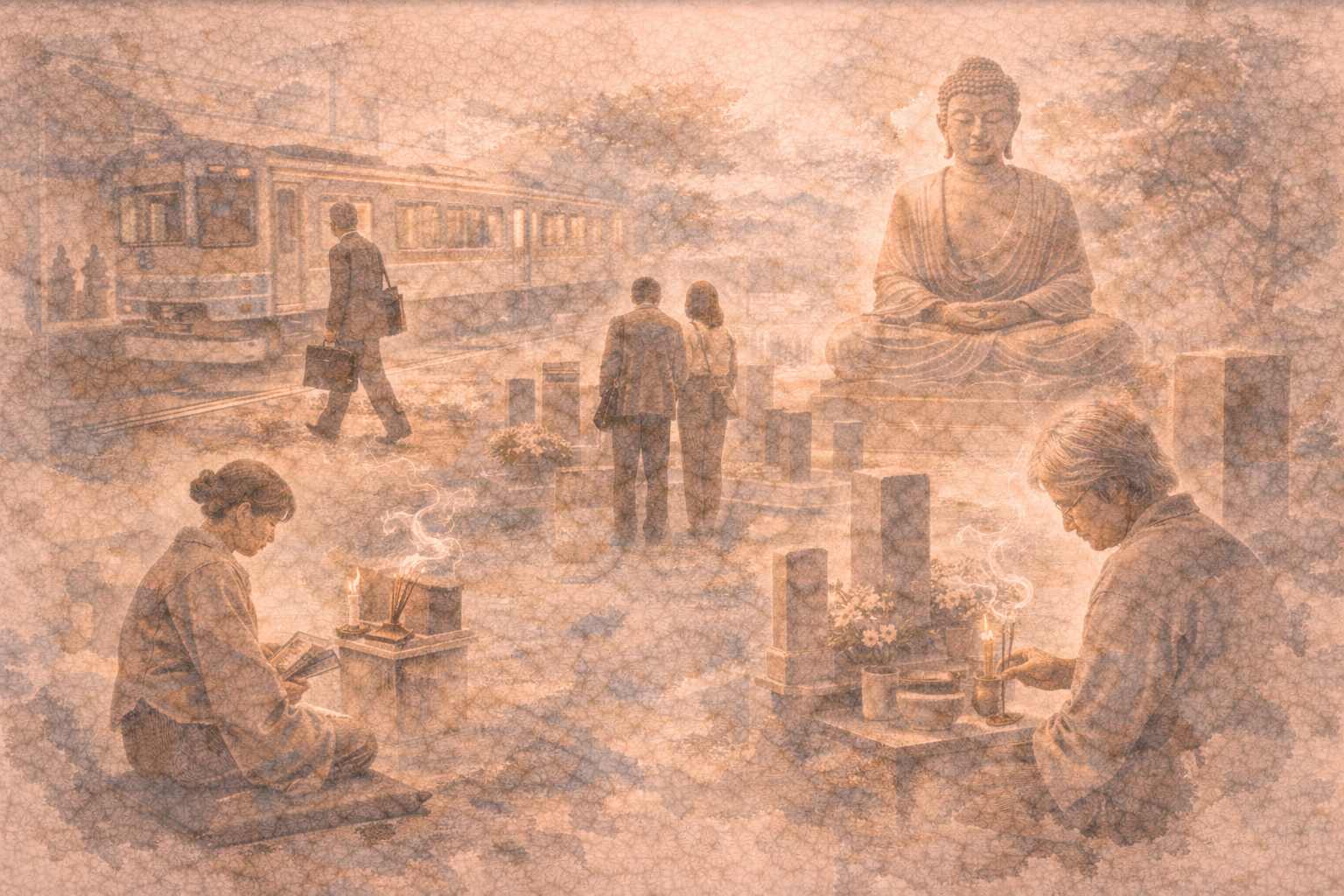
Grief is where the pattern becomes especially visible. Rather than treating death as a private psychological event only, many families relate to it as an ongoing relationship that needs tending. Visiting a grave, offering incense, or speaking a few words at home can function as a simple way to acknowledge love and loss without needing to solve them.
Seasonal awareness also trains the mind. The year is punctuated by memorial periods, temple events, and household routines that quietly say: time is moving; people are aging; things are passing. This can soften the shock of change by making change feel expected, even when it’s still painful.
In work and school life, you can see a preference for self-regulation: noticing when you’re tired, irritated, or distracted, and then adjusting so you don’t spill it everywhere. It’s not always peaceful—Japan is not a monastery—but the cultural ideal often leans toward composure and consideration.
Even aesthetics can shape inner experience. Simple spaces, uncluttered design, and quiet corners in temples or gardens can invite a natural settling of attention. You don’t have to “do” anything special; the environment makes it easier to notice your own mind and let unnecessary tension drop.
Over time, these small moments add up to a lived sense that life is workable when you keep returning to basics: show respect, keep your promises, don’t inflame what’s already hot, and remember what matters. That’s Buddhism in daily life as a pattern of responses, not a set of slogans.
Common Misunderstandings About Buddhism’s Role in Japan
Misunderstanding 1: “Most Japanese people aren’t Buddhist, so Buddhism doesn’t matter.” Many people don’t strongly identify with a single religion, but practices still shape life. In Japan, Buddhism often functions through family customs, community institutions, and life-cycle rituals, especially around death and remembrance.
Misunderstanding 2: “It’s only about temples and monks.” Temples matter, but the influence extends into homes, workplaces, and public behavior. The “Buddhist” part is frequently the way people handle impermanence, obligation, gratitude, and restraint—often without naming it.
Misunderstanding 3: “Japanese Buddhism is just philosophy or just superstition.” Everyday practice can include both practical ethics and ritual. Ritual isn’t automatically irrational; it can be a technology of attention and emotion, giving people a way to express respect, grief, and continuity.
Misunderstanding 4: “If it’s real Buddhism, it should look the same everywhere.” Buddhism adapts to culture. In Japan, it has long been woven into family systems, seasonal calendars, and community life. The shape differs, but the function—reducing suffering through wiser responses—can still be recognizable.
Misunderstanding 5: “Modern life has replaced it.” Modernity changes the surface, but it doesn’t remove the human needs Buddhism addresses: coping with loss, managing desire and anger, and finding meaning in change. Those needs keep the influence alive, even when it’s quiet.
Why It Matters Today: Meaning, Community, and a Practical Way to Face Change
Understanding how Buddhism still shapes everyday life in Japan helps explain why certain behaviors and priorities persist even in a high-tech society. It clarifies why remembrance is organized and scheduled, why quiet respect for shared space is valued, and why many people prefer modest, steady forms of care over dramatic emotional display.
It also highlights the role of temples as community anchors. Beyond tourism, temples can provide continuity: a place to mark time, ask for guidance, attend local events, or simply sit in a calmer environment. In an age of isolation, that kind of low-pressure community infrastructure matters.
On a personal level, the Buddhist lens offers a workable approach to stress: notice what’s changing, notice what you’re clinging to, and choose the next action that reduces harm. You don’t need to adopt an identity for that to be useful. You just need to see how your reactions create extra weight—and how small acts of attention can lighten it.
Finally, it matters because it reframes “tradition” as something alive. In Japan, Buddhism often survives not by demanding belief, but by offering forms that help people meet real life: grief, gratitude, duty, and the passing of seasons.
Conclusion: A Quiet Influence That Organizes Real Life
Buddhism still shapes everyday life in Japan less as a declared faith and more as a set of practical defaults: how to behave in shared space, how to keep bonds with family across generations, and how to face impermanence without falling apart. If you look for it only in formal worship, you’ll miss it. If you look for it in routines—remembrance, restraint, seasonal awareness, and small acts of care—you’ll see it everywhere.
Ask a Buddhist priest
Have a question about Buddhism?
In the GASSHO app, you can ask questions about Buddhist teachings, daily concerns, and how to understand Buddhism in everyday life.
Frequently Asked Questions
- FAQ 1: How does Buddhism still shape everyday life in Japan if many people don’t identify as religious?
- FAQ 2: What are the most common everyday Buddhist practices in Japanese homes?
- FAQ 3: Why are funerals and memorial services so central to Buddhism’s influence in Japan?
- FAQ 4: How do Japanese temples affect daily life beyond tourism?
- FAQ 5: How does the Buddhist idea of impermanence show up in everyday Japanese life?
- FAQ 6: Does Buddhism influence Japanese manners and public behavior?
- FAQ 7: How does Buddhism shape the way Japanese people relate to ancestors?
- FAQ 8: Is Buddhism in Japan mostly ritual rather than personal spirituality?
- FAQ 9: How does Buddhism influence Japanese attitudes toward suffering and hardship?
- FAQ 10: How does Buddhism still shape everyday life in Japan for younger generations?
- FAQ 11: What role do Buddhist holidays and seasonal observances play in Japanese daily routines?
- FAQ 12: How does Buddhism influence Japanese aesthetics in everyday spaces?
- FAQ 13: Are Japanese people “more Buddhist” at certain life events?
- FAQ 14: How does Buddhism shape everyday ethics in Japan without people talking about it?
- FAQ 15: What’s one simple way to notice how Buddhism still shapes everyday life in Japan while visiting?
FAQ 1: How does Buddhism still shape everyday life in Japan if many people don’t identify as religious?
Answer: In Japan, Buddhism often operates through customs rather than identity: family memorial routines, temple relationships, and cultural expectations around grief, respect, and self-restraint. People may not “claim” Buddhism, yet still follow Buddhist-shaped patterns for handling death, obligation, and change.
Takeaway: In Japan, Buddhism is often practiced as culture and routine more than as a stated belief.
FAQ 2: What are the most common everyday Buddhist practices in Japanese homes?
Answer: The most common are remembrance-oriented: offering incense or a small gesture of respect, speaking to deceased relatives, and observing memorial days. Even when done briefly, these actions keep family continuity and gratitude present in daily life.
Takeaway: Home practice is often about remembrance and maintaining bonds, not formal doctrine.
FAQ 3: Why are funerals and memorial services so central to Buddhism’s influence in Japan?
Answer: Funerals and memorials are moments when families need structure for grief, respect, and continuity. Buddhist rituals provide a shared language and schedule for mourning, helping people express care and responsibility across generations.
Takeaway: Buddhism remains influential because it supports families at life’s most vulnerable transitions.
FAQ 4: How do Japanese temples affect daily life beyond tourism?
Answer: Local temples can function as community infrastructure: hosting seasonal events, providing memorial services, offering quiet space, and maintaining ties among neighborhood families. They also preserve calendars and rituals that organize time and remembrance.
Takeaway: Temples often serve practical community roles that keep Buddhist influence present.
FAQ 5: How does the Buddhist idea of impermanence show up in everyday Japanese life?
Answer: Impermanence appears as an expectation that things change—seasons, relationships, health, work conditions—and that you meet change with composure and adjustment. It’s reflected in seasonal rituals, remembrance practices, and a preference for modest, steady responses over dramatic escalation.
Takeaway: Impermanence in Japan is often lived as a practical attitude toward change.
FAQ 6: Does Buddhism influence Japanese manners and public behavior?
Answer: Indirectly, yes. Many everyday norms emphasize self-restraint, awareness of others, and reducing disruption in shared spaces. While these norms have multiple roots, Buddhist-influenced values around mindful conduct and minimizing harm align closely with them.
Takeaway: Public etiquette often reflects a broader culture of restraint and consideration compatible with Buddhist ethics.
FAQ 7: How does Buddhism shape the way Japanese people relate to ancestors?
Answer: Many families maintain an ongoing relationship with ancestors through memorial days, grave visits, and household remembrance. This keeps gratitude and responsibility active, treating family bonds as continuing rather than ending abruptly at death.
Takeaway: Ancestor remembrance is a major channel through which Buddhism shapes daily life in Japan.
FAQ 8: Is Buddhism in Japan mostly ritual rather than personal spirituality?
Answer: It can look that way from the outside because rituals are visible and widely shared. But rituals often support inner life: they regulate attention, express emotion safely, and provide a steady way to face grief and uncertainty without needing to explain everything in words.
Takeaway: In Japan, ritual can be a practical support for inner stability, not “empty tradition.”
FAQ 9: How does Buddhism influence Japanese attitudes toward suffering and hardship?
Answer: A common influence is the idea that hardship is part of life and can be met with steadiness rather than denial. This can encourage people to focus on what can be done now—small duties, respectful behavior, and not adding extra conflict—especially during difficult periods.
Takeaway: Buddhism often supports a “meet reality as it is” approach to hardship in daily life.
FAQ 10: How does Buddhism still shape everyday life in Japan for younger generations?
Answer: Younger people may engage less through formal temple ties, yet they still encounter Buddhism through family memorial responsibilities, cultural events, and inherited ways of handling change and loss. The influence often arrives through household expectations and social norms rather than explicit teaching.
Takeaway: For many young people, Buddhism is “in the background,” carried by family and culture.
FAQ 11: What role do Buddhist holidays and seasonal observances play in Japanese daily routines?
Answer: They structure time around remembrance and gratitude, prompting visits, cleaning, offerings, and family gatherings. These observances create predictable moments to reflect, reconnect, and acknowledge impermanence through the turning of the year.
Takeaway: Seasonal observances keep Buddhist-shaped rhythms woven into ordinary schedules.
FAQ 12: How does Buddhism influence Japanese aesthetics in everyday spaces?
Answer: Many everyday aesthetics favor simplicity, quietness, and uncluttered space, which can support calm attention. While not exclusively Buddhist, these preferences resonate with Buddhist values of moderation and seeing clearly without excess distraction.
Takeaway: Everyday design and atmosphere can reflect Buddhist-compatible values like simplicity and attentiveness.
FAQ 13: Are Japanese people “more Buddhist” at certain life events?
Answer: Yes, Buddhism often becomes most visible at life-cycle moments—especially death, memorial anniversaries, and family transitions—because rituals provide a shared way to express respect, grief, and continuity when words feel insufficient.
Takeaway: Buddhism’s everyday influence intensifies around life events that require structure and meaning.
FAQ 14: How does Buddhism shape everyday ethics in Japan without people talking about it?
Answer: Ethics can be transmitted as “how we do things”: avoiding unnecessary harm, keeping harmony in shared spaces, and showing care through dependable actions. These habits are reinforced by family upbringing, community expectations, and the quiet authority of tradition.
Takeaway: In Japan, Buddhist-influenced ethics often appear as practical social habits rather than explicit moral statements.
FAQ 15: What’s one simple way to notice how Buddhism still shapes everyday life in Japan while visiting?
Answer: Pay attention to how people handle quiet respect: at graves, in temple spaces, and in small gestures of remembrance at home or in neighborhoods. Notice the emphasis on not disturbing others and on marking time through seasonal and memorial routines.
Takeaway: Look for patterns of respect, remembrance, and restraint—Buddhism often lives there.