



What Does Hannya Mean in Buddhism? Wisdom Beyond Ordinary Knowledge
Quick Summary
- Hannya (般若) in Buddhism means prajñā: wisdom that sees clearly, not just intelligence or learning.
- It points to direct understanding of how experience works, especially how clinging creates stress.
- Hannya is often linked with the Heart Sutra and “wisdom” teachings, but it’s practical, not mystical.
- This wisdom is relational and compassionate: clearer seeing tends to soften reactivity.
- It differs from “knowledge” because it’s about how you perceive, not what you can explain.
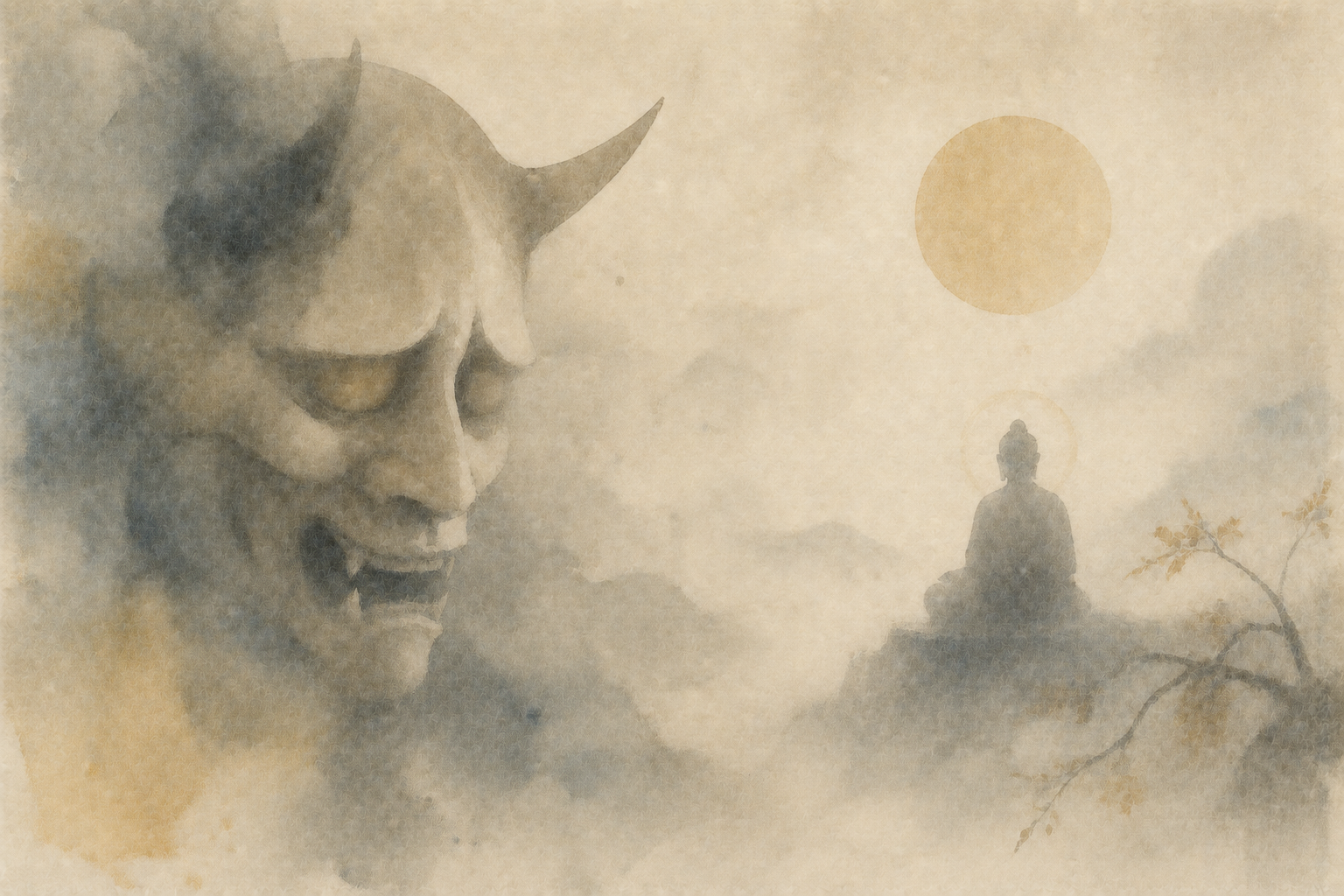
- Common confusion: mixing it up with the Hannya mask or treating it as a supernatural power.
- You can recognize hannya in small moments: pausing, noticing, and releasing a tight story about “me vs. them.”
Introduction
If you’ve searched “hannya meaning buddhism,” you’re probably stuck between two unsatisfying answers: either “it means wisdom” (too vague) or a pop-culture detour into masks and demons (often irrelevant to the Buddhist term). Hannya is a specific kind of wisdom—less like being well-informed and more like seeing through the mental habits that keep suffering on repeat. This explanation is written for Gassho readers who want clear language, accurate context, and a grounded way to recognize the meaning in real life.
In Japanese Buddhist vocabulary, hannya (般若) is the reading of the Sanskrit word prajñā, usually translated as “wisdom,” especially the wisdom that understands things as they are rather than as we wish they were.
Hannya as a Lens for Seeing Clearly
In Buddhism, hannya doesn’t mean collecting better opinions or winning arguments. It points to a shift in how experience is understood: thoughts, feelings, and perceptions are seen as events arising and passing, not as permanent truths that must be obeyed. That “seeing” is the heart of the term.
Ordinary knowledge is often additive: more facts, more concepts, more explanations. Hannya is more subtractive: it notices what we’re adding—assumptions, rigid labels, self-protective stories—and it loosens the grip of those additions. The result is not blankness; it’s clarity with less distortion.
This is why hannya is frequently associated with “perfection of wisdom” language: it’s not praising a genius IQ, but pointing to a completeness in seeing—seeing that includes impermanence, the way clinging tightens the mind, and the way identity can become a trap when it’s treated as fixed.
As a practical lens, hannya asks: “What am I taking as solid right now?” and “What happens if I stop treating this passing experience as a final verdict?” It’s a way of looking that reduces unnecessary suffering without requiring you to adopt a new personality or a new set of slogans.
GASSHO
Ask and learn about Buddhism in daily life.
GASSHO is a Buddhist community app where you can learn Buddhist teachings and ask questions to the head priest of Kongosanmaiin Temple on Mount Koya.
How Hannya Shows Up in Everyday Experience
You notice hannya most clearly when the mind is about to harden. A small irritation appears—someone interrupts you, a message feels cold, a plan changes—and the mind starts building a case. Hannya is the moment you see the case being built, not just the case itself.
It can feel like recognizing the difference between pain and the extra layer of “this shouldn’t be happening to me”. The first layer may still be there. The second layer is often optional, and hannya is the capacity to detect that optional layer in real time.
In conversation, hannya may appear as a pause before reacting. You catch the urge to defend, correct, or perform. You still speak, but the speech is less driven by the need to secure an identity. The content might be similar; the inner posture is different.
In self-judgment, hannya looks like seeing thoughts as thoughts. “I always mess things up” is recognized as a familiar mental script rather than a factual report. That recognition doesn’t magically erase the feeling, but it changes your relationship to it—less fusion, more space.
In desire, hannya shows up when you can feel the tightening around “I need this to be okay.” You might still want the outcome, but you see how the mind turns preference into a demand. Seeing the demand clearly often softens it.
In anxiety, hannya can be as simple as noticing how the mind time-travels. The body is here, but attention is rehearsing future threats. Hannya is the recognition of that movement—“planning is happening,” “catastrophizing is happening”—without immediately treating it as prophecy.
In ordinary tasks, hannya is the quiet intelligence of doing one thing at a time. Not as a productivity hack, but as a way to stop multiplying friction. When attention returns from spinning stories to what’s actually happening, the mind becomes less crowded.
Common Misunderstandings About Hannya
Misunderstanding 1: “Hannya just means being smart.” Intelligence can help you learn Buddhist ideas, but hannya is not the same as being clever. You can be brilliant and still be trapped by reactivity. Hannya is measured less by what you can explain and more by what you no longer need to cling to.
Misunderstanding 2: “Hannya is a mystical power.” The word can sound exotic, and it’s sometimes treated like a special aura. In Buddhist usage, it’s closer to clear seeing than supernatural ability. It’s ordinary in the sense that it works with ordinary experience: thoughts, sensations, emotions, and choices.
Misunderstanding 3: “Hannya is the same as the Hannya mask.” The Hannya mask is a cultural and theatrical motif with its own history and symbolism. It can be interesting, but it’s not the definition of hannya in Buddhism. The Buddhist term is about wisdom (prajñā), not a demon figure.
Misunderstanding 4: “Wisdom means detaching from life and feelings.” Hannya doesn’t require becoming cold or indifferent. Clear seeing often makes feelings more workable, not less human. It’s not about suppressing emotion; it’s about not being dominated by the stories that inflame emotion.
Misunderstanding 5: “If I had hannya, I’d never struggle.” The point isn’t a permanent state of calm. Hannya is the capacity to see what’s happening and respond with less confusion. Struggle can still arise; the difference is how quickly it’s recognized and how little extra suffering is added.
Why This Wisdom Matters Outside the Meditation Hall
Hannya matters because most suffering is amplified by mis-seeing: treating passing moods as identity, treating thoughts as commands, treating uncertainty as intolerable. When perception gets clearer, life doesn’t become perfect, but it becomes less needlessly combative.
In relationships, hannya supports fewer automatic escalations. You can notice the urge to be right, the urge to punish with silence, or the urge to secure reassurance. Seeing those urges doesn’t make you passive; it makes your choices less compulsive.
At work, hannya helps separate what’s actually required from what the mind dramatizes. Pressure may remain, but the inner narration—“If I fail, I am a failure”—can be recognized as a story rather than a fact. That recognition often improves focus and reduces burnout.
Ethically, hannya is not a moral lecture; it’s a clarity that reveals consequences. When you see how anger spreads, how dishonesty complicates the mind, or how greed never feels like “enough,” restraint becomes less about rules and more about sanity.
Most importantly, hannya is a kind of kindness to your own mind. It stops you from being endlessly recruited by every thought that shouts “urgent.” That alone can change the texture of a day.
Conclusion
The meaning of hannya in Buddhism is simple but not shallow: it is wisdom (prajñā) that sees experience clearly and loosens the grip of clinging. It’s not a badge, not a mood, and not the same thing as being knowledgeable. It’s the practical clarity that notices how suffering is constructed—and how, moment by moment, it can be constructed less.
Ask a Buddhist priest
Have a question about Buddhism?
In the GASSHO app, you can ask questions about Buddhist teachings, daily concerns, and how to understand Buddhism in everyday life.
Frequently Asked Questions
- FAQ 1: What is the meaning of hannya in Buddhism?
- FAQ 2: Is hannya the same as prajna?
- FAQ 3: Does hannya mean ordinary knowledge or intellectual learning?
- FAQ 4: Why is hannya often translated as “wisdom” in Buddhism?
- FAQ 5: What does “hannya shingyo” mean in Buddhism?
- FAQ 6: Is hannya a religious belief, or a way of seeing?
- FAQ 7: How does hannya relate to suffering in Buddhism?
- FAQ 8: Is hannya connected to compassion in Buddhism?
- FAQ 9: Does hannya mean “emptiness” in Buddhism?
- FAQ 10: What is the difference between hannya and intelligence?
- FAQ 11: Is the Hannya mask the same thing as hannya in Buddhism?
- FAQ 12: How is hannya practiced or developed in Buddhism?
- FAQ 13: Does hannya mean “no mind” or having no thoughts?
- FAQ 14: What does “prajnaparamita” mean in relation to hannya?
- FAQ 15: What is a simple everyday example of hannya in Buddhism?
FAQ 1: What is the meaning of hannya in Buddhism?
Answer: In Buddhism, hannya (般若) means prajñā, usually translated as “wisdom”—specifically the kind of wisdom that sees reality clearly and reduces confusion and clinging.
Takeaway: Hannya is wisdom as clear seeing, not just being smart.
FAQ 2: Is hannya the same as prajna?
Answer: Yes. “Hannya” is the Japanese reading used for the Sanskrit term prajñā, so they refer to the same Buddhist idea of wisdom.
Takeaway: Hannya is the Japanese term for prajñā.
FAQ 3: Does hannya mean ordinary knowledge or intellectual learning?
Answer: Not primarily. While learning can support understanding, hannya points to direct insight into how experience works—especially how grasping and fixed views create suffering.
Takeaway: Hannya goes beyond information and concepts.
FAQ 4: Why is hannya often translated as “wisdom” in Buddhism?
Answer: Because it refers to a discerning clarity that recognizes what is happening without distortion—seeing impermanence, reactivity, and the limits of rigid self-centered stories.
Takeaway: “Wisdom” is used because hannya is about accurate seeing.
FAQ 5: What does “hannya shingyo” mean in Buddhism?
Answer: Hannya Shingyō (般若心経) is the Japanese name for the Heart Sutra, often understood as a concise teaching associated with prajñā (hannya), or “wisdom.”
Takeaway: “Hannya Shingyo” means the Heart Sutra, linked with wisdom teachings.
FAQ 6: Is hannya a religious belief, or a way of seeing?
Answer: In Buddhist usage, hannya is best understood as a way of seeing clearly—an experiential discernment—rather than a belief you adopt on faith.
Takeaway: Hannya is a lens for understanding experience.
FAQ 7: How does hannya relate to suffering in Buddhism?
Answer: Hannya is the wisdom that recognizes how suffering is intensified by clinging, aversion, and confusion. By seeing these patterns more clearly, you add less extra suffering on top of unavoidable difficulty.
Takeaway: Hannya reduces suffering by revealing the mechanics of clinging.
FAQ 8: Is hannya connected to compassion in Buddhism?
Answer: Yes, in the sense that clearer seeing tends to soften self-centered reactivity. When you see thoughts and emotions more accurately, it becomes easier to respond with care rather than impulse.
Takeaway: Hannya supports compassion by reducing distorted reactions.
FAQ 9: Does hannya mean “emptiness” in Buddhism?
Answer: No. Hannya means “wisdom” (prajñā). It is often discussed alongside teachings about emptiness because that topic is commonly framed as something wisdom understands, but the words are not the same.
Takeaway: Hannya is wisdom; it is not the word for emptiness.
FAQ 10: What is the difference between hannya and intelligence?
Answer: Intelligence is the ability to think, learn, and solve problems. Hannya is the ability to see through mental habits that create suffering—especially the tendency to treat thoughts, labels, and identity-stories as solid and final.
Takeaway: Intelligence is cognitive skill; hannya is liberating clarity.
FAQ 11: Is the Hannya mask the same thing as hannya in Buddhism?
Answer: No. The Hannya mask is a cultural/theatrical symbol with its own meanings. In Buddhism, hannya refers to prajñā—wisdom. They share a word form in Japanese contexts, but the concepts are different.
Takeaway: Don’t confuse the Buddhist term “hannya” with the mask motif.
FAQ 12: How is hannya practiced or developed in Buddhism?
Answer: Hannya is cultivated through repeatedly noticing experience clearly—seeing thoughts as thoughts, recognizing clinging and aversion, and returning to what is actually happening rather than what the mind insists must be happening.
Takeaway: Hannya grows through clear observation and less reactivity.
FAQ 13: Does hannya mean “no mind” or having no thoughts?
Answer: Not exactly. Hannya doesn’t require eliminating thoughts; it’s the wisdom that understands thoughts accurately and doesn’t automatically cling to them as absolute truth.
Takeaway: Hannya is not thoughtlessness; it’s non-delusion about thoughts.
FAQ 14: What does “prajnaparamita” mean in relation to hannya?
Answer: Prajñāpāramitā is often translated as “perfection of wisdom.” Since hannya means prajñā, the phrase points to wisdom brought to fullness—wisdom that sees clearly without being trapped by rigid concepts.
Takeaway: Prajnaparamita is “wisdom to completion,” and hannya is that wisdom.
FAQ 15: What is a simple everyday example of hannya in Buddhism?
Answer: A simple example is noticing an angry story forming (“They disrespected me”), recognizing it as a mental construction, and choosing a response based on what’s actually needed rather than on the urge to defend an identity.
Takeaway: Hannya is the moment you see the story and loosen your grip.