



Fudo Myoo and Zodiac Beliefs: Why He Is Linked to the Rooster Year
Quick Summary
- “Fudo Myoo rooster year” usually points to a folk link between Fudo Myoo (Acala) and people born in the Year of the Rooster.
- The link is less about “fate” and more about using a symbol to steady the mind and clarify conduct.
- Fudo’s imagery (immovable presence, sword, rope, flame) is commonly read as training: cut confusion, bind harmful impulses, burn through hesitation.
- Rooster symbolism often emphasizes alertness, punctuality, and clear boundaries—qualities that pair naturally with Fudo’s “don’t wobble” energy.
- Different temples, calendars, and regions may present the association differently; it’s not a single universal rule.
- You don’t need to “believe in zodiac” to use the pairing as a practical reflection tool.
- A simple approach: treat the rooster year link as a reminder to be steady, honest, and consistent under pressure.
Introduction
You’ve seen “Fudo Myoo” mentioned alongside the Year of the Rooster and it feels oddly specific—like there must be a hidden rule you missed, or a promise of protection you’re supposed to claim. The truth is more grounded: the “Fudo Myoo rooster year” link is mainly a cultural way of pairing a strong, stabilizing figure with a zodiac symbol associated with alertness and straightforwardness, and people use that pairing as a mirror for how to live. At Gassho, we focus on practical meaning and lived experience rather than superstition.
A Clear Lens for the Fudo Myoo and Rooster Connection
It helps to treat zodiac pairings as a language of symbols rather than a system that dictates your destiny. When someone says “Fudo Myoo is linked to the rooster year,” they’re often pointing to a useful match in tone: Fudo represents steadiness under heat, and the rooster represents wakefulness and clarity. Put together, the pairing becomes a prompt—stay awake, stay upright, don’t drift.
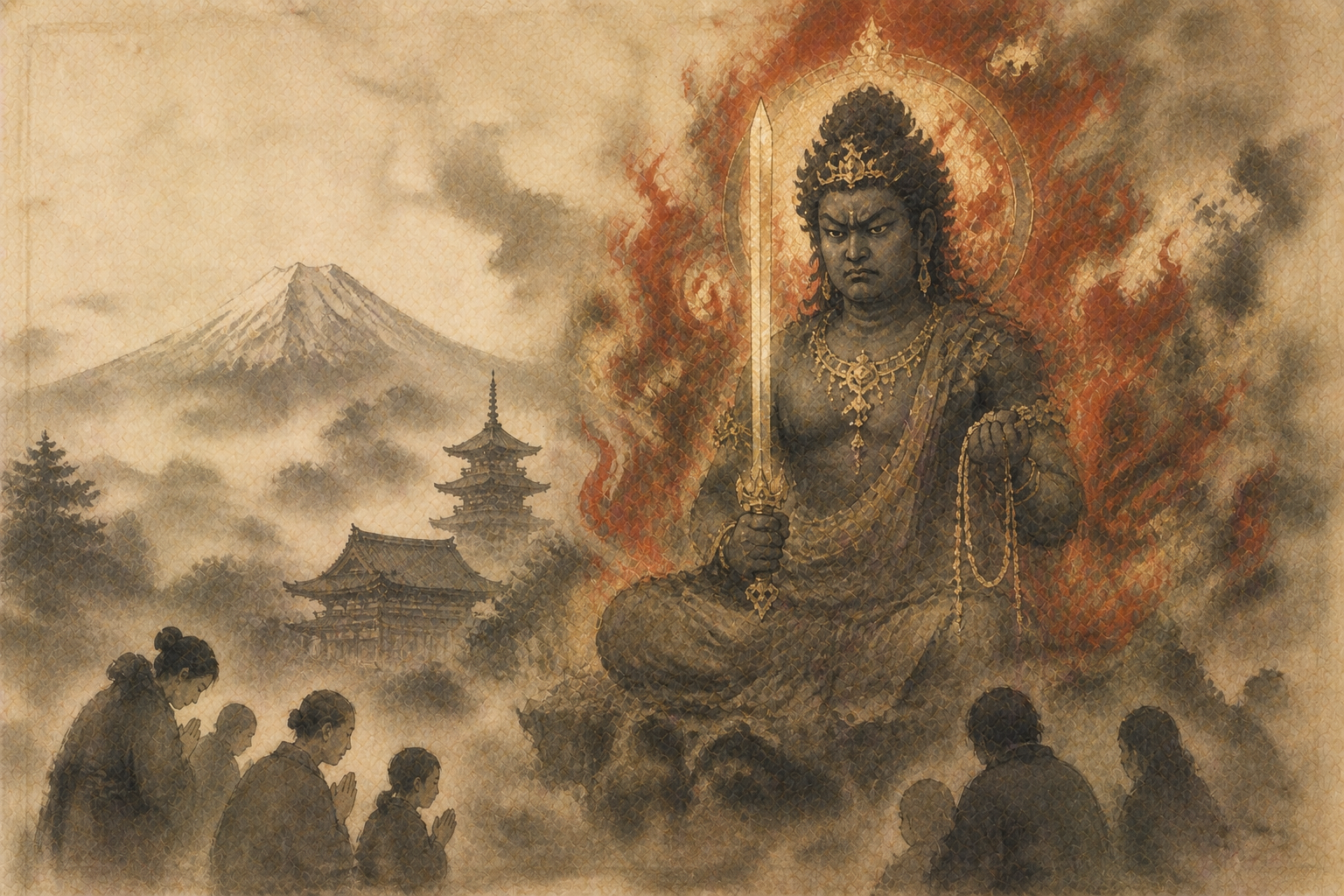
Fudo Myoo is commonly depicted as “immovable,” surrounded by flame, holding a sword and a rope. Read symbolically, that’s a complete toolkit for daily life: the flame is the heat of circumstances, the sword is discernment that cuts through excuses, and the rope is restraint that keeps harmful habits from running the show. “Immovable” doesn’t mean rigid; it means not being pushed around by every mood.
The rooster, in many zodiac interpretations, is associated with being on time, being direct, and noticing what others overlook. Whether or not you accept those traits as “true,” they’re easy to recognize as a style of attention: you see what’s happening, you name it, and you act without unnecessary delay. That style pairs naturally with Fudo’s emphasis on not wavering.
So the core view is simple: “Fudo Myoo rooster year” is best understood as a practical lens. It invites you to ask, “Where do I need to be more steady and more awake?” rather than “What will happen to me because I was born in a certain year?”
GASSHO
Ask and learn about Buddhism in daily life.
GASSHO is a Buddhist community app where you can learn Buddhist teachings and ask questions to the head priest of Kongosanmaiin Temple on Mount Koya.
How the Symbolism Shows Up in Ordinary Moments
Think about the moment you wake up and immediately reach for your phone. The rooster image is a nudge toward wakefulness, but not the frantic kind—more like clean attention. Fudo’s presence, in this same moment, is the feeling of not being yanked by impulse.
Or consider a conversation where you want to sound confident, but you can feel yourself performing. Rooster energy can show up as the urge to be “right” or to be seen as sharp. Fudo’s side of the pairing is the reminder to be steady instead: speak plainly, don’t decorate, don’t attack, don’t retreat.
When you’re procrastinating, the mind often creates fog: “I’ll start later,” “I need the perfect plan,” “I’m not in the mood.” The sword in Fudo’s iconography can be read as the ability to cut one clean line through that fog: choose the next small action. The rooster association adds a sense of timing—do it now, while it’s simple.
In stressful situations, people often swing between two extremes: clenching (trying to control everything) or collapsing (giving up). “Immovable” points to a third option: stay present without hardening. You still respond, but you don’t let the stress write your personality for the day.
There’s also the quieter version of this pairing: keeping promises to yourself. The rooster year link is often talked about as “diligence” or “consistency.” Fudo’s symbolism supports that by emphasizing restraint—less drama, fewer loopholes, more follow-through.
Even when you make a mistake, the pairing can be used skillfully. Rooster symbolism can tilt into self-criticism (“I should have known better”). Fudo’s steadiness is the counterbalance: acknowledge the error, correct it, and stop feeding it with extra shame.
Seen this way, “Fudo Myoo rooster year” isn’t a label you wear; it’s a way to notice your own patterns—especially the moments when you’re tempted to wobble, exaggerate, or delay.
Common Misreadings of “Fudo Myoo Rooster Year”
One misunderstanding is that the rooster year link is a guarantee of protection or luck. Many people approach it like a contract: “If I’m a Rooster, Fudo will fix my problems.” A more grounded approach is to treat it as a reminder to practice steadiness and clarity—qualities you can actually cultivate.
Another confusion is thinking the association is uniform everywhere. Zodiac customs vary by region and by calendar tradition, and temple materials can present different pairings or emphases. If you see conflicting claims, it doesn’t mean someone is lying; it often means you’re looking at different local conventions.
A third misreading is taking Fudo’s fierce imagery as a license for harshness. The sword and flames can be misused as a personal aesthetic for anger. Symbolically, though, the “cutting” is aimed at confusion and harmful habits, not at other people.
Finally, some people dismiss the whole topic as “just superstition,” and miss the practical value. Even if you don’t believe zodiac traits describe you, symbols can still function as prompts for attention: wake up, be consistent, and don’t get dragged by impulse.
Why This Pairing Can Be Useful in Daily Life
Daily life is full of small moments where we trade steadiness for comfort: we avoid a hard email, we soften a boundary we meant to keep, we say “yes” to something we resent. The “Fudo Myoo rooster year” pairing is useful because it points to two simple skills: clarity (see what’s happening) and stability (don’t wobble when you see it).
If you were born in the Year of the Rooster, the association can function like a personal cue: “Be awake and be consistent.” If you weren’t, it can still work as a seasonal reflection—an invitation to practice those same qualities without turning them into an identity.
Practically, you can apply the pairing in three everyday ways: (1) choose one non-negotiable habit and keep it small, (2) speak more plainly than you think you need to, and (3) when you feel reactive, pause long enough to choose your next action on purpose. None of this requires special beliefs—just willingness.
Conclusion
“Fudo Myoo rooster year” is best approached as a symbolic partnership: the rooster points to wakefulness and timing, and Fudo points to steadiness and restraint. If you use it as a mirror rather than a prediction, it becomes surprisingly practical—especially in the moments when you’re tempted to delay, perform, or get pulled off-center.
Ask a Buddhist priest
Have a question about Buddhism?
In the GASSHO app, you can ask questions about Buddhist teachings, daily concerns, and how to understand Buddhism in everyday life.
Frequently Asked Questions
- FAQ 1: What does “Fudo Myoo rooster year” mean?
- FAQ 2: Is Fudo Myoo the guardian deity for everyone born in the Rooster year?
- FAQ 3: Why is Fudo Myoo linked to the Rooster year specifically?
- FAQ 4: Does the Fudo Myoo rooster year link guarantee protection or good luck?
- FAQ 5: If I’m not born in the Rooster year, can I still connect with Fudo Myoo?
- FAQ 6: What qualities are emphasized when people talk about Fudo Myoo and the Rooster year?
- FAQ 7: Is the “Fudo Myoo rooster year” association the same in every Japanese zodiac list?
- FAQ 8: How do people practice with the Fudo Myoo rooster year idea without becoming superstitious?
- FAQ 9: What does Fudo Myoo’s “immovable” quality mean for someone born in the Rooster year?
- FAQ 10: Are there specific days or rituals tied to Fudo Myoo for Rooster-year people?
- FAQ 11: Does “Fudo Myoo rooster year” relate to personality traits of Rooster-year people?
- FAQ 12: What should I do if I see conflicting claims about Fudo Myoo and the Rooster year online?
- FAQ 13: Is the Fudo Myoo rooster year link Buddhist doctrine?
- FAQ 14: Can I keep a simple personal reminder based on the Fudo Myoo rooster year theme?
- FAQ 15: What is the most grounded way to interpret “Fudo Myoo rooster year” today?
FAQ 1: What does “Fudo Myoo rooster year” mean?
Answer: It usually refers to a folk or temple-calendar association that links Fudo Myoo with people born in the Year of the Rooster, using the pairing as a symbolic guide for steadiness, discipline, and clear attention.
Takeaway: Treat it as a symbolic connection, not a fixed rule of fate.
FAQ 2: Is Fudo Myoo the guardian deity for everyone born in the Rooster year?
Answer: Some sources present it that way, but it isn’t universally standardized across all regions and calendars. In practice, many people use the link devotionally or reflectively without claiming it as an absolute assignment.
Takeaway: The “guardian” idea depends on local tradition and how you use the symbol.
FAQ 3: Why is Fudo Myoo linked to the Rooster year specifically?
Answer: The pairing makes intuitive symbolic sense: rooster imagery emphasizes alertness and directness, while Fudo Myoo represents immovable steadiness and the power to cut through confusion. Many communities connect them as complementary qualities.
Takeaway: The link is often about matching qualities—wakefulness plus stability.
FAQ 4: Does the Fudo Myoo rooster year link guarantee protection or good luck?
Answer: No guarantee is built into the idea. People may pray for protection, but the most reliable value of the association is practical: it encourages steadiness, restraint, and clearer choices under pressure.
Takeaway: Use it as a prompt for conduct, not a promise of outcomes.
FAQ 5: If I’m not born in the Rooster year, can I still connect with Fudo Myoo?
Answer: Yes. The “Fudo Myoo rooster year” theme is one way people relate to Fudo, but many people connect with Fudo Myoo regardless of birth year because the symbolism speaks to universal struggles like fear, anger, and indecision.
Takeaway: Birth year isn’t a requirement to find meaning in Fudo Myoo.
FAQ 6: What qualities are emphasized when people talk about Fudo Myoo and the Rooster year?
Answer: Commonly emphasized qualities include alertness, consistency, straightforward speech, self-restraint, and the ability to stay steady when emotions or circumstances feel “hot.”
Takeaway: The pairing highlights wakefulness and follow-through.
FAQ 7: Is the “Fudo Myoo rooster year” association the same in every Japanese zodiac list?
Answer: Not always. Zodiac-to-deity associations can vary by region, temple, and the specific calendar or chart being used, so you may see different presentations depending on the source.
Takeaway: Variation is normal—check the context of the list you’re reading.
FAQ 8: How do people practice with the Fudo Myoo rooster year idea without becoming superstitious?
Answer: They treat it as a reflection tool: when distracted, they return to “wake up”; when reactive, they return to “don’t wobble.” The focus stays on attention and behavior rather than predictions.
Takeaway: Keep it practical—use the symbol to guide choices.
FAQ 9: What does Fudo Myoo’s “immovable” quality mean for someone born in the Rooster year?
Answer: It can be read as a reminder to stabilize strong opinions or quick reactions with patience and restraint—staying clear and direct without becoming sharp or rigid.
Takeaway: “Immovable” points to steadiness, not stubbornness.
FAQ 10: Are there specific days or rituals tied to Fudo Myoo for Rooster-year people?
Answer: Some temples hold regular Fudo observances and individuals may attend with personal intentions, including zodiac-linked ones, but there isn’t one universal Rooster-only ritual practiced everywhere.
Takeaway: Temple customs differ; the core is sincere, steady practice.
FAQ 11: Does “Fudo Myoo rooster year” relate to personality traits of Rooster-year people?
Answer: Many zodiac readings describe Rooster-year traits like diligence and frankness, and Fudo Myoo is then used as a balancing symbol for discipline and grounded courage. It’s best taken as a reflective framework, not a diagnosis.
Takeaway: Use traits as prompts for self-observation, not labels.
FAQ 12: What should I do if I see conflicting claims about Fudo Myoo and the Rooster year online?
Answer: Check whether the source is describing a specific temple tradition, a regional custom, or a generalized zodiac chart. Conflicts often come from mixing different lists rather than from one being “wrong.”
Takeaway: Compare sources by context, not by confidence level.
FAQ 13: Is the Fudo Myoo rooster year link Buddhist doctrine?
Answer: It’s better understood as cultural and devotional symbolism rather than core doctrine. People use it to orient the heart and mind, but it isn’t necessary for understanding basic Buddhist practice.
Takeaway: Think “helpful tradition,” not “required belief.”
FAQ 14: Can I keep a simple personal reminder based on the Fudo Myoo rooster year theme?
Answer: Yes—many people use a short phrase such as “wake up and stay steady” to capture the pairing: rooster for alertness, Fudo for immovable clarity when emotions surge.
Takeaway: A small, repeatable reminder is often the most useful practice.
FAQ 15: What is the most grounded way to interpret “Fudo Myoo rooster year” today?
Answer: Interpret it as a symbolic match that encourages consistent action and clear attention: notice what’s happening (rooster), then don’t get pushed around by impulse (Fudo). Let it shape your next choice, not your identity.
Takeaway: Make it behavioral—clarity in, steadiness out.