



What Does It Mean to Feel Protected by Fudo Myoo? A Beginner-Friendly Guide
Quick Summary
- To feel protected by Fudo Myoo often means feeling steadier, clearer, and less pulled around by fear or impulse.
- “Protection” can be understood as inner protection: boundaries, resolve, and the ability to stay with what’s difficult.
- Fudo’s fierce imagery points to compassion that doesn’t negotiate with harmful habits.
- The experience is usually ordinary: a pause before reacting, a stronger “no,” or calm during pressure.
- You don’t need special beliefs; you can treat Fudo as a symbol that trains attention and courage.
- Misunderstandings happen when protection is confused with control, luck, or aggression.
- A simple daily practice is to recall Fudo when you’re tempted to abandon your values.
Introduction: When “Protection” Is What You’re Actually Looking For
You might be drawn to Fudo Myoo because you’re tired of feeling mentally exposed—too reactive, too easily shaken, too quick to abandon your own boundaries when life gets loud. “Feel protected by Fudo Myoo” isn’t just a poetic phrase; it’s often a very practical longing for steadiness when anger, anxiety, craving, or people-pleasing start running the show. At Gassho, we focus on beginner-friendly, grounded ways to understand Buddhist symbols without requiring you to force belief.
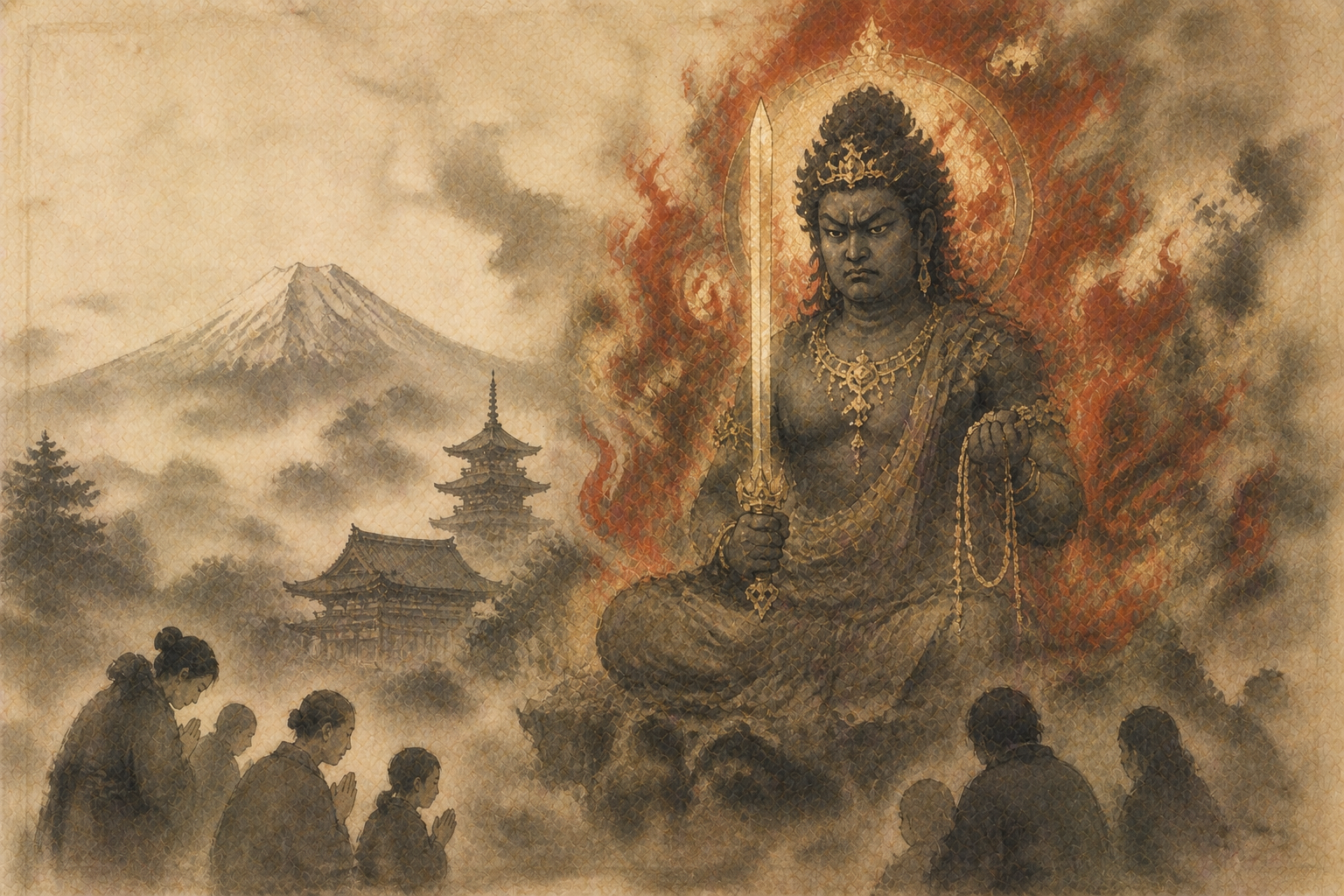
Fudo Myoo (often called “the Immovable One”) is commonly depicted with a fierce face, a sword, and a rope, surrounded by flames. If that imagery feels intense, you’re not alone. The key is that the intensity is not about violence toward others; it points to a kind of compassion that is willing to be firm—especially with what harms you from the inside.
A Clear Lens: What “Protected by Fudo Myoo” Can Point To
One helpful way to understand “feeling protected by Fudo Myoo” is to treat it as a lens for experience: when you remember Fudo, you remember the possibility of being unshakable in the middle of pressure. Protection, in this sense, isn’t a magical shield that prevents hard things from happening. It’s the inner capacity to meet hard things without immediately collapsing into old patterns.
Fudo’s “immovable” quality can be read as a kind of psychological and ethical stability. When your mind is pulled by fear, resentment, or the need to be liked, it’s easy to drift away from what you know is right for you. Feeling protected can mean you feel less available to those forces—like you have an anchor point that doesn’t bargain with panic.
The sword and rope imagery can also be understood in a very down-to-earth way. The sword represents cutting through confusion, excuses, and self-deception. The rope represents being “bound” to what matters—held close to your intention—so you don’t wander off into habits that cost you your peace.
Seen this way, Fudo Myoo becomes less like an external rescuer and more like a reminder of a fierce, protective clarity already available in human experience: the ability to stop, to see clearly, and to choose what you respect.
GASSHO
Ask and learn about Buddhism in daily life.
GASSHO is a Buddhist community app where you can learn Buddhist teachings and ask questions to the head priest of Kongosanmaiin Temple on Mount Koya.
How Feeling Protected Shows Up in Everyday Moments
Most people don’t “feel protected by Fudo Myoo” as fireworks or visions. It’s usually subtle, and it often shows up as a change in timing: you notice a reaction forming, and there’s a small gap before you act on it. That gap can feel like protection because it gives you options.
For example, you might feel the urge to send a sharp message, prove a point, or defend your ego. Remembering Fudo can feel like a firm hand on your shoulder: not shaming you, not suppressing you, just stopping the momentum long enough for you to choose a cleaner response.
Sometimes the “protected” feeling is physical. Your chest softens. Your jaw unclenches. Your breathing becomes less shallow. Nothing outside has changed yet, but you’re no longer adding extra danger through mental spiraling. In that moment, protection is the reduction of self-created threat.
In relationships, it can show up as boundaries that don’t need a dramatic explanation. You might simply say, “I can’t do that,” or “I need time,” and feel surprisingly steady afterward. The protection isn’t that nobody gets upset; it’s that you don’t abandon yourself to manage their reaction.
In work or study, feeling protected by Fudo can look like staying with the task when discomfort rises. You notice the mind reaching for distraction, perfectionism, or quitting. The “immovable” reminder helps you return to the next small step, without turning the discomfort into a personal failure story.
In moments of temptation—overindulging, doom-scrolling, gossiping, or numbing out—Fudo’s presence can feel like a bright line. Not a harsh moral judgment, but a clear recognition: “This will cost me.” That clarity can be experienced as protection because it prevents regret.
And sometimes it’s simply the feeling of being accompanied when you face something you’d rather avoid: a difficult conversation, a medical appointment, a grief wave, a lonely evening. You still feel what you feel, but you’re less likely to dramatize it or run from it. The protection is the steadiness to stay present.
Common Misunderstandings That Make the Idea Harder Than It Needs to Be
A frequent misunderstanding is thinking that feeling protected by Fudo Myoo means nothing bad will happen. When life still brings loss, conflict, or uncertainty, people assume the whole idea is false. A more workable interpretation is that protection means you’re less dominated by fear and reactivity when bad things happen.
Another confusion is equating Fudo’s fierceness with anger. Fudo imagery can look wrathful, so people assume the practice is about becoming tougher, colder, or more aggressive. But the “fierce” quality points to unwavering compassion: the kind that refuses to cooperate with what destroys your integrity.
Some people also worry they’re “doing it wrong” if they don’t feel anything dramatic. In reality, the most meaningful shifts are often quiet: fewer impulsive words, quicker recovery after stress, more honest self-talk, and a stronger ability to keep commitments.
Finally, it’s easy to turn “protection” into control—trying to use spiritual language to avoid uncertainty or to force outcomes. If the idea makes you more rigid, superstitious, or fearful of making mistakes, it may help to return to a simpler aim: clarity, steadiness, and ethical courage in the next moment.
Why This Kind of Protection Matters in Real Life
When you feel protected by Fudo Myoo, you’re less likely to outsource your stability to other people’s approval, the latest news cycle, or your own shifting moods. That matters because so much suffering comes from being yanked around by what’s loudest in the mind, not what’s wisest.
This “protection” supports cleaner choices. It helps you pause before speaking, notice before buying, and breathe before escalating. Over time, those small pauses reduce conflict and regret—not because you become perfect, but because you become less automatic.
It also supports self-respect. Many people don’t need more motivation; they need a steadier relationship with discomfort. Fudo’s immovable quality can be a reminder that you can tolerate the heat of a hard moment without betraying your values.
If you want a simple way to work with this in daily life, try this: when you feel pulled into a reaction, silently recall “Fudo” and ask, “What would be the immovable choice here?” Then do the smallest version of that choice—one sentence, one breath, one boundary, one honest action.
Conclusion: Let Protection Mean Steadiness, Not Escape
To feel protected by Fudo Myoo can be as simple as feeling less persuadable by fear, less hypnotized by impulse, and more able to stay with what you know is true. The fierce imagery doesn’t have to be taken literally; it can function as a practical reminder that compassion sometimes looks like firmness. If you keep the meaning grounded—clarity, boundaries, and the courage to face discomfort—“protection” becomes something you can recognize in ordinary life, not just in stories.
Ask a Buddhist priest
Have a question about Buddhism?
In the GASSHO app, you can ask questions about Buddhist teachings, daily concerns, and how to understand Buddhism in everyday life.
Frequently Asked Questions
- FAQ 1: What does it actually mean to feel protected by Fudo Myoo?
- FAQ 2: Is feeling protected by Fudo Myoo supposed to be a physical sensation?
- FAQ 3: Can I feel protected by Fudo Myoo without believing in anything supernatural?
- FAQ 4: Why does Fudo Myoo look so fierce if the feeling is “protected”?
- FAQ 5: Does feeling protected by Fudo Myoo mean I won’t have bad luck or accidents?
- FAQ 6: What if I try to connect with Fudo Myoo but don’t feel protected at all?
- FAQ 7: How can I invite the feeling of being protected by Fudo Myoo during anxiety?
- FAQ 8: Is feeling protected by Fudo Myoo the same as feeling safe?
- FAQ 9: Can feeling protected by Fudo Myoo help with anger and impulsive reactions?
- FAQ 10: What does the “rope” symbolize when I feel protected by Fudo Myoo?
- FAQ 11: Is it normal to feel emotional when I feel protected by Fudo Myoo?
- FAQ 12: How do I know I’m not just imagining the feeling of being protected by Fudo Myoo?
- FAQ 13: Can I feel protected by Fudo Myoo while still feeling fear?
- FAQ 14: What’s a simple daily practice to strengthen the feeling of being protected by Fudo Myoo?
- FAQ 15: If I feel protected by Fudo Myoo, does that mean I should be tougher with myself?
FAQ 1: What does it actually mean to feel protected by Fudo Myoo?
Answer: It often means you feel steadier under pressure—less pushed around by fear, anger, or compulsive habits—and more able to choose a clear next step. Many people experience this as inner protection (clarity and resolve) rather than a promise that nothing difficult will happen.
Takeaway: “Protected” can mean “less reactive and more grounded.”
FAQ 2: Is feeling protected by Fudo Myoo supposed to be a physical sensation?
Answer: It can be, but it doesn’t have to be. Some people notice a calmer breath, relaxed shoulders, or a settled belly; others notice it as a mental shift like “I can handle this.” Both are valid ways the experience can show up.
Takeaway: Protection may feel bodily, mental, or both—and it’s often subtle.
FAQ 3: Can I feel protected by Fudo Myoo without believing in anything supernatural?
Answer: Yes. You can relate to Fudo Myoo as a symbol that strengthens attention, courage, and boundaries. In that approach, “protection” is the practical effect of remembering firmness and clarity when you’re stressed or tempted.
Takeaway: You can treat Fudo as a psychological and ethical support, not a required belief.
FAQ 4: Why does Fudo Myoo look so fierce if the feeling is “protected”?
Answer: The fierceness can be understood as uncompromising compassion—energy that refuses to cooperate with what causes harm. Feeling protected by Fudo Myoo may feel like a firm “stop” to self-sabotage, not hostility toward others.
Takeaway: Fierce imagery can point to firm care, not aggression.
FAQ 5: Does feeling protected by Fudo Myoo mean I won’t have bad luck or accidents?
Answer: Not necessarily. Many people use “protected” to describe inner steadiness and reduced panic, not guaranteed outcomes. If you interpret protection as “I can meet what happens without falling apart,” the idea stays grounded and useful.
Takeaway: Think “resilience and clarity,” not “life without problems.”
FAQ 6: What if I try to connect with Fudo Myoo but don’t feel protected at all?
Answer: That’s common. Sometimes the mind is simply loud, tired, or overwhelmed. Instead of chasing a feeling, try looking for a small functional shift: a single calmer breath, one less reactive message, or one honest boundary.
Takeaway: Measure “protected” by small changes in response, not dramatic sensations.
FAQ 7: How can I invite the feeling of being protected by Fudo Myoo during anxiety?
Answer: Keep it simple: pause, exhale slowly, and recall “immovable.” Then ask, “What is the next steady action?” The feeling of protection often follows the act of returning to one clear step rather than trying to eliminate anxiety first.
Takeaway: Protection often comes from choosing steadiness inside the anxiety.
FAQ 8: Is feeling protected by Fudo Myoo the same as feeling safe?
Answer: They overlap, but they’re not identical. “Safe” can imply that nothing threatens you; “protected” can mean you have support and stability even when something does. With Fudo Myoo, protection often points to inner stability in the presence of difficulty.
Takeaway: You can feel protected even when life is still uncertain.
FAQ 9: Can feeling protected by Fudo Myoo help with anger and impulsive reactions?
Answer: It can, especially if you interpret Fudo’s “sword” as cutting through the story that justifies lashing out. Feeling protected may show up as a pause before speaking, a willingness to cool down, or a clearer boundary that doesn’t escalate into attack.
Takeaway: Protection can look like a pause that prevents regret.
FAQ 10: What does the “rope” symbolize when I feel protected by Fudo Myoo?
Answer: In a practical reading, the rope can symbolize being held to your intention—kept close to what matters when you’re tempted to drift into avoidance or harmful habits. Feeling protected can mean feeling “tethered” to your values in a supportive way.
Takeaway: The rope can mean supportive restraint and commitment.
FAQ 11: Is it normal to feel emotional when I feel protected by Fudo Myoo?
Answer: Yes. For some people, protection brings relief, and relief can release tears or soften long-held tension. Feeling protected may also highlight how hard you’ve been pushing alone, which can be emotional in a quiet, honest way.
Takeaway: Emotion can be a sign of release, not a problem.
FAQ 12: How do I know I’m not just imagining the feeling of being protected by Fudo Myoo?
Answer: You don’t need to prove it metaphysically. A grounded test is behavioral: do you recover faster from stress, act with more integrity, or set clearer boundaries? If the “protected” feeling supports wiser actions, it’s doing something real in your life.
Takeaway: Look for practical effects, not perfect certainty.
FAQ 13: Can I feel protected by Fudo Myoo while still feeling fear?
Answer: Yes. Protection doesn’t require fear to disappear. Many people describe it as fear being present but no longer in charge—like you can carry fear without letting it dictate your choices.
Takeaway: Protected can mean “fear is here, and I’m steady anyway.”
FAQ 14: What’s a simple daily practice to strengthen the feeling of being protected by Fudo Myoo?
Answer: Choose one recurring moment—before work, before sleep, or before a difficult conversation—and take 30 seconds to recall Fudo’s immovable steadiness. Ask, “What would I do today if I refused to abandon my values?” Then commit to one small action that matches your answer.
Takeaway: Repetition in ordinary moments builds the association with steadiness.
FAQ 15: If I feel protected by Fudo Myoo, does that mean I should be tougher with myself?
Answer: Not necessarily. Fudo’s firmness can be compassionate rather than harsh: clear boundaries, honest self-talk, and consistent follow-through without self-hatred. If “toughness” turns into shame, it’s usually a sign to return to steadiness and care instead of punishment.
Takeaway: Let protection feel firm and kind, not punitive.