



The Eight Auspicious Symbols of Buddhism Explained
Quick Summary
- The eight auspicious symbols of Buddhism are a visual “language” for qualities like clarity, compassion, and ethical steadiness.
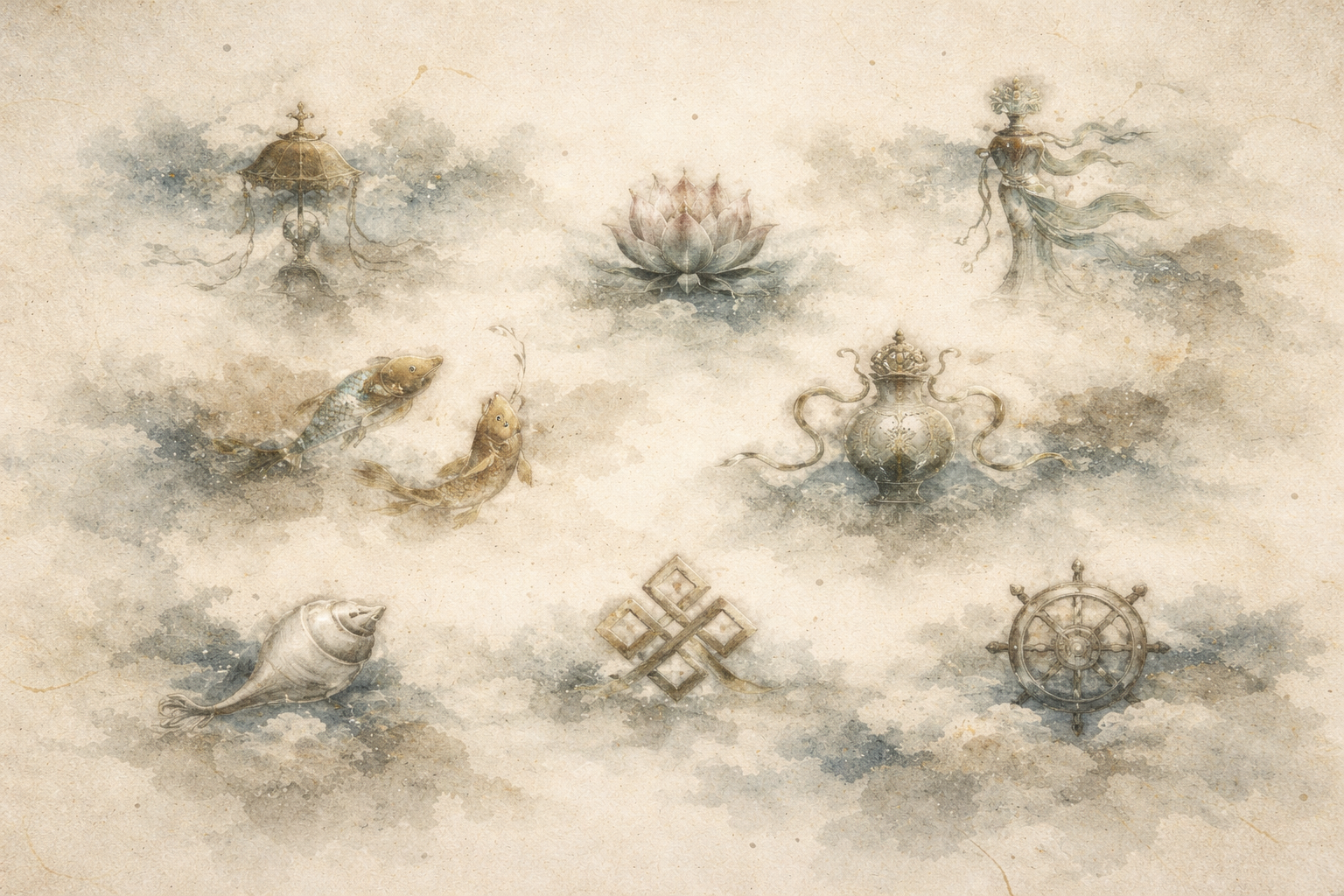
- Commonly listed as: parasol, golden fish, treasure vase, lotus, conch shell, endless knot, victory banner, and dharma wheel.
- They’re not lucky charms; they’re reminders that point attention toward wholesome ways of seeing and acting.
- Each symbol can be read psychologically: protection, freedom, contentment, purity, courageous speech, interconnection, resilience, and wise direction.
- You’ll see them in art, architecture, ritual objects, and everyday designs—often together as a set.
- Misreadings happen when people treat them as superstition or as mere decoration without context.
- Used well, they become practical cues for daily life: pause, notice, soften, choose, and return to what matters.
Introduction
You’ve probably seen the eight auspicious symbols of Buddhism on thangkas, temple walls, jewelry, or even modern prints—and felt stuck on the same question: are these meant to be “good luck” signs, or do they actually mean something you can use? They do mean something, but the meaning is easy to miss when the symbols are treated like exotic decoration rather than a practical set of reminders for the mind and heart. At Gassho, we focus on clear, grounded explanations that respect tradition while staying usable in everyday life.
The set is often called the “Eight Auspicious Symbols” (sometimes “Ashtamangala”), and while details can vary by region and artistic style, the core list is widely recognized: the parasol, golden fish, treasure vase, lotus, conch shell, endless knot, victory banner, and dharma wheel.
Rather than treating them as a belief test, it helps to read them as a visual toolkit: eight ways to remember what supports a steady, compassionate life when you’re busy, reactive, or uncertain.
A Practical Lens for Understanding the Eight Symbols
The eight auspicious symbols of Buddhism work best as a lens: they point to qualities you can recognize in experience—like protection from overwhelm, the relief of simplicity, or the strength to act ethically under pressure. In that sense, they’re less like “signs” and more like prompts that train attention toward what is skillful.
Each symbol compresses a teaching into an image. Images are fast: you can feel them before you can explain them. That’s why these symbols show up in places where people gather, practice, or reflect—because a single glance can nudge the mind back toward steadiness.
It’s also useful to remember that the symbols are meant to work together. One symbol might emphasize inner clarity, another ethical direction, another the warmth of compassion. Taken as a set, they suggest balance: protection without avoidance, confidence without aggression, and joy without grasping.
Below is a grounded way to understand each symbol—less as mythology, more as a human instruction manual.
GASSHO
Ask and learn about Buddhism in daily life.
GASSHO is a Buddhist community app where you can learn Buddhist teachings and ask questions to the head priest of Kongosanmaiin Temple on Mount Koya.
What Each Auspicious Symbol Can Remind You Of
The Parasol (Umbrella) is often associated with protection and dignity. In lived terms, it can point to the kind of protection that isn’t defensive: boundaries, wise restraint, and the ability to step out of unnecessary heat—social drama, compulsive comparison, or self-criticism.
The Golden Fish are commonly linked with freedom and fearlessness, moving through water without drowning. Psychologically, they can remind you what it feels like to move through emotions without being swallowed by them—staying responsive rather than panicked.
The Treasure Vase is associated with inexhaustible richness—often read as spiritual wealth, generosity, and contentment. In daily life, it can be a cue to notice sufficiency: the moment you stop scanning for what’s missing and recognize what’s already here.
The Lotus is the most widely recognized: it grows from mud yet opens clean and bright. As a reminder, it points to the possibility of clarity in messy conditions—showing up with decency even when your mood, history, or environment is complicated.
The Conch Shell is often depicted as a white, right-turning conch, linked with the far-reaching sound of truth. In practical terms, it can represent speech that is clear and beneficial: saying what needs to be said without cruelty, and listening without collapsing into agreement.
The Endless Knot symbolizes interconnection, mutual dependence, and the way causes and conditions weave together. It can remind you to pause before blaming yourself or others too quickly—because what’s happening is usually the result of many threads, not one simple fault.
The Victory Banner is associated with triumph—often understood as the victory of wisdom over confusion. In ordinary experience, it can point to resilience: the quiet win of not acting out an old habit, not feeding a grudge, or not abandoning what you know is right.
The Dharma Wheel (often with eight spokes) represents the path of practice and the turning of understanding into action. As a reminder, it asks a simple question: “What is the next wise step?” Not the perfect life plan—just the next step that reduces harm.
How These Symbols Show Up in Ordinary Experience
You notice the parasol when you’re about to say yes out of guilt. There’s a split second where you can feel the pressure to please, and also the possibility of a clean boundary. The symbol becomes a quiet permission slip: protect what matters without making anyone the enemy.
You notice the golden fish when emotion rises fast—irritation in traffic, anxiety before a meeting, the sting of a message that feels dismissive. The mind wants to thrash or freeze. The reminder is simple: keep moving, keep breathing, stay in the water without becoming the water.
You notice the treasure vase when you’re scrolling, shopping, or mentally bargaining: “If I just get that, then I’ll feel settled.” The symbol points to a different kind of wealth—one that grows when you practice gratitude, generosity, and honest simplicity.
You notice the lotus when you’re not at your best. Maybe you’re tired, reactive, or carrying old resentment. The lotus doesn’t deny the mud; it doesn’t pretend conditions are pure. It just opens anyway, which in human terms can look like apologizing, starting over, or choosing a kinder tone.
You notice the conch shell when you’re about to speak from adrenaline. There’s the urge to win, to be right, to land a sharp line. The conch reminder is not “be quiet”; it’s “be true.” Truth here includes timing, intention, and whether your words reduce harm.
You notice the endless knot when you’re stuck in a story about someone else: “They always do this,” or “I’m just like this.” The knot invites a wider view. It doesn’t excuse harmful behavior, but it softens the mind’s addiction to single-cause explanations and rigid identities.
You notice the victory banner when you feel pulled into an old loop—doomscrolling, gossip, self-sabotage, or the familiar urge to retaliate. The “victory” is often invisible to others: you pause, you don’t feed it, you choose a smaller, cleaner action. That’s the banner raised quietly inside.
You notice the dharma wheel when you’re overwhelmed by options. The mind wants certainty and control, but life offers complexity. The wheel points to direction rather than perfection: return to what is ethical, stabilizing, and compassionate, then take one step and let the next step reveal itself.
Common Misunderstandings That Flatten Their Meaning
Mistaking them for “luck” symbols. The eight auspicious symbols of Buddhism are often called “auspicious,” but that doesn’t have to mean superstition. A more useful reading is: these are conditions that support well-being—like clarity, restraint, and interconnection—so they are “fortunate” to cultivate.
Treating them as purely decorative. They are beautiful, and they do appear in design. But when you only see them as ornament, you lose their function as reminders. Even a small image can be used intentionally: as a cue to pause, soften, and choose wisely.
Assuming there is one fixed, universal interpretation. Meanings can vary across cultures and artistic traditions. That doesn’t make them meaningless; it means they’re living symbols. A grounded approach is to learn common associations, then test how the reminder works in your own attention and behavior.
Thinking you must “believe” in something to use them. Symbols can function as practical prompts without requiring metaphysical commitments. If a symbol helps you speak more carefully, act more generously, or see more clearly, it’s already doing its job.
Using them to bypass real problems. A symbol is not a substitute for apologizing, setting boundaries, seeking help, or changing harmful patterns. The healthiest use is the opposite of bypassing: the symbol helps you face what’s real with steadiness.
Why the Eight Symbols Still Matter in Daily Life
Modern life is saturated with signals that train craving and agitation: notifications, outrage cycles, comparison, and the pressure to perform. The eight auspicious symbols of Buddhism offer a different set of signals—ones that train steadiness, ethical sensitivity, and a wider view.
They also help translate “big” spiritual language into small, repeatable actions. The parasol can mean one boundary. The conch can mean one honest sentence. The endless knot can mean one moment of humility about causes and conditions. Over time, these small actions shape a life that feels less scattered.
Because they are visual, they work when you don’t have time to think. A quick glance can interrupt autopilot. That interruption is valuable: it creates a gap where you can choose your next move instead of being dragged by habit.
Finally, the symbols can reconnect you to intention. Not “What do I want right now?” but “What kind of person am I practicing to be?” That question is simple, but it changes the tone of a day.
Conclusion
The eight auspicious symbols of Buddhism are best understood as a calm, practical visual map: protection without fear, freedom within emotion, richness through contentment, purity within complexity, truthful communication, interconnection, resilience, and wise direction. You don’t need to turn them into superstition or strip them into decoration. Let them do what symbols do at their best—bring you back to what you already know, right when you’re about to forget.
Ask a Buddhist priest
Have a question about Buddhism?
In the GASSHO app, you can ask questions about Buddhist teachings, daily concerns, and how to understand Buddhism in everyday life.
Frequently Asked Questions
- FAQ 1: What are the eight auspicious symbols of Buddhism?
- FAQ 2: Do the eight auspicious symbols have one fixed meaning everywhere?
- FAQ 3: Are the eight auspicious symbols of Buddhism meant to bring good luck?
- FAQ 4: What does the parasol symbolize in the eight auspicious symbols?
- FAQ 5: What do the golden fish represent among the eight auspicious symbols?
- FAQ 6: What is the meaning of the treasure vase in the eight auspicious symbols of Buddhism?
- FAQ 7: Why is the lotus one of the eight auspicious symbols?
- FAQ 8: What does the conch shell symbolize in the eight auspicious symbols of Buddhism?
- FAQ 9: What is the endless knot and what does it mean?
- FAQ 10: What does the victory banner represent in the eight auspicious symbols?
- FAQ 11: What does the dharma wheel mean as one of the eight auspicious symbols of Buddhism?
- FAQ 12: Why are the eight auspicious symbols often shown together as a set?
- FAQ 13: Where do you commonly see the eight auspicious symbols of Buddhism?
- FAQ 14: Is it disrespectful to wear or display the eight auspicious symbols?
- FAQ 15: How can I use the eight auspicious symbols of Buddhism in a practical, non-superstitious way?
FAQ 1: What are the eight auspicious symbols of Buddhism?
Answer: The eight auspicious symbols of Buddhism are a traditional set of images used to represent supportive qualities on the path: the parasol, golden fish, treasure vase, lotus, conch shell, endless knot, victory banner, and dharma wheel.
Takeaway: They’re a set of eight visual reminders, commonly shown together.
FAQ 2: Do the eight auspicious symbols have one fixed meaning everywhere?
Answer: Not entirely. The core list is widely shared, but interpretations and emphasis can vary by culture, region, and artistic tradition. Most meanings overlap around themes like protection, clarity, interconnection, and ethical direction.
Takeaway: Expect shared themes, not a single universal dictionary.
FAQ 3: Are the eight auspicious symbols of Buddhism meant to bring good luck?
Answer: They’re often called “auspicious,” but they’re better understood as symbols of conditions that support well-being—like wise boundaries, truthful speech, and resilience—rather than as magical luck-bringers.
Takeaway: “Auspicious” can mean supportive and beneficial, not superstitious.
FAQ 4: What does the parasol symbolize in the eight auspicious symbols?
Answer: The parasol commonly symbolizes protection, dignity, and shelter from harmful conditions. Practically, it can be read as wise restraint and healthy boundaries that reduce overwhelm and reactivity.
Takeaway: The parasol points to protection that supports clarity.
FAQ 5: What do the golden fish represent among the eight auspicious symbols?
Answer: The golden fish are often associated with freedom, fearlessness, and moving through life without drowning in distress. In a psychological reading, they can suggest navigating emotions with steadiness and flexibility.
Takeaway: The fish symbolize ease and freedom of movement through experience.
FAQ 6: What is the meaning of the treasure vase in the eight auspicious symbols of Buddhism?
Answer: The treasure vase is commonly linked with abundance, generosity, and “inexhaustible” richness. Many people interpret it as inner wealth—contentment and the capacity to give—rather than mere material gain.
Takeaway: The vase points to sufficiency and generous well-being.
FAQ 7: Why is the lotus one of the eight auspicious symbols?
Answer: The lotus is a central Buddhist symbol because it grows from muddy water yet blooms clean and bright. It’s often used to represent purity, clarity, and compassionate action arising within imperfect conditions.
Takeaway: The lotus reminds you that clarity can appear even in “messy” life.
FAQ 8: What does the conch shell symbolize in the eight auspicious symbols of Buddhism?
Answer: The conch shell is often associated with the far-reaching sound of truth and the call to wakefulness. In everyday terms, it can represent clear communication—speech that is honest, timely, and intended to reduce harm.
Takeaway: The conch points to truthful, beneficial speech.
FAQ 9: What is the endless knot and what does it mean?
Answer: The endless knot symbolizes interconnection and the weaving of causes and conditions. It’s often read as a reminder that events and identities aren’t isolated; they arise through many influences and relationships.
Takeaway: The knot encourages a wider view than blame or simple stories.
FAQ 10: What does the victory banner represent in the eight auspicious symbols?
Answer: The victory banner commonly represents the triumph of wisdom over confusion and the strength to overcome unhelpful patterns. It can be understood as resilience and the ability to choose what is skillful under pressure.
Takeaway: The banner symbolizes inner victory over reactive habits.
FAQ 11: What does the dharma wheel mean as one of the eight auspicious symbols of Buddhism?
Answer: The dharma wheel represents the path of practice and the “turning” of understanding into lived action. Its spokes are often associated with wholesome qualities and balanced direction in life.
Takeaway: The wheel points to guidance—how to live, not just what to believe.
FAQ 12: Why are the eight auspicious symbols often shown together as a set?
Answer: Displaying them together emphasizes completeness and balance: multiple supportive qualities working in harmony (protection, clarity, interconnection, resilience, and wise direction). The set functions like a compact visual summary of what supports awakening and well-being.
Takeaway: Together, the eight symbols communicate balance rather than a single idea.
FAQ 13: Where do you commonly see the eight auspicious symbols of Buddhism?
Answer: They commonly appear in Buddhist art and architecture, on temple decorations, paintings, textiles, and ritual imagery. In modern contexts, they also show up in design and crafts inspired by Buddhist iconography.
Takeaway: They’re widely used as recognizable symbols in Buddhist visual culture.
FAQ 14: Is it disrespectful to wear or display the eight auspicious symbols?
Answer: Context and intention matter. Many people wear or display them respectfully as reminders of wholesome qualities. It’s generally wise to avoid using them in ways that trivialize, mock, or place them in disrespectful settings.
Takeaway: Use them with care and intention, not as a gimmick.
FAQ 15: How can I use the eight auspicious symbols of Buddhism in a practical, non-superstitious way?
Answer: Choose one symbol as a daily cue: the parasol for boundaries, the conch for careful speech, the endless knot for seeing complexity, or the dharma wheel for the next wise step. When you notice the image, pause and ask what action would reduce harm and increase clarity right now.
Takeaway: Let the symbols function as prompts for attention and ethical choice.