JP EN

Buddhism

Who Was Bodhidharma? The Monk Behind Zen Legends

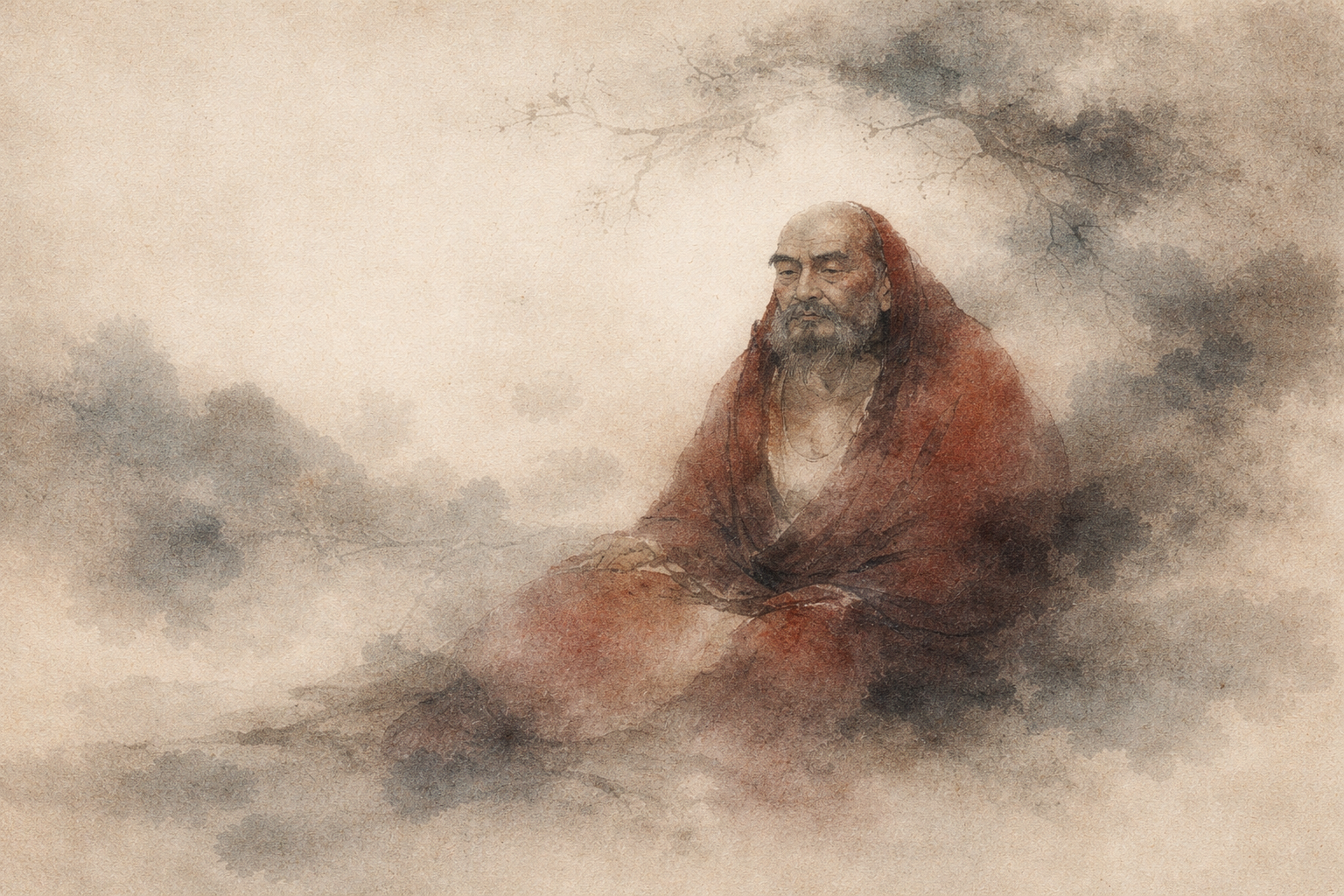
Watercolor-style image of an elderly monk in traditional robes sitting quietly in contemplation, surrounded by soft mist, symbolizing Bodhidharma and the origins of Zen teachings associated with discipline, meditation, and insight.

Quick Summary

  • Bodhidharma is remembered as a monk linked to the early identity of Zen, but much of his story is layered with legend.
  • Historically, he likely lived around the 5th–6th centuries and was associated with bringing a meditation-centered approach to China.
  • Many famous episodes (the “nine years facing a wall,” dramatic encounters, miraculous feats) function more like teaching stories than biography.
  • The heart of the Bodhidharma image is direct seeing: less reliance on words, more reliance on clear attention.
  • His legend highlights a practical question: what changes when you stop outsourcing your understanding to explanations?
  • Reading Bodhidharma well means holding two truths at once: history matters, and symbolism matters.
  • What endures is not a perfect timeline, but a stance toward experience: steady, simple, and unromantic.

Introduction: Why Bodhidharma Feels Hard to Pin Down

You searched “who was Bodhidharma” because the answers you’ve seen don’t agree: some describe a real historical monk, others repeat wild legends, and a few treat him like a symbol rather than a person. The frustrating part is that all three approaches show up side by side, as if they’re the same kind of truth. At Gassho, we focus on clear, practice-grounded explanations that respect both history and lived experience.

Bodhidharma is most often presented as a foreign monk who became a catalyst for a new emphasis on meditation and direct insight in China. The earliest sources are sparse and sometimes contradictory, which is why later generations filled in the gaps with stories that teach through shock, humor, and exaggeration. If you want a clean “biography,” you’ll be disappointed; if you want to understand why his name became a shorthand for a certain kind of clarity, the puzzle starts to make sense.

So the useful question isn’t only “Did this happen exactly like this?” but also “What is this story trying to train me to notice?” Bodhidharma’s reputation points to a style of understanding that doesn’t depend on perfect concepts, and that can feel unsettling in a culture that treats explanation as the same thing as insight.

A Practical Lens for Understanding Bodhidharma

One grounded way to approach Bodhidharma is to treat him as a meeting point between history and instruction. Historically, he appears as a monk associated with a meditation-forward approach; symbolically, he becomes a portrait of what it looks like to stop negotiating with your own mind. This lens avoids two extremes: treating every legend as literal fact, or dismissing everything because the record is incomplete.

Through this lens, “Bodhidharma” points to direct seeing: noticing what is happening right now without immediately turning it into a story about you. That doesn’t require adopting a new belief. It’s more like learning to recognize the difference between an experience and the commentary that rushes in to manage it.

Many Bodhidharma stories emphasize simplicity and refusal to be impressed—by status, by cleverness, even by spiritual performance. Read plainly, the message is not “be harsh” or “be mysterious.” It’s “be honest about what you actually know, and don’t pretend that borrowed language is the same as understanding.”

When you hold Bodhidharma this way, the question “who was Bodhidharma” becomes two questions that support each other: who was he likely in the historical record, and why did later communities keep using his image to point toward a certain kind of attention?

How the Bodhidharma Theme Shows Up in Ordinary Life

In everyday life, most of us live inside a running explanation. Something happens, and within seconds we’ve built a narrative: what it means, who’s at fault, what it says about our future. The Bodhidharma theme is the moment you notice that this narrative is optional.

You might be in a conversation and feel a small sting—someone interrupts you, or doesn’t respond the way you expected. Before you “decide” anything, there’s a raw sensation: heat in the face, tightness in the chest, a quickening in the mind. The usual habit is to convert that into certainty: “They don’t respect me.” The Bodhidharma angle is simply seeing the sting as a sting, without rushing to crown it as truth.

Or consider distraction. You sit down to work, and within minutes you’re checking messages, opening tabs, chasing little hits of relief. A legend like “facing the wall” can be read as a dramatic image of something very ordinary: staying with what’s in front of you when your mind begs for an exit.

There’s also the experience of wanting a teacher, a method, or a quote to remove uncertainty. When you feel lost, it’s tempting to collect answers the way you collect tools. The Bodhidharma mood doesn’t reject learning; it questions the impulse to use learning as a substitute for looking. Sometimes the most honest move is to admit, “I don’t actually know what this is yet,” and stay present anyway.

In conflict, the same pattern appears. You rehearse what you’ll say, you polish your argument, you prepare to win. But if you pause, you can often find a simpler truth underneath: fear of being dismissed, fear of being wrong, fear of losing connection. The Bodhidharma theme is not “be passive.” It’s “see what’s driving you before you speak.”

Even in pleasant moments, the mind can’t stop grabbing. You enjoy a quiet morning and immediately think, “How do I keep this?” That grasping subtly turns ease into tension. The Bodhidharma image points to a different relationship with experience: letting it be complete without trying to own it.

None of this requires dramatic feats. It’s the small, repeatable act of noticing what’s happening, noticing the story about it, and giving yourself the option to return to what’s real and immediate.

Common Misunderstandings About Bodhidharma

Mistake 1: Thinking the legends must be literally true to be valuable. Many Bodhidharma stories are best read as teaching devices. Their job is to provoke a shift in how you look, not to satisfy modern standards of documentation.

Mistake 2: Assuming “direct insight” means rejecting study or ethics. The point is not anti-intellectualism. It’s recognizing that concepts can describe an experience without delivering it. You can learn a lot and still miss what’s happening in your own mind.

Mistake 3: Romanticizing harshness as authenticity. Some people imitate the “tough” Bodhidharma vibe—bluntness, dismissal, shock—without the underlying clarity. Directness without care often becomes performance.

Mistake 4: Treating Bodhidharma as a mascot for being special. The deeper implication is the opposite: stop trying to be a particular kind of person and look at what’s already here. The stories often puncture spiritual ambition rather than feed it.

Mistake 5: Believing there is one clean, universally agreed biography. The historical record is limited. Different texts emphasize different details, and later traditions shaped the narrative for their own purposes. Uncertainty here is normal, not a failure.

Why Bodhidharma Still Matters Today

Bodhidharma matters because he represents a corrective to a very modern problem: confusing information with transformation. You can read endlessly about calm, clarity, and compassion while remaining trapped in the same reactive loops. The Bodhidharma legend keeps pointing back to the simplest test—what happens in your attention when life presses you?

He also matters because his story models a healthy skepticism toward status. Whether or not every encounter happened as told, the repeated theme is that titles, institutions, and impressive language don’t guarantee wisdom. That’s useful in any era where confidence can be mistaken for depth.

Finally, Bodhidharma matters because he gives permission to be plain. Not dull—plain. To stop decorating your life with constant self-commentary and to meet experience directly. When you do that, even briefly, you can respond with a little more space and a little less compulsion.

Conclusion: A Person, a Legend, and a Pointer

Who was Bodhidharma? Likely a real monk from outside China whose memory became attached to a strong emphasis on meditation and direct insight, and whose biography was later amplified into vivid teaching stories. If you read him only as history, you’ll keep running into uncertainty; if you read him only as myth, you’ll miss the human context. Hold both: a person in a blurry record, and a pointer toward a way of seeing that is immediate, steady, and hard to fake.

Frequently Asked Questions

FAQ 1: Who was Bodhidharma in historical terms?
Answer: Bodhidharma is generally described as a monk active around the 5th–6th centuries, remembered for bringing a meditation-centered approach to China; however, early records are limited and later sources add legendary detail.
Takeaway: Bodhidharma is likely historical, but the surviving biography is incomplete.

Back to FAQ Table of Contents

FAQ 2: Was Bodhidharma a real person or a myth?
Answer: Most scholars treat Bodhidharma as a real figure whose life story was later expanded into mythic narratives; the “Bodhidharma” we inherit is part person, part teaching symbol.
Takeaway: He’s best understood as historical core plus legendary layers.

Back to FAQ Table of Contents

FAQ 3: Where was Bodhidharma from?
Answer: Traditional accounts place Bodhidharma’s origins in India or Central Asia, but the exact region is debated because early sources are vague and later retellings differ.
Takeaway: His “foreign origin” is consistent in tradition, but the specifics are uncertain.

Back to FAQ Table of Contents

FAQ 4: When did Bodhidharma live?
Answer: He is commonly placed in the late 5th to early 6th century, though dates vary across sources and should be treated as approximate rather than exact.
Takeaway: Think “rough period,” not a precise modern timeline.

Back to FAQ Table of Contents

FAQ 5: Why is Bodhidharma associated with Zen?
Answer: Bodhidharma is associated with Zen because later tradition remembered him as embodying a direct, meditation-forward approach that emphasized seeing clearly rather than relying only on explanations or ritual forms.
Takeaway: His name became shorthand for direct insight and practice.

Back to FAQ Table of Contents

FAQ 6: Did Bodhidharma really meditate facing a wall for nine years?
Answer: The “nine years facing a wall” story is widely treated as a legend or symbolic teaching image rather than a verifiable historical event, pointing to unwavering attention and simplicity.
Takeaway: Read it as instruction about steadiness, not a confirmed fact.

Back to FAQ Table of Contents

FAQ 7: What is the meaning of Bodhidharma’s “wall-gazing” legend?
Answer: “Wall-gazing” is often interpreted as a metaphor for non-distraction: staying with immediate experience without chasing mental stories, arguments, or self-justifications.
Takeaway: The legend points to stable attention and fewer mental detours.

Back to FAQ Table of Contents

FAQ 8: Did Bodhidharma meet Emperor Wu, and what does that story mean?
Answer: The meeting with Emperor Wu is a famous teaching story in which Bodhidharma refuses to flatter spiritual “merit,” highlighting the gap between external achievement and inner clarity; its historicity is uncertain.
Takeaway: The point is to question what you think “counts” as understanding.

Back to FAQ Table of Contents

FAQ 9: What teachings are attributed to Bodhidharma?
Answer: Teachings attributed to Bodhidharma emphasize direct seeing, not being trapped by words, and relying on lived understanding rather than secondhand certainty; specific texts linked to him are debated in authorship.
Takeaway: The consistent theme is direct insight over mere explanation.

Back to FAQ Table of Contents

FAQ 10: What does “a special transmission outside the scriptures” mean in relation to Bodhidharma?
Answer: It means that reading and concepts can point, but they don’t replace firsthand clarity; Bodhidharma is used to symbolize learning that must be verified in experience, not just agreed with intellectually.
Takeaway: Words can guide, but they can’t do the seeing for you.

Back to FAQ Table of Contents

FAQ 11: Why is Bodhidharma often depicted with a fierce face and wide eyes?
Answer: The fierce iconography reflects later artistic and cultural choices meant to convey intensity, wakefulness, and uncompromising honesty; it’s not a reliable portrait of his actual appearance.
Takeaway: The image is symbolic—about alertness—more than biography.

Back to FAQ Table of Contents

FAQ 12: Is Bodhidharma the founder of Zen?
Answer: He is often called the founder in traditional storytelling, but “founder” is an oversimplification: Zen developed through many influences over time, with Bodhidharma serving as a key emblematic starting point.
Takeaway: He’s a central origin figure in tradition, not a single-handed inventor.

Back to FAQ Table of Contents

FAQ 13: What is the difference between the historical Bodhidharma and the legendary Bodhidharma?
Answer: The historical Bodhidharma is the minimally documented monk behind early references; the legendary Bodhidharma is the expanded figure in later stories designed to teach directness, discipline, and clarity through memorable scenes.
Takeaway: History gives a core; legend gives a teaching voice.

Back to FAQ Table of Contents

FAQ 14: What sources talk about who Bodhidharma was?
Answer: Bodhidharma appears in early Chinese Buddhist historical and biographical collections, with later Zen literature elaborating his life; the farther from the earliest records, the more stylized the narrative tends to become.
Takeaway: Earlier sources are thinner; later sources are richer but more legendary.

Back to FAQ Table of Contents

FAQ 15: Why do people still ask “who was Bodhidharma” today?
Answer: People keep asking because Bodhidharma sits at the crossroads of history and practice: he’s a real-seeming figure wrapped in stories that challenge how we define understanding, effort, and authenticity.
Takeaway: The question persists because the legend points to a timeless human problem—confusing ideas with insight.

Back to FAQ Table of Contents

Back to list