



Bodhidharma Legends and What They Came to Mean
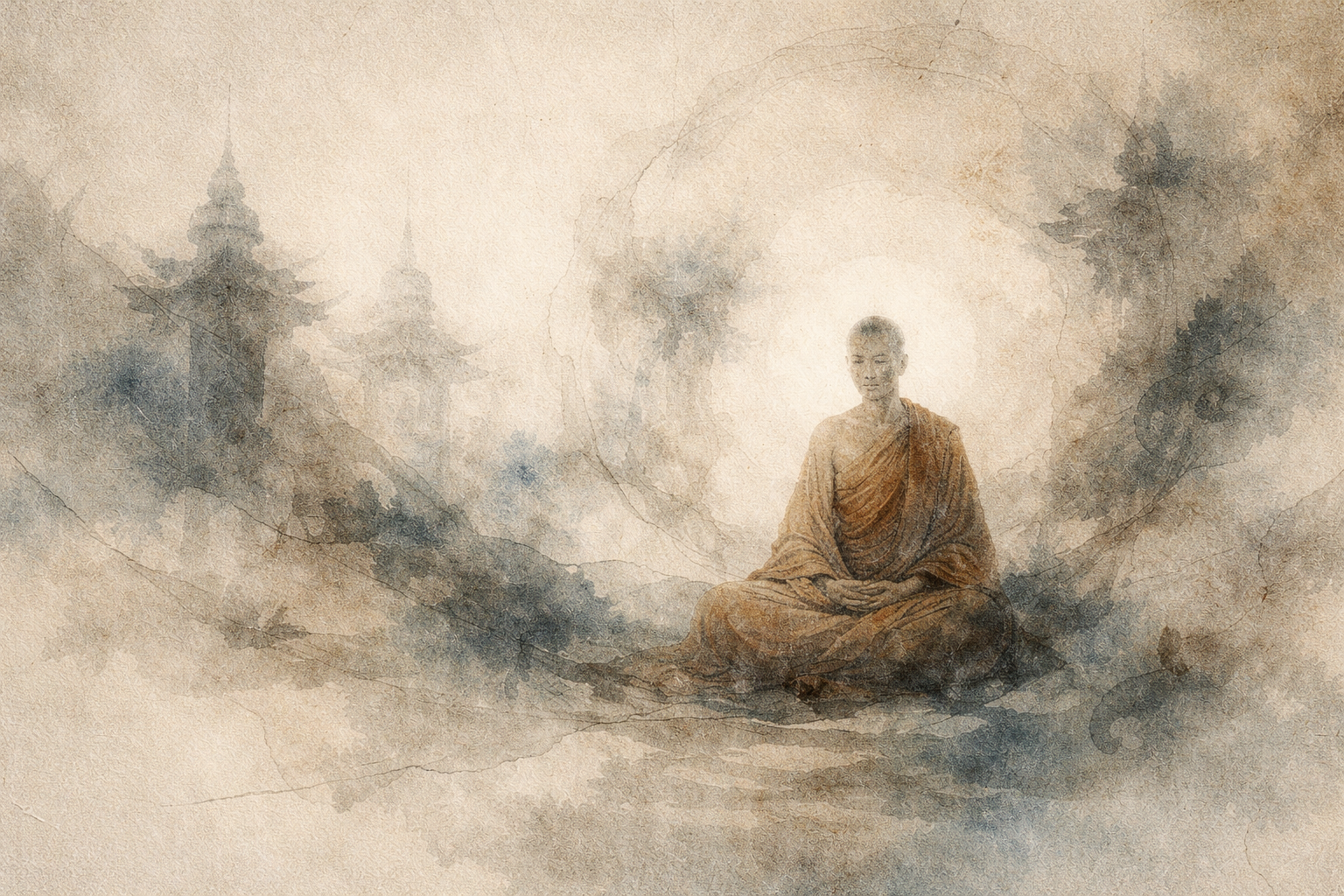
Stories about Bodhidharma are vivid: a blunt meeting with an emperor, years facing a wall, tea plants growing from discarded eyelids, and extraordinary physical powers. These stories have shaped art and popular memory far beyond the historical evidence.
This article does not use legends as a substitute for biography. It asks when a story appears, what it teaches, and why later communities continued to tell it.
Why Bodhidharma attracted legends
Bodhidharma came to represent directness, endurance, and refusal to flatter religious authority. A figure carrying those values naturally became the center of teaching stories.
The familiar stories do not all appear at the same date or in the same kind of source. Later lineage texts, temple traditions, and popular retellings expanded the record, so this page identifies uncertainty instead of presenting legend as established biography.
GASSHO
Ask and learn about Buddhism in daily life.
GASSHO is a Buddhist community app where you can learn Buddhist teachings and ask questions to the head priest of Kongosanmaiin Temple on Mount Koya.
The meeting with Emperor Wu
In the famous dialogue, Emperor Wu lists his support for Buddhist institutions and asks about the merit he has earned. Bodhidharma's uncompromising reply challenges the idea that spiritual realization can be secured through public achievement alone.
The story is central to Chan teaching literature, but its later literary form should not be treated as a transcript. Its importance lies in the tension between visible good works and attachment to spiritual reward.
Nine years facing a wall
The image of Bodhidharma sitting before a wall for nine years embodies sustained practice. It also became a visual shorthand for meditation that does not seek constant stimulation or approval.
Early references to contemplation and later, fully developed cave narratives are not identical. The story can inspire practice while its historical details remain uncertain.
Eyelids, tea, and wakefulness
One later legend says that Bodhidharma cut off his eyelids after falling asleep and that tea plants grew where they fell. The story links tea with monastic wakefulness and determined meditation.
It should not be presented as medical advice, historical botany, or an action to imitate. Its symbolic force comes from the dramatic refusal to surrender attention.
Shaolin and martial arts claims
Popular culture often credits Bodhidharma with creating martial arts at Shaolin. The historical development of Chinese martial traditions is far more complex, and simple founder claims are not supported by early evidence.
The connection remains culturally influential. A careful account recognizes that influence while avoiding the claim that one foreign monk invented an entire martial tradition.
How to read the legends responsibly
Ask when the source was composed, what genre it belongs to, and what lesson the story serves. A later lineage text or temple legend can be religiously important without functioning as an eyewitness report.
Where the date or source history is disputed, the wording remains provisional. For origin, chronology, transmission, and the limited historical record, use the separate biography.
For the evidence-based account, see the historical record about Bodhidharma.
FAQ
- Did Bodhidharma really face a wall for nine years?
- Did Bodhidharma create tea?
- Did Bodhidharma invent Shaolin kung fu?
Did Bodhidharma really face a wall for nine years?
The image is central to later tradition, but the precise nine-year cave story cannot be confirmed as a straightforward historical event.
Did Bodhidharma create tea?
No historical evidence supports that claim. The eyelids-and-tea story is a later legend connecting tea, wakefulness, and meditation.
Did Bodhidharma invent Shaolin kung fu?
The development of Chinese martial arts is much more complex, and early evidence does not support a simple one-person origin story.