JP EN

Buddhism

Bodhidharma: The Legend Behind Zen Buddhism

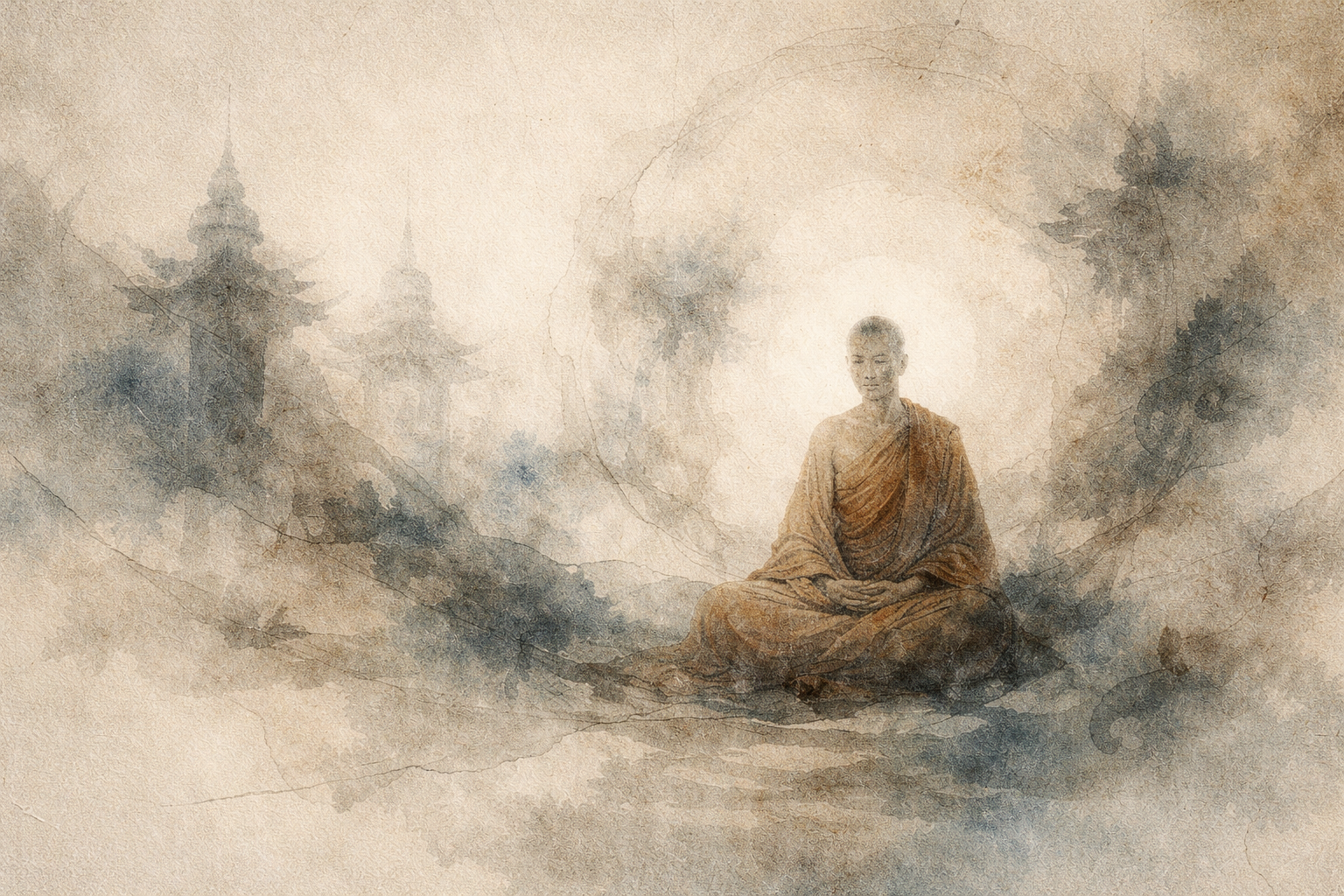
A watercolor-style scene of a Buddhist monk seated in meditation with a soft halo of light behind him, surrounded by misty mountains and distant temple pagodas, symbolizing the contemplative spirit and legendary influence of Bodhidharma in the origins of Zen Buddhism.

Quick Summary

  • The bodhidharma legend blends history, teaching stories, and later folk imagination into one powerful Zen origin narrative.
  • Many famous details—nine years facing a wall, cutting off eyelids, crossing a river on a reed—function more like symbols than biography.
  • The legend points to a simple emphasis: seeing directly, without leaning on comforting explanations.
  • Different cultures retold Bodhidharma in different tones: austere monk, fierce protector, humorous icon, or stubborn outsider.
  • Asking “Did it really happen?” is natural, but the legend mainly asks, “What is happening right now in your own mind?”
  • Reading the story as a mirror—rather than a museum label—keeps it relevant to work stress, relationships, fatigue, and silence.
  • The most enduring part of the bodhidharma legend is its mood: steady attention, plain speech, and refusal to bargain with distraction.

Introduction

The bodhidharma legend can feel confusing because it’s told like a biography, quoted like a teaching, and repeated like a campfire story—so it’s hard to know what you’re supposed to take literally and what you’re supposed to feel. The quickest way to get unstuck is to stop treating the legend as a fact-checking problem and start treating it as a lens for noticing how the mind clings to certainty, drama, and identity when life gets quiet. This approach reflects how Zen stories have been read and used for centuries across East Asian Buddhist literature and popular culture.

Bodhidharma is traditionally remembered as an Indian monk associated with the transmission of meditation teachings into China, but the “Bodhidharma” most people meet today is a figure shaped by many retellings. Some versions are spare and severe. Others are playful, even cartoonish. The tension between those tones is part of the point: the legend survives because it can hold both the hard edge of discipline and the ordinary humor of being human.

When people search for “bodhidharma legend,” they’re often trying to sort out a handful of famous scenes: the wall-gazing, the encounter with an emperor, the missing eyelids, the single sandal, the reed crossing. Each scene has been used to express something about attention and attachment, but none of them require you to suspend common sense. You can let the story be strange without forcing it to be “true” in the modern biographical sense.

The Legend as a Lens, Not a Biography

A legend works differently than a timeline. It compresses what matters into images that stick: a person who won’t turn away from the wall, a conversation that refuses flattery, a journey that doesn’t look comfortable. The bodhidharma legend is less interested in documenting where someone slept on a given night and more interested in showing what the mind does when it can’t rely on familiar supports.

In ordinary life, the mind constantly negotiates. At work it bargains for recognition. In relationships it bargains for reassurance. When tired, it bargains for an easier story about why things feel heavy. The legend’s stark scenes highlight that negotiating habit by contrast: a figure who doesn’t offer the usual social exchange, who doesn’t sweeten the message, who doesn’t decorate silence.

That’s why the most famous moments are so blunt. “Facing the wall” can be read as the refusal to keep turning toward stimulation. The emperor scene can be read as the refusal to turn practice into a transaction. Even the more extreme motifs—like eyelids and tea—can be read as folk ways of talking about drowsiness, effort, and the mind’s tendency to drift.

Seen this way, the legend isn’t asking for belief. It’s offering a mood: directness, simplicity, and a willingness to stay with what is present even when it isn’t entertaining. That mood is recognizable in modern life whenever you stop refreshing, stop rehearsing, and simply notice what the moment feels like without trying to improve it.

How the Bodhidharma Legend Shows Up in Ordinary Moments

There are days when the mind wants a dramatic reason for everything. If a meeting goes badly, it wants a villain. If someone is distant, it wants a story that explains the whole relationship. The bodhidharma legend quietly undermines that impulse by presenting scenes where the usual emotional “plot” doesn’t develop, and you’re left with something plainer: the raw feeling of wanting an answer.

In a crowded schedule, attention gets chopped into small pieces. You answer a message while thinking about the next task, while half-feeling the tension in your shoulders. The wall-gazing image can land here as a simple contrast: what is it like when attention is not split, when it is not constantly leaning forward? Even imagining that contrast can reveal how restless the mind has become.

In relationships, the mind often tries to secure itself by being understood. When that doesn’t happen, irritation rises, then self-justification, then the urge to “win” the conversation. The legend’s blunt exchanges—especially the ones that feel socially awkward—can mirror the discomfort of not getting the response you hoped for. The point isn’t to imitate bluntness; it’s to notice the craving underneath the need to be met in a particular way.

Fatigue is another place the legend becomes surprisingly practical. When tired, the mind looks for shortcuts: scrolling, snacking, background noise, anything that blurs the edge of experience. Stories about Bodhidharma battling sleepiness are often told in exaggerated forms, but the inner experience is familiar: the moment you realize you’ve drifted, and the small embarrassment of having left your own life unattended for a while.

Silence can feel like a problem to solve. In an elevator, in a quiet room, in the pause after someone speaks, the mind rushes to fill space. The bodhidharma legend repeatedly places you in that kind of space—where nothing is offered to hold onto—and lets you feel the reflex to decorate the moment. That reflex is not a moral failure; it’s a habit built from years of stimulation and social performance.

Even the more theatrical motifs—crossing water on a reed, leaving with a single sandal—can be felt psychologically in small ways. The mind wants a clean exit, a neat ending, a final explanation. But life often doesn’t provide that. Things end oddly. People misunderstand. You walk away still carrying questions. The legend’s strangeness can normalize that unfinished quality without turning it into a tragedy.

Over time, what stands out is not the spectacle but the steadiness. The legend keeps returning to the same human moment: attention meets experience, and the mind tries to turn it into something else. Seeing that turn—again and again, in emails, in arguments, in exhaustion, in quiet—makes the story feel less like ancient folklore and more like a description of Tuesday afternoon.

Where People Get Stuck with the Story

One common misunderstanding is thinking the bodhidharma legend is mainly a test of historical accuracy. It’s reasonable to ask what can be verified, but the legend’s influence doesn’t come from being a perfect record. It comes from how it frames a human problem: the mind’s hunger for certainty and its discomfort with plain, unadorned experience.

Another place people get stuck is treating the legend as a personality ideal—assuming the point is to become severe, unfeeling, or socially blunt. That reading often comes from fatigue with modern noise, so the mind swings toward an opposite fantasy: total hardness. But the legend’s sharpness is better understood as clarity, not coldness, and clarity can exist without theatrics.

Some readers also assume the more extreme elements must be either literally true or completely worthless. Habit pushes toward that all-or-nothing stance because it feels efficient. Yet symbolic stories can be useful without being factual, and factual details can be interesting without being the main point. The legend can be held lightly, like a mirror you pick up when you notice yourself reaching for a comforting story.

Finally, it’s easy to treat Bodhidharma as a distant icon—someone else’s culture, someone else’s time, someone else’s mind. That distance can become a way to avoid the uncomfortable part: the legend keeps pointing back to the immediate texture of your own attention. The moment that feels too ordinary to matter is often the moment the story is actually about.

Why the Legend Still Feels Close to Home

Modern life offers endless ways to stay slightly distracted. The bodhidharma legend remains compelling because it refuses that bargain without needing to preach. It presents a figure who doesn’t chase the next thing, and that contrast can be felt even by someone who has never read a single Buddhist text.

In workplaces that reward constant performance, the emperor story can echo as a quiet question about what you think you’re buying with your effort—approval, security, identity. In families and friendships, the legend’s awkward silences can resemble the moments when you realize you can’t control how you’re perceived. In exhaustion, the drowsiness motifs resemble the daily experience of slipping away from your own life and then noticing you’ve slipped.

The legend also survives because it can be held at different distances. Some people enjoy it as cultural history. Some keep it as a set of images. Some simply feel its atmosphere: fewer explanations, more direct contact. However it’s held, it tends to return attention to the same place—this moment, before it is turned into a story.

Conclusion

The bodhidharma legend doesn’t need to be solved. It keeps pointing to what is already here: the mind reaching, the mind resisting, the mind settling for a moment. In that ordinary movement, the Dharma is not far away. It can be checked quietly in the middle of daily life, where attention meets what it meets.

Frequently Asked Questions

FAQ 1: What is the bodhidharma legend in simple terms?
Answer: The bodhidharma legend is a collection of stories about Bodhidharma, a monk remembered for bringing a direct, meditation-centered approach to awakening into China. The legend mixes sparse historical memory with vivid scenes—like long wall-gazing and blunt conversations—to highlight clarity, attention, and non-attachment.
Real result: The Encyclopaedia Britannica entry on Bodhidharma notes that many details about him are legendary, reflecting how later communities shaped the narrative.
Takeaway: The bodhidharma legend is less a biography and more a set of teaching-images.

Back to FAQ Table of Contents

FAQ 2: Is the bodhidharma legend historically accurate?
Answer: Parts may reflect real people and events, but many famous elements are not verifiable and are widely treated as later legendary development. The bodhidharma legend is best approached as a traditional narrative that conveys values and perspectives, not as a modern historical record.
Real result: The Stanford Encyclopedia of Philosophy overview of Chan Buddhism discusses how early Chan history includes hagiography and lineage narratives that are not straightforward historical reporting.
Takeaway: “Legendary” doesn’t mean useless—it means the story is doing a different job than documentation.

Back to FAQ Table of Contents

FAQ 3: Why does the bodhidharma legend say he faced a wall for nine years?
Answer: The “nine years facing a wall” motif dramatizes unwavering attention and the refusal to chase stimulation. Whether literal or symbolic, it functions as an image of staying with experience without constantly seeking novelty, reassurance, or distraction.
Real result: The Britannica overview of Chan (Zen) describes the tradition’s emphasis on meditation and direct insight, which later stories often express through striking images like prolonged wall-gazing.
Takeaway: The wall scene points to steadiness, not spectacle.

Back to FAQ Table of Contents

FAQ 4: What is the meaning of Bodhidharma “wall-gazing” in the legend?
Answer: In the bodhidharma legend, wall-gazing is commonly read as a symbol of turning away from external entertainment and toward direct seeing. The “wall” can represent simplicity: nothing to grasp, nothing to decorate, just the mind meeting what is present.
Real result: The Stanford Encyclopedia of Philosophy (Chan Buddhism) notes Chan’s preference for direct realization over reliance on elaborate conceptual frameworks, which legends often portray through minimalistic scenes.
Takeaway: Wall-gazing is a metaphor for unembellished attention.

Back to FAQ Table of Contents

FAQ 5: Did Bodhidharma really cut off his eyelids in the legend?
Answer: The eyelid story is generally treated as a dramatic legend rather than a historical claim. It expresses a familiar human experience—drowsiness and drifting attention—by turning it into an unforgettable image about the cost of staying awake to one’s life.
Real result: The Britannica biography of Bodhidharma highlights that many popular stories about him are legendary and vary across retellings.
Takeaway: The eyelid motif is a folk-symbol for the struggle with sleepiness and distraction.

Back to FAQ Table of Contents

FAQ 6: How did tea become connected to the bodhidharma legend?
Answer: In some versions of the bodhidharma legend, tea plants spring from Bodhidharma’s discarded eyelids, linking tea with wakefulness. Historically, tea culture developed through many social and economic factors, but the legend offers a memorable symbolic origin story that ties tea to alert presence.
Real result: The Britannica article on tea describes tea’s long cultural history in Asia, separate from any single origin tale, which helps explain why legendary links function symbolically rather than as documentation.
Takeaway: The tea connection is a story about wakefulness, not botany.

Back to FAQ Table of Contents

FAQ 7: What is the Bodhidharma and Emperor Wu story supposed to show?
Answer: The emperor dialogue in the bodhidharma legend is often used to highlight how easily the mind turns spiritual life into a transaction—seeking credit, status, or a guaranteed payoff. The story’s bluntness spotlights the discomfort of not getting the validating answer one expects.
Real result: The Stanford Encyclopedia of Philosophy (Chan Buddhism) discusses Chan’s rhetorical style and its use of sharp dialogues to challenge conventional expectations.
Takeaway: The emperor scene points to the limits of “spiritual accounting.”

Back to FAQ Table of Contents

FAQ 8: Why is Bodhidharma often depicted as fierce or intimidating in the legend?
Answer: Fierce depictions emphasize uncompromising clarity: a presence that doesn’t flatter, entertain, or soothe the ego. Over time, artists and storytellers amplified these features because they communicate “directness” instantly, even to people who don’t know the backstory.
Real result: The Metropolitan Museum of Art’s materials on Chinese Buddhist art show how Buddhist figures are often stylized to convey specific qualities (power, protection, austerity), which helps explain why Bodhidharma’s image became so visually forceful.
Takeaway: The fierce face is visual shorthand for unsoftened attention.

Back to FAQ Table of Contents

FAQ 9: What does it mean that Bodhidharma crossed a river on a reed in the legend?
Answer: The reed-crossing episode is typically read as a miracle tale that signals freedom from ordinary constraints. Symbolically, it can also suggest lightness: not being weighed down by the mind’s heavy insistence on control, certainty, and fixed identity.
Real result: The Britannica overview of Chan notes the tradition’s rich legendary literature, where extraordinary images often function as teaching-symbols rather than reportage.
Takeaway: The reed crossing is a picture of lightness, not a physics lesson.

Back to FAQ Table of Contents

FAQ 10: What is the “single sandal” ending in the bodhidharma legend?
Answer: In one famous ending, Bodhidharma is said to be seen leaving with a single sandal after his death, and later his tomb is found empty except for one sandal. The story underscores the theme of elusiveness: the teaching cannot be pinned down as a possession, and the figure cannot be reduced to a neat conclusion.
Real result: The Britannica biography notes the proliferation of legendary motifs around Bodhidharma, reflecting how communities used narrative to express meaning beyond verifiable detail.
Takeaway: The single sandal story keeps the legend open-ended.

Back to FAQ Table of Contents

FAQ 11: Is the bodhidharma legend the same across China and Japan?
Answer: No. Core motifs overlap, but tone and emphasis shift across cultures and time periods. In Japan, Bodhidharma is widely known as “Daruma,” and the legend often blends with folk art and popular symbolism, while Chinese sources preserve different narrative textures and priorities.
Real result: The Britannica article on Zen describes how Zen developed in different regions, which helps explain why stories and images also evolved locally.
Takeaway: The bodhidharma legend is a family of stories, not one fixed script.

Back to FAQ Table of Contents

FAQ 12: How is the bodhidharma legend related to Daruma dolls?
Answer: Daruma dolls are a Japanese folk representation inspired by Bodhidharma’s image and associated qualities like perseverance and steadiness. While the dolls are not “proof” of the legend, they show how the bodhidharma legend moved from monastic storytelling into everyday culture as a symbol people could live with.
Real result: The Britannica entry on Daruma dolls explains their cultural role and connection to Bodhidharma imagery.
Takeaway: Daruma dolls are the legend translated into daily-life symbolism.

Back to FAQ Table of Contents

FAQ 13: What parts of the bodhidharma legend are likely later additions?
Answer: The most miraculous or highly stylized episodes—like reed-crossing, the single-sandal departure, and the eyelid-to-tea origin—are commonly understood as later legendary elaborations. Over centuries, communities added vivid motifs because they made the story memorable and expressive, especially for oral retelling and art.
Real result: The Stanford Encyclopedia of Philosophy (Chan Buddhism) discusses how lineage and hagiographic materials developed over time, which supports the idea that some motifs are later narrative layers.
Takeaway: Later additions often reveal what people wanted the story to communicate.

Back to FAQ Table of Contents

FAQ 14: Why do Zen traditions use legends like the bodhidharma legend at all?
Answer: Legends carry a teaching atmosphere in a compact form: they transmit values, tone, and perspective through images that are easy to remember. The bodhidharma legend persists because it can be recalled in a stressful moment and still point to directness and simplicity without requiring a long explanation.
Real result: The Britannica article on Zen notes Zen’s distinctive use of stories and dialogues, which helps explain why legendary narratives remain central in its cultural expression.
Takeaway: The legend is a portable mirror for the mind.

Back to FAQ Table of Contents

FAQ 15: How should a modern reader approach the bodhidharma legend?
Answer: A modern reader can hold the bodhidharma legend lightly: respect its cultural depth, stay honest about what can’t be verified, and notice what the images reveal about attention, craving, and discomfort with silence. The most useful question is often not “Did this happen?” but “What does this scene illuminate in ordinary experience?”
Real result: The Stanford Encyclopedia of Philosophy (Chan Buddhism) emphasizes Chan’s orientation toward direct insight, which aligns with reading legends as pointers rather than propositions.
Takeaway: Let the legend point back to what you can actually observe.

Back to FAQ Table of Contents

Back to list