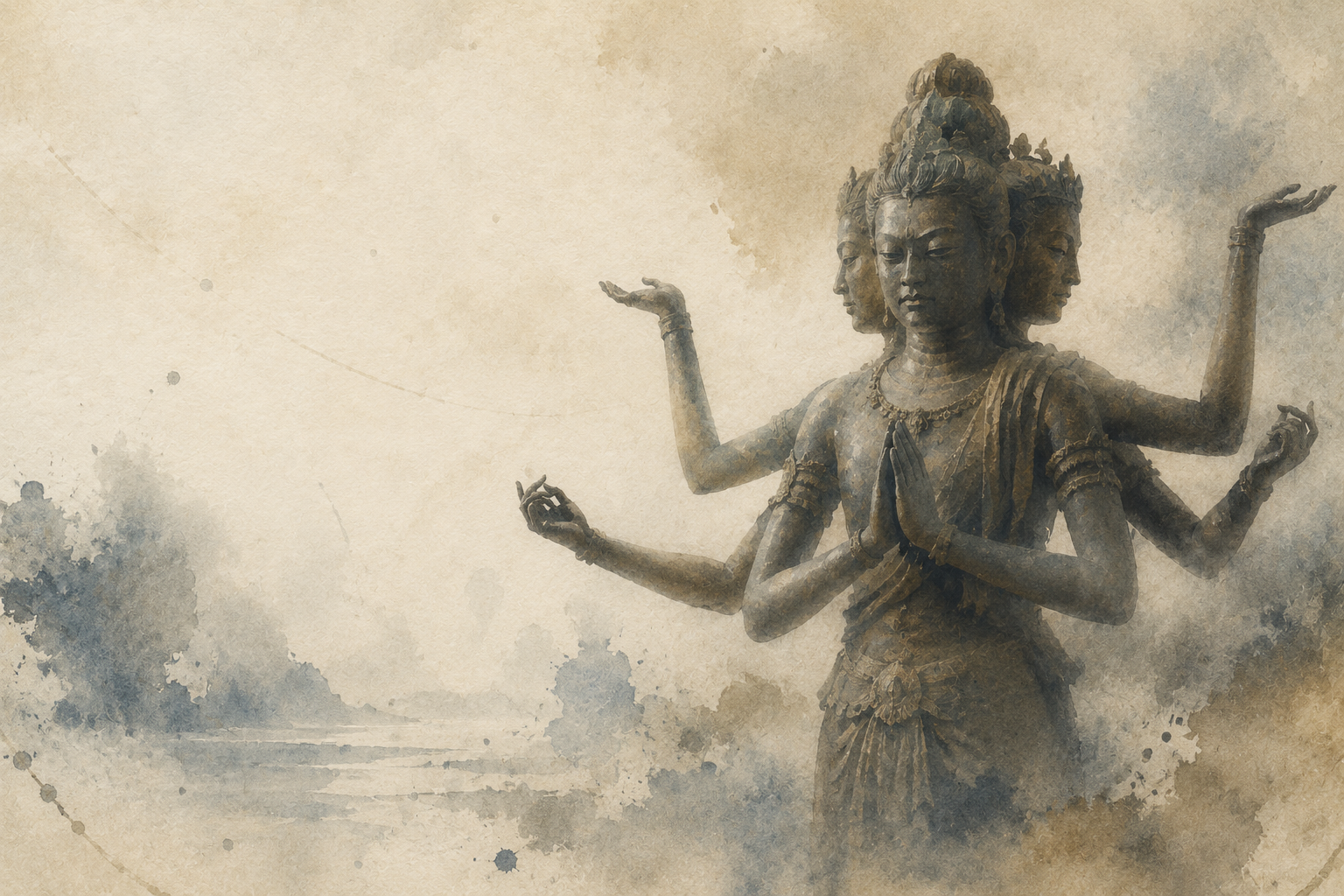
What Are Asuras in Buddhism? Pride, Conflict, and the Realm of Fighting Spirits
Quick Summary
- In Buddhism, asuras are “fighting spirits” linked with rivalry, pride, and constant comparison.
- The asura realm is often described as a mode of experience: always needing to win, prove, or outshine.
- Asura energy can look like ambition and drive, but it easily turns into conflict and resentment.
- The core pattern is fixation on status: “Where do I rank, and who threatens my position?”
- Noticing the bodily signs of comparison (tight chest, heat, urgency) helps interrupt the spiral.
- Practical antidotes include humility, rejoicing in others’ success, and choosing non-escalation.
- Understanding asuras in Buddhism turns everyday conflict into a clear mirror for self-awareness.
Introduction
You keep seeing “asuras” described as demons, gods, jealous titans, or just a mythic footnote—and none of that helps when what you actually want is a clean explanation of what asuras mean in Buddhism and why they’re associated with pride and conflict. The useful way to approach asuras Buddhism is to treat the asura realm as a recognizable pattern of mind: the reflex to compare, compete, and escalate until life feels like a permanent contest. Gassho is a Zen/Buddhism site focused on practical clarity rather than mystical hype.
In traditional Buddhist imagery, asuras are powerful beings who are perpetually at odds—often portrayed as combative, easily provoked, and obsessed with victory. But the point isn’t to collect fantasy lore; it’s to notice how quickly the “fight for status” can take over a human day. When you understand the asura lens, you can spot the moment pride hardens into hostility and choose a different response.
The Buddhist Lens on Asuras: A Realm of Comparison and Struggle
In asuras Buddhism, “asura” points to a style of suffering built around rivalry. It’s the mind that measures itself against others, scans for threats to reputation, and treats disagreement as a personal challenge. Whether described as a literal realm of rebirth or a psychological realm you enter in this very moment, the signature is the same: life becomes a scoreboard.
This lens is especially useful because it explains why conflict can feel strangely energizing. Asura energy has heat and momentum: it wants to act, respond, correct, dominate, and win. The problem is that the fuel is unstable—pride, envy, and the fear of being diminished—so even “victory” rarely brings ease. It just resets the contest.
Asuras are often contrasted with calmer, more contented states. In the asura mode, contentment is interpreted as weakness, and humility feels like losing. The mind narrows to a single question: “How do I come out on top?” That narrowing is the suffering—not because ambition is inherently wrong, but because the heart becomes dependent on comparison for its sense of worth.
Seen this way, asuras in Buddhism are less about labeling “bad people” and more about recognizing a universal reflex. The asura realm is what happens when identity is built from rank, and the world is treated as a battlefield for validation.
GASSHO
Ask and learn about Buddhism in daily life.
GASSHO is a Buddhist community app where you can learn Buddhist teachings and ask questions to the head priest of Kongosanmaiin Temple on Mount Koya.
How the Asura Pattern Shows Up in Everyday Life
It can start innocently: you hear someone else’s good news and, before you mean to, your attention snaps to what it implies about you. The mind runs a quick calculation—who’s ahead, who’s behind, who’s admired, who’s overlooked. Even if you smile, something inside tightens.
Then comes the urge to correct the imbalance. You might “casually” mention your own achievement, sharpen your tone, or look for a flaw in the other person’s success. The asura realm often hides under competence: you tell yourself you’re just being honest, just being high-standard, just not letting things slide.
In conversation, the asura pattern can feel like listening only to reload. While someone speaks, you prepare your counterpoint, your proof, your winning line. The body often gives it away: jaw set, shoulders lifted, breath shallow, a sense of forward-leaning urgency.
Online, it can become even more automatic. A comment feels like an attack; a disagreement becomes a referendum on your intelligence or goodness. You refresh for reactions, craft the perfect reply, and keep going long after the topic stopped mattering. The mind isn’t seeking understanding—it’s seeking dominance or safety through dominance.
At work, asura energy can look like relentless productivity mixed with resentment. You take on more, not only to help, but to be undeniable. When recognition doesn’t arrive, irritation rises: “After everything I do, how can they not see?” The pain isn’t just workload; it’s the hunger to be ranked correctly.
In close relationships, the asura realm can show up as keeping score. Who apologized last? Who sacrifices more? Who is “right”? Even tenderness can get recruited into the contest: giving becomes a way to gain moral high ground, and conflict becomes a way to prove you matter.
The most revealing moment is often right after you “win.” There may be a brief rush—then a hollow aftertaste, or a new target appears. That’s a classic sign of the asura pattern: the mind can’t rest because it’s guarding an identity built on comparison.
Common Misunderstandings About Asuras in Buddhism
Misunderstanding 1: “Asuras are just demons.” Some depictions make asuras look monstrous, but in Buddhism they’re often portrayed as powerful beings driven by jealousy and conflict. The key theme is not “evil,” but agitation and rivalry.
Misunderstanding 2: “The asura realm is only myth, so it doesn’t matter.” Even if you treat the realms as symbolic, the asura realm describes a very real human experience: the mind that can’t stop competing. Symbolic doesn’t mean imaginary; it means readable.
Misunderstanding 3: “Asura energy is always bad.” Drive, courage, and intensity can be useful. The issue is the underlying fixation: when motivation depends on beating others, it tends to produce collateral damage—inside you and around you.
Misunderstanding 4: “If I feel competitive, I’m an asura.” Buddhism isn’t asking you to adopt a new insult for yourself. “Asura” is a mirror for a moment-to-moment pattern. The point is to notice the shift into comparison and soften it, not to build a new identity around being “competitive.”
Misunderstanding 5: “The solution is to suppress anger.” Suppression often keeps the fight alive internally. A more workable approach is to recognize the heat of escalation, feel it clearly, and choose actions that reduce harm rather than intensify the contest.
Why Understanding Asuras Helps With Pride and Conflict
Asuras Buddhism matters because it gives you a precise name for a common trap: mistaking self-worth for relative position. When the mind believes “I am only okay if I’m above,” it will manufacture enemies, interpret neutral events as disrespect, and treat small frictions as battles that must be won.
Once you can label the pattern—“this is the asura realm showing up”—you gain a small but crucial pause. In that pause, you can check what’s actually happening: Is there a real problem to solve, or is this pride reacting to a perceived slight? Is the next message meant to clarify, or to punish?
Practically, the antidotes are simple but not always easy: choose non-escalation, practice humility without self-erasure, and learn to rejoice in others’ success. Rejoicing is especially direct medicine for the asura pattern because it breaks the assumption that another person’s gain is your loss.
Understanding asuras also protects relationships. Many conflicts aren’t about the stated topic; they’re about status, face, and the fear of being diminished. Seeing that clearly can shift the goal from “win” to “repair,” which is often the difference between a short argument and a long-term rupture.
Conclusion
Asuras in Buddhism point to the suffering of rivalry: pride that needs an opponent, ambition that can’t rest, and conflict that feels necessary even when it’s exhausting. Whether you understand the asura realm as cosmology or as psychology, the practical value is the same—recognizing the moment your mind turns life into a contest.
When you notice the asura pattern early—comparison, tightening, urgency, the need to “set the record straight”—you can choose a response that doesn’t feed the fight. That choice doesn’t make you passive; it makes you free enough to act without being owned by pride.
Ask a Buddhist priest
Have a question about Buddhism?
In the GASSHO app, you can ask questions about Buddhist teachings, daily concerns, and how to understand Buddhism in everyday life.
Frequently Asked Questions
- FAQ 1: What are asuras in Buddhism?
- FAQ 2: Are asuras considered gods, demons, or something else in Buddhism?
- FAQ 3: What is the asura realm in Buddhism?
- FAQ 4: Why are asuras linked with pride in Buddhism?
- FAQ 5: What emotions are associated with asuras in Buddhism?
- FAQ 6: Are asuras always “bad” in Buddhism?
- FAQ 7: How do asuras differ from devas in Buddhism?
- FAQ 8: Are asuras part of the Six Realms in Buddhism?
- FAQ 9: What does “asura energy” mean in a Buddhist context?
- FAQ 10: How can I tell if I’m in an asura mind-state according to Buddhism?
- FAQ 11: What are practical antidotes to the asura realm in Buddhism?
- FAQ 12: Do asuras in Buddhism represent actual beings or psychological states?
- FAQ 13: Why do Buddhist stories depict asuras as always fighting?
- FAQ 14: How do asuras relate to karma in Buddhism?
- FAQ 15: What is the main lesson of asuras Buddhism for daily conflicts?
FAQ 1: What are asuras in Buddhism?
Answer: In Buddhism, asuras are often described as powerful “fighting spirits” associated with jealousy, pride, and conflict. They represent a realm (or mind-state) dominated by rivalry and the need to win.
Takeaway: Asuras Buddhism points to the suffering of constant competition.
FAQ 2: Are asuras considered gods, demons, or something else in Buddhism?
Answer: Asuras are sometimes portrayed as god-like beings and sometimes as demon-like antagonists, depending on the story. In Buddhist usage, they’re best understood as beings defined by combative jealousy rather than a simple “good vs. evil” category.
Takeaway: Asuras aren’t just “demons”; they symbolize rivalry-driven suffering.
FAQ 3: What is the asura realm in Buddhism?
Answer: The asura realm is one of the realms commonly discussed in Buddhism, characterized by conflict, competitiveness, and obsession with status. It can be read as a literal realm of rebirth or as a description of a mental world you enter when comparison takes over.
Takeaway: The asura realm is the “always fighting, never satisfied” mode of experience.
FAQ 4: Why are asuras linked with pride in Buddhism?
Answer: In asuras Buddhism, pride shows up as a fragile identity that needs to be proven through victory. When self-worth depends on being above others, pride easily turns into defensiveness, jealousy, and aggression.
Takeaway: Asura pride is pride that needs an opponent.
FAQ 5: What emotions are associated with asuras in Buddhism?
Answer: Asuras are commonly associated with jealousy, envy, anger, resentment, and competitiveness. The emotional tone is energized but tense—driven by comparison and easily triggered by perceived disrespect.
Takeaway: Asura emotions cluster around rivalry and status anxiety.
FAQ 6: Are asuras always “bad” in Buddhism?
Answer: Asuras aren’t usually framed as purely evil; they’re powerful but trapped in conflict. The asura pattern can include courage and drive, yet it becomes suffering when it’s fueled by jealousy and the need to dominate.
Takeaway: The problem isn’t power—it’s compulsive rivalry.
FAQ 7: How do asuras differ from devas in Buddhism?
Answer: Devas are typically associated with pleasure, ease, and refined enjoyment, while asuras are associated with struggle, envy, and conflict. Both can be seen as unstable when clung to: devas through complacency, asuras through aggression and comparison.
Takeaway: Devas drift into comfort; asuras surge into competition.
FAQ 8: Are asuras part of the Six Realms in Buddhism?
Answer: Yes, asuras are commonly included among the Six Realms described in many Buddhist presentations. They represent the realm of jealousy and conflict, often positioned between the animal and deva realms in traditional lists.
Takeaway: Asuras are a standard realm symbolizing combative comparison.
FAQ 9: What does “asura energy” mean in a Buddhist context?
Answer: “Asura energy” is a modern way of pointing to the asura-like pattern of mind: intense drive mixed with competitiveness, quick escalation, and fixation on winning or being right. It’s not a technical term, but it matches the traditional theme well.
Takeaway: Asura energy is ambition that easily turns into conflict.
FAQ 10: How can I tell if I’m in an asura mind-state according to Buddhism?
Answer: Signs include compulsive comparison, irritability at others’ success, a strong need to prove yourself, and a tendency to interpret disagreement as disrespect. Physically, it often feels like tightness, heat, and urgency to respond.
Takeaway: If life feels like a scoreboard, the asura realm is active.
FAQ 11: What are practical antidotes to the asura realm in Buddhism?
Answer: Helpful antidotes include pausing before reacting, practicing humility, and consciously rejoicing in others’ good fortune. Choosing non-escalation and speaking to understand (not to win) also directly weakens the asura pattern.
Takeaway: Rejoicing and non-escalation are direct medicine for asura rivalry.
FAQ 12: Do asuras in Buddhism represent actual beings or psychological states?
Answer: Different Buddhists interpret this differently. Many take asuras as literal beings within Buddhist cosmology, while others emphasize their psychological meaning as a pattern of jealousy and conflict. Either way, the teaching functions as a mirror for suffering.
Takeaway: Literal or symbolic, “asura” points to the same rivalry-based distress.
FAQ 13: Why do Buddhist stories depict asuras as always fighting?
Answer: The constant fighting illustrates a mind that can’t settle because it’s fueled by envy and pride. The imagery dramatizes how comparison creates endless conflict: even when one battle ends, the need to prove oneself starts another.
Takeaway: The fighting symbolizes the restless loop of comparison.
FAQ 14: How do asuras relate to karma in Buddhism?
Answer: In Buddhist terms, actions rooted in jealousy, aggression, and pride tend to condition further agitation and conflict. The asura realm is often used to show how certain intentions and habits lead to a life shaped by rivalry and hostility.
Takeaway: Asura karma is the momentum of conflict-making intentions.
FAQ 15: What is the main lesson of asuras Buddhism for daily conflicts?
Answer: The main lesson is to recognize when a disagreement has turned into a status battle. When you see the asura impulse—needing to win, needing to be right—you can shift toward clarity, restraint, and repair rather than escalation.
Takeaway: Spot the status fight early, and you can choose peace without passivity.