



The Meaning of Amitabha Buddha
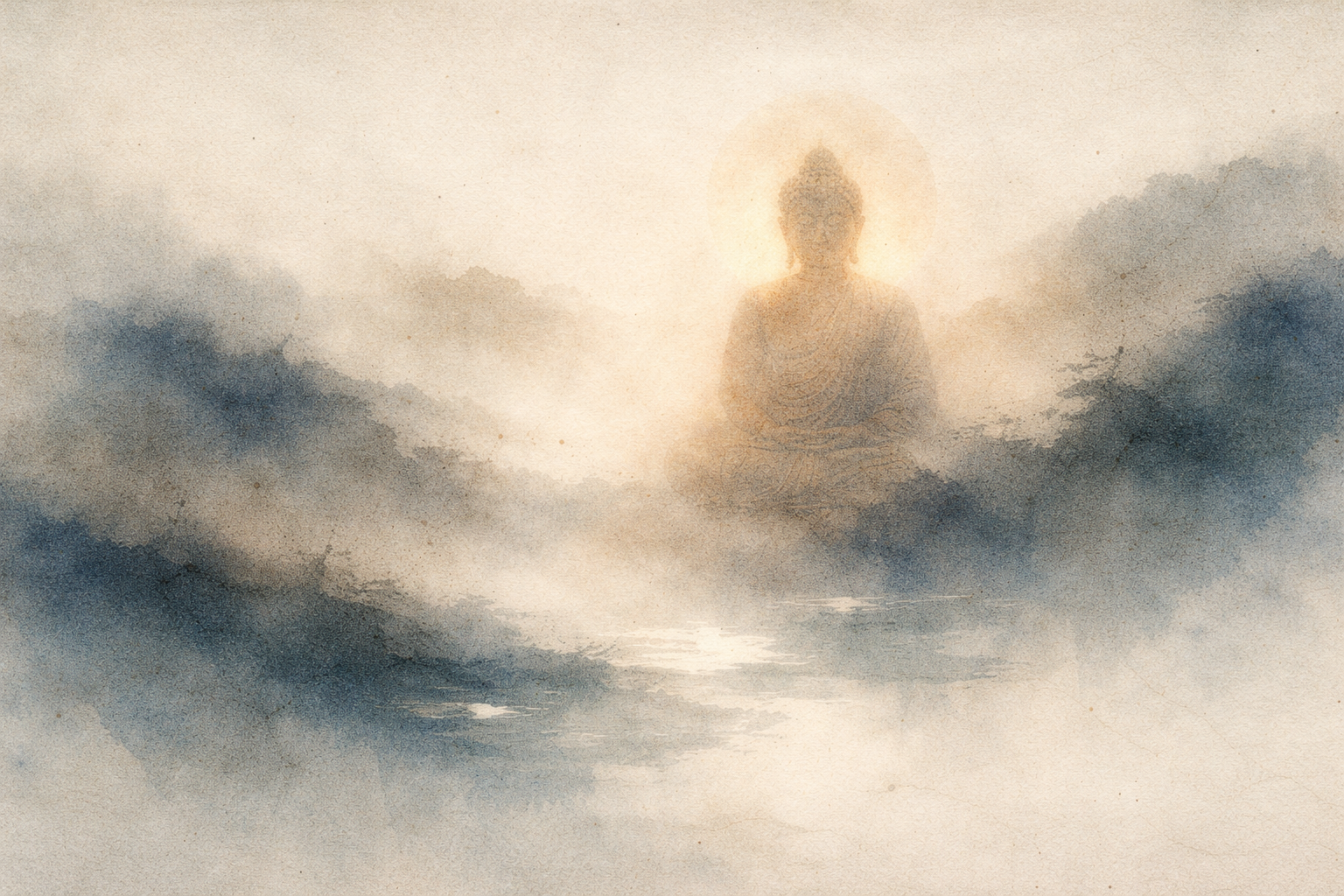
Quick Summary
A few grounded ways people tend to recognize “Amitabha Buddha meaning” in real life, without needing to sort out every term first.
- Amitabha is commonly read as “Infinite Light,” a name that points to clarity that doesn’t feel owned by “me.”
- Amitayus is commonly read as “Infinite Life,” a name that points to continuity—breath, time, and presence moving on without strain.
- In everyday terms, Amitabha can feel like being seen without being judged, even when the mind is messy.
- The “meaning” often lands less as a concept and more as a mood of warmth, steadiness, and spacious attention.
- Many people confuse Amitabha with a distant deity; others reduce it to a self-help symbol—both miss the lived middle.
- Thinking of “light” as what reveals (rather than what dazzles) makes the name feel practical and intimate.
- What matters most is how the idea changes the texture of a moment: less tightening, more room.
Introduction
The phrase “Amitabha Buddha” can sound like it should have one clean definition, but the more you look, the more it splits into translations, imagery, and devotional language that doesn’t match modern ears. It’s easy to feel stuck between “Is this literal?” and “Is this just symbolic?”—and neither option feels satisfying for someone who simply wants the meaning to land in lived experience. This approach is written from long familiarity with Buddhist language as it’s actually encountered by everyday readers.
At the simplest level, Amitabha is a name that is often translated as Infinite Light. In many contexts you’ll also see Amitayus, often translated as Infinite Life. These aren’t meant to function like a biography or a historical label; they behave more like a pointer—toward what the mind recognizes when it stops trying to control the whole scene.
When people search “amitabha buddha meaning,” they’re often trying to resolve a quiet mismatch: the heart responds to the image or the name, but the intellect doesn’t know where to place it. The goal here isn’t to force a conclusion. It’s to make the name feel less like a foreign object and more like a mirror held up to ordinary awareness.
Core Perspective
Think of the name as something you can feel in the background—like light in a room, not a lecture in your head.
One workable way to understand Amitabha Buddha is as a lens for noticing what is already present when experience is not being squeezed into a narrow story. “Light” here doesn’t need to be mystical. Light is what makes things visible. It reveals. It softens confusion by simply showing what’s there—without needing to argue with it first.
In that sense, “Infinite Light” can be read as the intuition that awareness is not as small as the day’s mood. Thoughts can be sharp, repetitive, or self-critical, and yet there can still be a wider field in which those thoughts are known. The name points to that wider field—not as an achievement, but as something repeatedly glimpsed in ordinary life.
“Infinite Life” can be read in a similarly grounded way. Life continues: breath after breath, moment after moment. Even when the mind insists that everything is stuck, experience keeps moving. The meaning isn’t that life becomes endless in a fantasy sense; it’s that the present moment has a kind of continuity that doesn’t require constant personal management.
So Amitabha’s meaning can be held as a human recognition: clarity that illuminates without harshness, and continuity that doesn’t depend on willpower. The name becomes less about “believing in something” and more about recognizing a tone of mind that is already familiar, even if it’s usually overlooked.
How This Appears in Experience
It shows up in small shifts—like the moment the mind stops bracing and starts noticing.
Sometimes the “meaning” of Amitabha is easiest to spot when the mind is doing what it always does: replaying a conversation, anticipating criticism, building a case for why things are hard. In the middle of that, there can be a brief widening—an instant where the whole mental knot is seen at once. Not solved. Just seen. That simple visibility is close to what “light” points toward.
It can also appear as a change in how attention relates to discomfort. A tense email arrives. The body tightens. The mind starts narrating. Then, for a second, the reaction is noticed as a reaction—heat in the face, pressure in the chest, fast thoughts. The situation hasn’t improved, but the experience is less fused. The “light” is the noticing itself, and the softness is the lack of extra punishment layered on top.
In quieter moments, “Infinite Life” can feel like the steady, unremarkable fact that the moment keeps arriving. The kettle boils. A car passes. The breath continues. Even boredom has texture. There’s a kind of gentle persistence to experience that doesn’t need to be inspirational to be real.
And sometimes it shows up socially. Someone makes a mistake—maybe you, maybe someone else. The usual reflex is to label, to fix, to distance. But occasionally there’s a different response: a simple recognition of shared human messiness. Not indulgence. Not condemnation. Just a clear, warm seeing. That tone—clear and non-cruel—is another way the name can become tangible.
Common Misunderstandings
Most confusion comes from trying to force an old symbol into modern categories too quickly.
One common misunderstanding is treating Amitabha as either only a supernatural figure “out there” or only a psychological metaphor “in here.” The mind likes clean boxes. But lived experience is often less tidy: symbols can be emotionally real without needing to be reduced to either literalism or dismissal.
Another misunderstanding is assuming that “Infinite Light” must mean constant positivity. Many people hear “light” and imagine permanent uplift, as if clarity should erase grief, irritation, or doubt. But in ordinary life, light doesn’t delete what’s in the room—it reveals it. Clarity can include the uncomfortable parts without turning them into a personal failure.
It’s also easy to confuse “meaning” with “information.” People look for the one correct translation, the one correct story, the one correct explanation. That habit is natural; it’s how the modern mind tries to feel safe. But with names like Amitabha, meaning often arrives more like recognition than like a definition—gradually, through repeated contact with the feeling-tone the name evokes.
Finally, some people assume that if a symbol is powerful, it must be dramatic. In practice, what’s most convincing is often quiet: a little less self-hatred, a little more room around a thought, a little more willingness to let a moment be what it is. The mind may overlook these because they don’t announce themselves.
Why It Matters
It matters because the name can change the atmosphere of a moment without changing the facts of the moment.
In daily life, the mind often runs on a tight loop: evaluate, compare, defend, regret. A name like Amitabha can function like a different lighting in the same room. The same problems are present, but they’re seen with less glare and less shadow. That shift is subtle, yet it affects how a day feels from the inside.
It can matter in the smallest places: waiting in line, rereading a text before sending it, lying awake with a familiar worry. In those moments, “Infinite Light” can be understood as the possibility of seeing the worry clearly without becoming it. “Infinite Life” can be understood as the quiet reminder that the moment continues, even when the mind insists it’s trapped.
Over time, this kind of reflection tends to blend into ordinary perception. The name stops being a foreign term and becomes a shorthand for a recognizable human capacity: to know experience, and to let that knowing be gentle.
Conclusion
The meaning of Amitabha Buddha is often closest when it is not being held as an idea. Light reveals what is here. Life continues as this moment. In the middle of ordinary days, awareness quietly confirms what the name points toward.
Frequently Asked Questions
- FAQ 1: What does Amitabha Buddha mean in simple terms?
- FAQ 2: What is the difference between Amitabha and Amitayus?
- FAQ 3: What does “Infinite Light” mean as a lived experience?
- FAQ 4: Is Amitabha Buddha a real being or a symbol?
- FAQ 5: Why is Amitabha associated with compassion and warmth?
- FAQ 6: What does Amitabha have to do with chanting?
- FAQ 7: What is the “Pure Land” in relation to Amitabha?
- FAQ 8: Is Amitabha the same as Shakyamuni Buddha?
- FAQ 9: Why is Amitabha often shown in red or gold?
- FAQ 10: What does Amitabha’s “light” illuminate?
- FAQ 11: Does Amitabha Buddha meaning change across cultures?
- FAQ 12: Can someone connect with Amitabha without being religious?
- FAQ 13: Is Amitabha connected to death and dying?
- FAQ 14: What is the most common misunderstanding about Amitabha Buddha?
- FAQ 15: What’s one sentence that captures Amitabha Buddha meaning?
FAQ 1: What does Amitabha Buddha mean in simple terms?
Answer: In simple terms, Amitabha Buddha is commonly understood as “Infinite Light”—a name that points to clear, spacious awareness that can hold experience without harshness. Many people also connect the name with a sense of being met with warmth rather than judgment, especially when the mind feels tangled or self-critical.
Real result: The Encyclopaedia Britannica entry on Amitabha notes the widespread association of Amitabha with “Infinite Light” and “Infinite Life” across Buddhist cultures.
Takeaway: Amitabha’s meaning often lands as clarity with kindness.
FAQ 2: What is the difference between Amitabha and Amitayus?
Answer: Amitabha and Amitayus are closely related names that emphasize different aspects: Amitabha is commonly translated as “Infinite Light,” while Amitayus is commonly translated as “Infinite Life.” In everyday terms, one points toward what reveals (light/clarity) and the other toward what continues (life/continuity), and many people experience them as two angles on the same presence.
Real result: The Metropolitan Museum of Art (Heilbrunn Timeline of Art History) discusses Amitabha/Amitayus iconography and naming in Buddhist art, reflecting how both names circulate together.
Takeaway: Light and life are two familiar ways the same meaning is felt.
FAQ 3: What does “Infinite Light” mean as a lived experience?
Answer: As lived experience, “Infinite Light” can feel like the moment a thought is seen clearly without being believed completely. The situation may not change, but the inner atmosphere changes: less mental squeezing, more room around what’s happening. It’s often quiet—more like visibility than like inspiration.
Real result: Research summarized by the American Psychological Association describes how mindfulness and related contemplative approaches can increase awareness of thoughts and emotions, supporting a more observant relationship to inner experience.
Takeaway: “Light” can mean simple, non-dramatic seeing.
FAQ 4: Is Amitabha Buddha a real being or a symbol?
Answer: Many people approach Amitabha as a real Buddha, while others relate to Amitabha as a symbol that expresses qualities like clarity and compassion. In practice, the question often softens over time because the name functions as a point of contact with experience—how the heart and attention respond—rather than as a problem that must be solved intellectually.
Real result: The Stanford Encyclopedia of Philosophy overview on Buddhism notes the diversity of Buddhist thought and practice, including different ways sacred figures are understood across contexts.
Takeaway: The meaning often becomes clearer than the category.
FAQ 5: Why is Amitabha associated with compassion and warmth?
Answer: Amitabha is often associated with compassion because the imagery around “light” is not just brightness—it’s a kind of non-threatening illumination. People frequently describe the felt sense as being received rather than evaluated, which naturally reads as warmth. Even without adopting specific beliefs, the symbol tends to evoke a gentler inner tone.
Real result: The Encyclopaedia Britannica entry on Amitabha highlights Amitabha’s central place in devotional contexts where compassion and saving grace are emphasized.
Takeaway: Warmth is often how “light” is emotionally understood.
FAQ 6: What does Amitabha have to do with chanting?
Answer: Amitabha is closely linked with chanting because the name itself becomes a simple, repeatable sound that many people find emotionally steadying. For some, chanting feels like a way to stay close to the meaning—clarity, warmth, continuity—without needing to keep explaining it in the mind.
Real result: Studies such as the review in Frontiers in Human Neuroscience (mantra meditation review) discuss how repetitive vocal practices can influence attention and stress-related physiology.
Takeaway: The name can carry meaning through sound, not analysis.
FAQ 7: What is the “Pure Land” in relation to Amitabha?
Answer: The Pure Land is traditionally described as a realm associated with Amitabha, often portrayed as supportive for awakening. Even when taken as imagery, it can be felt as a contrast to the usual inner environment: less agitation, less self-attack, more ease in seeing clearly. People often connect with the idea because it names a longing for a mind that isn’t constantly at war with itself.
Real result: The Encyclopaedia Britannica entry on Pure Land Buddhism outlines the centrality of Amitabha and the Pure Land in East Asian Buddhist devotion.
Takeaway: “Pure Land” often resonates as a picture of inner ease.
FAQ 8: Is Amitabha the same as Shakyamuni Buddha?
Answer: Amitabha and Shakyamuni are not the same figure. Shakyamuni refers to the historical Buddha of our world age, while Amitabha is described as another Buddha with a distinct name, symbolism, and associated imagery. For many readers, the practical point is that different names highlight different qualities the mind can recognize and value.
Real result: The Encyclopaedia Britannica biography of the Buddha distinguishes the historical Buddha from later developed devotional Buddhas in Mahayana contexts.
Takeaway: Different Buddhas often function as different mirrors.
FAQ 9: Why is Amitabha often shown in red or gold?
Answer: Red and gold are commonly used to convey radiance, warmth, and an unmistakable presence—visual shorthand for “light.” Even without knowing the art history, many people intuitively read these colors as luminous and reassuring, which matches how Amitabha is often felt emotionally.
Real result: Museum resources like the Smithsonian’s National Museum of Asian Art frequently describe how color and iconography communicate qualities such as radiance and sacred presence in Buddhist images.
Takeaway: The colors reinforce the felt sense of illumination.
FAQ 10: What does Amitabha’s “light” illuminate?
Answer: In experiential terms, Amitabha’s “light” illuminates what is already happening: thoughts, reactions, and the emotional weather of a moment. Illumination doesn’t have to mean approval or denial—it can simply mean visibility. When something is visible, it’s less likely to run the whole mind from the shadows.
Real result: The American Psychological Association notes that meditation-related practices can support increased awareness of internal states, which aligns with the everyday meaning of “illumination” as clearer noticing.
Takeaway: Light can mean seeing experience without extra distortion.
FAQ 11: Does Amitabha Buddha meaning change across cultures?
Answer: The core translations (“Infinite Light,” “Infinite Life”) remain recognizable, but emphasis and imagery can shift across languages and cultures. Some contexts highlight devotion and refuge; others highlight symbolism and inner qualities. This variation is normal—meaning is carried not only by definitions, but by how communities feel and use the name over time.
Real result: The Encyclopaedia Britannica entry on Amitabha describes Amitabha’s broad presence across multiple Asian cultures, reflecting diverse expressions around the same figure.
Takeaway: The name stays familiar even as the framing changes.
FAQ 12: Can someone connect with Amitabha without being religious?
Answer: Yes. Many people connect with Amitabha as a symbol of clarity and compassion, or as a name that evokes steadiness in the heart. Even without adopting religious commitments, the imagery of “light” and “life” can still feel like a truthful description of what awareness is like when it’s less contracted.
Real result: The Pew Research Center’s religion research has documented the growth of “spiritual but not religious” identification, reflecting how many people engage religious symbols in non-institutional ways.
Takeaway: The meaning can be met as experience, not identity.
FAQ 13: Is Amitabha connected to death and dying?
Answer: Amitabha is often connected with death and dying in traditions that emphasize remembrance of Amitabha at the end of life and aspiration toward the Pure Land. On a human level, the connection can also be understood as the wish for a mind that is less frightened and less alone when facing change—whether that change is a major loss or a small ending inside an ordinary day.
Real result: The Encyclopaedia Britannica entry on Pure Land Buddhism notes the importance of Amitabha devotion, including end-of-life contexts, in several Pure Land traditions.
Takeaway: The association often reflects a longing for steadiness at the edge of change.
FAQ 14: What is the most common misunderstanding about Amitabha Buddha?
Answer: A common misunderstanding is thinking the meaning must be either strictly literal (a distant savior figure only) or strictly metaphorical (a nice idea only). That split is a habit of modern thinking. For many people, the name works more like a living symbol: it can be revered, contemplated, and felt—without needing to be flattened into a single category.
Real result: The Stanford Encyclopedia of Philosophy overview on Buddhism reflects the diversity of interpretations and the difficulty of reducing Buddhist concepts to one uniform frame.
Takeaway: The meaning often lives between belief and metaphor.
FAQ 15: What’s one sentence that captures Amitabha Buddha meaning?
Answer: Amitabha Buddha meaning can be captured as: the sense of clear, boundless awareness that illuminates experience with warmth rather than judgment.
Real result: Standard references such as Encyclopaedia Britannica consistently connect Amitabha with “Infinite Light,” supporting this concise summary as a faithful, widely used framing.
Takeaway: A single name can point to clarity that feels kind.