



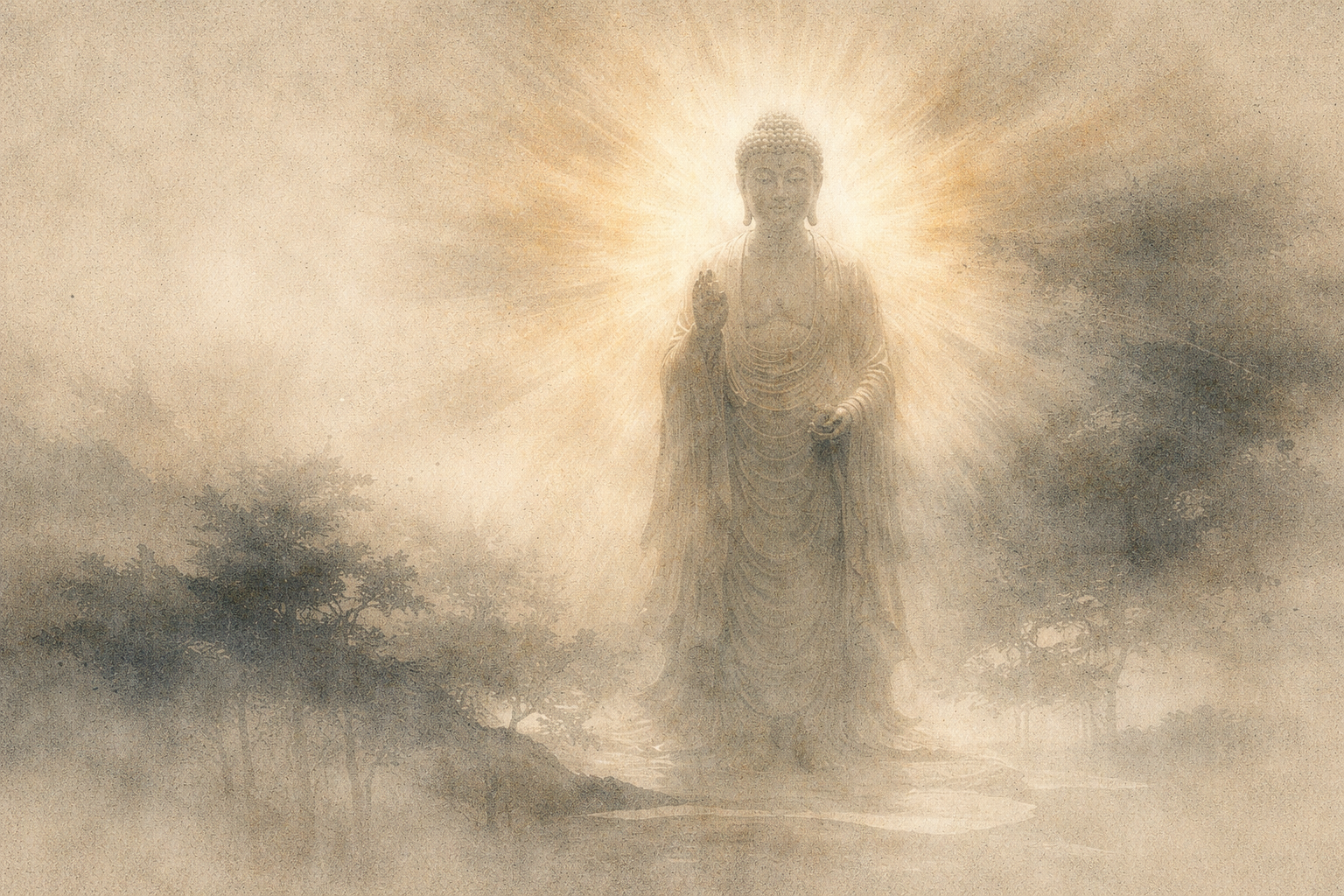
Amitabha: The Buddha of Boundless Light
Quick Summary
- Amitabha is a Buddha figure associated with boundless light and boundless life, often used as a simple lens for remembering openness.
- In everyday terms, “boundless light” can be read as clarity that doesn’t need perfect conditions to be present.
- Thinking of Amitabha isn’t about adopting a new belief; it can be a way to soften the mind’s habit of narrowing.
- The name and image often function like a steady reference point when attention is scattered, tired, or reactive.
- Misunderstandings usually come from treating Amitabha as either “only symbolic” or “only literal,” instead of noticing what the idea does in experience.
- In relationships and work, the Amitabha lens can highlight how quickly the mind turns people into fixed stories.
- What matters most is the immediate shift: from contraction to a little more space, from self-judgment to a little more warmth.
Introduction
If “Amitabha” sounds like a distant religious figure, it can feel irrelevant to the very real problems of modern life: stress at work, friction in relationships, and the constant sense of being behind. But the name keeps showing up because it points to something practical—how the mind can remember openness when it’s busy shrinking everything into threat, blame, or urgency. This article is written for Gassho by a long-time Zen/Buddhism editor focused on clear, experience-first explanations.
Amitabha is commonly described as the Buddha of Boundless Light, and that phrase can be approached without drama. “Light” can be read as the simple capacity to notice, to illuminate what is happening without immediately tightening around it. “Boundless” can be read as the possibility that clarity and care are not limited to the moments when life is easy.
When people feel confused about Amitabha, it’s often because they assume they must decide what to believe before they can understand. Another approach is to treat Amitabha as a mirror: not something to prove, but something that reveals how the mind behaves when it feels cornered.
Amitabha as a Lens for Openness
One grounded way to understand Amitabha is to see the image and name as a reminder of a wider field of awareness than the one the mind usually defaults to. In a tense meeting, attention can become a narrow beam: scanning for danger, searching for the right words, bracing for judgment. The Amitabha lens points to the possibility that awareness can be broader than that beam, holding the whole moment without being swallowed by it.
“Boundless light” doesn’t need to mean something supernatural to be meaningful. It can describe the ordinary fact that noticing is already here—before the mind finishes its commentary. Even when fatigue is heavy and patience is thin, there can still be a basic clarity that registers sound, sensation, and mood. The Amitabha lens emphasizes that clarity is not earned by being perfect; it is recognized by stopping the habit of overlooking it.
In relationships, the mind often reduces a person to a single trait: “difficult,” “cold,” “disappointing,” “needy.” That reduction feels efficient, but it also creates suffering because it blocks the complexity that is actually present. Amitabha can be held as a gentle counterweight to that narrowing—an invitation to let the picture be larger than the label, even when the conversation is awkward or unresolved.
In silence, the same narrowing happens internally. A small worry becomes the whole world. A single mistake becomes a fixed identity. The Amitabha lens doesn’t argue with those thoughts; it simply suggests that the mind’s frame can widen, allowing thoughts to be present without granting them total authority over the moment.
How Amitabha Shows Up in Ordinary Moments
Consider the moment right before opening an email you don’t want to read. The body tightens, the mind predicts outcomes, and attention collapses into a small, defensive posture. In that contraction, “boundless light” can be understood as the opposite movement: not forcing calm, but noticing the contraction as contraction, and letting the awareness around it be a little wider.
In a conversation with someone close, there are often tiny flashes of reactivity—interrupting, rehearsing a rebuttal, scanning for disrespect. The Amitabha lens can appear as a brief pause where the mind recognizes, “This is the old reflex.” The content of the conversation may not change, but the inner grip can soften enough to hear what is actually being said.
Fatigue is another place where the idea becomes concrete. When tired, the mind tends to become harsh and impatient, as if exhaustion is a personal failure. “Boundless life” can be read here as a refusal to reduce the self to today’s energy level. There is still a living continuity underneath the mood—breath, sensation, the simple fact of being here—without needing to turn it into a story of inadequacy.
In the middle of routine tasks—washing dishes, commuting, answering messages—attention often disappears into autopilot. Then a small irritation arises: a slow driver, a messy kitchen, a delayed reply. The Amitabha lens can show up as a quick recognition that irritation is not the whole scene. Sound, color, movement, and the body’s sensations are also present, and that broader noticing changes the texture of the moment.
When shame appears, it tends to demand secrecy and isolation. The mind says, “This should not be seen.” “Light,” in a very plain sense, is what makes seeing possible. The Amitabha lens can be felt as the willingness to let the experience be seen internally—without immediately trying to fix it, justify it, or push it away. The shame may still be there, but it is no longer the only thing in the room.
Even in quiet, the mind can keep searching for something to solve. A memory surfaces, a plan forms, a worry repeats. The Amitabha lens is not a command to stop thinking; it is the recognition that thoughts are events within awareness, not the boundary of awareness. That recognition can be subtle, like noticing the sky is larger than the weather.
Over time, the most noticeable shift is often not dramatic peace, but a small increase in space around experience. The same stressors still arrive—deadlines, misunderstandings, fatigue—but the mind is a little less compelled to turn each one into a final verdict. In that sense, Amitabha functions less like an answer and more like a steady orientation toward openness.
Misreadings That Naturally Arise
A common misunderstanding is to treat Amitabha as relevant only if one accepts a specific set of metaphysical claims. That assumption can make the whole topic feel like a test of belief. But many people relate to Amitabha in a simpler way: as a name that points the mind toward clarity and warmth when it is stuck in tight, repetitive patterns.
Another misunderstanding is the opposite: dismissing Amitabha as “just a symbol,” as if symbols cannot affect lived experience. The mind is shaped by images and words all day long—status, failure, success, attractiveness, threat. It is natural that a symbol oriented toward boundlessness could also shape attention, not by force, but by repeated familiarity.
People also sometimes imagine that “boundless light” means never feeling anger, grief, or confusion. When those emotions appear, they conclude the idea is irrelevant. Yet the lens is often most visible precisely when emotions are present: it highlights the difference between feeling something fully and being reduced to it.
Finally, there can be a subtle misunderstanding that the point is to hold the “right” image of Amitabha. In ordinary life, the mind already strains to get things right—tone, timing, performance. The Amitabha lens is gentler than that. It points to the possibility of widening, even when the mind is imperfect, even when the day is messy.
Where the Amitabha Perspective Touches Daily Life
In work life, pressure often narrows attention to outcomes and approval. The Amitabha lens can quietly reframe the day as more than a scoreboard: there is also the felt sense of the body at the desk, the tone of an email, the way urgency changes breathing. Noticing those elements doesn’t remove responsibility; it simply restores a wider context.
In family life, old roles can feel fixed—who is responsible, who is difficult, who is misunderstood. The phrase “boundless light” can sit in the background as a reminder that people are rarely only one thing. Even when patterns repeat, there are still moments of softness, humor, and ordinary decency that the mind can miss when it is braced for conflict.
In solitude, the mind often turns inward with a critical voice. The Amitabha lens can be felt as a different atmosphere: not self-improvement, not self-attack, but a simple willingness to let experience be illuminated without punishment. Daily life continues—laundry, bills, errands—yet the inner posture can be a little less cramped.
In public life, there is constant stimulation and constant judgment. The Amitabha lens doesn’t require withdrawing from that world. It simply suggests that even in noise, awareness can be wider than the noise, and even in disagreement, the heart can remember something larger than winning.
Conclusion
Amitabha can be held lightly, like a name for the possibility of boundless clarity in the middle of ordinary conditions. Thoughts, moods, and roles keep moving, and none of them need to be the final measure of a moment. The Dharma is verified quietly, in the way awareness meets the next email, the next conversation, the next breath.
Frequently Asked Questions
- FAQ 1: Who is Amitabha?
- FAQ 2: What does the name “Amitabha” mean?
- FAQ 3: Why is Amitabha called the Buddha of Boundless Light?
- FAQ 4: Is Amitabha the same as Amida Buddha?
- FAQ 5: How is Amitabha typically depicted in Buddhist art?
- FAQ 6: What is the connection between Amitabha and compassion?
- FAQ 7: Do you have to believe in Amitabha literally to find the teaching meaningful?
- FAQ 8: What is the “Pure Land” in relation to Amitabha?
- FAQ 9: What is nianfo or nembutsu, and how is it related to Amitabha?
- FAQ 10: Is chanting Amitabha’s name considered meditation?
- FAQ 11: What does “boundless life” mean in connection with Amitabha?
- FAQ 12: Are there common mantras associated with Amitabha?
- FAQ 13: How does Amitabha relate to everyday stress and anxiety?
- FAQ 14: Is Amitabha mentioned in major Buddhist sutras?
- FAQ 15: How is Amitabha different from Shakyamuni Buddha?
FAQ 1: Who is Amitabha?
Answer: Amitabha is a Buddha figure widely associated with boundless light and boundless life. Many people relate to Amitabha as a way of remembering clarity and openness when the mind feels tight, reactive, or discouraged.
Real result: Encyclopaedia Britannica’s overview of Amitabha describes Amitabha as a celestial Buddha central to Pure Land traditions across Asia.
Takeaway: Amitabha is often approached as a steady reference point for openness and clarity.
FAQ 2: What does the name “Amitabha” mean?
Answer: “Amitabha” is commonly explained as “Infinite Light” or “Boundless Light.” In everyday terms, it can be taken as a pointer to awareness that can illuminate experience without needing everything to be resolved first.
Real result: The Princeton Dictionary of Buddhism (Princeton University Press) notes Amitābha is interpreted as “Infinite Light,” paired with Amitāyus, “Infinite Life.”
Takeaway: The name itself functions like a reminder of spacious clarity.
FAQ 3: Why is Amitabha called the Buddha of Boundless Light?
Answer: Amitabha is called the Buddha of Boundless Light because “light” symbolizes illumination—seeing clearly—while “boundless” suggests that this clarity is not limited to ideal moods or perfect circumstances. Many readers find this language helpful as a way to counter the mind’s habit of narrowing into fear or judgment.
Real result: Academic summaries of the Larger Sukhāvatīvyūha Sūtra commonly highlight Amitabha’s “immeasurable light” as a defining attribute in the text tradition.
Takeaway: “Boundless light” points to clarity that can be present even in ordinary difficulty.
FAQ 4: Is Amitabha the same as Amida Buddha?
Answer: Yes. “Amida” is the Japanese form of the name Amitabha (Amitābha). You may also see “Amida Butsu,” which refers to Amitabha Buddha in Japanese usage.
Real result: Standard reference works on Buddhism list Amida as the Japanese reading of Amitābha/Amitāyus in East Asian contexts.
Takeaway: Amitabha and Amida refer to the same Buddha figure, expressed in different languages.
FAQ 5: How is Amitabha typically depicted in Buddhist art?
Answer: Amitabha is often shown seated in a meditative posture, sometimes with a serene expression and symbolic hand gestures (mudras). In many images, the overall feeling is calm and luminous, emphasizing the theme of clarity rather than intensity.
Real result: The Metropolitan Museum of Art’s essays on Buddhist iconography discuss how Buddhas are depicted with standardized features and gestures that communicate qualities like serenity and awakening (see Met essays on Buddhism).
Takeaway: Amitabha imagery is designed to evoke steadiness and clear presence.
FAQ 6: What is the connection between Amitabha and compassion?
Answer: Amitabha is frequently associated with an atmosphere of welcome and care—an emphasis on warmth that does not depend on personal perfection. For many people, this connection matters most as an inner shift: from self-condemnation toward a more humane, spacious way of meeting experience.
Real result: Scholarly introductions to Pure Land literature commonly describe Amitabha devotion as oriented around trust, refuge, and compassionate aspiration rather than self-powered achievement.
Takeaway: Amitabha is often held as a symbol of unconditional warmth toward lived experience.
FAQ 7: Do you have to believe in Amitabha literally to find the teaching meaningful?
Answer: Not necessarily. Many people engage Amitabha as a practical pointer—an image and name that helps the mind remember openness, especially when it becomes rigid or reactive. Others relate to Amitabha devotionally. Both approaches can be meaningful depending on temperament and context.
Real result: Contemporary Buddhist studies writing often notes that Buddhist figures can function devotionally, symbolically, and psychologically across different communities and individuals.
Takeaway: Amitabha can be approached as a lived reference point, not only as a belief statement.
FAQ 8: What is the “Pure Land” in relation to Amitabha?
Answer: The “Pure Land” is traditionally described as a realm associated with Amitabha where conditions support awakening. Some people interpret it literally; others treat it as a way of speaking about supportive conditions for clarity and compassion. The key point is that the language emphasizes relief from the mind’s usual confusion and struggle.
Real result: Encyclopaedia Britannica’s Pure Land entries describe it as a major devotional current centered on Amitabha and aspiration for rebirth in his land (see Pure Land Buddhism).
Takeaway: “Pure Land” language highlights supportive conditions for clear, compassionate awareness.
FAQ 9: What is nianfo or nembutsu, and how is it related to Amitabha?
Answer: Nianfo (Chinese) and nembutsu (Japanese) refer to reciting or recollecting Amitabha Buddha’s name. For many practitioners, the repetition functions as a steady anchor that gathers scattered attention and softens anxious mental loops.
Real result: Academic descriptions of East Asian Buddhist practice routinely identify nianfo/nembutsu as central forms of Amitabha devotion and recollection.
Takeaway: Name-recitation is a common way Amitabha is remembered and kept close in daily life.
FAQ 10: Is chanting Amitabha’s name considered meditation?
Answer: It can be. Repeating Amitabha’s name often stabilizes attention, reduces mental wandering, and creates a simple rhythm that makes inner experience easier to observe. Whether someone calls it “meditation” or “devotion,” the lived effect is often a quieter, more collected mind.
Real result: Research reviews on mantra-style repetition practices commonly report associations with reduced stress and improved attentional stability, though results vary by method and population (for example, see NIH-indexed discussions of mantra meditation in PubMed).
Takeaway: Name-recitation can function as an attention-stabilizing contemplative practice.
FAQ 11: What does “boundless life” mean in connection with Amitabha?
Answer: “Boundless life” is often paired with “boundless light” to express continuity and immeasurability. In a simple, experiential reading, it can point to the way life continues through changing moods—fatigue, joy, irritation—without any single state being the whole story.
Real result: Reference texts frequently explain Amitāyus (“Infinite Life”) as closely linked with Amitābha, sometimes treated as two aspects of the same Buddha figure in different contexts.
Takeaway: “Boundless life” can be read as a reminder not to reduce life to today’s passing state.
FAQ 12: Are there common mantras associated with Amitabha?
Answer: Yes. In addition to reciting Amitabha’s name (such as “Namo Amitabha” in various languages), some traditions use longer formulas and dharanis associated with Amitabha. People often choose what is familiar in their culture or community, keeping the emphasis on recollection and steadiness rather than complexity.
Real result: Museum catalogs and liturgical studies of Buddhist chanting document multiple Amitabha-related recitations across regions and languages.
Takeaway: Amitabha practice often centers on simple recollection, sometimes expressed through short or longer recitations.
FAQ 13: How does Amitabha relate to everyday stress and anxiety?
Answer: Amitabha can be understood as a reminder of spacious awareness when stress narrows the mind into urgency and self-criticism. The practical relevance is not in escaping problems, but in meeting them with a little more inner room—enough to respond rather than only react.
Real result: Psychological research on attentional narrowing under stress supports the everyday observation that anxiety constricts perception and flexibility, which aligns with why “widening” images can feel stabilizing.
Takeaway: Amitabha language can counter the mind’s stress-driven habit of contraction.
FAQ 14: Is Amitabha mentioned in major Buddhist sutras?
Answer: Yes. Amitabha is prominently featured in Pure Land sutras, including texts commonly known in English as the Larger Sutra of Immeasurable Life and the Amitabha (or Smaller) Sutra. These texts describe Amitabha and the aspiration connected with his Pure Land.
Real result: The BDK English Tripiṭaka series includes translations of key Pure Land sutras that reference Amitabha (see BDK America).
Takeaway: Amitabha is grounded in a well-established sutra tradition.
FAQ 15: How is Amitabha different from Shakyamuni Buddha?
Answer: Shakyamuni Buddha refers to the historical Buddha commonly associated with the origin of Buddhism in India, while Amitabha is a Buddha figure especially associated with boundless light and Pure Land devotion. In lived terms, people often relate to Shakyamuni through teachings and stories, and to Amitabha through recollection, imagery, and the felt sense of refuge and openness those evoke.
Real result: Standard Buddhist reference sources distinguish the historical Buddha (Śākyamuni) from celestial Buddhas such as Amitābha in their definitions and historical summaries.
Takeaway: Shakyamuni and Amitabha are distinct figures, often approached through different emphases.