



The Mahajanapadas: The Political World of the Buddha Explained
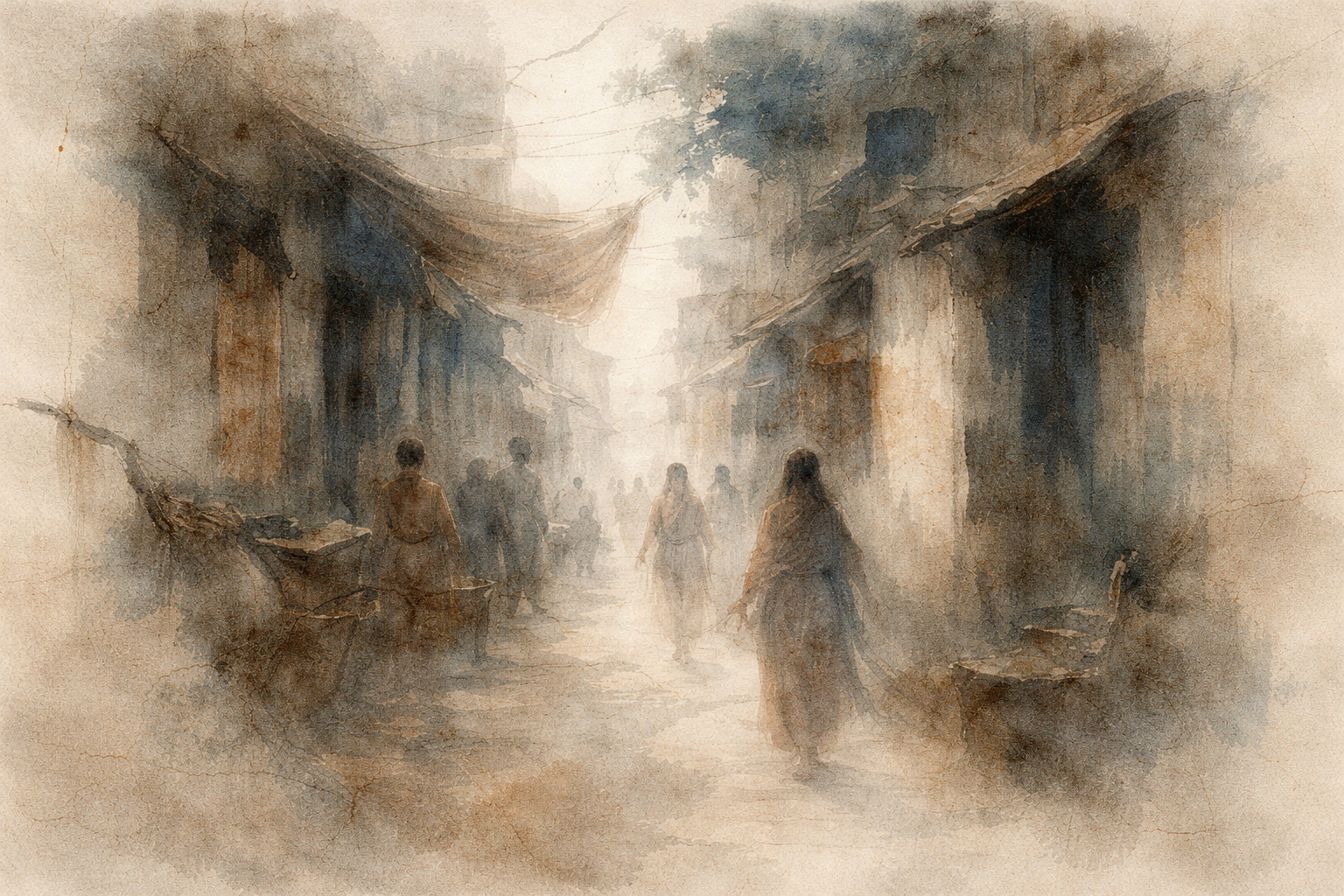
Taxes and patronage also shape inner life. When resources are extracted and redistributed, people become sensitive to who is favored and who is overlooked. That sensitivity can become a constant comparison—quietly checking your place in the social order. In a workplace, it looks like watching who gets credit. In a family, it looks like noticing who gets listened to. In a growing state, it looks like watching who has access to officials, land, and protection.
Urban growth creates noise—literal and mental. More voices, more transactions, more friction. The mind adapts by narrowing focus, by filtering, by becoming selective. Sometimes that selectivity looks like wisdom; sometimes it looks like numbness. When early Buddhist scenes take place near city gates, parks, and monasteries close to towns, it can be read as a human need for a little space at the edge of the crowd.
And then there is the simple fact of difference. Different mahajanapadas meant different customs, accents, and expectations. When you move between social worlds—office and home, friend group and family—you can feel the mind switching masks. That switching is not a moral failure; it is a conditioned response. Seeing the Buddha’s world as a network of distinct states makes the social complexity of those encounters feel immediate and recognizable.
Misreadings That Make the Mahajanapadas Feel Distant
A common misunderstanding is to treat the mahajanapadas as a clean, settled map—sixteen names, fixed borders, done. But political reality is rarely that tidy. Influence shifts, alliances change, and the importance of a region depends on trade, harvests, and leadership. When the topic is presented as a static list, it becomes hard to feel why it matters.
Another easy misreading is to assume “politics” is separate from inner life. Yet most people know what it is like to carry a tense environment inside the body: shoulders up, jaw tight, attention scattered. Large states, court culture, and competition for resources don’t just change laws; they change how people speak, how they trust, and how they protect themselves emotionally.
It’s also natural to imagine the Buddha’s setting as either purely rural and simple or purely royal and dramatic. The mahajanapadas point to something more ordinary: a mixed world of farms and towns, merchants and monks, kings and councils, with long stretches of routine in between. That ordinariness is precisely what makes the background useful—it matches the way most human lives actually feel.
Finally, some readers assume that knowing the mahajanapadas is only for specialists. But the value is not in showing off names. The value is in recognizing how conditions shape attention—how a crowded place, a powerful institution, or a precarious livelihood can quietly steer the mind toward fear, ambition, or exhaustion without anyone announcing it.
Why This Context Still Feels Familiar
Most people live inside systems they didn’t design: workplace hierarchies, housing markets, family expectations, social media incentives. The mahajanapadas are an older version of that same truth. They remind us that the Buddha’s world included institutions, pressure, and inequality—conditions that can make the mind contract even when nothing “bad” is happening in the moment.
When a story is set in a capital city rather than a village, the emotional weather changes. There is more comparison, more performance, more sense of being watched. That is not ancient; it is daily life for many people now. Seeing the mahajanapadas behind the scenes makes early Buddhist settings feel less like distant scripture and more like recognizable human environments.
It also softens the tendency to romanticize the past. A “simpler time” is often just a time whose hardships are no longer felt in the body. The political world of the mahajanapadas included security and insecurity, opportunity and constraint. That mixture is familiar: a life where some doors open because of where you are, and other doors close for the same reason.
And in quiet moments—waiting in line, sitting in traffic, lying awake after a long day—context becomes visible. You can feel how much of the mind is responding to structures: schedules, money, reputation, uncertainty. The mahajanapadas are a reminder that this kind of responding has always been part of human life, even in the Buddha’s time.
Conclusion
The mahajanapadas were not just names on a map. They were the conditions of ordinary days—movement, risk, status, and shelter—through which people tried to find steadiness. When those conditions are noticed, the Buddha’s world becomes less distant and more immediate. The rest can be verified in the small politics of one’s own day: what tightens the mind, what loosens it, and what remains when nothing needs to be defended.
Frequently Asked Questions
- FAQ 1: What does “mahajanapadas” mean?
- FAQ 2: How many mahajanapadas were there?
- FAQ 3: Are the “sixteen mahajanapadas” always the same list?
- FAQ 4: When did the mahajanapadas exist?
- FAQ 5: Which mahajanapadas were most important in the Buddha’s lifetime?
- FAQ 6: What is the difference between a janapada and a mahajanapada?
- FAQ 7: Were the mahajanapadas kingdoms or republics?
- FAQ 8: What were the main capitals associated with key mahajanapadas?
- FAQ 9: How do the mahajanapadas appear in early Buddhist texts?
- FAQ 10: Did the mahajanapadas have fixed borders like modern states?
- FAQ 11: Why did Magadha become so powerful among the mahajanapadas?
- FAQ 12: What role did trade play in the rise of the mahajanapadas?
- FAQ 13: How are the mahajanapadas connected to urbanization in ancient India?
- FAQ 14: Are the mahajanapadas the same as the later Mauryan Empire?
- FAQ 15: Why should modern readers care about the mahajanapadas?
FAQ 1: What does “mahajanapadas” mean?
Answer: “Mahajanapadas” refers to the “great janapadas,” meaning the major territorial states of North India in the period around the Buddha’s lifetime. Rather than a single empire, it points to a landscape of multiple competing polities—some centered on royal courts, others organized as confederacies.
Takeaway: The term names the big political units that formed the Buddha’s everyday world.
FAQ 2: How many mahajanapadas were there?
Answer: The most common traditional framing is “sixteen mahajanapadas.” That number is a conventional list used in several ancient sources, but it should be understood as a historical snapshot rather than a permanent, universally agreed census.
Takeaway: “Sixteen” is the standard reference point, not a guarantee of a single fixed roster.
FAQ 3: Are the “sixteen mahajanapadas” always the same list?
Answer: No. Different ancient texts and later summaries can vary in which states they emphasize or how they name them. Variations reflect shifting political realities, regional perspectives, and the fact that influence changed over time.
Takeaway: The mahajanapadas are best treated as a changing political landscape, not a single immutable list.
FAQ 4: When did the mahajanapadas exist?
Answer: They are generally placed in the late Vedic to early historic period of North India, especially around the 6th to 4th centuries BCE (dates vary by scholarly reconstruction). This overlaps with the era traditionally associated with the Buddha’s life and teaching activity.
Takeaway: The mahajanapadas belong to the same broad timeframe as early Buddhism’s formative setting.
FAQ 5: Which mahajanapadas were most important in the Buddha’s lifetime?
Answer: Magadha and Kosala are often treated as especially influential in early Buddhist geography and narrative, with frequent references to their rulers, capitals, and major towns. Other regions also matter, but these two repeatedly appear as major centers of power and patronage.
Takeaway: Magadha and Kosala are central for understanding the political backdrop of many early Buddhist scenes.
FAQ 6: What is the difference between a janapada and a mahajanapada?
Answer: A janapada is a territorial realm or “foothold of a people,” while a mahajanapada is a larger, more prominent state among them. The “maha-” signals greater scale or significance—often tied to stronger administration, larger cities, or wider influence.
Takeaway: All mahajanapadas are janapadas, but not all janapadas are “great” ones.
FAQ 7: Were the mahajanapadas kingdoms or republics?
Answer: Both forms existed. Some mahajanapadas were monarchies ruled by kings, while others are described as republic-like confederacies (often discussed as gana-sanghas) with assemblies and shared governance among elites. The political map was mixed rather than uniform.
Takeaway: The mahajanapadas included multiple models of rule, not just kingship.
FAQ 8: What were the main capitals associated with key mahajanapadas?
Answer: Commonly cited examples include Rājagaha (associated with Magadha) and Sāvatthī (associated with Kosala), both frequently referenced in early Buddhist narratives. Other mahajanapadas also had important urban centers, reflecting the period’s growing city life and administration.
Takeaway: Capitals matter because they were where power, wealth, and large audiences tended to gather.
FAQ 9: How do the mahajanapadas appear in early Buddhist texts?
Answer: They appear indirectly through place names, travel routes, rulers, and the social settings of teachings—towns, parks, monasteries near cities, and royal or merchant patronage. Recognizing the mahajanapadas helps readers understand why certain regions recur and why travel and security are practical concerns in the stories.
Takeaway: The mahajanapadas are the real-world geography behind many familiar early Buddhist locations.
FAQ 10: Did the mahajanapadas have fixed borders like modern states?
Answer: Not in the modern sense. Borders were often fluid, shaped by rivers, forests, forts, alliances, and military pressure. Control could be stronger near capitals and weaker at the edges, and influence could shift quickly with conflict or diplomacy.
Takeaway: Think “zones of influence” more than crisp lines on a map.
FAQ 11: Why did Magadha become so powerful among the mahajanapadas?
Answer: Magadha’s rise is often linked to strategic geography, access to resources, and effective state-building—factors that supported stronger armies, administration, and urban growth. Over time, Magadha’s expansion helped set the stage for larger imperial formations in North India.
Takeaway: Magadha combined location, resources, and governance in a way that amplified its influence.
FAQ 12: What role did trade play in the rise of the mahajanapadas?
Answer: Trade routes increased wealth, connected distant regions, and encouraged the growth of towns and cities. As commerce expanded, states that controlled key routes or markets could collect revenue and strengthen administration, which in turn reinforced their political standing.
Takeaway: Trade didn’t just move goods—it helped build the conditions for larger states.
FAQ 13: How are the mahajanapadas connected to urbanization in ancient India?
Answer: The mahajanapada period is closely associated with the growth of cities, specialized occupations, and more complex governance. Urban centers became hubs for markets, courts, and public life—settings that also appear frequently in early Buddhist narratives.
Takeaway: The mahajanapadas and early cities grew together, each reinforcing the other.
FAQ 14: Are the mahajanapadas the same as the later Mauryan Empire?
Answer: No. The mahajanapadas refer to an earlier multi-state landscape. The Mauryan Empire came later and represents a more consolidated imperial structure, with Magadha often seen as a key predecessor region in that broader political evolution.
Takeaway: Mahajanapadas are the pre-imperial map; Mauryan rule is a later unification.
FAQ 15: Why should modern readers care about the mahajanapadas?
Answer: Because they make the Buddha’s world legible: why certain places mattered, how travel and patronage worked, and what kinds of social pressures people carried. Understanding the mahajanapadas turns “ancient India” from a vague backdrop into a human environment shaped by power, economy, and everyday uncertainty.
Takeaway: The mahajanapadas help early Buddhism read like life, not legend.
Trade routes running through major states meant movement: caravans, travelers, wandering teachers, and news. Movement sounds freeing, but it also brings uncertainty. When the road is long and the border is real, the mind starts counting: food, safety, time, weather, permission. Even now, a simple commute can create a low-grade vigilance that lingers in the body after you arrive.
Where states competed, people learned to live with rumors of conflict. You can feel what that does to attention in modern life: a tense headline, a sudden policy change, a message from a supervisor that reads colder than expected. The mind tries to stabilize itself by predicting outcomes. It reaches for certainty. In a landscape of rival mahajanapadas, that reaching would have been ordinary, not exceptional.
Taxes and patronage also shape inner life. When resources are extracted and redistributed, people become sensitive to who is favored and who is overlooked. That sensitivity can become a constant comparison—quietly checking your place in the social order. In a workplace, it looks like watching who gets credit. In a family, it looks like noticing who gets listened to. In a growing state, it looks like watching who has access to officials, land, and protection.
Urban growth creates noise—literal and mental. More voices, more transactions, more friction. The mind adapts by narrowing focus, by filtering, by becoming selective. Sometimes that selectivity looks like wisdom; sometimes it looks like numbness. When early Buddhist scenes take place near city gates, parks, and monasteries close to towns, it can be read as a human need for a little space at the edge of the crowd.
And then there is the simple fact of difference. Different mahajanapadas meant different customs, accents, and expectations. When you move between social worlds—office and home, friend group and family—you can feel the mind switching masks. That switching is not a moral failure; it is a conditioned response. Seeing the Buddha’s world as a network of distinct states makes the social complexity of those encounters feel immediate and recognizable.
Misreadings That Make the Mahajanapadas Feel Distant
A common misunderstanding is to treat the mahajanapadas as a clean, settled map—sixteen names, fixed borders, done. But political reality is rarely that tidy. Influence shifts, alliances change, and the importance of a region depends on trade, harvests, and leadership. When the topic is presented as a static list, it becomes hard to feel why it matters.
Another easy misreading is to assume “politics” is separate from inner life. Yet most people know what it is like to carry a tense environment inside the body: shoulders up, jaw tight, attention scattered. Large states, court culture, and competition for resources don’t just change laws; they change how people speak, how they trust, and how they protect themselves emotionally.
It’s also natural to imagine the Buddha’s setting as either purely rural and simple or purely royal and dramatic. The mahajanapadas point to something more ordinary: a mixed world of farms and towns, merchants and monks, kings and councils, with long stretches of routine in between. That ordinariness is precisely what makes the background useful—it matches the way most human lives actually feel.
Finally, some readers assume that knowing the mahajanapadas is only for specialists. But the value is not in showing off names. The value is in recognizing how conditions shape attention—how a crowded place, a powerful institution, or a precarious livelihood can quietly steer the mind toward fear, ambition, or exhaustion without anyone announcing it.
Why This Context Still Feels Familiar
Most people live inside systems they didn’t design: workplace hierarchies, housing markets, family expectations, social media incentives. The mahajanapadas are an older version of that same truth. They remind us that the Buddha’s world included institutions, pressure, and inequality—conditions that can make the mind contract even when nothing “bad” is happening in the moment.
When a story is set in a capital city rather than a village, the emotional weather changes. There is more comparison, more performance, more sense of being watched. That is not ancient; it is daily life for many people now. Seeing the mahajanapadas behind the scenes makes early Buddhist settings feel less like distant scripture and more like recognizable human environments.
It also softens the tendency to romanticize the past. A “simpler time” is often just a time whose hardships are no longer felt in the body. The political world of the mahajanapadas included security and insecurity, opportunity and constraint. That mixture is familiar: a life where some doors open because of where you are, and other doors close for the same reason.
And in quiet moments—waiting in line, sitting in traffic, lying awake after a long day—context becomes visible. You can feel how much of the mind is responding to structures: schedules, money, reputation, uncertainty. The mahajanapadas are a reminder that this kind of responding has always been part of human life, even in the Buddha’s time.
Conclusion
The mahajanapadas were not just names on a map. They were the conditions of ordinary days—movement, risk, status, and shelter—through which people tried to find steadiness. When those conditions are noticed, the Buddha’s world becomes less distant and more immediate. The rest can be verified in the small politics of one’s own day: what tightens the mind, what loosens it, and what remains when nothing needs to be defended.
Frequently Asked Questions
- FAQ 1: What does “mahajanapadas” mean?
- FAQ 2: How many mahajanapadas were there?
- FAQ 3: Are the “sixteen mahajanapadas” always the same list?
- FAQ 4: When did the mahajanapadas exist?
- FAQ 5: Which mahajanapadas were most important in the Buddha’s lifetime?
- FAQ 6: What is the difference between a janapada and a mahajanapada?
- FAQ 7: Were the mahajanapadas kingdoms or republics?
- FAQ 8: What were the main capitals associated with key mahajanapadas?
- FAQ 9: How do the mahajanapadas appear in early Buddhist texts?
- FAQ 10: Did the mahajanapadas have fixed borders like modern states?
- FAQ 11: Why did Magadha become so powerful among the mahajanapadas?
- FAQ 12: What role did trade play in the rise of the mahajanapadas?
- FAQ 13: How are the mahajanapadas connected to urbanization in ancient India?
- FAQ 14: Are the mahajanapadas the same as the later Mauryan Empire?
- FAQ 15: Why should modern readers care about the mahajanapadas?
FAQ 1: What does “mahajanapadas” mean?
Answer: “Mahajanapadas” refers to the “great janapadas,” meaning the major territorial states of North India in the period around the Buddha’s lifetime. Rather than a single empire, it points to a landscape of multiple competing polities—some centered on royal courts, others organized as confederacies.
Takeaway: The term names the big political units that formed the Buddha’s everyday world.
FAQ 2: How many mahajanapadas were there?
Answer: The most common traditional framing is “sixteen mahajanapadas.” That number is a conventional list used in several ancient sources, but it should be understood as a historical snapshot rather than a permanent, universally agreed census.
Takeaway: “Sixteen” is the standard reference point, not a guarantee of a single fixed roster.
FAQ 3: Are the “sixteen mahajanapadas” always the same list?
Answer: No. Different ancient texts and later summaries can vary in which states they emphasize or how they name them. Variations reflect shifting political realities, regional perspectives, and the fact that influence changed over time.
Takeaway: The mahajanapadas are best treated as a changing political landscape, not a single immutable list.
FAQ 4: When did the mahajanapadas exist?
Answer: They are generally placed in the late Vedic to early historic period of North India, especially around the 6th to 4th centuries BCE (dates vary by scholarly reconstruction). This overlaps with the era traditionally associated with the Buddha’s life and teaching activity.
Takeaway: The mahajanapadas belong to the same broad timeframe as early Buddhism’s formative setting.
FAQ 5: Which mahajanapadas were most important in the Buddha’s lifetime?
Answer: Magadha and Kosala are often treated as especially influential in early Buddhist geography and narrative, with frequent references to their rulers, capitals, and major towns. Other regions also matter, but these two repeatedly appear as major centers of power and patronage.
Takeaway: Magadha and Kosala are central for understanding the political backdrop of many early Buddhist scenes.
FAQ 6: What is the difference between a janapada and a mahajanapada?
Answer: A janapada is a territorial realm or “foothold of a people,” while a mahajanapada is a larger, more prominent state among them. The “maha-” signals greater scale or significance—often tied to stronger administration, larger cities, or wider influence.
Takeaway: All mahajanapadas are janapadas, but not all janapadas are “great” ones.
FAQ 7: Were the mahajanapadas kingdoms or republics?
Answer: Both forms existed. Some mahajanapadas were monarchies ruled by kings, while others are described as republic-like confederacies (often discussed as gana-sanghas) with assemblies and shared governance among elites. The political map was mixed rather than uniform.
Takeaway: The mahajanapadas included multiple models of rule, not just kingship.
FAQ 8: What were the main capitals associated with key mahajanapadas?
Answer: Commonly cited examples include Rājagaha (associated with Magadha) and Sāvatthī (associated with Kosala), both frequently referenced in early Buddhist narratives. Other mahajanapadas also had important urban centers, reflecting the period’s growing city life and administration.
Takeaway: Capitals matter because they were where power, wealth, and large audiences tended to gather.
FAQ 9: How do the mahajanapadas appear in early Buddhist texts?
Answer: They appear indirectly through place names, travel routes, rulers, and the social settings of teachings—towns, parks, monasteries near cities, and royal or merchant patronage. Recognizing the mahajanapadas helps readers understand why certain regions recur and why travel and security are practical concerns in the stories.
Takeaway: The mahajanapadas are the real-world geography behind many familiar early Buddhist locations.
FAQ 10: Did the mahajanapadas have fixed borders like modern states?
Answer: Not in the modern sense. Borders were often fluid, shaped by rivers, forests, forts, alliances, and military pressure. Control could be stronger near capitals and weaker at the edges, and influence could shift quickly with conflict or diplomacy.
Takeaway: Think “zones of influence” more than crisp lines on a map.
FAQ 11: Why did Magadha become so powerful among the mahajanapadas?
Answer: Magadha’s rise is often linked to strategic geography, access to resources, and effective state-building—factors that supported stronger armies, administration, and urban growth. Over time, Magadha’s expansion helped set the stage for larger imperial formations in North India.
Takeaway: Magadha combined location, resources, and governance in a way that amplified its influence.
FAQ 12: What role did trade play in the rise of the mahajanapadas?
Answer: Trade routes increased wealth, connected distant regions, and encouraged the growth of towns and cities. As commerce expanded, states that controlled key routes or markets could collect revenue and strengthen administration, which in turn reinforced their political standing.
Takeaway: Trade didn’t just move goods—it helped build the conditions for larger states.
FAQ 13: How are the mahajanapadas connected to urbanization in ancient India?
Answer: The mahajanapada period is closely associated with the growth of cities, specialized occupations, and more complex governance. Urban centers became hubs for markets, courts, and public life—settings that also appear frequently in early Buddhist narratives.
Takeaway: The mahajanapadas and early cities grew together, each reinforcing the other.
FAQ 14: Are the mahajanapadas the same as the later Mauryan Empire?
Answer: No. The mahajanapadas refer to an earlier multi-state landscape. The Mauryan Empire came later and represents a more consolidated imperial structure, with Magadha often seen as a key predecessor region in that broader political evolution.
Takeaway: Mahajanapadas are the pre-imperial map; Mauryan rule is a later unification.
FAQ 15: Why should modern readers care about the mahajanapadas?
Answer: Because they make the Buddha’s world legible: why certain places mattered, how travel and patronage worked, and what kinds of social pressures people carried. Understanding the mahajanapadas turns “ancient India” from a vague backdrop into a human environment shaped by power, economy, and everyday uncertainty.
Takeaway: The mahajanapadas help early Buddhism read like life, not legend.
In a smaller community, reputation can feel like a fixed label. In a larger political unit, reputation becomes something you manage—through alliances, through money, through proximity to power. That management shows up internally as rehearsal: replaying conversations, anticipating criticism, trying to stay one step ahead. When early texts mention wealthy householders, royal ministers, and crowded cities, it helps to remember the inner life that often comes with those roles.
Trade routes running through major states meant movement: caravans, travelers, wandering teachers, and news. Movement sounds freeing, but it also brings uncertainty. When the road is long and the border is real, the mind starts counting: food, safety, time, weather, permission. Even now, a simple commute can create a low-grade vigilance that lingers in the body after you arrive.
Where states competed, people learned to live with rumors of conflict. You can feel what that does to attention in modern life: a tense headline, a sudden policy change, a message from a supervisor that reads colder than expected. The mind tries to stabilize itself by predicting outcomes. It reaches for certainty. In a landscape of rival mahajanapadas, that reaching would have been ordinary, not exceptional.
Taxes and patronage also shape inner life. When resources are extracted and redistributed, people become sensitive to who is favored and who is overlooked. That sensitivity can become a constant comparison—quietly checking your place in the social order. In a workplace, it looks like watching who gets credit. In a family, it looks like noticing who gets listened to. In a growing state, it looks like watching who has access to officials, land, and protection.
Urban growth creates noise—literal and mental. More voices, more transactions, more friction. The mind adapts by narrowing focus, by filtering, by becoming selective. Sometimes that selectivity looks like wisdom; sometimes it looks like numbness. When early Buddhist scenes take place near city gates, parks, and monasteries close to towns, it can be read as a human need for a little space at the edge of the crowd.
And then there is the simple fact of difference. Different mahajanapadas meant different customs, accents, and expectations. When you move between social worlds—office and home, friend group and family—you can feel the mind switching masks. That switching is not a moral failure; it is a conditioned response. Seeing the Buddha’s world as a network of distinct states makes the social complexity of those encounters feel immediate and recognizable.
Misreadings That Make the Mahajanapadas Feel Distant
A common misunderstanding is to treat the mahajanapadas as a clean, settled map—sixteen names, fixed borders, done. But political reality is rarely that tidy. Influence shifts, alliances change, and the importance of a region depends on trade, harvests, and leadership. When the topic is presented as a static list, it becomes hard to feel why it matters.
Another easy misreading is to assume “politics” is separate from inner life. Yet most people know what it is like to carry a tense environment inside the body: shoulders up, jaw tight, attention scattered. Large states, court culture, and competition for resources don’t just change laws; they change how people speak, how they trust, and how they protect themselves emotionally.
It’s also natural to imagine the Buddha’s setting as either purely rural and simple or purely royal and dramatic. The mahajanapadas point to something more ordinary: a mixed world of farms and towns, merchants and monks, kings and councils, with long stretches of routine in between. That ordinariness is precisely what makes the background useful—it matches the way most human lives actually feel.
Finally, some readers assume that knowing the mahajanapadas is only for specialists. But the value is not in showing off names. The value is in recognizing how conditions shape attention—how a crowded place, a powerful institution, or a precarious livelihood can quietly steer the mind toward fear, ambition, or exhaustion without anyone announcing it.
Why This Context Still Feels Familiar
Most people live inside systems they didn’t design: workplace hierarchies, housing markets, family expectations, social media incentives. The mahajanapadas are an older version of that same truth. They remind us that the Buddha’s world included institutions, pressure, and inequality—conditions that can make the mind contract even when nothing “bad” is happening in the moment.
When a story is set in a capital city rather than a village, the emotional weather changes. There is more comparison, more performance, more sense of being watched. That is not ancient; it is daily life for many people now. Seeing the mahajanapadas behind the scenes makes early Buddhist settings feel less like distant scripture and more like recognizable human environments.
It also softens the tendency to romanticize the past. A “simpler time” is often just a time whose hardships are no longer felt in the body. The political world of the mahajanapadas included security and insecurity, opportunity and constraint. That mixture is familiar: a life where some doors open because of where you are, and other doors close for the same reason.
And in quiet moments—waiting in line, sitting in traffic, lying awake after a long day—context becomes visible. You can feel how much of the mind is responding to structures: schedules, money, reputation, uncertainty. The mahajanapadas are a reminder that this kind of responding has always been part of human life, even in the Buddha’s time.
Conclusion
The mahajanapadas were not just names on a map. They were the conditions of ordinary days—movement, risk, status, and shelter—through which people tried to find steadiness. When those conditions are noticed, the Buddha’s world becomes less distant and more immediate. The rest can be verified in the small politics of one’s own day: what tightens the mind, what loosens it, and what remains when nothing needs to be defended.
Frequently Asked Questions
- FAQ 1: What does “mahajanapadas” mean?
- FAQ 2: How many mahajanapadas were there?
- FAQ 3: Are the “sixteen mahajanapadas” always the same list?
- FAQ 4: When did the mahajanapadas exist?
- FAQ 5: Which mahajanapadas were most important in the Buddha’s lifetime?
- FAQ 6: What is the difference between a janapada and a mahajanapada?
- FAQ 7: Were the mahajanapadas kingdoms or republics?
- FAQ 8: What were the main capitals associated with key mahajanapadas?
- FAQ 9: How do the mahajanapadas appear in early Buddhist texts?
- FAQ 10: Did the mahajanapadas have fixed borders like modern states?
- FAQ 11: Why did Magadha become so powerful among the mahajanapadas?
- FAQ 12: What role did trade play in the rise of the mahajanapadas?
- FAQ 13: How are the mahajanapadas connected to urbanization in ancient India?
- FAQ 14: Are the mahajanapadas the same as the later Mauryan Empire?
- FAQ 15: Why should modern readers care about the mahajanapadas?
FAQ 1: What does “mahajanapadas” mean?
Answer: “Mahajanapadas” refers to the “great janapadas,” meaning the major territorial states of North India in the period around the Buddha’s lifetime. Rather than a single empire, it points to a landscape of multiple competing polities—some centered on royal courts, others organized as confederacies.
Takeaway: The term names the big political units that formed the Buddha’s everyday world.
FAQ 2: How many mahajanapadas were there?
Answer: The most common traditional framing is “sixteen mahajanapadas.” That number is a conventional list used in several ancient sources, but it should be understood as a historical snapshot rather than a permanent, universally agreed census.
Takeaway: “Sixteen” is the standard reference point, not a guarantee of a single fixed roster.
FAQ 3: Are the “sixteen mahajanapadas” always the same list?
Answer: No. Different ancient texts and later summaries can vary in which states they emphasize or how they name them. Variations reflect shifting political realities, regional perspectives, and the fact that influence changed over time.
Takeaway: The mahajanapadas are best treated as a changing political landscape, not a single immutable list.
FAQ 4: When did the mahajanapadas exist?
Answer: They are generally placed in the late Vedic to early historic period of North India, especially around the 6th to 4th centuries BCE (dates vary by scholarly reconstruction). This overlaps with the era traditionally associated with the Buddha’s life and teaching activity.
Takeaway: The mahajanapadas belong to the same broad timeframe as early Buddhism’s formative setting.
FAQ 5: Which mahajanapadas were most important in the Buddha’s lifetime?
Answer: Magadha and Kosala are often treated as especially influential in early Buddhist geography and narrative, with frequent references to their rulers, capitals, and major towns. Other regions also matter, but these two repeatedly appear as major centers of power and patronage.
Takeaway: Magadha and Kosala are central for understanding the political backdrop of many early Buddhist scenes.
FAQ 6: What is the difference between a janapada and a mahajanapada?
Answer: A janapada is a territorial realm or “foothold of a people,” while a mahajanapada is a larger, more prominent state among them. The “maha-” signals greater scale or significance—often tied to stronger administration, larger cities, or wider influence.
Takeaway: All mahajanapadas are janapadas, but not all janapadas are “great” ones.
FAQ 7: Were the mahajanapadas kingdoms or republics?
Answer: Both forms existed. Some mahajanapadas were monarchies ruled by kings, while others are described as republic-like confederacies (often discussed as gana-sanghas) with assemblies and shared governance among elites. The political map was mixed rather than uniform.
Takeaway: The mahajanapadas included multiple models of rule, not just kingship.
FAQ 8: What were the main capitals associated with key mahajanapadas?
Answer: Commonly cited examples include Rājagaha (associated with Magadha) and Sāvatthī (associated with Kosala), both frequently referenced in early Buddhist narratives. Other mahajanapadas also had important urban centers, reflecting the period’s growing city life and administration.
Takeaway: Capitals matter because they were where power, wealth, and large audiences tended to gather.
FAQ 9: How do the mahajanapadas appear in early Buddhist texts?
Answer: They appear indirectly through place names, travel routes, rulers, and the social settings of teachings—towns, parks, monasteries near cities, and royal or merchant patronage. Recognizing the mahajanapadas helps readers understand why certain regions recur and why travel and security are practical concerns in the stories.
Takeaway: The mahajanapadas are the real-world geography behind many familiar early Buddhist locations.
FAQ 10: Did the mahajanapadas have fixed borders like modern states?
Answer: Not in the modern sense. Borders were often fluid, shaped by rivers, forests, forts, alliances, and military pressure. Control could be stronger near capitals and weaker at the edges, and influence could shift quickly with conflict or diplomacy.
Takeaway: Think “zones of influence” more than crisp lines on a map.
FAQ 11: Why did Magadha become so powerful among the mahajanapadas?
Answer: Magadha’s rise is often linked to strategic geography, access to resources, and effective state-building—factors that supported stronger armies, administration, and urban growth. Over time, Magadha’s expansion helped set the stage for larger imperial formations in North India.
Takeaway: Magadha combined location, resources, and governance in a way that amplified its influence.
FAQ 12: What role did trade play in the rise of the mahajanapadas?
Answer: Trade routes increased wealth, connected distant regions, and encouraged the growth of towns and cities. As commerce expanded, states that controlled key routes or markets could collect revenue and strengthen administration, which in turn reinforced their political standing.
Takeaway: Trade didn’t just move goods—it helped build the conditions for larger states.
FAQ 13: How are the mahajanapadas connected to urbanization in ancient India?
Answer: The mahajanapada period is closely associated with the growth of cities, specialized occupations, and more complex governance. Urban centers became hubs for markets, courts, and public life—settings that also appear frequently in early Buddhist narratives.
Takeaway: The mahajanapadas and early cities grew together, each reinforcing the other.
FAQ 14: Are the mahajanapadas the same as the later Mauryan Empire?
Answer: No. The mahajanapadas refer to an earlier multi-state landscape. The Mauryan Empire came later and represents a more consolidated imperial structure, with Magadha often seen as a key predecessor region in that broader political evolution.
Takeaway: Mahajanapadas are the pre-imperial map; Mauryan rule is a later unification.
FAQ 15: Why should modern readers care about the mahajanapadas?
Answer: Because they make the Buddha’s world legible: why certain places mattered, how travel and patronage worked, and what kinds of social pressures people carried. Understanding the mahajanapadas turns “ancient India” from a vague backdrop into a human environment shaped by power, economy, and everyday uncertainty.
Takeaway: The mahajanapadas help early Buddhism read like life, not legend.
Imagine walking into a busy town where you don’t know anyone. Your attention naturally tightens. You scan faces. You listen for tone. You become careful with words. That subtle tightening is not a philosophical idea; it is a human response to a social environment. The mahajanapadas describe a world where more people lived in larger settlements, and that shift alone changes the texture of daily awareness.
In a smaller community, reputation can feel like a fixed label. In a larger political unit, reputation becomes something you manage—through alliances, through money, through proximity to power. That management shows up internally as rehearsal: replaying conversations, anticipating criticism, trying to stay one step ahead. When early texts mention wealthy householders, royal ministers, and crowded cities, it helps to remember the inner life that often comes with those roles.
Trade routes running through major states meant movement: caravans, travelers, wandering teachers, and news. Movement sounds freeing, but it also brings uncertainty. When the road is long and the border is real, the mind starts counting: food, safety, time, weather, permission. Even now, a simple commute can create a low-grade vigilance that lingers in the body after you arrive.
Where states competed, people learned to live with rumors of conflict. You can feel what that does to attention in modern life: a tense headline, a sudden policy change, a message from a supervisor that reads colder than expected. The mind tries to stabilize itself by predicting outcomes. It reaches for certainty. In a landscape of rival mahajanapadas, that reaching would have been ordinary, not exceptional.
Taxes and patronage also shape inner life. When resources are extracted and redistributed, people become sensitive to who is favored and who is overlooked. That sensitivity can become a constant comparison—quietly checking your place in the social order. In a workplace, it looks like watching who gets credit. In a family, it looks like noticing who gets listened to. In a growing state, it looks like watching who has access to officials, land, and protection.
Urban growth creates noise—literal and mental. More voices, more transactions, more friction. The mind adapts by narrowing focus, by filtering, by becoming selective. Sometimes that selectivity looks like wisdom; sometimes it looks like numbness. When early Buddhist scenes take place near city gates, parks, and monasteries close to towns, it can be read as a human need for a little space at the edge of the crowd.
And then there is the simple fact of difference. Different mahajanapadas meant different customs, accents, and expectations. When you move between social worlds—office and home, friend group and family—you can feel the mind switching masks. That switching is not a moral failure; it is a conditioned response. Seeing the Buddha’s world as a network of distinct states makes the social complexity of those encounters feel immediate and recognizable.
Misreadings That Make the Mahajanapadas Feel Distant
A common misunderstanding is to treat the mahajanapadas as a clean, settled map—sixteen names, fixed borders, done. But political reality is rarely that tidy. Influence shifts, alliances change, and the importance of a region depends on trade, harvests, and leadership. When the topic is presented as a static list, it becomes hard to feel why it matters.
Another easy misreading is to assume “politics” is separate from inner life. Yet most people know what it is like to carry a tense environment inside the body: shoulders up, jaw tight, attention scattered. Large states, court culture, and competition for resources don’t just change laws; they change how people speak, how they trust, and how they protect themselves emotionally.
It’s also natural to imagine the Buddha’s setting as either purely rural and simple or purely royal and dramatic. The mahajanapadas point to something more ordinary: a mixed world of farms and towns, merchants and monks, kings and councils, with long stretches of routine in between. That ordinariness is precisely what makes the background useful—it matches the way most human lives actually feel.
Finally, some readers assume that knowing the mahajanapadas is only for specialists. But the value is not in showing off names. The value is in recognizing how conditions shape attention—how a crowded place, a powerful institution, or a precarious livelihood can quietly steer the mind toward fear, ambition, or exhaustion without anyone announcing it.
Why This Context Still Feels Familiar
Most people live inside systems they didn’t design: workplace hierarchies, housing markets, family expectations, social media incentives. The mahajanapadas are an older version of that same truth. They remind us that the Buddha’s world included institutions, pressure, and inequality—conditions that can make the mind contract even when nothing “bad” is happening in the moment.
When a story is set in a capital city rather than a village, the emotional weather changes. There is more comparison, more performance, more sense of being watched. That is not ancient; it is daily life for many people now. Seeing the mahajanapadas behind the scenes makes early Buddhist settings feel less like distant scripture and more like recognizable human environments.
It also softens the tendency to romanticize the past. A “simpler time” is often just a time whose hardships are no longer felt in the body. The political world of the mahajanapadas included security and insecurity, opportunity and constraint. That mixture is familiar: a life where some doors open because of where you are, and other doors close for the same reason.
And in quiet moments—waiting in line, sitting in traffic, lying awake after a long day—context becomes visible. You can feel how much of the mind is responding to structures: schedules, money, reputation, uncertainty. The mahajanapadas are a reminder that this kind of responding has always been part of human life, even in the Buddha’s time.
Conclusion
The mahajanapadas were not just names on a map. They were the conditions of ordinary days—movement, risk, status, and shelter—through which people tried to find steadiness. When those conditions are noticed, the Buddha’s world becomes less distant and more immediate. The rest can be verified in the small politics of one’s own day: what tightens the mind, what loosens it, and what remains when nothing needs to be defended.
Frequently Asked Questions
- FAQ 1: What does “mahajanapadas” mean?
- FAQ 2: How many mahajanapadas were there?
- FAQ 3: Are the “sixteen mahajanapadas” always the same list?
- FAQ 4: When did the mahajanapadas exist?
- FAQ 5: Which mahajanapadas were most important in the Buddha’s lifetime?
- FAQ 6: What is the difference between a janapada and a mahajanapada?
- FAQ 7: Were the mahajanapadas kingdoms or republics?
- FAQ 8: What were the main capitals associated with key mahajanapadas?
- FAQ 9: How do the mahajanapadas appear in early Buddhist texts?
- FAQ 10: Did the mahajanapadas have fixed borders like modern states?
- FAQ 11: Why did Magadha become so powerful among the mahajanapadas?
- FAQ 12: What role did trade play in the rise of the mahajanapadas?
- FAQ 13: How are the mahajanapadas connected to urbanization in ancient India?
- FAQ 14: Are the mahajanapadas the same as the later Mauryan Empire?
- FAQ 15: Why should modern readers care about the mahajanapadas?
FAQ 1: What does “mahajanapadas” mean?
Answer: “Mahajanapadas” refers to the “great janapadas,” meaning the major territorial states of North India in the period around the Buddha’s lifetime. Rather than a single empire, it points to a landscape of multiple competing polities—some centered on royal courts, others organized as confederacies.
Takeaway: The term names the big political units that formed the Buddha’s everyday world.
FAQ 2: How many mahajanapadas were there?
Answer: The most common traditional framing is “sixteen mahajanapadas.” That number is a conventional list used in several ancient sources, but it should be understood as a historical snapshot rather than a permanent, universally agreed census.
Takeaway: “Sixteen” is the standard reference point, not a guarantee of a single fixed roster.
FAQ 3: Are the “sixteen mahajanapadas” always the same list?
Answer: No. Different ancient texts and later summaries can vary in which states they emphasize or how they name them. Variations reflect shifting political realities, regional perspectives, and the fact that influence changed over time.
Takeaway: The mahajanapadas are best treated as a changing political landscape, not a single immutable list.
FAQ 4: When did the mahajanapadas exist?
Answer: They are generally placed in the late Vedic to early historic period of North India, especially around the 6th to 4th centuries BCE (dates vary by scholarly reconstruction). This overlaps with the era traditionally associated with the Buddha’s life and teaching activity.
Takeaway: The mahajanapadas belong to the same broad timeframe as early Buddhism’s formative setting.
FAQ 5: Which mahajanapadas were most important in the Buddha’s lifetime?
Answer: Magadha and Kosala are often treated as especially influential in early Buddhist geography and narrative, with frequent references to their rulers, capitals, and major towns. Other regions also matter, but these two repeatedly appear as major centers of power and patronage.
Takeaway: Magadha and Kosala are central for understanding the political backdrop of many early Buddhist scenes.
FAQ 6: What is the difference between a janapada and a mahajanapada?
Answer: A janapada is a territorial realm or “foothold of a people,” while a mahajanapada is a larger, more prominent state among them. The “maha-” signals greater scale or significance—often tied to stronger administration, larger cities, or wider influence.
Takeaway: All mahajanapadas are janapadas, but not all janapadas are “great” ones.
FAQ 7: Were the mahajanapadas kingdoms or republics?
Answer: Both forms existed. Some mahajanapadas were monarchies ruled by kings, while others are described as republic-like confederacies (often discussed as gana-sanghas) with assemblies and shared governance among elites. The political map was mixed rather than uniform.
Takeaway: The mahajanapadas included multiple models of rule, not just kingship.
FAQ 8: What were the main capitals associated with key mahajanapadas?
Answer: Commonly cited examples include Rājagaha (associated with Magadha) and Sāvatthī (associated with Kosala), both frequently referenced in early Buddhist narratives. Other mahajanapadas also had important urban centers, reflecting the period’s growing city life and administration.
Takeaway: Capitals matter because they were where power, wealth, and large audiences tended to gather.
FAQ 9: How do the mahajanapadas appear in early Buddhist texts?
Answer: They appear indirectly through place names, travel routes, rulers, and the social settings of teachings—towns, parks, monasteries near cities, and royal or merchant patronage. Recognizing the mahajanapadas helps readers understand why certain regions recur and why travel and security are practical concerns in the stories.
Takeaway: The mahajanapadas are the real-world geography behind many familiar early Buddhist locations.
FAQ 10: Did the mahajanapadas have fixed borders like modern states?
Answer: Not in the modern sense. Borders were often fluid, shaped by rivers, forests, forts, alliances, and military pressure. Control could be stronger near capitals and weaker at the edges, and influence could shift quickly with conflict or diplomacy.
Takeaway: Think “zones of influence” more than crisp lines on a map.
FAQ 11: Why did Magadha become so powerful among the mahajanapadas?
Answer: Magadha’s rise is often linked to strategic geography, access to resources, and effective state-building—factors that supported stronger armies, administration, and urban growth. Over time, Magadha’s expansion helped set the stage for larger imperial formations in North India.
Takeaway: Magadha combined location, resources, and governance in a way that amplified its influence.
FAQ 12: What role did trade play in the rise of the mahajanapadas?
Answer: Trade routes increased wealth, connected distant regions, and encouraged the growth of towns and cities. As commerce expanded, states that controlled key routes or markets could collect revenue and strengthen administration, which in turn reinforced their political standing.
Takeaway: Trade didn’t just move goods—it helped build the conditions for larger states.
FAQ 13: How are the mahajanapadas connected to urbanization in ancient India?
Answer: The mahajanapada period is closely associated with the growth of cities, specialized occupations, and more complex governance. Urban centers became hubs for markets, courts, and public life—settings that also appear frequently in early Buddhist narratives.
Takeaway: The mahajanapadas and early cities grew together, each reinforcing the other.
FAQ 14: Are the mahajanapadas the same as the later Mauryan Empire?
Answer: No. The mahajanapadas refer to an earlier multi-state landscape. The Mauryan Empire came later and represents a more consolidated imperial structure, with Magadha often seen as a key predecessor region in that broader political evolution.
Takeaway: Mahajanapadas are the pre-imperial map; Mauryan rule is a later unification.
FAQ 15: Why should modern readers care about the mahajanapadas?
Answer: Because they make the Buddha’s world legible: why certain places mattered, how travel and patronage worked, and what kinds of social pressures people carried. Understanding the mahajanapadas turns “ancient India” from a vague backdrop into a human environment shaped by power, economy, and everyday uncertainty.
Takeaway: The mahajanapadas help early Buddhism read like life, not legend.
Imagine walking into a busy town where you don’t know anyone. Your attention naturally tightens. You scan faces. You listen for tone. You become careful with words. That subtle tightening is not a philosophical idea; it is a human response to a social environment. The mahajanapadas describe a world where more people lived in larger settlements, and that shift alone changes the texture of daily awareness.
In a smaller community, reputation can feel like a fixed label. In a larger political unit, reputation becomes something you manage—through alliances, through money, through proximity to power. That management shows up internally as rehearsal: replaying conversations, anticipating criticism, trying to stay one step ahead. When early texts mention wealthy householders, royal ministers, and crowded cities, it helps to remember the inner life that often comes with those roles.
Trade routes running through major states meant movement: caravans, travelers, wandering teachers, and news. Movement sounds freeing, but it also brings uncertainty. When the road is long and the border is real, the mind starts counting: food, safety, time, weather, permission. Even now, a simple commute can create a low-grade vigilance that lingers in the body after you arrive.
Where states competed, people learned to live with rumors of conflict. You can feel what that does to attention in modern life: a tense headline, a sudden policy change, a message from a supervisor that reads colder than expected. The mind tries to stabilize itself by predicting outcomes. It reaches for certainty. In a landscape of rival mahajanapadas, that reaching would have been ordinary, not exceptional.
Taxes and patronage also shape inner life. When resources are extracted and redistributed, people become sensitive to who is favored and who is overlooked. That sensitivity can become a constant comparison—quietly checking your place in the social order. In a workplace, it looks like watching who gets credit. In a family, it looks like noticing who gets listened to. In a growing state, it looks like watching who has access to officials, land, and protection.
Urban growth creates noise—literal and mental. More voices, more transactions, more friction. The mind adapts by narrowing focus, by filtering, by becoming selective. Sometimes that selectivity looks like wisdom; sometimes it looks like numbness. When early Buddhist scenes take place near city gates, parks, and monasteries close to towns, it can be read as a human need for a little space at the edge of the crowd.
And then there is the simple fact of difference. Different mahajanapadas meant different customs, accents, and expectations. When you move between social worlds—office and home, friend group and family—you can feel the mind switching masks. That switching is not a moral failure; it is a conditioned response. Seeing the Buddha’s world as a network of distinct states makes the social complexity of those encounters feel immediate and recognizable.
Misreadings That Make the Mahajanapadas Feel Distant
A common misunderstanding is to treat the mahajanapadas as a clean, settled map—sixteen names, fixed borders, done. But political reality is rarely that tidy. Influence shifts, alliances change, and the importance of a region depends on trade, harvests, and leadership. When the topic is presented as a static list, it becomes hard to feel why it matters.
Another easy misreading is to assume “politics” is separate from inner life. Yet most people know what it is like to carry a tense environment inside the body: shoulders up, jaw tight, attention scattered. Large states, court culture, and competition for resources don’t just change laws; they change how people speak, how they trust, and how they protect themselves emotionally.
It’s also natural to imagine the Buddha’s setting as either purely rural and simple or purely royal and dramatic. The mahajanapadas point to something more ordinary: a mixed world of farms and towns, merchants and monks, kings and councils, with long stretches of routine in between. That ordinariness is precisely what makes the background useful—it matches the way most human lives actually feel.
Finally, some readers assume that knowing the mahajanapadas is only for specialists. But the value is not in showing off names. The value is in recognizing how conditions shape attention—how a crowded place, a powerful institution, or a precarious livelihood can quietly steer the mind toward fear, ambition, or exhaustion without anyone announcing it.
Why This Context Still Feels Familiar
Most people live inside systems they didn’t design: workplace hierarchies, housing markets, family expectations, social media incentives. The mahajanapadas are an older version of that same truth. They remind us that the Buddha’s world included institutions, pressure, and inequality—conditions that can make the mind contract even when nothing “bad” is happening in the moment.
When a story is set in a capital city rather than a village, the emotional weather changes. There is more comparison, more performance, more sense of being watched. That is not ancient; it is daily life for many people now. Seeing the mahajanapadas behind the scenes makes early Buddhist settings feel less like distant scripture and more like recognizable human environments.
It also softens the tendency to romanticize the past. A “simpler time” is often just a time whose hardships are no longer felt in the body. The political world of the mahajanapadas included security and insecurity, opportunity and constraint. That mixture is familiar: a life where some doors open because of where you are, and other doors close for the same reason.
And in quiet moments—waiting in line, sitting in traffic, lying awake after a long day—context becomes visible. You can feel how much of the mind is responding to structures: schedules, money, reputation, uncertainty. The mahajanapadas are a reminder that this kind of responding has always been part of human life, even in the Buddha’s time.
Conclusion
The mahajanapadas were not just names on a map. They were the conditions of ordinary days—movement, risk, status, and shelter—through which people tried to find steadiness. When those conditions are noticed, the Buddha’s world becomes less distant and more immediate. The rest can be verified in the small politics of one’s own day: what tightens the mind, what loosens it, and what remains when nothing needs to be defended.
Frequently Asked Questions
- FAQ 1: What does “mahajanapadas” mean?
- FAQ 2: How many mahajanapadas were there?
- FAQ 3: Are the “sixteen mahajanapadas” always the same list?
- FAQ 4: When did the mahajanapadas exist?
- FAQ 5: Which mahajanapadas were most important in the Buddha’s lifetime?
- FAQ 6: What is the difference between a janapada and a mahajanapada?
- FAQ 7: Were the mahajanapadas kingdoms or republics?
- FAQ 8: What were the main capitals associated with key mahajanapadas?
- FAQ 9: How do the mahajanapadas appear in early Buddhist texts?
- FAQ 10: Did the mahajanapadas have fixed borders like modern states?
- FAQ 11: Why did Magadha become so powerful among the mahajanapadas?
- FAQ 12: What role did trade play in the rise of the mahajanapadas?
- FAQ 13: How are the mahajanapadas connected to urbanization in ancient India?
- FAQ 14: Are the mahajanapadas the same as the later Mauryan Empire?
- FAQ 15: Why should modern readers care about the mahajanapadas?
FAQ 1: What does “mahajanapadas” mean?
Answer: “Mahajanapadas” refers to the “great janapadas,” meaning the major territorial states of North India in the period around the Buddha’s lifetime. Rather than a single empire, it points to a landscape of multiple competing polities—some centered on royal courts, others organized as confederacies.
Takeaway: The term names the big political units that formed the Buddha’s everyday world.
FAQ 2: How many mahajanapadas were there?
Answer: The most common traditional framing is “sixteen mahajanapadas.” That number is a conventional list used in several ancient sources, but it should be understood as a historical snapshot rather than a permanent, universally agreed census.
Takeaway: “Sixteen” is the standard reference point, not a guarantee of a single fixed roster.
FAQ 3: Are the “sixteen mahajanapadas” always the same list?
Answer: No. Different ancient texts and later summaries can vary in which states they emphasize or how they name them. Variations reflect shifting political realities, regional perspectives, and the fact that influence changed over time.
Takeaway: The mahajanapadas are best treated as a changing political landscape, not a single immutable list.
FAQ 4: When did the mahajanapadas exist?
Answer: They are generally placed in the late Vedic to early historic period of North India, especially around the 6th to 4th centuries BCE (dates vary by scholarly reconstruction). This overlaps with the era traditionally associated with the Buddha’s life and teaching activity.
Takeaway: The mahajanapadas belong to the same broad timeframe as early Buddhism’s formative setting.
FAQ 5: Which mahajanapadas were most important in the Buddha’s lifetime?
Answer: Magadha and Kosala are often treated as especially influential in early Buddhist geography and narrative, with frequent references to their rulers, capitals, and major towns. Other regions also matter, but these two repeatedly appear as major centers of power and patronage.
Takeaway: Magadha and Kosala are central for understanding the political backdrop of many early Buddhist scenes.
FAQ 6: What is the difference between a janapada and a mahajanapada?
Answer: A janapada is a territorial realm or “foothold of a people,” while a mahajanapada is a larger, more prominent state among them. The “maha-” signals greater scale or significance—often tied to stronger administration, larger cities, or wider influence.
Takeaway: All mahajanapadas are janapadas, but not all janapadas are “great” ones.
FAQ 7: Were the mahajanapadas kingdoms or republics?
Answer: Both forms existed. Some mahajanapadas were monarchies ruled by kings, while others are described as republic-like confederacies (often discussed as gana-sanghas) with assemblies and shared governance among elites. The political map was mixed rather than uniform.
Takeaway: The mahajanapadas included multiple models of rule, not just kingship.
FAQ 8: What were the main capitals associated with key mahajanapadas?
Answer: Commonly cited examples include Rājagaha (associated with Magadha) and Sāvatthī (associated with Kosala), both frequently referenced in early Buddhist narratives. Other mahajanapadas also had important urban centers, reflecting the period’s growing city life and administration.
Takeaway: Capitals matter because they were where power, wealth, and large audiences tended to gather.
FAQ 9: How do the mahajanapadas appear in early Buddhist texts?
Answer: They appear indirectly through place names, travel routes, rulers, and the social settings of teachings—towns, parks, monasteries near cities, and royal or merchant patronage. Recognizing the mahajanapadas helps readers understand why certain regions recur and why travel and security are practical concerns in the stories.
Takeaway: The mahajanapadas are the real-world geography behind many familiar early Buddhist locations.
FAQ 10: Did the mahajanapadas have fixed borders like modern states?
Answer: Not in the modern sense. Borders were often fluid, shaped by rivers, forests, forts, alliances, and military pressure. Control could be stronger near capitals and weaker at the edges, and influence could shift quickly with conflict or diplomacy.
Takeaway: Think “zones of influence” more than crisp lines on a map.
FAQ 11: Why did Magadha become so powerful among the mahajanapadas?
Answer: Magadha’s rise is often linked to strategic geography, access to resources, and effective state-building—factors that supported stronger armies, administration, and urban growth. Over time, Magadha’s expansion helped set the stage for larger imperial formations in North India.
Takeaway: Magadha combined location, resources, and governance in a way that amplified its influence.
FAQ 12: What role did trade play in the rise of the mahajanapadas?
Answer: Trade routes increased wealth, connected distant regions, and encouraged the growth of towns and cities. As commerce expanded, states that controlled key routes or markets could collect revenue and strengthen administration, which in turn reinforced their political standing.
Takeaway: Trade didn’t just move goods—it helped build the conditions for larger states.
FAQ 13: How are the mahajanapadas connected to urbanization in ancient India?
Answer: The mahajanapada period is closely associated with the growth of cities, specialized occupations, and more complex governance. Urban centers became hubs for markets, courts, and public life—settings that also appear frequently in early Buddhist narratives.
Takeaway: The mahajanapadas and early cities grew together, each reinforcing the other.
FAQ 14: Are the mahajanapadas the same as the later Mauryan Empire?
Answer: No. The mahajanapadas refer to an earlier multi-state landscape. The Mauryan Empire came later and represents a more consolidated imperial structure, with Magadha often seen as a key predecessor region in that broader political evolution.
Takeaway: Mahajanapadas are the pre-imperial map; Mauryan rule is a later unification.
FAQ 15: Why should modern readers care about the mahajanapadas?
Answer: Because they make the Buddha’s world legible: why certain places mattered, how travel and patronage worked, and what kinds of social pressures people carried. Understanding the mahajanapadas turns “ancient India” from a vague backdrop into a human environment shaped by power, economy, and everyday uncertainty.
Takeaway: The mahajanapadas help early Buddhism read like life, not legend.
Quick Summary
- The mahajanapadas were the major states of North India around the Buddha’s lifetime, shaping daily life, travel, and security.
- They mark a shift from smaller clans to larger, organized polities—some monarchies, some republic-like confederacies.
- Magadha and Kosala became especially influential, affecting where the Buddha taught and who supported the early community.
- Trade routes, taxes, and urban growth made certain regions wealthy—and made social pressure and inequality more visible.
- Understanding the mahajanapadas clarifies why certain cities (like Rājagaha and Sāvatthī) appear so often in early texts.
- The political landscape helps explain patronage, conflict, and the practical realities of wandering teachers.
- Seen clearly, “the Buddha’s world” looks less like mythic India and more like a busy, contested human map.
Introduction
If “mahajanapadas” feels like a textbook word that never connects to real life, that’s the problem: it gets treated as a list to memorize instead of the living political world the Buddha moved through—roads, borders, taxes, rival kings, and crowded market towns. When you see the mahajanapadas as the background noise of ordinary life—who felt safe, who had food, who could travel, who had time to listen—many familiar scenes in early Buddhism suddenly make practical sense. This explanation draws on widely cited early Indian historical frameworks and the recurring geographic references found across early Buddhist sources.
What the Mahajanapadas Really Point To
The mahajanapadas are often introduced as “sixteen great states,” but the more useful way to hold them is as a lens on how life was organized: where authority sat, how resources moved, and what kinds of pressures people lived under. In any era, the shape of power quietly shapes the shape of attention—what feels urgent, what feels possible, what feels dangerous. The Buddha’s India was not a single unified country; it was a patchwork of competing regions with different rules and different levels of stability.
In ordinary terms, the mahajanapadas are the difference between a small town where everyone knows your family and a large city where you can disappear into the crowd. They are the difference between a local chief and a court with administrators, taxes, and standing armies. When a society grows more complex, people gain new opportunities—trade, travel, education—but they also inherit new anxieties: debt, status competition, and the constant sense that life is being measured.
This is not about adopting a belief about history. It is about noticing how context works. When you’re tired after work, your mind doesn’t float in empty space; it reacts inside a web of obligations. In the same way, the Buddha’s conversations didn’t happen in a vacuum. They happened in places where rulers negotiated power, merchants negotiated prices, and ordinary people negotiated survival.
Even today, a change in management at work can change how you breathe at your desk. A tense relationship can change how you hear a simple sentence. The mahajanapadas are that kind of background condition—large-scale, mostly unspoken, but constantly shaping what people notice and what they ignore.
How This Political Landscape Shows Up in Everyday Life
Imagine walking into a busy town where you don’t know anyone. Your attention naturally tightens. You scan faces. You listen for tone. You become careful with words. That subtle tightening is not a philosophical idea; it is a human response to a social environment. The mahajanapadas describe a world where more people lived in larger settlements, and that shift alone changes the texture of daily awareness.
In a smaller community, reputation can feel like a fixed label. In a larger political unit, reputation becomes something you manage—through alliances, through money, through proximity to power. That management shows up internally as rehearsal: replaying conversations, anticipating criticism, trying to stay one step ahead. When early texts mention wealthy householders, royal ministers, and crowded cities, it helps to remember the inner life that often comes with those roles.
Trade routes running through major states meant movement: caravans, travelers, wandering teachers, and news. Movement sounds freeing, but it also brings uncertainty. When the road is long and the border is real, the mind starts counting: food, safety, time, weather, permission. Even now, a simple commute can create a low-grade vigilance that lingers in the body after you arrive.
Where states competed, people learned to live with rumors of conflict. You can feel what that does to attention in modern life: a tense headline, a sudden policy change, a message from a supervisor that reads colder than expected. The mind tries to stabilize itself by predicting outcomes. It reaches for certainty. In a landscape of rival mahajanapadas, that reaching would have been ordinary, not exceptional.
Taxes and patronage also shape inner life. When resources are extracted and redistributed, people become sensitive to who is favored and who is overlooked. That sensitivity can become a constant comparison—quietly checking your place in the social order. In a workplace, it looks like watching who gets credit. In a family, it looks like noticing who gets listened to. In a growing state, it looks like watching who has access to officials, land, and protection.
Urban growth creates noise—literal and mental. More voices, more transactions, more friction. The mind adapts by narrowing focus, by filtering, by becoming selective. Sometimes that selectivity looks like wisdom; sometimes it looks like numbness. When early Buddhist scenes take place near city gates, parks, and monasteries close to towns, it can be read as a human need for a little space at the edge of the crowd.
And then there is the simple fact of difference. Different mahajanapadas meant different customs, accents, and expectations. When you move between social worlds—office and home, friend group and family—you can feel the mind switching masks. That switching is not a moral failure; it is a conditioned response. Seeing the Buddha’s world as a network of distinct states makes the social complexity of those encounters feel immediate and recognizable.
Misreadings That Make the Mahajanapadas Feel Distant
A common misunderstanding is to treat the mahajanapadas as a clean, settled map—sixteen names, fixed borders, done. But political reality is rarely that tidy. Influence shifts, alliances change, and the importance of a region depends on trade, harvests, and leadership. When the topic is presented as a static list, it becomes hard to feel why it matters.
Another easy misreading is to assume “politics” is separate from inner life. Yet most people know what it is like to carry a tense environment inside the body: shoulders up, jaw tight, attention scattered. Large states, court culture, and competition for resources don’t just change laws; they change how people speak, how they trust, and how they protect themselves emotionally.
It’s also natural to imagine the Buddha’s setting as either purely rural and simple or purely royal and dramatic. The mahajanapadas point to something more ordinary: a mixed world of farms and towns, merchants and monks, kings and councils, with long stretches of routine in between. That ordinariness is precisely what makes the background useful—it matches the way most human lives actually feel.
Finally, some readers assume that knowing the mahajanapadas is only for specialists. But the value is not in showing off names. The value is in recognizing how conditions shape attention—how a crowded place, a powerful institution, or a precarious livelihood can quietly steer the mind toward fear, ambition, or exhaustion without anyone announcing it.
Why This Context Still Feels Familiar
Most people live inside systems they didn’t design: workplace hierarchies, housing markets, family expectations, social media incentives. The mahajanapadas are an older version of that same truth. They remind us that the Buddha’s world included institutions, pressure, and inequality—conditions that can make the mind contract even when nothing “bad” is happening in the moment.
When a story is set in a capital city rather than a village, the emotional weather changes. There is more comparison, more performance, more sense of being watched. That is not ancient; it is daily life for many people now. Seeing the mahajanapadas behind the scenes makes early Buddhist settings feel less like distant scripture and more like recognizable human environments.
It also softens the tendency to romanticize the past. A “simpler time” is often just a time whose hardships are no longer felt in the body. The political world of the mahajanapadas included security and insecurity, opportunity and constraint. That mixture is familiar: a life where some doors open because of where you are, and other doors close for the same reason.
And in quiet moments—waiting in line, sitting in traffic, lying awake after a long day—context becomes visible. You can feel how much of the mind is responding to structures: schedules, money, reputation, uncertainty. The mahajanapadas are a reminder that this kind of responding has always been part of human life, even in the Buddha’s time.
Conclusion
The mahajanapadas were not just names on a map. They were the conditions of ordinary days—movement, risk, status, and shelter—through which people tried to find steadiness. When those conditions are noticed, the Buddha’s world becomes less distant and more immediate. The rest can be verified in the small politics of one’s own day: what tightens the mind, what loosens it, and what remains when nothing needs to be defended.
Frequently Asked Questions
- FAQ 1: What does “mahajanapadas” mean?
- FAQ 2: How many mahajanapadas were there?
- FAQ 3: Are the “sixteen mahajanapadas” always the same list?
- FAQ 4: When did the mahajanapadas exist?
- FAQ 5: Which mahajanapadas were most important in the Buddha’s lifetime?
- FAQ 6: What is the difference between a janapada and a mahajanapada?
- FAQ 7: Were the mahajanapadas kingdoms or republics?
- FAQ 8: What were the main capitals associated with key mahajanapadas?
- FAQ 9: How do the mahajanapadas appear in early Buddhist texts?
- FAQ 10: Did the mahajanapadas have fixed borders like modern states?
- FAQ 11: Why did Magadha become so powerful among the mahajanapadas?
- FAQ 12: What role did trade play in the rise of the mahajanapadas?
- FAQ 13: How are the mahajanapadas connected to urbanization in ancient India?
- FAQ 14: Are the mahajanapadas the same as the later Mauryan Empire?
- FAQ 15: Why should modern readers care about the mahajanapadas?
FAQ 1: What does “mahajanapadas” mean?
Answer: “Mahajanapadas” refers to the “great janapadas,” meaning the major territorial states of North India in the period around the Buddha’s lifetime. Rather than a single empire, it points to a landscape of multiple competing polities—some centered on royal courts, others organized as confederacies.
Takeaway: The term names the big political units that formed the Buddha’s everyday world.
FAQ 2: How many mahajanapadas were there?
Answer: The most common traditional framing is “sixteen mahajanapadas.” That number is a conventional list used in several ancient sources, but it should be understood as a historical snapshot rather than a permanent, universally agreed census.
Takeaway: “Sixteen” is the standard reference point, not a guarantee of a single fixed roster.
FAQ 3: Are the “sixteen mahajanapadas” always the same list?
Answer: No. Different ancient texts and later summaries can vary in which states they emphasize or how they name them. Variations reflect shifting political realities, regional perspectives, and the fact that influence changed over time.
Takeaway: The mahajanapadas are best treated as a changing political landscape, not a single immutable list.
FAQ 4: When did the mahajanapadas exist?
Answer: They are generally placed in the late Vedic to early historic period of North India, especially around the 6th to 4th centuries BCE (dates vary by scholarly reconstruction). This overlaps with the era traditionally associated with the Buddha’s life and teaching activity.
Takeaway: The mahajanapadas belong to the same broad timeframe as early Buddhism’s formative setting.
FAQ 5: Which mahajanapadas were most important in the Buddha’s lifetime?
Answer: Magadha and Kosala are often treated as especially influential in early Buddhist geography and narrative, with frequent references to their rulers, capitals, and major towns. Other regions also matter, but these two repeatedly appear as major centers of power and patronage.
Takeaway: Magadha and Kosala are central for understanding the political backdrop of many early Buddhist scenes.
FAQ 6: What is the difference between a janapada and a mahajanapada?
Answer: A janapada is a territorial realm or “foothold of a people,” while a mahajanapada is a larger, more prominent state among them. The “maha-” signals greater scale or significance—often tied to stronger administration, larger cities, or wider influence.
Takeaway: All mahajanapadas are janapadas, but not all janapadas are “great” ones.
FAQ 7: Were the mahajanapadas kingdoms or republics?
Answer: Both forms existed. Some mahajanapadas were monarchies ruled by kings, while others are described as republic-like confederacies (often discussed as gana-sanghas) with assemblies and shared governance among elites. The political map was mixed rather than uniform.
Takeaway: The mahajanapadas included multiple models of rule, not just kingship.
FAQ 8: What were the main capitals associated with key mahajanapadas?
Answer: Commonly cited examples include Rājagaha (associated with Magadha) and Sāvatthī (associated with Kosala), both frequently referenced in early Buddhist narratives. Other mahajanapadas also had important urban centers, reflecting the period’s growing city life and administration.
Takeaway: Capitals matter because they were where power, wealth, and large audiences tended to gather.
FAQ 9: How do the mahajanapadas appear in early Buddhist texts?
Answer: They appear indirectly through place names, travel routes, rulers, and the social settings of teachings—towns, parks, monasteries near cities, and royal or merchant patronage. Recognizing the mahajanapadas helps readers understand why certain regions recur and why travel and security are practical concerns in the stories.
Takeaway: The mahajanapadas are the real-world geography behind many familiar early Buddhist locations.
FAQ 10: Did the mahajanapadas have fixed borders like modern states?
Answer: Not in the modern sense. Borders were often fluid, shaped by rivers, forests, forts, alliances, and military pressure. Control could be stronger near capitals and weaker at the edges, and influence could shift quickly with conflict or diplomacy.
Takeaway: Think “zones of influence” more than crisp lines on a map.
FAQ 11: Why did Magadha become so powerful among the mahajanapadas?
Answer: Magadha’s rise is often linked to strategic geography, access to resources, and effective state-building—factors that supported stronger armies, administration, and urban growth. Over time, Magadha’s expansion helped set the stage for larger imperial formations in North India.
Takeaway: Magadha combined location, resources, and governance in a way that amplified its influence.
FAQ 12: What role did trade play in the rise of the mahajanapadas?
Answer: Trade routes increased wealth, connected distant regions, and encouraged the growth of towns and cities. As commerce expanded, states that controlled key routes or markets could collect revenue and strengthen administration, which in turn reinforced their political standing.
Takeaway: Trade didn’t just move goods—it helped build the conditions for larger states.
FAQ 13: How are the mahajanapadas connected to urbanization in ancient India?
Answer: The mahajanapada period is closely associated with the growth of cities, specialized occupations, and more complex governance. Urban centers became hubs for markets, courts, and public life—settings that also appear frequently in early Buddhist narratives.
Takeaway: The mahajanapadas and early cities grew together, each reinforcing the other.
FAQ 14: Are the mahajanapadas the same as the later Mauryan Empire?
Answer: No. The mahajanapadas refer to an earlier multi-state landscape. The Mauryan Empire came later and represents a more consolidated imperial structure, with Magadha often seen as a key predecessor region in that broader political evolution.
Takeaway: Mahajanapadas are the pre-imperial map; Mauryan rule is a later unification.
FAQ 15: Why should modern readers care about the mahajanapadas?
Answer: Because they make the Buddha’s world legible: why certain places mattered, how travel and patronage worked, and what kinds of social pressures people carried. Understanding the mahajanapadas turns “ancient India” from a vague backdrop into a human environment shaped by power, economy, and everyday uncertainty.
Takeaway: The mahajanapadas help early Buddhism read like life, not legend.