



Why Zen Says “Kill the Buddha” (And What It Actually Means)
Quick Summary
- In Zen, “kill the Buddha” is a blunt way of saying: don’t cling to an idea of awakening, purity, or a perfect teacher.
- It points to how quickly the mind turns helpful symbols into rigid beliefs and self-images.
- The phrase is not about violence; it’s about dropping mental idols that block direct seeing.
- It challenges spiritual “insurance policies” like “If I think the right thoughts, I’ll be safe.”
- In daily life, it shows up as releasing the need to be right, special, or certain.
- It can sound harsh because it targets a very human habit: outsourcing our own clarity to concepts.
- The practical meaning is simple: meet this moment without hiding behind a sacred picture of it.
Introduction
“Kill the Buddha” can sound like Zen trying to shock you, or worse, like it’s dismissing Buddhism itself. But the confusion usually comes from taking the phrase as a statement about a historical figure, when it’s really aimed at something much closer: the way the mind grabs a comforting image of “Buddha” and uses it to avoid the rawness of ordinary life. Gassho writes about Zen language the way it functions in lived experience, not as a slogan to admire.
When people search for “kill the buddha zen,” they’re often trying to reconcile two things that feel incompatible: respect for the Buddha and a Zen line that sounds like disrespect. The tension is the point. Zen is pressing on the place where reverence quietly turns into dependency—where “Buddha” becomes a mental authority you consult instead of a mirror that reflects what’s happening right now.
It also helps to notice how easily spiritual language becomes a hiding place. A person can talk about compassion while staying cold in a relationship, or talk about emptiness while staying stubborn at work. “Kill the Buddha” is a refusal to let the mind use sacred words as a substitute for direct contact with what’s actually going on.
The Real Target: Clinging to an Image of “Buddha”
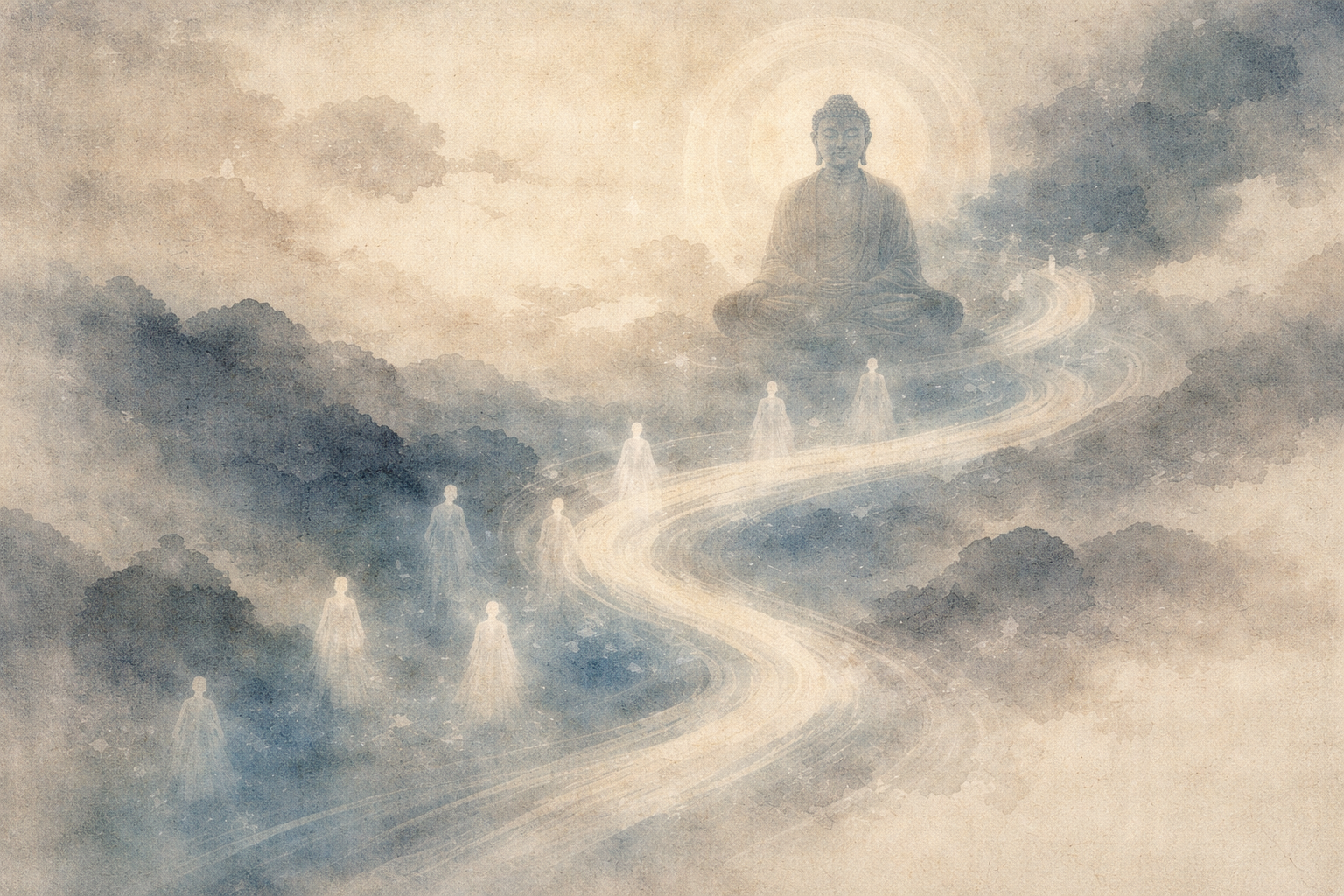
In this phrase, “Buddha” is not primarily a person. It’s the mind’s tendency to create an ideal—perfect calm, perfect wisdom, perfect goodness—and then measure life against it. The ideal feels inspiring at first, but it can quickly become a screen between you and your actual experience, like looking at a photo of the ocean while ignoring the sound of waves right outside.
In ordinary situations, this shows up as leaning on a concept to feel secure. At work, it might be the thought, “A wise person wouldn’t feel irritated,” followed by shame when irritation appears. In relationships, it might be, “If I were truly spiritual, I wouldn’t need reassurance,” followed by silence instead of honesty. The “Buddha” being “killed” is that rigid inner standard that turns living feelings into evidence for or against your worth.
It can also be the habit of borrowing certainty. When you’re tired, stressed, or lonely, the mind wants something solid to hold: a quote, a rule, a holy image of how things should be. Zen’s bluntness is a way of saying that borrowed certainty is still a kind of restlessness. It keeps attention pointed at an idea rather than at the immediate texture of this moment.
Even “Buddha” as a symbol of goodness can become a problem when it’s used to split life into acceptable and unacceptable parts. Then fatigue becomes “unspiritual,” anger becomes “failure,” and silence becomes something to achieve rather than something already present. The phrase pushes against that split, not by replacing it with a new belief, but by removing the need for a protected, idealized reference point.
GASSHO
Ask and learn about Buddhism in daily life.
GASSHO is a Buddhist community app where you can learn Buddhist teachings and ask questions to the head priest of Kongosanmaiin Temple on Mount Koya.
How “Kill the Buddha” Feels in Ordinary Moments
It often begins as a small inner jolt: noticing that you’re trying to be a certain kind of person rather than meeting what’s here. Maybe you’re listening to someone you love, but half your attention is on whether you’re listening “well enough.” The phrase points to that extra layer—the self-monitoring that turns a simple moment into a performance.
In a busy day, it can look like chasing a calm state as if calm were a badge. You finish one task and immediately reach for another, then feel disappointed that you’re not peaceful. “Kill the Buddha” is the moment you see the chase itself: the mind trying to secure an identity called “the calm one,” while the body is simply breathing and the room is simply a room.
In conflict, the “Buddha” you might need to kill is the inner judge that insists you must be above the mess. You might feel heat in the chest, a tightening in the jaw, and then the thought, “I shouldn’t be like this.” The phrase doesn’t ask you to justify anger or indulge it. It points to the added suffering of turning a human reaction into a spiritual problem that needs to be hidden.
In silence, it can show up as expecting silence to deliver something—an answer, a sign, a special clarity. Then silence becomes another product the mind wants from the moment. “Kill the Buddha” is the soft recognition that the wanting is louder than the silence, and that the silence doesn’t need to perform.
In fatigue, the mind often reaches for ideals as a way to push through: “A strong practitioner wouldn’t be this drained.” That thought can feel motivating, but it also hardens the day. The phrase points to the possibility of dropping the idealized self-image and simply acknowledging tiredness as tiredness—without turning it into a verdict.
In moments of success, the “Buddha” can become a trophy. You handle something well and immediately build a story: “Now I’m getting it.” Then the next mistake feels like a fall from grace. “Kill the Buddha” is the refusal to turn a clean moment into a permanent identity, because identity is exactly what gets threatened.
Even in kindness, the mind can cling. You do something generous and then subtly watch yourself doing it, hoping it confirms you’re a good person. The phrase points to that subtle grasping. Not to condemn it, but to notice how quickly the mind turns living action into a self-portrait.
Where People Get Stuck With This Phrase
A common misunderstanding is to hear “kill the Buddha” as cynicism—like Zen is saying nothing matters, so you might as well discard respect, ethics, or tradition. But the phrase is aimed at clinging, not care. It’s pointing to the way the mind can use even the highest symbols as a shield against vulnerability and uncertainty.
Another misunderstanding is to treat it as permission to be dismissive: “I don’t need teachers, texts, or community because Zen says kill the Buddha.” That move can be another form of clinging—clinging to independence as an identity. The phrase is less about rejecting external forms and more about noticing the inner grasp that turns any form into an idol.
Some people also turn the phrase into a dramatic inner battle, as if they must destroy thoughts or force the mind into emptiness. That tends to create more tension. The “killing” here is not a violent mental act; it’s the simple, repeated recognition of when an idea has become a substitute for direct contact with what’s happening.
And sometimes the phrase is misunderstood as anti-Buddha, when it’s actually anti-fixation. The mind loves to freeze living reality into something it can hold. “Buddha” can become one more frozen thing. The phrase is a reminder that what’s alive can’t be possessed, only met.
Why This Teaching Touches Daily Life So Directly
Most suffering in daily life isn’t caused by a lack of spiritual ideas. It’s caused by the extra layer of clinging—wanting certainty in a conversation, wanting control over a mood, wanting a clean self-image in a messy week. “Kill the Buddha” matters because it points to that extra layer without requiring a new identity to replace it.
In relationships, it can soften the habit of keeping score: who is more mature, who is more patient, who is more “awake.” When that scoring relaxes, what remains is often simpler: tone of voice, timing, the need to be heard, the wish to be understood. The phrase points back to what is actually happening between people, not what should be happening according to an ideal.
At work, it can loosen the pressure to be flawless. Not by lowering standards, but by removing the spiritualized fear of being seen as imperfect. Then a mistake is just a mistake, feedback is just feedback, and the day is just the day. The mind doesn’t have to protect a sacred self-image while answering emails.
In quiet moments—washing dishes, walking to the store, sitting in a car—this teaching can feel like a small release from the need to interpret everything. Life doesn’t have to prove anything. The phrase points to the ordinary immediacy that’s already available, before the mind builds a statue out of it.
Conclusion
“Kill the Buddha” is a way of letting go of the mind’s habit of turning living reality into something to worship or fear. When the idol drops, what remains is not an answer, but the plainness of this moment. The Dharma is close enough to be verified in the next breath, the next word, the next ordinary task.
Ask a Buddhist priest
Have a question about Buddhism?
In the GASSHO app, you can ask questions about Buddhist teachings, daily concerns, and how to understand Buddhism in everyday life.
Frequently Asked Questions
- FAQ 1: What does “kill the Buddha” mean in Zen?
- FAQ 2: Is “kill the Buddha” meant literally?
- FAQ 3: Why does Zen use such a harsh phrase like “kill the Buddha”?
- FAQ 4: Does “kill the Buddha” mean Zen is anti-Buddhist?
- FAQ 5: Who is the “Buddha” you’re supposed to “kill” in Zen?
- FAQ 6: How does “kill the Buddha” relate to attachment in Zen?
- FAQ 7: Is “kill the Buddha” about rejecting teachers or scriptures?
- FAQ 8: What is the practical meaning of “kill the Buddha” in daily life?
- FAQ 9: Does “kill the Buddha” mean you shouldn’t respect the Buddha?
- FAQ 10: How can “kill the Buddha” be understood without Zen jargon?
- FAQ 11: Is “kill the Buddha” the same as saying “nothing is sacred”?
- FAQ 12: Why do people quote “kill the Buddha” so often in Zen?
- FAQ 13: Can “kill the Buddha” be used to justify rude or dismissive behavior?
- FAQ 14: How does “kill the Buddha” relate to the idea of awakening in Zen?
- FAQ 15: What should I remember when reading “kill the Buddha” in Zen texts?
FAQ 1: What does “kill the Buddha” mean in Zen?
Answer: In Zen, “kill the Buddha” means letting go of clinging to an idea of Buddha—an idealized image of perfection, certainty, or awakening that the mind uses as a substitute for direct experience. It points to dropping mental idols, not rejecting compassion or wisdom.
Takeaway: The phrase targets fixation on an image, not the living reality it points toward.
FAQ 2: Is “kill the Buddha” meant literally?
Answer: No. It is not a literal statement about harming anyone. It is a provocative way of saying that if “Buddha” becomes a rigid concept you cling to, that clinging should be cut through so you can meet reality directly.
Takeaway: It’s symbolic language aimed at attachment, not violence.
FAQ 3: Why does Zen use such a harsh phrase like “kill the Buddha”?
Answer: Zen sometimes uses blunt language to interrupt habitual thinking. A softer phrase can be absorbed as “nice advice,” while a sharp phrase exposes how strongly the mind clings to sacred images and certainty.
Takeaway: The harshness is meant to wake up attention, not to promote disrespect.
FAQ 4: Does “kill the Buddha” mean Zen is anti-Buddhist?
Answer: No. The phrase critiques attachment to concepts, including religious concepts. It’s aimed at the tendency to turn “Buddha” into an external authority or a mental idol rather than a pointer to immediate experience.
Takeaway: It challenges clinging, not Buddhism itself.
FAQ 5: Who is the “Buddha” you’re supposed to “kill” in Zen?
Answer: It refers to the Buddha as an idea you cling to—such as a perfect standard, a comforting belief, or a spiritual identity. When that idea blocks direct seeing, Zen says to drop it.
Takeaway: The “Buddha” here is often a mental picture, not a person.
FAQ 6: How does “kill the Buddha” relate to attachment in Zen?
Answer: It highlights that attachment can form around “good” things too—teachings, ideals, and holy images. When you cling to them for security, they can become obstacles rather than supports.
Takeaway: Even sacred concepts can become a form of grasping.
FAQ 7: Is “kill the Buddha” about rejecting teachers or scriptures?
Answer: Not necessarily. It’s about noticing when reliance becomes dependency—when a teacher, text, or quote is used to avoid meeting your own experience. The issue is clinging, not learning.
Takeaway: The phrase warns against outsourcing clarity to authority.
FAQ 8: What is the practical meaning of “kill the Buddha” in daily life?
Answer: Practically, it points to dropping the need to maintain a spiritual self-image—like needing to be calm, wise, or “above it.” It’s a reminder to meet irritation, fatigue, and uncertainty without turning them into a verdict about who you are.
Takeaway: It’s about releasing the extra layer of self-protection around experience.
FAQ 9: Does “kill the Buddha” mean you shouldn’t respect the Buddha?
Answer: Respect and clinging are different. Zen is pointing out that respect can quietly turn into idolization, where “Buddha” becomes a fixed ideal used to judge yourself and others.
Takeaway: Respect can remain, while fixation can drop.
FAQ 10: How can “kill the Buddha” be understood without Zen jargon?
Answer: It can be understood as: “Don’t cling to your idea of what enlightenment or goodness should look like.” When an ideal becomes a shield from real feelings and real situations, let the shield go.
Takeaway: Drop the ideal; meet the moment.
FAQ 11: Is “kill the Buddha” the same as saying “nothing is sacred”?
Answer: Not exactly. It’s more like saying that what is most meaningful can’t be reduced to a concept you possess. When “sacred” becomes a rigid object in the mind, Zen pushes you back toward direct contact rather than ownership.
Takeaway: It’s not nihilism; it’s a warning against turning life into an object.
FAQ 12: Why do people quote “kill the Buddha” so often in Zen?
Answer: Because it captures a central Zen concern: the mind’s tendency to cling to symbols and turn them into identity. It’s memorable, but it can also be misunderstood when repeated as a slogan rather than examined in experience.
Takeaway: The quote is common because the habit it points to is common.
FAQ 13: Can “kill the Buddha” be used to justify rude or dismissive behavior?
Answer: It can be misused that way, but that misses the point. The phrase is aimed at inner clinging and self-deception, not at giving permission to disregard others or act carelessly.
Takeaway: Cutting through illusion is not the same as being harsh with people.
FAQ 14: How does “kill the Buddha” relate to the idea of awakening in Zen?
Answer: It points to how “awakening” can become another object the mind grasps—an imagined finish line or identity. When awakening is held as a concept to possess, it can obscure the immediacy of experience that Zen emphasizes.
Takeaway: Awakening isn’t helped by clinging to an image of awakening.
FAQ 15: What should I remember when reading “kill the Buddha” in Zen texts?
Answer: Remember that Zen often speaks in strong medicine for a subtle habit: turning pointers into possessions. Read it as a reminder to release fixation on sacred images and return to what is actually happening in front of you.
Takeaway: Don’t worship the pointer—notice what it points to.