



The Lotus: Why Purity Grows from Mud
Quick Summary
- In Buddhism, the lotus flower symbol points to purity that isn’t separate from difficulty—it rises through it.
- “Mud” isn’t treated as a mistake; it represents ordinary conditions like stress, confusion, and imperfect relationships.
- The lotus image emphasizes how clarity can appear without needing life to become clean first.
- Different lotus colors are often used to highlight different qualities (like clarity, compassion, or wisdom), without requiring a single fixed meaning.
- The symbol is less about being “pure” and more about not being owned by what’s messy.
- Seen in art and stories, the lotus works as a reminder: what’s difficult can be the very ground of awakening.
- In daily life, the lotus points back to small moments of noticing—before reaction hardens into habit.
Introduction
If “lotus flower symbol Buddhism” sounds like a pretty decoration with a vague message—“be pure,” “stay positive,” “rise above”—that confusion is understandable, and it also misses the point. The lotus isn’t asking anyone to escape the mud; it’s pointing to how a mind can be unstained even while life stays complicated, loud, and unfinished. This explanation is written for Gassho, a Zen/Buddhism site focused on grounded, everyday clarity.
The lotus grows in murky water and still opens cleanly to the light. That simple botanical fact became a visual shorthand for something people recognize in themselves: the possibility of steadiness in the middle of pressure, and tenderness in the middle of disappointment. The symbol endures because it doesn’t require ideal conditions—it speaks to the conditions most people actually have.
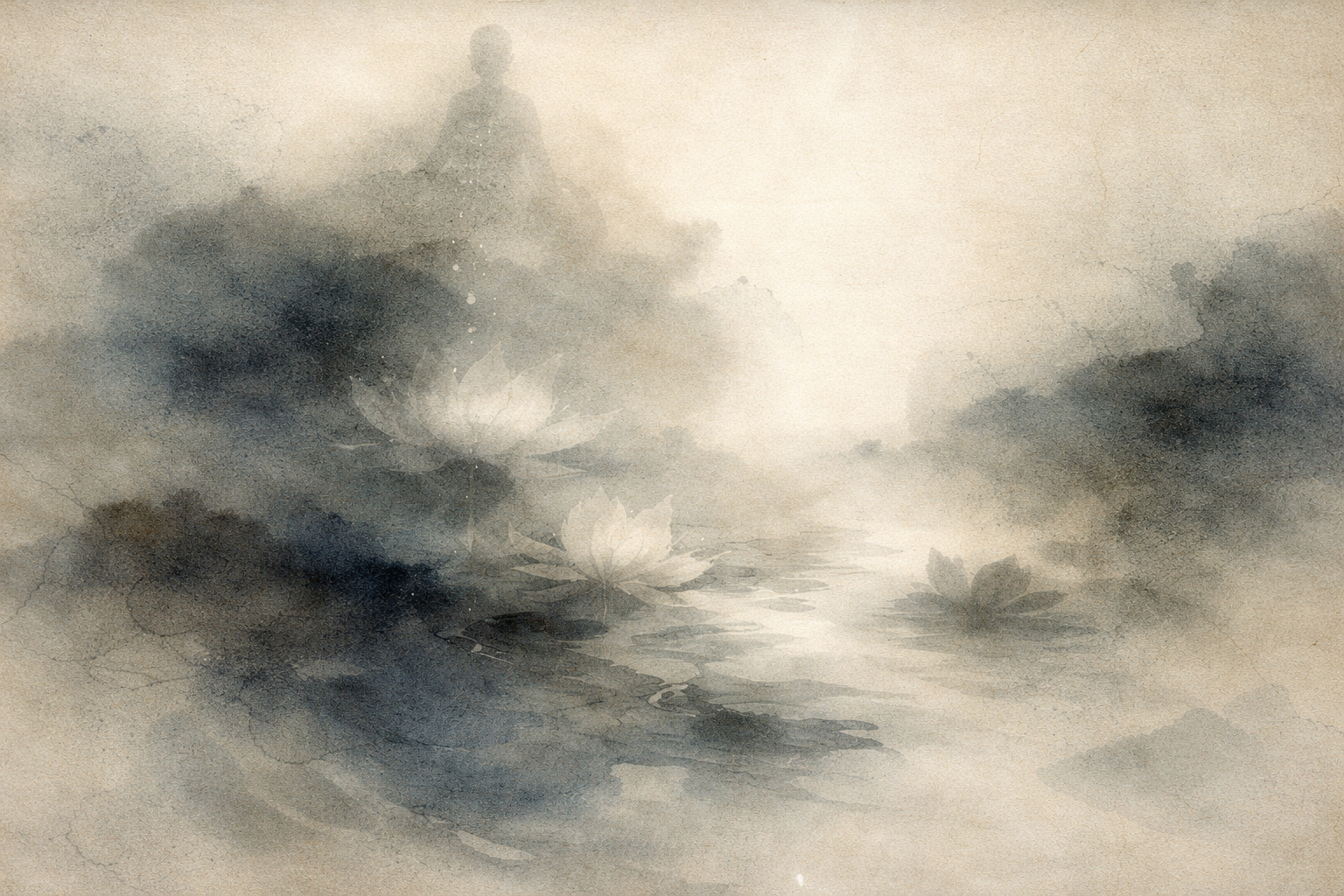
When the lotus appears beneath a figure in Buddhist art, it often signals dignity that isn’t borrowed from status, success, or mood. It suggests a kind of inner cleanliness that doesn’t come from controlling everything, but from not being dragged around by everything. The image is quiet, but it’s not passive.
The Lotus as a Lens for Purity Without Denial
As a symbol in Buddhism, the lotus flower is less a moral badge and more a way of seeing experience. “Purity” here doesn’t mean spotless behavior or a permanently calm personality. It points to the capacity for awareness to remain clear even when thoughts, emotions, and circumstances are mixed.
Mud is part of the image on purpose. It stands in for the ordinary conditions people tend to resist: fatigue at work, resentment in a relationship, the dullness of routine, the sting of being misunderstood. The lotus doesn’t pretend those conditions aren’t there. It suggests that clarity can be present without waiting for those conditions to disappear.
In everyday terms, this can look like being in a tense meeting and noticing the body tighten—jaw, shoulders, breath—without immediately turning that tension into a story about enemies or failure. The situation may still be unpleasant. The “lotus” aspect is the small space where noticing happens before the mind adds extra mud.
It can also look like silence at home after an argument: the mind wants to rehearse what should have been said, or predict what will happen next. The lotus image points to the possibility that awareness can hold the discomfort without needing to win it, fix it, or dramatize it. Nothing mystical—just a different relationship to what’s already here.
GASSHO
Ask and learn about Buddhism in daily life.
GASSHO is a Buddhist community app where you can learn Buddhist teachings and ask questions to the head priest of Kongosanmaiin Temple on Mount Koya.
How the Symbol Shows Up in Ordinary Moments
In lived experience, “mud” often arrives as speed. The day moves fast, attention fragments, and the mind starts living one step ahead—planning, defending, comparing. The lotus symbol becomes relevant right there, not as an idea, but as a contrast: the possibility of being present without being smeared by the rush.
Sometimes the mud is emotional heat. A message is read the wrong way. A tone of voice lands sharply. Before anything is said out loud, there is a surge—tightness in the chest, a quickening in the breath, a narrowing of attention. The lotus points to the moment of noticing that surge as a surge, rather than immediately treating it as proof that someone is wrong.
Sometimes the mud is dullness. Not dramatic suffering—just the gray feeling of repeating the same tasks, the same commute, the same responsibilities. In that dullness, the mind may look for stimulation or drift into complaint. The lotus image quietly suggests that clarity doesn’t require excitement; it can appear as simple contact with what’s being done.
In relationships, mud can be the old reflex to protect an identity: the one who is right, the one who is competent, the one who is easygoing. When that identity feels threatened, the mind scrambles to restore it. The lotus symbol, held gently, points to dignity that doesn’t depend on winning the moment.
At work, mud can be the constant measuring: productivity, recognition, the fear of falling behind. Even when things go well, the mind can stay braced, as if success must be defended. The lotus points to a steadiness that isn’t built from reassurance. It’s the steadiness of seeing pressure as pressure, without turning it into a verdict on the self.
In the body, mud can be simple discomfort—restlessness, aches, the urge to adjust, the urge to check the phone. The lotus image doesn’t demand a perfect posture or a perfect mood. It points to the possibility of being intimate with sensation without immediately making it a problem that must be solved.
Even in quiet moments—washing dishes, waiting in line, sitting in a parked car—mud can be the mind’s habit of leaving. The lotus symbol is a reminder that leaving isn’t mandatory. Attention can return, again and again, without drama, and without needing the moment to become special.
Misreadings That Make the Lotus Feel Unreal
A common misunderstanding is to treat the lotus as a demand for constant serenity: if the lotus is pure, then anger or grief must mean failure. But the symbol includes the mud. It doesn’t erase human reactions; it points to not being defined by them.
Another misreading is to turn “rising from the mud” into a story of self-improvement where difficult feelings are merely obstacles to overcome. That framing can make ordinary life feel like a problem to fix before it can be lived. The lotus symbol is quieter: it suggests that difficulty can be the very place where clarity is recognized.
It’s also easy to make the lotus purely decorative—an aesthetic associated with calm spaces, candles, and soft music—while leaving daily reactivity untouched. That’s not a moral critique; it’s just how symbols get flattened when they’re separated from experience. The lotus becomes meaningful again when it’s remembered in the middle of irritation, fatigue, or uncertainty.
Finally, some people assume the lotus has one fixed meaning that must be memorized correctly. In practice, symbols work more like mirrors than definitions. The lotus can point to purity, resilience, dignity, or openness depending on what is being lived. The image stays the same; what it reveals can change from day to day.
Where the Lotus Meets the Texture of Daily Life
The lotus flower symbol in Buddhism matters because it doesn’t ask for a different life. It speaks directly to this one: the email that lands wrong, the family dynamic that repeats, the tired evening when patience runs thin. The symbol doesn’t solve those moments; it reframes what they can be.
In small ways, the lotus shows up as the difference between being swept away and being aware of being swept away. The day can still be messy. The mind can still react. And yet there can be a clean thread running through it: a simple knowing of what is happening.
It can also soften the harsh inner standard that says purity means never struggling. The lotus suggests that struggle is not disqualifying. The mud is not a personal flaw; it’s the shared condition of being human—busy, sensitive, imperfect, and still capable of clarity.
Over time, the symbol becomes less like a concept and more like a quiet companion. Not something to display, but something that occasionally comes to mind when the heart feels crowded. The lotus doesn’t add anything new; it reminds what is already possible in the middle of what is already here.
Conclusion
The lotus opens without arguing with the mud. In the same way, clarity can appear without life first becoming neat. When conditions feel thick or unclear, the symbol simply points back to what is aware of that thickness. The rest is verified in ordinary moments.
Ask a Buddhist priest
Have a question about Buddhism?
In the GASSHO app, you can ask questions about Buddhist teachings, daily concerns, and how to understand Buddhism in everyday life.
Frequently Asked Questions
- FAQ 1: What does the lotus flower symbol mean in Buddhism?
- FAQ 2: Why is the lotus associated with purity in Buddhism?
- FAQ 3: What does “growing from mud” symbolize in Buddhist teachings?
- FAQ 4: Is the lotus flower symbol the same across all Buddhist cultures?
- FAQ 5: What do different lotus colors mean in Buddhism?
- FAQ 6: What is the meaning of a closed lotus bud versus an open lotus in Buddhism?
- FAQ 7: Why are Buddhist figures often shown sitting or standing on a lotus?
- FAQ 8: Does the lotus flower symbol represent enlightenment in Buddhism?
- FAQ 9: What is the relationship between the lotus symbol and compassion in Buddhism?
- FAQ 10: How is the lotus used in Buddhist art and iconography?
- FAQ 11: Is the lotus flower symbol connected to rebirth in Buddhism?
- FAQ 12: What does a lotus mandala represent in Buddhism?
- FAQ 13: Are lotus tattoos considered Buddhist symbols?
- FAQ 14: How does the lotus symbol differ in Buddhism versus Hinduism?
- FAQ 15: What is the simplest way to understand the lotus flower symbol in Buddhism?
FAQ 1: What does the lotus flower symbol mean in Buddhism?
Answer: In Buddhism, the lotus flower symbol commonly points to purity and clarity that are not separate from difficult conditions. Because a lotus grows in muddy water yet blooms cleanly, it’s used as an image for an unstained mind appearing within ordinary confusion, stress, and imperfection.
Takeaway: The lotus suggests purity that can exist within life as it is.
FAQ 2: Why is the lotus associated with purity in Buddhism?
Answer: The lotus is associated with purity because it rises from murky water and opens above the surface without carrying the mud on its petals. Symbolically, this reflects the possibility of clarity and integrity even when the surrounding conditions are messy or emotionally charged.
Takeaway: Purity here means “unstained,” not “untouched by life.”
FAQ 3: What does “growing from mud” symbolize in Buddhist teachings?
Answer: “Growing from mud” symbolizes that awakening and inner clarity are not dependent on perfect circumstances. The “mud” can be read as everyday suffering, confusion, and reactive habits—conditions that are acknowledged rather than denied.
Takeaway: The difficult parts of life are included in the path, not excluded from it.
FAQ 4: Is the lotus flower symbol the same across all Buddhist cultures?
Answer: The lotus is widely recognized across Buddhist cultures, but its emphasis can vary by region, art style, and context. The core association—purity arising within ordinary conditions—tends to remain, while details (like color meanings or artistic conventions) may differ.
Takeaway: The lotus is shared, but its nuances can be culturally shaped.
FAQ 5: What do different lotus colors mean in Buddhism?
Answer: Lotus colors are often used symbolically in Buddhist contexts. While meanings can vary, common associations include: white with purity, pink with the “classic” lotus ideal, red with compassion, and blue with wisdom or insight. These are interpretive cues rather than strict rules.
Takeaway: Color symbolism is suggestive—meant to point, not to lock meaning in.
FAQ 6: What is the meaning of a closed lotus bud versus an open lotus in Buddhism?
Answer: A closed lotus bud is often used to suggest potential or what has not yet opened, while an open lotus suggests full expression of purity and clarity. In Buddhist imagery, this can function as a gentle visual metaphor for what is latent versus what is revealed.
Takeaway: Bud and bloom can symbolize potential and openness without implying a rigid “rank.”
FAQ 7: Why are Buddhist figures often shown sitting or standing on a lotus?
Answer: A lotus seat in Buddhist art often indicates spiritual dignity and an unstained quality. It visually communicates that the figure’s clarity is not dependent on worldly conditions, much like the lotus rises above muddy water without being dirtied by it.
Takeaway: The lotus base is a symbol of unshakable dignity rather than social status.
FAQ 8: Does the lotus flower symbol represent enlightenment in Buddhism?
Answer: The lotus can represent enlightenment in a broad symbolic sense, especially as an image of awakening that appears within ordinary conditions. However, it’s also used more generally to point to purity, clarity, and the possibility of being untainted by confusion even before anything feels “resolved.”
Takeaway: The lotus can point to awakening, but it also points to everyday clarity.
FAQ 9: What is the relationship between the lotus symbol and compassion in Buddhism?
Answer: The lotus is sometimes linked with compassion because it suggests a heart that can remain open and clean even when surrounded by suffering. In that sense, compassion is not portrayed as sentimental positivity, but as steadiness and care that can arise within difficulty.
Takeaway: The lotus can hint at compassion that isn’t overwhelmed by the world’s “mud.”
FAQ 10: How is the lotus used in Buddhist art and iconography?
Answer: In Buddhist art, the lotus appears as a pedestal, a hand-held flower, a pattern in halos, and decorative motifs in temples and manuscripts. Its role is typically symbolic: it visually communicates purity, clarity, and the emergence of what is noble from ordinary conditions.
Takeaway: In iconography, the lotus is a visual shorthand for “unstained clarity.”
FAQ 11: Is the lotus flower symbol connected to rebirth in Buddhism?
Answer: The lotus can be connected to rebirth in some Buddhist imagery and stories, where it suggests emergence into a new condition or a purified state. More broadly, it can also symbolize moment-to-moment renewal: the possibility of not being fixed by what just happened.
Takeaway: The lotus can suggest renewal, whether interpreted cosmically or psychologically.
FAQ 12: What does a lotus mandala represent in Buddhism?
Answer: A lotus mandala often uses the lotus as an organizing pattern to express harmony, purity, and an ordered wholeness emerging from complexity. The lotus form can indicate a centered clarity, with petals suggesting radiating qualities or aspects of awakened life.
Takeaway: A lotus mandala uses the flower’s structure to symbolize centered, unfolding clarity.
FAQ 13: Are lotus tattoos considered Buddhist symbols?
Answer: Lotus tattoos are often inspired by Buddhist symbolism, especially the themes of purity, resilience, and clarity arising from difficulty. Whether a tattoo is “Buddhist” depends on the wearer’s intent and context, but the lotus image itself is widely recognized as a Buddhist-associated symbol.
Takeaway: A lotus tattoo commonly echoes Buddhist themes, even when worn in a personal, non-religious way.
FAQ 14: How does the lotus symbol differ in Buddhism versus Hinduism?
Answer: Both Buddhism and Hinduism use the lotus as a sacred symbol, often connected with purity and divine or awakened qualities. In Buddhism, the lotus is frequently emphasized as purity arising within suffering and ordinary conditions, while Hindu contexts may more often highlight divine beauty, auspiciousness, and cosmic order (though there is overlap).
Takeaway: The lotus is shared across traditions, but Buddhist usage often stresses “unstained within the mud.”
FAQ 15: What is the simplest way to understand the lotus flower symbol in Buddhism?
Answer: The simplest understanding is: the lotus blooms cleanly even though it grows in mud. In Buddhism, that becomes a symbol for clarity and purity that can appear in the middle of stress, confusion, and imperfect life—without needing those conditions to vanish first.
Takeaway: The lotus points to purity that doesn’t require a perfect world.