



Buddhist Paintings: Themes, Symbols, and Different Traditions
Quick Summary
- Buddhist paintings are visual “teaching tools” that point attention toward qualities like clarity, compassion, and steadiness.
- Common themes include the Buddha’s life, bodhisattvas, protectors, pure lands, and symbolic landscapes.
- Symbols—mudras, lotus flowers, halos, colors, and animals—work like a visual language with layered meanings.
- Different regions developed distinct styles: Indian roots, Tibetan thangka traditions, Chinese and Korean ink painting, and Japanese iconography.
- These images are not “just decoration”; they shape mood, attention, and ethical intention in a room.
- Reading a Buddhist painting well means noticing composition, gesture, and context—not only identifying the figure.
- Respectful viewing is simple: slow down, look carefully, and let the image do its quiet work.
Introduction
You can look at Buddhist paintings for years and still feel unsure what you’re actually seeing: a calm face, a busy halo, a hand gesture, a fierce figure, a sea of gold—yet the meaning stays just out of reach. The confusion usually comes from treating these images like ordinary “art subjects” instead of a visual language designed to train attention and communicate values without many words. At Gassho, we focus on practical, grounded ways to read Buddhist imagery without turning it into a quiz or a belief test.
Buddhist paintings appear across temples, homes, museums, and modern studios, but their purpose tends to stay consistent: they offer a stable reference point for the mind. Whether the style is delicate ink wash or dense, jewel-like color, the image is often built to guide how you look—where your eyes rest, what you notice first, and what emotional tone is encouraged.
This matters because the “content” of a Buddhist painting is not only the figure depicted; it’s also the atmosphere it creates. A serene Buddha can soften agitation. A compassionate bodhisattva can remind you to respond rather than react. A protector can mirror the energy needed to cut through confusion. The painting becomes a mirror for inner states, not a demand for agreement.
A Clear Lens for Understanding Buddhist Paintings
A helpful way to approach Buddhist paintings is to see them as intentional compositions that shape attention. Instead of asking, “Do I believe in this figure?” try asking, “What quality is this image training me to recognize?” The painting is less a statement about the world and more a method for orienting the mind toward steadiness, care, and insight.
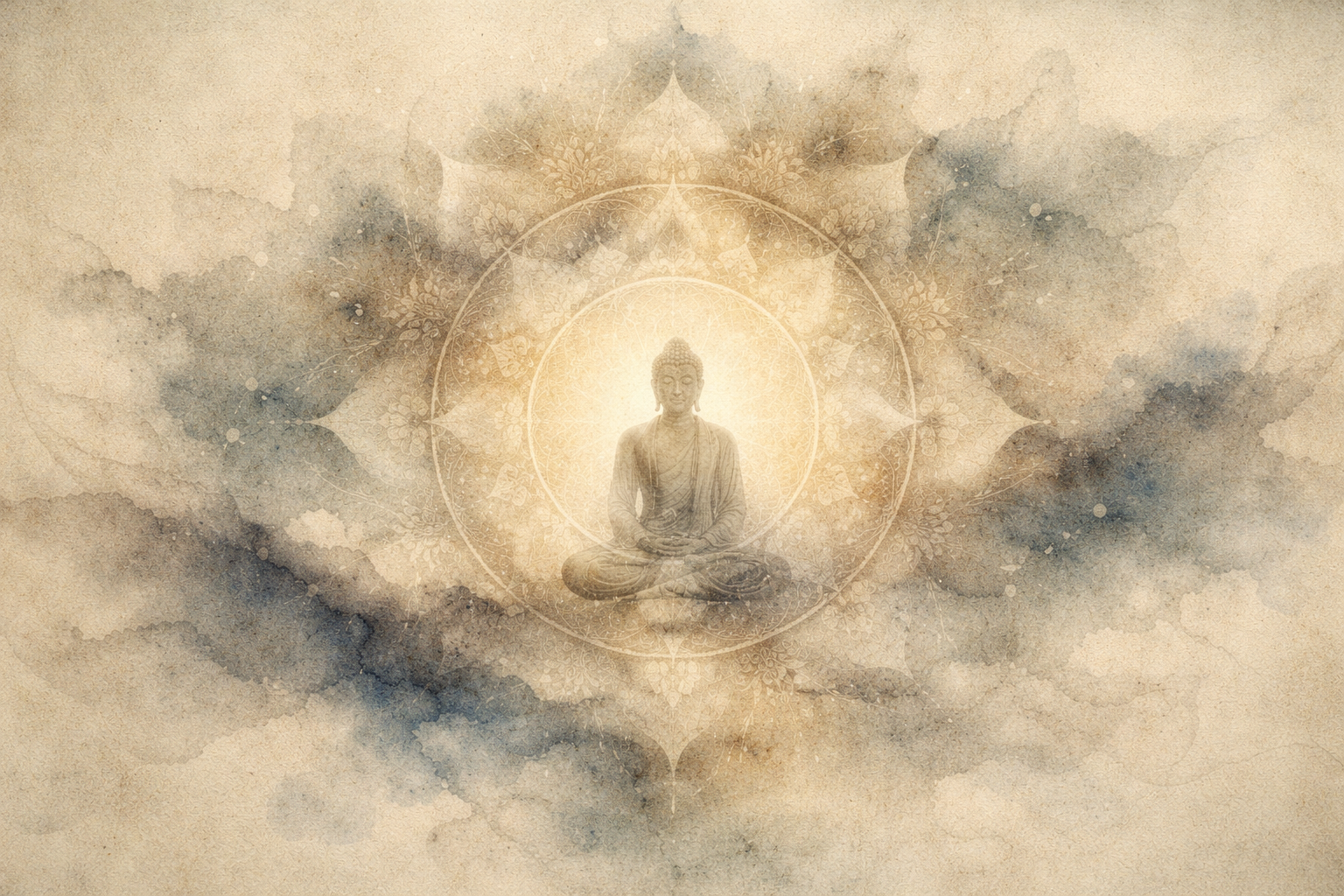
In this lens, symbols are not random decorations. A lotus is not merely pretty; it suggests purity emerging from messy conditions. A halo is not just a glow effect; it indicates awakened clarity. Hand gestures are not theatrical poses; they communicate specific attitudes—reassurance, teaching, generosity, fearlessness. The painting becomes readable when you treat it like a vocabulary.
Composition matters as much as iconography. Central placement can signal stability. Symmetry can calm the eye. Repetition of patterns can create a rhythmic, almost meditative viewing experience. Even fierce imagery can be composed to feel contained and purposeful rather than chaotic, pointing to the possibility of meeting strong emotions without being ruled by them.
Most importantly, Buddhist paintings are designed to be met slowly. Their meaning often unfolds through sustained looking: first you notice the figure, then the gesture, then the supporting symbols, then the background world, and finally the mood the whole image leaves in your body. That shift—from quick recognition to patient seeing—is part of the point.
GASSHO
Ask and learn about Buddhism in daily life.
GASSHO is a Buddhist community app where you can learn Buddhist teachings and ask questions to the head priest of Kongosanmaiin Temple on Mount Koya.
How These Images Show Up in Everyday Experience
When you first stand in front of a Buddhist painting, the mind often does what it always does: it labels. “Buddha.” “Gold.” “Scary.” “Beautiful.” That quick labeling can be useful, but it can also end the encounter too soon, as if naming the subject equals understanding it.
If you stay a little longer, you may notice your attention moving in patterns. Your eyes return to the face. They follow the curve of a hand. They pause on a lotus or a wheel. This is ordinary attention at work—drawn, released, drawn again—and the painting quietly reveals how restless or steady you feel that day.
Emotional reactions show up quickly too. A peaceful image can feel comforting, or it can feel strangely distant if you’re stressed. A wrathful protector can feel threatening, or it can feel like relief—an image that “permits” strength and boundary. The painting doesn’t force a single response; it makes your current response visible.
Many people notice a subtle shift when they stop trying to “get it right” and instead let the image set a pace. Breathing slows. The shoulders drop. The gaze softens. This isn’t mystical; it’s what happens when you give the nervous system a stable, coherent object to rest on.
Details begin to matter in a different way. You might see that the figure’s posture is upright but not rigid, suggesting alert ease. You might notice that the eyes are lowered, not to avoid the world, but to indicate inward steadiness. You might see that the background is not empty; it’s a world arranged to support the central quality being expressed.
Over time, Buddhist paintings can become a kind of emotional weather report. On some days you’ll feel nothing. On other days a single symbol—an open palm, a bowl, a simple robe—lands with surprising force. The image hasn’t changed; your capacity to notice has.
In ordinary life, this can translate into small moments: pausing before replying, recognizing irritation before it becomes speech, remembering compassion when it would be easier to dismiss someone. The painting is not doing the work for you; it’s reminding you what “work” looks like in the first place.
Common Misunderstandings About Buddhist Paintings
One common misunderstanding is assuming Buddhist paintings are meant to be “worshipped” in a simplistic sense. In many contexts they are treated with respect, but their deeper function is often educational and contemplative: they point to qualities to cultivate and patterns to recognize in the mind.
Another misunderstanding is reading every image as literal history. Some paintings depict events from the Buddha’s life, but many are symbolic maps of inner life—compassion, wisdom, protection, generosity—expressed through figures and landscapes. Treating everything as either “fact” or “fiction” misses how symbolic art works.
People also assume wrathful figures represent evil or violence. In Buddhist visual language, fierce expressions often symbolize the energy of cutting through confusion and protecting what is wholesome. The intensity is directed at ignorance and harmful patterns, not at ordinary human vulnerability.
It’s also easy to think you must memorize names, Sanskrit terms, or complex iconography to appreciate Buddhist paintings. Knowledge helps, but the first level of understanding is experiential: what does the image invite you to notice, and what does it do to your attention when you look carefully?
Finally, modern viewers sometimes flatten Buddhist paintings into “aesthetic mindfulness décor.” Beauty can be part of the method, but the images are usually built to communicate ethics and insight. If you only treat them as a vibe, you miss the message embedded in posture, gesture, and symbol.
Why Buddhist Paintings Still Matter Today
Buddhist paintings matter because they offer a non-verbal way to remember what you value. In a day filled with fast content and constant opinion, an image that asks you to slow down can be quietly radical. It doesn’t argue; it steadies.
They also preserve cultural memory. Different regions developed distinct visual solutions—how to show compassion, how to depict awakening, how to represent protection—while keeping a shared symbolic grammar. Learning to see these differences can deepen respect for the diversity of Buddhist traditions without turning it into a competition.
On a personal level, Buddhist paintings can support ethical intention. A simple image of generosity can nudge you toward giving. A depiction of calm presence can remind you to listen fully. A scene of impermanence can soften the grip of “this must go my way.” These are small shifts, but they accumulate.
Even in a museum context, where the painting is removed from ritual life, it can still function as a training in attention. If you let yourself look without rushing, you practice patience, nuance, and humility—qualities that are increasingly rare and increasingly needed.
Conclusion
Buddhist paintings are best understood as a visual practice: a way of shaping attention through symbol, composition, and mood. When you stop demanding instant interpretation and start looking slowly, the images become less mysterious and more practical—quiet reminders of clarity, compassion, and steadiness.
If you want a simple next step, choose one painting and spend three minutes with it. Notice where your eyes go, what you feel in your body, and which details you keep returning to. That’s already the beginning of “reading” Buddhist paintings in the way they were meant to be read.
Ask a Buddhist priest
Have a question about Buddhism?
In the GASSHO app, you can ask questions about Buddhist teachings, daily concerns, and how to understand Buddhism in everyday life.
GASSHO is an app for exploring Buddhism in everyday life.
Learn more about Buddhist deities.


Frequently Asked Questions
- FAQ 1: What are Buddhist paintings meant to do?
- FAQ 2: How can I identify the figure in a Buddhist painting?
- FAQ 3: What do hand gestures mean in Buddhist paintings?
- FAQ 4: Why is the lotus so common in Buddhist paintings?
- FAQ 5: What does a halo or aura represent in Buddhist paintings?
- FAQ 6: Are wrathful figures in Buddhist paintings considered evil?
- FAQ 7: What is a thangka, and is it a type of Buddhist painting?
- FAQ 8: How do Chinese and Japanese Buddhist paintings differ from Tibetan styles?
- FAQ 9: What are common themes shown in Buddhist paintings?
- FAQ 10: Do colors have specific meanings in Buddhist paintings?
- FAQ 11: Can Buddhist paintings be appreciated without religious belief?
- FAQ 12: What should I pay attention to first when viewing Buddhist paintings?
- FAQ 13: Is it disrespectful to display Buddhist paintings at home?
- FAQ 14: How can I tell if a Buddhist painting is traditional or modern?
- FAQ 15: What’s the best way to learn the symbolism in Buddhist paintings?
FAQ 1: What are Buddhist paintings meant to do?
Answer: Buddhist paintings are typically meant to guide attention and communicate qualities like awakening, compassion, protection, and ethical intention through a symbolic visual language, not just to decorate a space.
Takeaway: Treat Buddhist paintings as visual teachings as much as artworks.
FAQ 2: How can I identify the figure in a Buddhist painting?
Answer: Look for consistent identifiers such as hand gestures (mudras), objects held (lotus, vajra, bowl), posture, throne or seat, halo style, and accompanying attendants or animals; these clues often matter more than facial features.
Takeaway: Identification comes from attributes and context, not realism.
FAQ 3: What do hand gestures mean in Buddhist paintings?
Answer: Hand gestures (mudras) function like a vocabulary: they can indicate teaching, reassurance, meditation, generosity, or calling the earth as witness, depending on the gesture and the figure depicted.
Takeaway: Mudras are a key to “reading” Buddhist paintings.
FAQ 4: Why is the lotus so common in Buddhist paintings?
Answer: The lotus often symbolizes purity and clarity arising from difficult conditions, since it grows from muddy water yet appears clean and bright; it can also signal spiritual unfolding and dignity.
Takeaway: The lotus points to inner cleanliness without denying life’s mess.
FAQ 5: What does a halo or aura represent in Buddhist paintings?
Answer: Halos and radiant aureoles commonly represent awakened clarity, spiritual presence, and the “illumining” quality of wisdom and compassion; different shapes and flames can add nuance.
Takeaway: A halo is symbolic language for clarity, not a special effect.
FAQ 6: Are wrathful figures in Buddhist paintings considered evil?
Answer: Usually not; wrathful figures often symbolize fierce compassion and protective energy aimed at cutting through confusion and harmful patterns, expressed through intense faces, flames, and dynamic poses.
Takeaway: Fierce imagery often represents protection and clarity, not malice.
FAQ 7: What is a thangka, and is it a type of Buddhist painting?
Answer: A thangka is a traditional Tibetan Buddhist painting on cloth (often framed with textile brocade), designed for teaching, contemplation, and ritual display, with carefully standardized iconography.
Takeaway: Thangkas are a major and highly structured form of Buddhist painting.
FAQ 8: How do Chinese and Japanese Buddhist paintings differ from Tibetan styles?
Answer: Broadly, Tibetan paintings often emphasize detailed iconography, saturated color, and diagram-like clarity, while Chinese and Japanese traditions frequently use ink, softer color, and expressive brushwork, with more emphasis on atmosphere and empty space.
Takeaway: Regional styles vary, but the symbolic intent remains central.
FAQ 9: What are common themes shown in Buddhist paintings?
Answer: Common themes include the Buddha’s life scenes, bodhisattvas embodying compassion or wisdom, pure lands, protective figures, mandala-like cosmologies, and moral or contemplative narratives.
Takeaway: Themes often point to qualities to cultivate and perspectives to remember.
FAQ 10: Do colors have specific meanings in Buddhist paintings?
Answer: Yes, colors are often symbolic—white can suggest purity, red can suggest compassion or power, blue can suggest vastness or depth, gold can suggest awakened radiance—though meanings can shift by region and context.
Takeaway: Color is part of the message, but context determines the nuance.
FAQ 11: Can Buddhist paintings be appreciated without religious belief?
Answer: Yes; you can appreciate Buddhist paintings as cultural heritage, symbolic psychology, and disciplined visual design, and you can still benefit from the way they train attention and evoke calm or reflection.
Takeaway: Belief isn’t required to look carefully and learn from the imagery.
FAQ 12: What should I pay attention to first when viewing Buddhist paintings?
Answer: Start with overall mood and composition (where the eye is led), then notice posture and facial expression, then hands and objects, then supporting figures and background symbols; let meaning build in layers.
Takeaway: Read Buddhist paintings from whole-to-detail, not detail-to-whole.
FAQ 13: Is it disrespectful to display Buddhist paintings at home?
Answer: It’s generally not disrespectful if you display them thoughtfully—keep them clean, place them in a dignified location, and avoid using sacred images in trivial or degrading contexts; local cultural expectations can vary.
Takeaway: Respect is mostly about placement, intention, and context.
FAQ 14: How can I tell if a Buddhist painting is traditional or modern?
Answer: Traditional works often follow standardized iconography, proportions, and attributes, while modern Buddhist paintings may simplify forms, mix styles, or reinterpret symbols; materials and composition choices can also signal the era.
Takeaway: Iconographic consistency often indicates a more traditional approach.
FAQ 15: What’s the best way to learn the symbolism in Buddhist paintings?
Answer: Combine slow looking with a reliable iconography guide, compare multiple paintings of the same figure, and learn a small set of recurring symbols (mudras, lotus, wheel, halos, offerings) before expanding to more complex scenes.
Takeaway: Learn Buddhist painting symbolism step-by-step, anchored in repeated viewing.