



Why 49 Days Matter After Death in Japanese Buddhist Tradition
Quick Summary
- In Japanese Buddhist custom, the first 49 days after death are treated as a focused mourning and memorial period.
- Families often hold weekly memorial services (every seven days), culminating in the 49th-day observance.
- The “49 days” framework gives grief a container: a clear rhythm for prayer, remembrance, and practical tasks.
- It supports the living as much as it honors the dead—helping relatives process loss without rushing it.
- Many households maintain a simple daily routine of offering, cleaning, and quiet reflection during this time.
- The 49th day is often treated as a turning point: life doesn’t “move on,” but it begins to re-form.
- Practices vary by region and family, but the meaning is consistently about care, continuity, and remembrance.
Introduction
If you’re dealing with a death in Japan (or in a Japanese family), the “49 days” rule can feel oddly specific: why this number, why the weekly services, and why do people treat the 49th day like a major threshold? It’s not just tradition for tradition’s sake—it’s a practical way to hold grief, organize support, and express care in a time when most people are emotionally scattered. At Gassho, we focus on explaining Buddhist-informed customs in plain language without turning them into dogma.
Understanding the 49-day period helps you participate respectfully—whether you’re a family member, a friend attending services, or someone trying to make sense of what to do with your own mourning.
The 49-day lens: a time-bound container for mourning and remembrance
In Japanese Buddhist tradition, the 49 days after death are commonly treated as a distinct interval in which the relationship between the living and the deceased is expressed through steady, repeated acts of remembrance. Rather than asking you to “believe” something, the custom offers a lens: grief is not a single event, but a process that benefits from structure.
The number 49 is typically understood through a seven-by-seven rhythm: seven-day cycles observed with memorial moments, leading to the 49th day as a culminating service. This rhythm matters because it turns mourning into something you can actually do—show up, light incense, offer flowers, say a few words, sit quietly—especially when your mind can’t handle big explanations.
Within this lens, memorial services are not “payments” or mechanical rituals. They are repeated reminders that a life mattered, that relationships continue to shape us, and that care can be expressed even when the person is no longer physically present.
Just as importantly, the 49-day period supports the living community. It creates predictable moments when relatives gather, check on one another, share stories, and handle practical responsibilities without pretending that everything is fine.
GASSHO
Ask and learn about Buddhism in daily life.
GASSHO is a Buddhist community app where you can learn Buddhist teachings and ask questions to the head priest of Kongosanmaiin Temple on Mount Koya.
How the 49 days feel in ordinary life
In the first days after a death, attention is fragmented. You may feel strangely efficient while making arrangements, then suddenly unable to answer a simple question. The 49-day framework meets that reality: it doesn’t demand constant intensity, but it does invite steady contact with what happened.
A weekly memorial rhythm can feel like a handrail. You don’t have to decide every day how to grieve; you just keep a small appointment with remembrance. That appointment might be a temple service, a visit to the grave, or a quiet moment at home.
People often notice that grief comes in waves: a calm morning, a heavy afternoon, a sudden memory while washing dishes. The 49-day period doesn’t stop the waves, but it normalizes them. It says, in effect, “Of course this is still here—keep meeting it gently.”
There’s also a social dimension that affects the inner experience. When others come to offer condolences, bring food, or attend a service, it can reduce the sense of isolation. Even brief interactions—bowing, exchanging a few words—can make the loss feel held by more than one person’s mind.
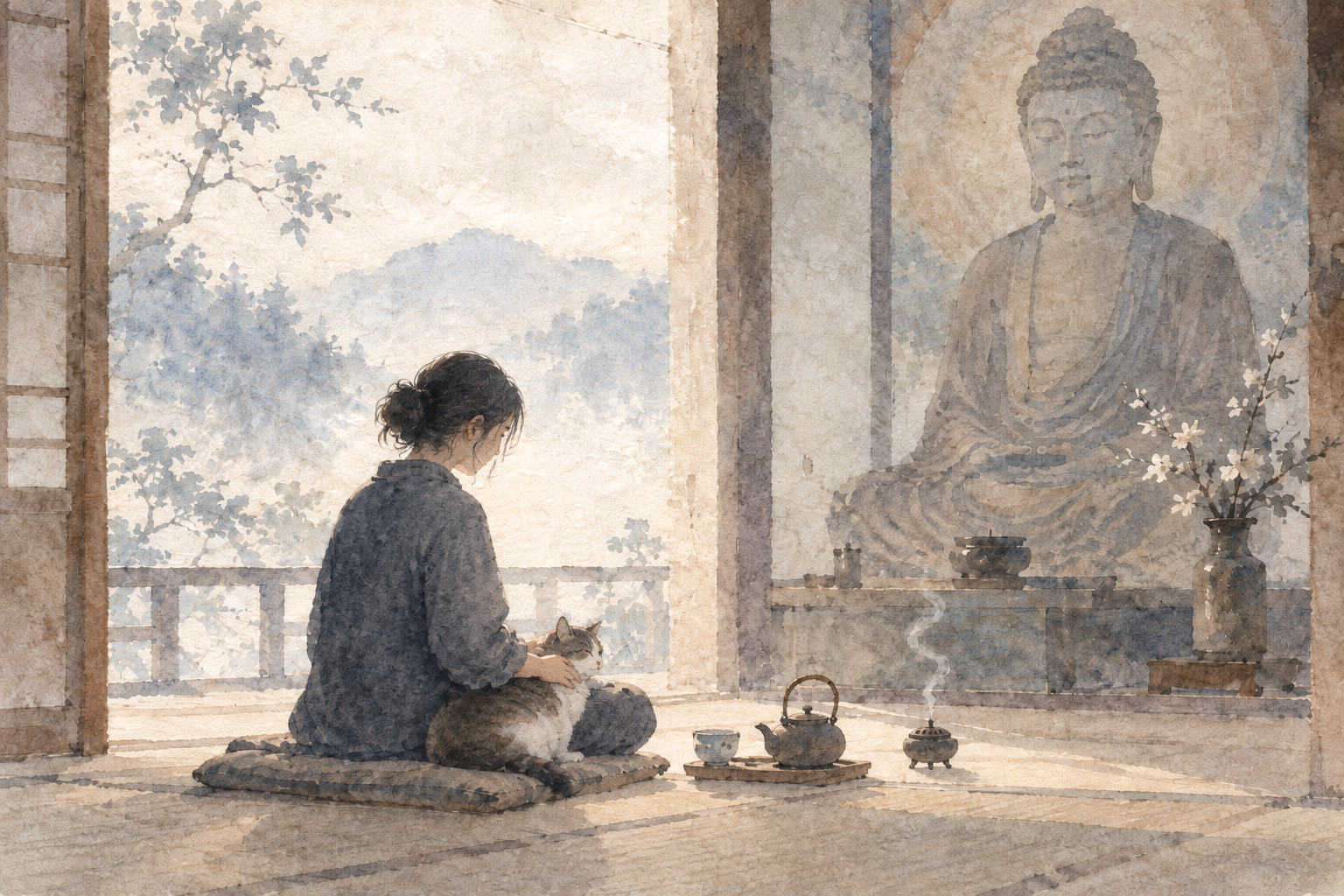
Many families keep simple daily gestures during this time: tidying a memorial space, offering tea or rice, lighting incense, or speaking the person’s name. These actions can steady attention. They give the body something calm to do when the heart is loud.
As the weeks pass, the mind often starts to test the idea of “normal.” You may catch yourself laughing, then feel guilty. Or you may feel numb and worry you’re doing it wrong. The 49-day container makes room for these shifts without forcing a conclusion.
By the time the 49th day arrives, many people feel a quiet change—not closure, but a reorganization. The loss is still real, yet the days begin to hold more than the loss. Marking the 49th day acknowledges that transition with care rather than denial.
Common misunderstandings about the 49-day observance
One common misunderstanding is that the 49 days are only about what happens to the deceased. In practice, the custom also functions as a compassionate schedule for the living—an agreed-upon period when support is expected and grief is allowed to be visible.
Another misunderstanding is that every family does it identically. Some households hold all the weekly services; others focus on key days; some combine observances for practical reasons. Variation doesn’t automatically mean disrespect—it often reflects distance, finances, health, or family dynamics.
People also sometimes assume the 49th day is a “deadline” for sadness. It isn’t. The point is not to stop grieving on day 50; it’s to mark a meaningful threshold and to recognize that life will continue to change shape around the absence.
Finally, outsiders may read the rituals as empty formality. But for many mourners, form is what makes emotion bearable. A bow, a candle, a shared meal—small forms can carry what words can’t.
Why this tradition still matters today
Modern life often treats grief as an interruption to “get over.” The 49-day period quietly argues the opposite: grief deserves time, repetition, and community. It gives permission to slow down without needing to justify it.
It also helps families coordinate care. When there is a known sequence of memorial moments, relatives can plan visits, share responsibilities, and check in on the person most affected. The structure reduces decision fatigue at a time when even small choices can feel overwhelming.
On a personal level, the 49 days can support a healthier relationship with memory. Instead of either clinging to the past or avoiding it, you practice touching memory in small doses—enough to stay honest, not so much that you drown.
And for those who are not Buddhist, the period can still be meaningful as a human practice: a respectful, time-bound way to honor a life, support a family, and acknowledge that love doesn’t disappear just because a body is gone.
Conclusion
In Japanese Buddhist tradition, 49 days matter because they create a steady rhythm for remembrance at the exact moment life feels least steady. The weekly cadence and the 49th-day milestone help families express care, share grief, and begin reorganizing daily life around a new reality. Whether you participate deeply or simply attend to support someone else, understanding the purpose of the 49 days makes the custom feel less mysterious—and more like a quiet form of compassion.
Ask a Buddhist priest
Have a question about Buddhism?
In the GASSHO app, you can ask questions about Buddhist teachings, daily concerns, and how to understand Buddhism in everyday life.
Frequently Asked Questions
- FAQ 1: Why are the first 49 days after death considered important in Japanese Buddhist tradition?
- FAQ 2: What does the number 49 represent in the Japanese Buddhist 49-day mourning period?
- FAQ 3: What is the 49th-day memorial service called in Japan?
- FAQ 4: Are memorial services held every seven days during the 49 days?
- FAQ 5: Why is the 49th day treated as a turning point for the family?
- FAQ 6: Is the 49-day practice meant for the deceased or for the living?
- FAQ 7: What do people typically do during the 49 days after a death in Japanese Buddhist households?
- FAQ 8: What should a non-Buddhist understand about the meaning of the 49 days in Japan?
- FAQ 9: Is it considered bad luck to do certain things before the 49 days are over?
- FAQ 10: What happens if the family cannot hold all the seven-day services leading up to day 49?
- FAQ 11: Why do people offer incense during the 49 days in Japanese Buddhist tradition?
- FAQ 12: Is the 49th day the same as the funeral in Japan?
- FAQ 13: How does the 49-day period relate to grief and emotional processing?
- FAQ 14: What is appropriate to say or do when attending a 49th-day memorial service?
- FAQ 15: After the 49 days, are there still memorial observances in Japanese Buddhist tradition?
FAQ 1: Why are the first 49 days after death considered important in Japanese Buddhist tradition?
Answer: They’re treated as a dedicated mourning and memorial period with a clear rhythm of remembrance, often marked in seven-day intervals and culminating on the 49th day. The structure supports both honoring the deceased and helping the living process grief with community support.
Takeaway: The 49 days function as a practical container for remembrance and mourning.
FAQ 2: What does the number 49 represent in the Japanese Buddhist 49-day mourning period?
Answer: It’s commonly understood as seven cycles of seven days, which creates a steady cadence of memorial observances. This seven-by-seven structure is why families often hold services every seventh day, with the 49th day as a key milestone.
Takeaway: “49” is tied to a seven-day rhythm repeated seven times.
FAQ 3: What is the 49th-day memorial service called in Japan?
Answer: It’s commonly referred to as “shijūkunichi” (the 49th day). Families may also describe it as the 49th-day memorial service, and it’s often treated as a major point in the mourning calendar.
Takeaway: The 49th day is widely known as shijūkunichi and is a central observance.
FAQ 4: Are memorial services held every seven days during the 49 days?
Answer: Often, yes—many families observe services or memorial moments on each seventh day (7th, 14th, 21st, and so on) leading up to the 49th. In real life, schedules vary, and some families focus on fewer key dates due to distance, cost, or health.
Takeaway: Weekly observances are common, but families adapt the schedule.
FAQ 5: Why is the 49th day treated as a turning point for the family?
Answer: The 49th day often marks the end of the most intensive mourning interval and acknowledges a shift: life begins to re-form around the loss. It’s less about “closure” and more about recognizing a change in how the family carries the person’s memory forward.
Takeaway: The 49th day is a milestone that helps people transition without erasing grief.
FAQ 6: Is the 49-day practice meant for the deceased or for the living?
Answer: In practice, it serves both: it honors the deceased through continued remembrance and supports the living by giving grief a shared structure. The repeated gatherings and rituals also help relatives check on one another during a vulnerable time.
Takeaway: The 49 days are as much about supporting mourners as honoring the dead.
FAQ 7: What do people typically do during the 49 days after a death in Japanese Buddhist households?
Answer: Common actions include attending memorial services, offering incense and flowers, keeping a small daily routine of remembrance at home, visiting the grave, and gathering with relatives to share support. The exact practices depend on family custom and local norms.
Takeaway: The period is marked by repeated, simple acts of remembrance and community support.
FAQ 8: What should a non-Buddhist understand about the meaning of the 49 days in Japan?
Answer: You don’t need to share specific beliefs to respect the custom. The 49 days can be understood as a culturally and spiritually meaningful mourning schedule that helps families remember the deceased and care for one another through repeated, supportive gatherings.
Takeaway: Treat the 49 days as a respectful mourning framework, not a belief test.
FAQ 9: Is it considered bad luck to do certain things before the 49 days are over?
Answer: Some families avoid celebratory events or major social announcements during the 49-day mourning period, treating it as a time of restraint and respect. How strict this is varies widely, so it’s best to follow the family’s lead and ask gently if unsure.
Takeaway: Many households keep the 49 days quieter, but customs differ by family.
FAQ 10: What happens if the family cannot hold all the seven-day services leading up to day 49?
Answer: Families often adapt—focusing on the funeral, a smaller set of weekly observances, and the 49th-day service, or combining gatherings for practical reasons. The intent—steady remembrance and support—matters more than perfect scheduling.
Takeaway: The 49-day tradition is commonly adjusted to fit real-life constraints.
FAQ 11: Why do people offer incense during the 49 days in Japanese Buddhist tradition?
Answer: Incense offerings are a simple, repeated gesture of respect and remembrance. During the 49 days, the act of offering can also steady attention and provide a calm routine when emotions are unsettled.
Takeaway: Incense is a practical, symbolic way to show ongoing care during the 49 days.
FAQ 12: Is the 49th day the same as the funeral in Japan?
Answer: No. The funeral happens soon after death, while the 49th day is a later memorial milestone. The period between them is often filled with smaller observances that support mourning and remembrance.
Takeaway: The funeral and the 49th day are different events with different roles.
FAQ 13: How does the 49-day period relate to grief and emotional processing?
Answer: The 49 days provide a predictable rhythm when grief feels unpredictable. Regular memorial moments can reduce isolation, give mourners a way to “do something” with their love and sadness, and create space for emotions to change week by week without forcing a quick recovery.
Takeaway: The 49 days help grief unfold with structure rather than pressure.
FAQ 14: What is appropriate to say or do when attending a 49th-day memorial service?
Answer: Follow the family’s lead: arrive on time, dress modestly, offer incense if invited, and keep your words simple—express condolences and appreciation for the person’s life. The most supportive presence is often quiet, respectful participation rather than trying to “fix” anyone’s feelings.
Takeaway: At the 49th day, calm respect and simple condolences are usually best.
FAQ 15: After the 49 days, are there still memorial observances in Japanese Buddhist tradition?
Answer: Yes. Many families continue with later memorial dates (often at set intervals such as one year and beyond), but the first 49 days are treated as the most concentrated early period. The 49th day is a milestone, not the end of remembrance.
Takeaway: The 49 days are a key early phase, and remembrance often continues afterward.